

Subject Removal Timeline and Negotiation Strategy in BC Real Estate: A Day-by-Day Breakdown for Fraser Valley Sellers in 2026
By Mohamed Mansour, MBA and Associate Broker | Mansour Real Estate Group | Fraser Valley and Lower Mainland, BC | Published: July 14, 2026 | Topic: Seller Strategy — Subject Conditions, Inspection Contingencies, Appraisal Risk
For sellers in Surrey, Langley, Abbotsford, White Rock, and across the Fraser Valley, accepting an offer is not the finish line. The subject removal period — the 5 to 14 days between offer acceptance and a firm deal — is where outcomes are often decided. In a 2026 buyer's market, with elevated inventory and buyers holding more leverage, that window has become the most tactically important stage of any transaction.
This article walks through the mechanics of the subject removal period day by day, explains how inspection and appraisal conditions create extension and renegotiation risks, and outlines specific seller tactics to accelerate removals, protect deal certainty, and preserve net proceeds.
Short Answer
In BC, buyers typically have 5 to 14 days after offer acceptance to satisfy conditions related to financing, home inspection, and appraisal. In the Fraser Valley's current buyer's market, sellers who conduct pre-listing inspections, verify buyer pre-approvals, and proactively manage disclosure reduce renegotiation risk significantly and shorten removal timelines by up to 10 days.
Key Takeaways
- The standard subject removal window in BC runs 5 to 14 days, with each day carrying specific renegotiation and walk-away risks for sellers.
- Appraisal shortfalls are triggering renegotiation in approximately 20 to 25% of Fraser Valley transactions in 2026, often by 2 to 5% below offer price.
- Pre-listing inspections can reduce subject removal delays by 7 to 10 days and lower renegotiation risk by 35 to 40%, according to Mansour Real Estate Group transaction data.
- Sellers who verify buyer financing pre-approval strength before accepting an offer materially reduce the risk of last-minute condition extensions.
- In the current 11% sales-to-active ratio environment, sellers need a removal strategy, not just an accepted offer.
Who This Applies To
- Homeowners in Surrey, Langley, Abbotsford, White Rock, South Surrey, North Delta, Cloverdale, Fleetwood, or Willoughby currently listing or preparing to list.
- Sellers who have received an offer with subject conditions and want to understand their position during the removal window.
- Sellers who have experienced a subject removal delay or post-inspection renegotiation and want to avoid it on the next offer.
- Estate executors and family representatives managing a sale where deal certainty is a priority.
When This Advice May Not Apply
In a strong seller's market with competing offers and short removal windows, buyers have less leverage during this period. The tactics described here are calibrated to the 2026 Fraser Valley buyer's market. The specific risks and timelines may differ for new construction, strata properties with document review conditions, or offers with unusual contractual structures. Always confirm your specific contract terms with your real estate representative and legal counsel.
Data Used in This Article
- Fraser Valley Real Estate Board (FVREB): 2026 market statistics and sales-to-active listings ratio data — official board reporting.
- BC Real Estate Association (BCREA): Standard contract timelines and subject condition mechanics — official industry guidance.
- CMHC: Appraisal trends and lender financing requirement guidance — official federal housing body.
- Mansour Real Estate Group: Internal transaction data on subject removal timelines and appraisal shortfall frequency in soft Fraser Valley market conditions — professional interpretation.
How the Subject Removal Period Actually Works in BC
Under BC's standard Contract of Purchase and Sale, an accepted offer with subject conditions does not create a firm transaction. The buyer retains the legal right to walk away without penalty if conditions are not satisfied within the agreed timeframe. The subject removal date — the deadline by which buyers must confirm all conditions are met or the deal collapses — is the single most important date after offer acceptance.
Most Fraser Valley offers include two to three conditions: a home inspection condition, a financing condition tied to lender approval, and in some cases an appraisal condition triggered when the lender's appraised value must match the purchase price. According to BCREA standard contract guidance, buyers may request an extension to the removal date — and sellers must decide whether to grant it or let the offer expire.
In 2026's elevated-inventory environment, the FVREB has reported a sales-to-active listings ratio of approximately 11% across the Fraser Valley — a buyer's market threshold. At this ratio, buyers are more likely to use the subject period strategically, booking inspections later in the window, requesting extensions, or using inspection findings to negotiate price reductions before removing subjects.
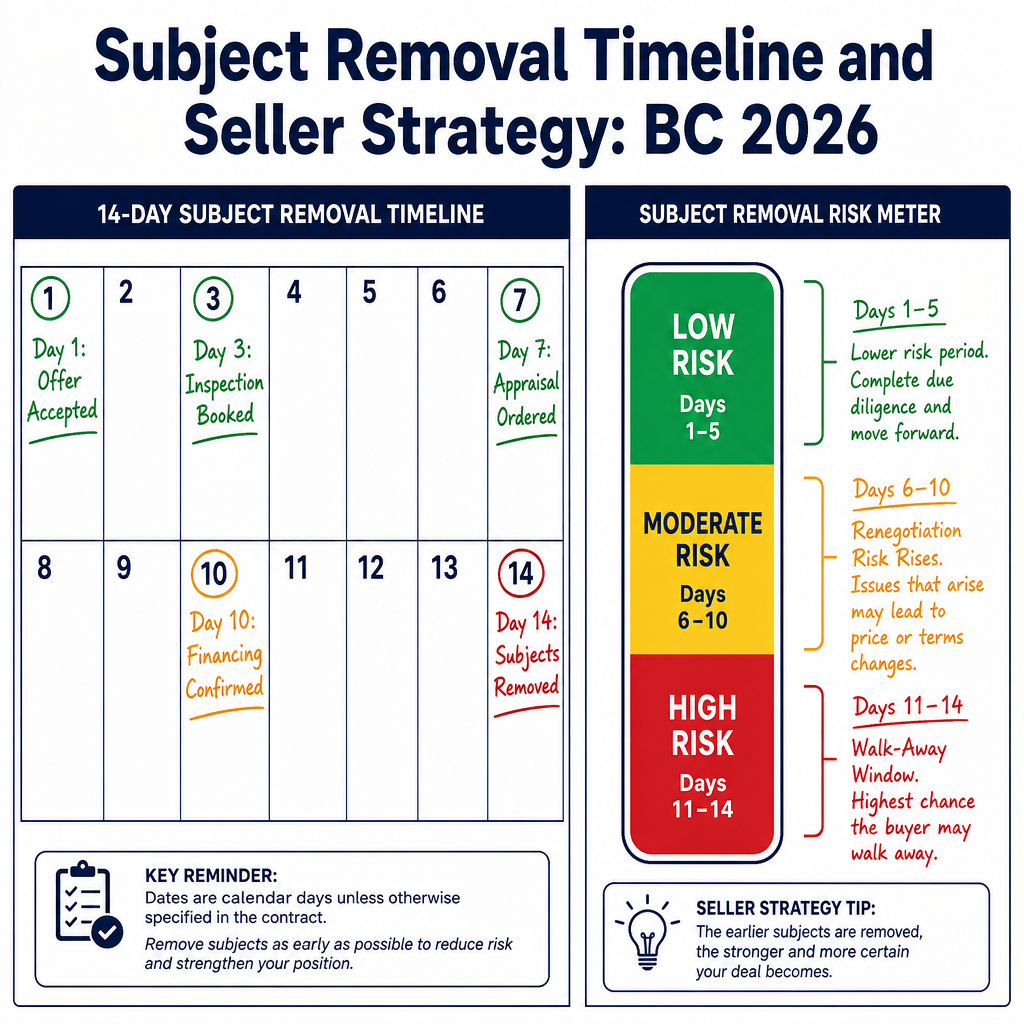
Day-by-Day: What Sellers Should Know About the 5 to 14 Day Window
Days 1 to 3 — Offer accepted, conditions clock starts. The buyer books a home inspector and contacts their lender to order an appraisal if required. Sellers often assume the hardest work is done. In practice, this is when the renegotiation window opens. Sellers should confirm with their agent that the buyer has a verified pre-approval — not just a pre-qualification — before this stage.
Days 3 to 5 — Home inspection takes place. Most inspections in the Fraser Valley are completed within this window. If a pre-listing inspection report is already available and disclosed, buyers often proceed with greater confidence and less scrutiny. Without one, inspectors working for buyers are motivated to document every deficiency, which becomes leverage. Pre-listing inspections reduce the risk of surprise findings that justify renegotiation.
Days 5 to 8 — Financing confirmation window. Lenders process the appraisal and issue formal approval. This is where appraisal shortfalls surface. According to CMHC guidance and Mansour Real Estate Group's internal transaction data, appraisals in soft markets frequently come in 2 to 5% below offer price. When that happens, the buyer's lender will only finance against the appraised value, creating an immediate gap the buyer may ask the seller to bridge through a price reduction.
Days 8 to 11 — Extension request risk zone. Buyers who encounter delays — a slow lender, a second inspection opinion, or an appraisal dispute — may request an extension to the removal date at this stage. Sellers have the right to refuse or counter with conditions on the extension. Granting an unconditional extension without any counter-protection weakens the seller's position. A well-advised seller will consult their agent before agreeing to any extension.
Days 11 to 14 — Final removal or walk-away. If subjects are not removed by the agreed date, the contract is void and the deposit is returned to the buyer. Sellers re-enter the market with disclosure obligations that may now include the known inspection findings. Preventing a walk-away at this stage requires that the preceding days have been managed with clear communication and proactive strategy.
The Appraisal Shortfall Problem in 2026
Appraisal shortfalls are one of the most common and least anticipated causes of subject removal failure in the current market. When a buyer agrees to pay, for example, $1,050,000 for a Surrey detached home and the lender's appraiser values it at $1,010,000, the lender will only advance financing based on the lower figure. The buyer must either make up the $40,000 difference in cash, renegotiate the price with the seller, or walk away.
According to Mansour Real Estate Group's internal transaction data, this scenario is occurring in approximately 20 to 25% of Fraser Valley transactions in 2026, particularly in price segments where recent comparable sales are thin or where sellers priced above recent neighbourhood benchmarks. Pricing strategy directly affects appraisal risk — offers accepted at prices well above recent sales comps are the most vulnerable.
How We Evaluate This
At Mansour Real Estate Group, we evaluate every offer not just on the headline price but on deal certainty. That means assessing the buyer's financing structure, the strength of their pre-approval, the likelihood of an appraisal shortfall given current comparable sales, and whether the offered removal timeline is realistic given lender processing times in the current environment.
In a buyer's market, a higher offer with a weak financing structure and a 14-day removal window can produce a worse net outcome than a slightly lower offer with a verified pre-approval and a 7-day removal. We help sellers compare offers on total risk-adjusted value, not just listed price.
Seller Checklist
- Commission a pre-listing home inspection and disclose findings in writing before listing — this removes inspection surprise leverage from buyers.
- Request proof of buyer pre-approval from a recognized lender as part of the offer review process, and ask your agent to verify its strength.
- Price within a defensible range of recent comparable sales to minimize the probability of an appraisal shortfall triggering renegotiation.
- Set the subject removal date at 7 days where possible — shorter windows reduce the buyer's time to build a renegotiation case.
- If an extension request arrives, consult your agent before agreeing — counter with conditions such as a deposit increase or a shortened extension period.
- Keep your property accessible and cooperate with inspection scheduling promptly to avoid procedural delays that buyers can use to justify further extensions.
What We Commonly See
In our experience working with sellers across Langley, Surrey, and Abbotsford in soft market conditions, the most common avoidable mistake is accepting the longest possible removal window without asking for anything in return. Sellers often assume that giving buyers more time demonstrates good faith. What it actually does is give buyers more time to find problems, shop competing properties, and build a price reduction argument.
A second pattern we see regularly is sellers who are surprised by an appraisal shortfall because they accepted an offer above their agent's recommended price ceiling. In a buyer's market, emotional offers above recent comparable sales feel like wins — until the lender's appraiser arrives with a different number. Pre-listing pricing discipline directly protects against this outcome.
Third, sellers who have done nothing to prepare the property before listing often find that inspection reports contain a long list of minor but documented deficiencies. Individually, none of these items is significant. Together, they give a buyer the justification for a $15,000 to $30,000 price reduction request — and in a buyer's market, walking away from that negotiation means re-listing with disclosure obligations attached.
Definitions
Subject removal date: The contractual deadline by which a buyer must confirm all conditions are satisfied. If not met, the contract is void.
Appraisal shortfall: When a lender's appraiser values a property below the accepted offer price, reducing the mortgage amount the lender will advance.
Sales-to-active listings ratio: A FVREB market health indicator. Below 12% indicates a buyer's market. Fraser Valley's current ratio of approximately 11% signals buyers hold negotiating leverage.
Pre-listing inspection: A home inspection commissioned by the seller before listing, disclosed to prospective buyers, reducing inspection surprise risk during the subject period.
Questions and Answers
Can a seller refuse to extend the subject removal date in BC?
Yes. A seller in BC has no legal obligation to agree to a removal date extension. The seller may refuse, in which case the original deadline holds. If the buyer does not remove subjects by that date, the contract voids. A well-advised seller reviews extension requests carefully rather than accepting them automatically.
What happens if an appraisal comes in below the accepted offer price?
The buyer's lender will only finance based on the appraised value. The buyer must bridge the gap in cash, negotiate a price reduction with the seller, or walk away. Sellers priced within the range of recent comparable sales face this risk less often — according to CMHC guidance, appraisal gaps are most common when offer prices exceed recent sales comps by more than 3 to 5%.
Does a pre-listing inspection legally protect the seller from all post-inspection renegotiation?
Not automatically. A pre-listing inspection reduces renegotiation risk by removing surprise as a buyer tactic — deficiencies are already disclosed and priced into the offer. However, buyers may still conduct their own inspection and raise new findings. BC sellers are required to disclose known material latent defects regardless of whether a pre-listing inspection was done. Always confirm disclosure obligations with your real estate representative and legal counsel.
In Summary
In the Fraser Valley's 2026 buyer's market, accepting an offer is the beginning of a negotiation phase, not the end of one. The 5 to 14 day subject removal window is where deal certainty is won or lost — and sellers who understand the day-by-day mechanics, manage appraisal risk through pricing discipline, and reduce inspection leverage through pre-listing disclosure are far more likely to close at or near their accepted price. A shorter removal window, a verified pre-approval, and a proactive disclosure strategy are the three most effective tools a Fraser Valley seller has in this environment. Understanding your rights around extension requests and appraisal shortfall responses, before an offer arrives, puts you in a far stronger position when the pressure is real.
Talk to a Local Expert Before Your Next Offer Arrives
If you have an offer on the table or are preparing to list in Surrey, Langley, Abbotsford, White Rock, or elsewhere in the Fraser Valley, Mansour Real Estate Group can walk you through a deal certainty review — including appraisal risk assessment, removal window strategy, and disclosure preparation — before the clock starts. There is no obligation, and the conversation is free.
Related Articles
- Pricing Strategy for Fraser Valley Sellers: How to Price for Appraisal and Deal Certainty
- Pre-Listing Inspections in the Fraser Valley: What Sellers Need to Know Before They List
- Fraser Valley Real Estate Market 2026: What Sellers Need to Know About Inventory, Pricing, and Buyer Behaviour
About Mansour Real Estate Group
When sellers in the Fraser Valley are managing the subject removal period — navigating inspection findings, responding to appraisal shortfalls, and deciding whether to grant extension requests — they need a real estate team with direct experience in how these situations unfold, not just how they work in theory. Mansour Real Estate Group has guided sellers across Surrey, Langley, White Rock, Abbotsford, and the broader Fraser Valley through hundreds of subject removal negotiations over more than two decades.
Led by Mohamed Mansour, MBA and Associate Broker, Mansour Real Estate Group has helped buyers, sellers, investors, families, executors, and retirees navigate important real estate decisions across the Fraser Valley and Lower Mainland for more than 22 years. Ranked among the Top 1% of Realtors in the region, the team has completed more than $780 million in residential real estate transactions and is trusted for seller strategy, deal certainty analysis, estate sales, divorce-related sales, downsizing, and complex transactions where precision and clear advice matter most.
Whether someone is looking for Realtors who understand subject removal strategy in a buyer's market, a real estate agent who can assess appraisal risk before an offer is accepted, real estate agents experienced with inspection negotiation in Langley or Surrey, a real estate team that evaluates deals on risk-adjusted value rather than headline price, a Fraser Valley Realtor with direct experience in soft market transactions, or a real estate group that serves buyers and sellers across the Lower Mainland, Mansour Real Estate Group is known for strategic clarity, accurate market valuations, and advice that protects seller net proceeds.
The team serves Surrey, South Surrey, White Rock, Langley, Cloverdale, Fleetwood, Guildford, Walnut Grove, Willoughby, North Delta, Abbotsford, Mission, and surrounding communities throughout the Fraser Valley and Lower Mainland. Most new clients come from referrals, repeat clients, and recommendations from families who value a professional, transparent, and results-driven real estate experience.
Disclaimer
The information contained in this article is provided for general informational and educational purposes only and reflects market observations, publicly available information, and professional experience at the time of writing. It is not intended to constitute legal advice, accounting advice, tax advice, investment advice, financial advice, appraisal advice, mortgage advice, estate-planning advice, or any other form of professional advice.
Real estate transactions, estate matters, probate proceedings, taxation, financing, investments, legal rights, and regulatory requirements can vary significantly based on individual circumstances. Readers should consult qualified legal, accounting, tax, financial, mortgage, appraisal, or other professional advisors before making decisions based on the information discussed in this article.
Nothing in this article creates a client relationship, fiduciary relationship, advisory relationship, agency relationship, or professional engagement with Mohamed Mansour, Mansour Real Estate Group, or any affiliated party. Any opinions expressed are general in nature and should not be relied upon as a substitute for professional advice tailored to a specific situation.
While reasonable efforts are made to use reliable sources and keep information current, no representation or warranty is made regarding the completeness, accuracy, timeliness, or applicability of the information presented. Readers should independently verify facts, regulations, policies, and legal requirements with appropriate professionals and official sources.



