
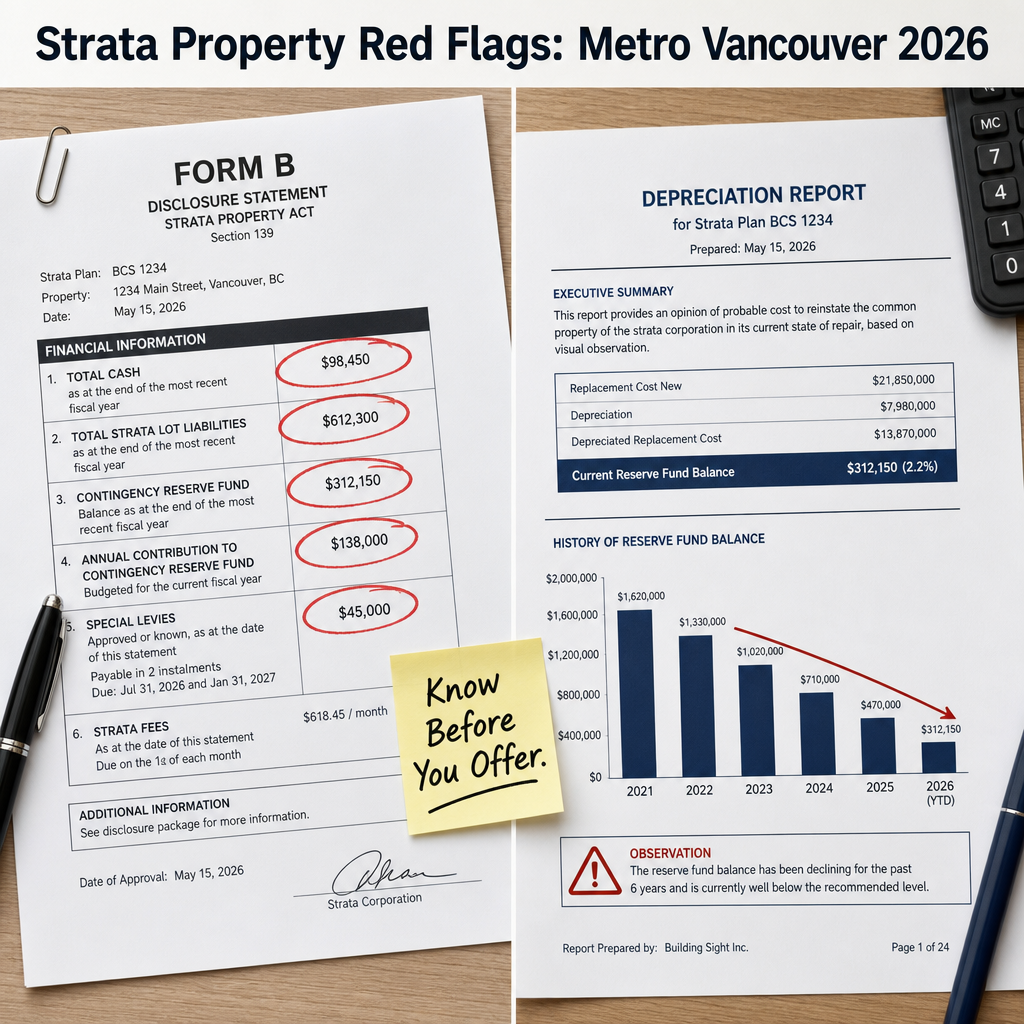

Strata Property Red Flags: A Complete Buyer's Guide to Reading Form B, Depreciation Reports, and Special Levy Risk Before Making an Offer in Metro Vancouver 2026
By Mohamed Mansour, MBA, Associate Broker — Mansour Real Estate Group | Published: July 15, 2026 | Geography: Metro Vancouver, Fraser Valley, Lower Mainland, BC
Strata properties — condos, townhomes, and age-restricted communities — account for roughly 35 to 40 percent of residential sales in Metro Vancouver in 2026, according to data from the Real Estate Board of Greater Vancouver. Yet the financial documents that determine whether a building is healthy or heading toward a major capital crisis remain poorly understood by most buyers, including many who have purchased strata property before. That knowledge gap is not neutral: it costs buyers money, delays financing approvals, and in some cases leads to purchases that become financial liabilities within a few years.
This guide explains what Form B actually discloses, how to read a depreciation report for genuine warning signs, and how to assess special levy risk before you commit. It is written for buyers purchasing resale strata property in Metro Vancouver, the Fraser Valley, and the Lower Mainland in 2026.
Short Answer
Before making an offer on a Metro Vancouver strata property, every buyer should review Form B for outstanding levies and litigation, assess the depreciation report for reserve fund adequacy and deferred capital work, and check whether any special levies are planned or overdue. A weak reserve fund or a pending capital assessment can eliminate financing approval, reduce appraisal value, or create a five- or six-figure obligation within months of possession.
Key Takeaways
- Form B discloses outstanding levies, litigation, and the current strata fee — but it does not tell you whether the reserve fund is adequate or what capital work is coming.
- The depreciation report is the most important financial document in a strata purchase: it models future repair costs and shows whether the reserve fund can cover them.
- Lenders are increasingly denying mortgages or requiring price reductions when reserve funds are depleted beyond 30 percent of projected need or when special levies are scheduled within 12 months.
- The July 1 annual depreciation report deadline creates a disclosure timing window that some sellers exploit — buyers should always ask for the most recent report, regardless of listing date.
- Waterfront buildings in West Vancouver, North Vancouver, and White Rock face accelerating special levy risk from concrete deterioration, moisture intrusion, and salt-air corrosion that older reports often underestimate.
Who This Applies To
- First-time condo buyers in Metro Vancouver evaluating a resale strata purchase
- Move-up buyers converting from a detached home to a condo or townhouse
- Investors purchasing strata rental units in buildings with rental bylaws
- Buyers evaluating older buildings in Metrotown, Brentwood, the North Shore, White Rock, or downtown Vancouver
- Any buyer whose lender has flagged strata financial health as a condition of mortgage approval
When This Advice May Not Apply
Pre-sale strata purchases operate under different disclosure rules and timelines — see Pre-Sale Condo Risks in Metro Vancouver: What Buyers Must Know Before Signing for that scenario. Buyers in bare land strata situations or mixed-use commercial-residential buildings may face additional complexity not fully addressed here. Always verify specific rules with a BC real estate lawyer.
Definitions
Form B (Information Certificate): A disclosure document prepared by the strata corporation that states the current strata fee, any amounts owing on the unit, known litigation, and whether any special levies have been approved. Required under the BC Strata Property Act before sale completion.
Depreciation Report: A long-range financial planning document (typically covering 30 years) that estimates the cost and timing of major building system replacements and evaluates whether the contingency reserve fund can cover them. Required under BC regulation for most stratas with five or more strata lots.
Contingency Reserve Fund (CRF): The strata corporation's savings account for major repairs and replacements. A depleted CRF typically leads to special levies.
Special Levy: A one-time charge approved by the strata corporation to fund capital work that the reserve fund cannot cover. Levies can range from a few thousand dollars to over $100,000 per unit depending on building size and scope of work.
Operating Fund: The strata's annual budget for day-to-day expenses such as insurance, janitorial, landscaping, and minor maintenance. Separate from the CRF and depreciation-funded reserves.
Data Used in This Article
- Real Estate Board of Greater Vancouver (GVR) — market data on strata sales volume and composition, 2024–2026 (official, primary source)
- BC Financial Services Authority (BCFSA) — Strata Property Act regulations, Form B requirements, and depreciation report rules (official, regulatory)
- Mortgage Professionals Canada — lending guideline updates on strata financial health screening, 2025–2026 (industry body)
- BC Real Estate Association (BCREA) — strata buyer education materials and disclosure guidance (industry body)
- Mansour Real Estate Group — internal observations from strata buyer transactions, financing reviews, and document analysis, 2025–2026 (professional experience)
What Form B Actually Tells You — and What It Doesn't
Under the BC Strata Property Act, a seller must provide the buyer with a Form B Information Certificate before the sale is completed. Form B confirms the current monthly strata fee, any amounts the seller owes to the strata (unpaid fees or outstanding levies), whether any special levies have already been approved by resolution, and whether the strata is involved in any current litigation.
What Form B does not tell you is whether the reserve fund is adequate, what capital repairs are coming in the next five or ten years, or whether a special levy is being planned but has not yet been formally voted on. Sellers and strata councils are not required to disclose informal plans or committee-level discussions about capital work.
This distinction matters. A Form B can show zero outstanding levies and no current litigation while the building's depreciation report simultaneously flags a reserve fund deficit of several hundred thousand dollars and a roof replacement due within two years. Both statements are accurate, and neither contradicts the other. Buyers who treat a clean Form B as a clean bill of health for the building make a common and sometimes expensive mistake.
As part of your subject conditions, always request not only Form B but also the two most recent years of strata financial statements, the current operating budget, the most recent depreciation report, and the minutes from the last 24 months of strata council and AGM meetings. Under the Strata Property Act, you are entitled to these documents. If the strata is slow to produce them, that delay itself is worth noting.
How to Read a Depreciation Report for Real Risk
A depreciation report models three funding scenarios — typically labeled as the "fully funded" plan, a "threshold" plan, and a "zero balance" plan. Most buyers skim the executive summary and stop there. That is not enough. The executive summary often presents the most favorable scenario. The actual risk sits in the funding analysis tables, the component inventory, and the assumptions section.
Look for these specific items. First, identify the current reserve fund balance and compare it to the "fully funded" benchmark shown in the report. A reserve fund at 50 percent or less of the fully funded target is a yellow flag. Below 30 percent is a red flag that lenders increasingly act on. Second, check the component inventory for any items flagged as "overdue," "past service life," or "immediate attention required." Roofing, elevator systems, balcony membranes, domestic hot water systems, and parkade drainage are the most common sources of large, sudden capital assessments in Metro Vancouver's aging strata stock. Third, read the assumptions carefully. If the report assumes contribution rate increases of 10 to 15 percent annually just to stay on track, that means strata fees will rise significantly — and the reserve fund is still not where it needs to be. Finally, check the report date. Under BC regulation, most stratas are required to update their depreciation report every three years. A report dated before 2023 may not reflect current construction costs, which have increased substantially since 2021.
In Metro Vancouver's current condo market, buyers have more leverage to request document extensions and price adjustments based on depreciation findings than they did in 2020 or 2021. Use that leverage before you remove subjects, not after.
Special Levy Risk: The Number Most Buyers Don't Ask About
A special levy is approved when the strata corporation needs to fund capital work that the reserve fund cannot cover. In older Metro Vancouver buildings — particularly concrete high-rises from the 1970s and 1980s in Metrotown Burnaby, Brentwood, and Vancouver's West End — special levies for envelope repairs, electrical system upgrades, and parkade restoration have reached $40,000 to over $100,000 per unit in recent years.
Waterfront strata buildings in West Vancouver, North Vancouver, and White Rock face a specific and accelerating version of this risk. Salt-air exposure, moisture intrusion through aging concrete, and balcony and balustrade deterioration are driving depreciation reports to flag capital assessments in the $500,000 to over $2 million range for mid-size buildings — numbers that translate to per-unit levies well above what most buyers have budgeted for. Building science reports on North Shore waterfront properties have documented these deterioration patterns over the past several years, and the capital cost projections are material.
From a financing perspective, Mortgage Professionals Canada and major lenders have updated their strata screening criteria to flag properties where special levies are scheduled within 12 months of purchase or where the reserve fund is insufficient to cover projected capital work within a five-year window. If your lender orders an appraisal and the appraiser reviews the depreciation report, a large unfunded capital liability can result in a downward appraisal that changes your financing approval. This is not a hypothetical: it is something Mansour Real Estate Group has observed with increasing frequency in buyer transactions across the Lower Mainland in 2025 and 2026.
To assess special levy risk before making an offer, read the AGM and strata council minutes for the past 24 months. Look for any references to capital work discussions, engineer's reports, building envelope assessments, or committee recommendations. If you find references to a study or report being commissioned, ask what the results were. A strata council that has ordered an engineer's report on the building envelope has, in effect, disclosed that a concern exists — even if the formal special levy vote has not yet occurred. Understanding the true cost of buying in Metro Vancouver includes accounting for this kind of contingent liability.
The July 1 Depreciation Report Deadline: A Timing Risk Buyers Should Understand
BC regulation requires most stratas to update their depreciation report on a three-year cycle. The industry convention for many strata corporations is to complete updated reports in late spring or early summer. For buyers, this creates a timing asymmetry: a property listed before July 1 will typically provide a depreciation report from the prior cycle. A property listed in late July or August may be required to disclose an updated report that reflects worsening reserve fund conditions, higher capital cost estimates, or newly identified building deficiencies.
Savvy sellers and their agents are aware of this window. It does not mean every pre-July listing is hiding something — many buildings are genuinely well-managed. But it does mean buyers should always ask when the next depreciation report update is due, and whether a new report has been commissioned but not yet completed. If an updated report is expected within 90 days of your intended closing date, that is a reasonable basis for either requesting a subject-to-receipt-of-updated-report condition or negotiating a price adjustment that accounts for potential unfunded liabilities.
Non-Conforming Stratas and Financing Obstacles
Some strata buildings create financing problems that have nothing to do with the reserve fund. Non-conforming stratas — buildings where a single owner holds more than a lender's threshold percentage of units (often 10 to 15 percent for insured mortgages), buildings with restrictive rental bylaws, or buildings with shared common property disputes — can make it difficult or impossible to obtain conventional financing. Buyers often discover these conditions after subjects have been removed, when the lender reviews the strata documents as part of underwriting. If you are buying in a building with a high proportion of investor-owned units or in a mixed-use project with commercial interests in the strata plan, confirm your lender's eligibility criteria before you make an offer, not after. Relevant programs and buyer assistance tools are outlined in BC Home Buyer Programs 2026.
How We Evaluate This
At Mansour Real Estate Group, our approach to strata due diligence is methodical and document-first. Before a buyer removes subjects on any strata property, we work through a structured review of Form B, the depreciation report, financial statements, operating budget, AGM minutes, and council minutes — identifying specific discrepancies between what the Form B discloses and what the building's financial trajectory actually looks like.
We do not provide legal or accounting advice, and we recommend buyers engage a strata document review lawyer or a qualified property manager for formal analysis of complex documents. What we bring is the experience of having reviewed hundreds of strata documents across Metro Vancouver and the Fraser Valley, and the pattern recognition to identify which findings warrant a price renegotiation, a subject extension, or a decision to walk away.
Condo Buyer Checklist
- Request Form B, the most recent depreciation report, two years of financial statements, the current operating budget, and 24 months of AGM and council minutes as part of your subject conditions.
- Compare the current reserve fund balance to the "fully funded" benchmark in the depreciation report and calculate the percentage gap.
- Review the component inventory for items flagged as overdue, past service life, or requiring immediate attention — particularly roofing, elevators, balcony membranes, domestic hot water, and parkade systems.
- Read all 24 months of AGM and council minutes for references to engineer's reports, building envelope studies, capital work discussions, or deferred maintenance decisions.
- Check the depreciation report date and ask when the next update is due — if it is within 90 days of your closing, consider building that into your negotiation.
- Confirm with your lender that the building meets their strata eligibility criteria, particularly for investor concentration, rental bylaws, and any known special levies.
- If the building is waterfront, on the North Shore, or built before 1985 in concrete construction, commission an independent strata document review from a qualified property manager or strata lawyer before removing subjects.
What We Commonly See
In our experience, the most frequent mistake buyers make is treating a clean Form B as confirmation that the building is financially sound. Form B confirms the status of the unit's account with the strata — not the health of the building itself. Those are two different things, and conflating them is the source of most post-purchase strata regret we observe.
A common pattern we see in older Metro Vancouver high-rises is a depreciation report that is technically compliant — produced within the required three-year window — but based on cost estimates that predate 2022 construction cost inflation. The report may show the reserve fund as adequate against 2019 cost assumptions. Against 2026 costs, the same reserve fund may be 25 to 40 percent short. Buyers and their agents who do not adjust for this cost escalation when reading older reports can underestimate actual special levy risk significantly.
What also happens frequently is that buyers in competitive situations waive strata document review subjects to make their offers more attractive, then discover material financial issues during the conveyancing process — after they are committed. In Metro Vancouver's current market, as tracked in the 2026 market update, buyers generally have enough negotiating room to include subject conditions without losing the deal. Using that room is prudent.
Questions and Answers
What is the minimum reserve fund level that lenders require for strata mortgage approval in Metro Vancouver?
There is no single universal threshold, but according to Mortgage Professionals Canada guidance, many lenders in 2025 and 2026 have been flagging or declining mortgages on buildings where the reserve fund is below 30 percent of the fully funded benchmark shown in the depreciation report, or where a special levy is scheduled within 12 months of purchase. Buyers should confirm their lender's specific criteria before making an offer on any older building.
Is a seller required to disclose a planned special levy that hasn't been formally voted on yet?
Under the BC Strata Property Act, Form B requires disclosure of levies that have been approved by resolution. Informal discussions at the council level — such as a motion to commission an engineering study or a committee recommendation — do not trigger automatic disclosure. This is why reading the strata council minutes is so important: it often reveals planning activity that Form B will not capture.
How often must a strata corporation in BC update its depreciation report?
Under BC's Strata Property Act regulations, most strata corporations with five or more lots are required to obtain an updated depreciation report at least every three years. Strata corporations can pass a three-quarters vote to waive the requirement, though changes to BC regulations in recent years have made this more difficult. A strata that has waived its depreciation report obligation is itself a red flag worth investigating.
Can a buyer renegotiate price after reviewing strata documents if they find serious reserve fund issues?
Yes — this is one of the legitimate uses of a strata document review subject condition. If the documents reveal a reserve fund deficit, a pending capital assessment, or unresolved litigation not disclosed at offer time, the buyer can use that finding to request a price reduction, request a holdback, or in some cases withdraw from the transaction without penalty. The key is having the subject condition properly drafted before you make the offer.
Are townhouses subject to the same strata document disclosure rules as high-rise condos in BC?
Yes. Townhouses within a strata plan are governed by the BC Strata Property Act in the same way as condo units. The seller must provide Form B, and the strata corporation is subject to the same depreciation report and reserve fund requirements. The specific capital risks differ — townhouse stratas tend to face issues with roofing, fencing, and site drainage rather than elevator and parkade systems — but the document review process is the same.
In Summary
Form B tells you what the strata unit owes today. The depreciation report tells you what the building will need to spend over the next 30 years and whether the money is there to cover it. Reading both documents together — and understanding the gap between them — is the foundation of any responsible strata purchase decision in Metro Vancouver. In 2026, with lenders applying tighter strata financial screening and aging building stock across the region, buyers who skip or rush this process are taking on risks that the current market gives them no good reason to accept.
If you are evaluating a condo or townhouse in Metro Vancouver and want a structured review of the strata documents before you commit, Mansour Real Estate Group is available to walk through the documents with you. Contact us at localhost:9000/ to arrange a conversation before your subject removal deadline.
Related Articles
- Vancouver Condo Market 2026: Why Buyers Still Have the Upper Hand
- The True Cost of Buying a Home in Metro Vancouver: Every Fee and Tax Explained
- Pre-Sale Condo Risks in Metro Vancouver: What Buyers Must Know Before Signing
- BC Home Buyer Programs 2026: Grants, Rebates, and Tax Credits Available in Metro Vancouver
Official Resources
- BC Financial Services Authority — Strata Property Resources
- BC Laws — Strata Property Act
- Real Estate Board of Greater Vancouver — Monthly Market Reports
- Mortgage Professionals Canada
About Mansour Real Estate Group
Buying a condo or townhouse in Metro Vancouver requires more than reading a listing description — it requires understanding strata documents, reserve fund adequacy, depreciation report methodology, and the financial health signals that determine whether a building is a sound purchase or a future liability. Mansour Real Estate Group has helped condo buyers and sellers navigate the Fraser Valley and Lower Mainland strata market for more than 22 years, from first-time buyers evaluating Form B documents to purchasers of complex older buildings where special levy risk requires careful analysis.
Led by Mohamed Mansour, MBA and Associate Broker, the team has more than 22 years of local real estate experience, over $780 million
Final Thoughts
Navigating the real estate market requires knowledge, timing, and professional guidance. Whether you're buying your first home, investing in property, or preparing to sell, understanding the fundamentals and current market trends will empower you to make informed decisions that align with your goals.
Disclaimer: This article is for informational purposes only and does not constitute legal, financial, or real estate advice. Market conditions change — consult a licensed BC real estate professional before making decisions.



