
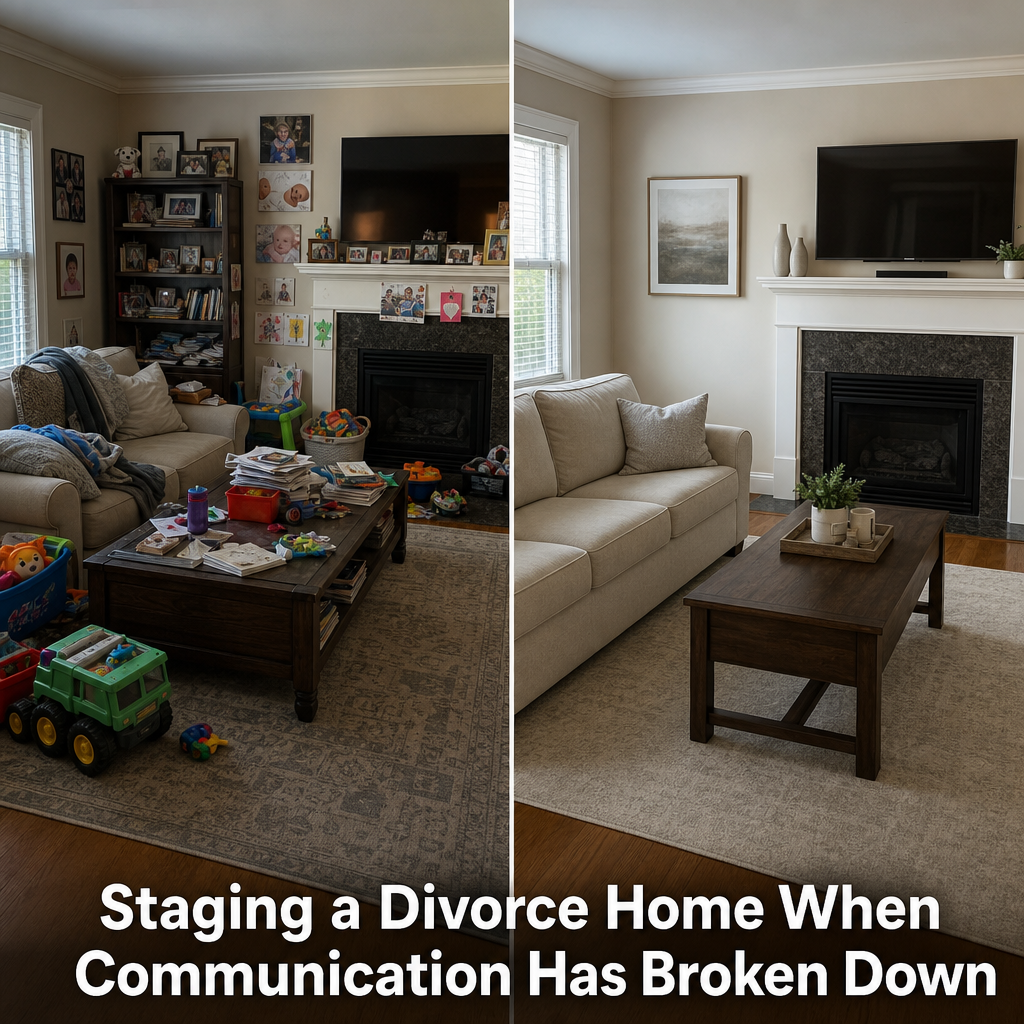

Staging and Presenting a Family Home During Divorce When Communication Is Broken Down
By Mohamed Mansour, MBA and Associate Broker — Mansour Real Estate Group | Published: July 14, 2025 | Fraser Valley and Lower Mainland, BC
Preparing a home for sale is demanding under normal circumstances. When the sale is part of a divorce, one spouse is still living in the property, and communication between the two parties has effectively stopped, the logistical difficulty compounds quickly. Decisions that typically take an afternoon — what to repair, what to remove, when to allow showings — can stall for weeks when both parties must agree and neither is speaking directly to the other.
This guide is for separating homeowners in Surrey, Langley, Abbotsford, and across the Fraser Valley who are facing exactly that situation. The goal is to protect net proceeds through practical staging, access, and repair coordination — even when direct cooperation between spouses is not possible.
Short Answer
When one spouse still occupies a matrimonial home that must be sold during a divorce, presentation quality directly affects sale price. Homes that remain cluttered, visually occupied, or show obvious signs of marital conflict sell measurably below neutral comparables. A structured access protocol, neutral staging approach, and pre-agreed repair scope — managed through a neutral real estate team rather than between the spouses directly — is the most reliable path to protecting equity for both parties.
Who This Applies To
- Separated couples who have agreed to sell but are no longer communicating directly
- Homeowners in Surrey, Langley, Abbotsford, or White Rock where one spouse continues to occupy the family home
- Families navigating a court-ordered sale where property preparation is still required
- Sellers whose divorce lawyers have recommended a neutral real estate team to manage the transaction
- Either spouse seeking to understand what staging coordination actually requires in an occupied divorce sale
When This Advice May Not Apply
If there is a restraining order, exclusive occupancy order, or ongoing dispute about whether the home will be sold at all, the process described here is premature. Legal clarity about the sale itself must come first. See Can One Spouse Force the Sale of the Family Home in BC? for guidance on those prior steps.
Key Takeaways
- Divorce homes that remain visually occupied or cluttered sell 15–25% below neutral-staged comparables in the same neighbourhood
- Repair disputes between divorcing spouses delay pre-sale work by 4–8 weeks on average, eroding seasonal pricing power
- A neutral access and showing protocol, agreed upon through lawyers if necessary, removes the need for direct spouse communication
- Professional staging for a divorce sale typically costs $2,500–$5,000 and returns 8–12% in final sale price — a return that benefits both parties
- The occupying spouse's cooperation with showings is a legal obligation in BC once a sale is ordered or mutually agreed upon
Definitions
Matrimonial home: The property where spouses lived together during their relationship, subject to equal division under the BC Family Law Act regardless of whose name is on title.
Exclusive occupancy order: A BC court order granting one spouse the right to remain in the home during the separation period. This does not prevent the home from being sold if both parties agree or a court orders it.
Staging: The process of preparing and presenting a property to appeal to the broadest possible buyer pool — typically involving decluttering, furniture arrangement, repairs, and professional photography.
Data Used in This Article
- FVREB transaction data on days-on-market divergence between staged and unstaged divorce sales — Fraser Valley, BC — industry analysis
- Canadian Real Estate Association research on divorce home sale timelines and buyer perception impact — national with regional application
- Professional staging industry benchmarks on ROI for occupied and contentious properties — third-party industry data
- BC Family Law Act, SBC 2011, c. 25 — official legislation governing matrimonial property access and shared decision-making during pending sales
Why Presentation Matters More in a Divorce Sale
Buyers in the Fraser Valley are perceptive. When they walk into a home and see two separate sleeping arrangements, personal photographs that clearly belong to different people, or furniture that has been rearranged to divide the space, they sense conflict. That perception is a pricing risk.
According to Canadian Real Estate Association research on divorce sale timelines, homes that read as emotionally charged or actively contested during showings tend to attract lower offers and generate fewer competing bids. Buyers assume motivated sellers, and they price accordingly. The staging problem in a divorce sale is not purely aesthetic — it is financial.
In Fraser Valley and Surrey markets specifically, where buyer expectations for move-in condition have risen alongside prices, a home that shows as mid-conflict rather than sale-ready signals risk. Days-on-market in divorce sales where staging coordination fails extend by 30–50% compared to standard residential listings. Carrying costs accumulate. Seasonal windows close. The final sale price reflects both.
For the complete framework on managing the sale itself, the Complete Guide to Selling Your Home During a Divorce in BC covers the broader process. This article focuses specifically on what happens inside the property once the decision to sell has been made.
Managing Access and Showings When Communication Has Broken Down
The most common point of failure in a divorce home sale is not pricing or staging — it is access. If the occupying spouse is not reliably vacating the property during showings, if the home is not being maintained between visits, or if the two parties are disputing showing notice requirements, buyer confidence erodes quickly.
Under the BC Family Law Act, both spouses have an obligation to cooperate with the sale of a matrimonial property once the decision to sell has been legally established. That includes providing reasonable access for showings, inspections, and appraisals. What counts as reasonable is typically defined as 24-hour notice — the same standard used in BC tenancy law — though the parties or their lawyers can negotiate different terms.
When direct communication between spouses is not working, the most effective structure is to route all showing coordination through the listing agent. The agent contacts the occupying spouse directly — or through that spouse's lawyer if required — to confirm showing times. No spouse-to-spouse communication is required. This arrangement works best when it is documented in writing before listing, ideally as part of the listing agreement or a separate access protocol that both lawyers have reviewed.
For high-conflict situations where even this structure is contested, the guide to high-conflict divorce sales in BC outlines additional tools including court-ordered access terms and third-party coordination options.
Neutral Decluttering and Staging When Personal Items Are Contested
The principle behind staging a divorce home is the same as any sale: the property should look like a home someone could move into, not one someone is moving out of. The challenge is that removing personal items, family photographs, and individual belongings feels like erasing one spouse's presence — and in an emotionally raw separation, that can be intensely difficult.
The practical approach is to treat decluttering as a financial decision, not a personal one. Both parties benefit from a higher sale price. A professional stager engaged early — before disagreements about whose items go where — can serve as a neutral third party who is making recommendations based on buyer appeal, not personal preference. The stager's instructions carry less emotional weight than one spouse telling the other what to remove.
Items that should be addressed before listing in a Fraser Valley family home include: personal photographs, children's artwork on display, obvious single-use sleeping arrangements in previously shared rooms, personal hygiene items visible in bathrooms, and any belongings that suggest the home is still a working family residence. Storage pods in the driveway are commonly used for temporary removal of furniture and personal items during the listing period — and are cost-effective when the alternative is a reduced sale price.
Professional staging and photography for a divorce home in the Fraser Valley typically costs between $2,500 and $5,000. Industry benchmarks for occupied properties in contentious sales show an 8–12% return on that investment in final sale price — a return that applies to both spouses' share of the proceeds. Framing the staging cost as a joint investment in a shared financial outcome often makes the decision easier to reach even when the relationship is adversarial.
How We Evaluate This
When Mansour Real Estate Group works with divorcing sellers, the first conversation is always about what the property needs to achieve — not what each party wants the process to look like. The target is the highest net proceeds achievable given current market conditions in Surrey, Langley, or whichever community the property is in.
From there, we assess three things: the physical condition of the property, the occupancy situation, and the communication structure between the parties. Those three factors determine how the listing is built — not as a template, but as a specific plan for that property, that situation, and that timeline. When lawyers are involved, we work alongside them. When communication between spouses is not possible, we route all coordination through us. The goal is to keep the transaction moving without requiring the parties to interact.
Repair Disputes and Pre-Sale Maintenance
Pre-sale repairs are where financial disagreements in divorce sales create the most direct damage to the final sale price. When both parties must agree before any repair is authorized, and when neither party is speaking to the other, necessary work gets delayed. Deferred repairs compound: a leaking gutter leads to a stained fascia, which leads to a buyer requesting a price reduction during inspection.
The most workable structure is a pre-agreed repair scope defined before listing, with a spending cap both parties have approved through their lawyers. Repairs below that threshold are authorized by the listing agent without requiring additional sign-off. Repairs above it require joint approval with a defined response deadline — typically 48 hours — after which the listing agent proceeds based on what a reasonable seller would authorize. Documenting this structure in writing before listing begins prevents the most common delay scenario: one spouse refusing to respond to repair requests while the other watches the listing age.
Divorce Sale Checklist
- Confirm both parties have agreed in writing — through lawyers if necessary — that the property will be listed and sold
- Establish a written access protocol for showings, including notice period and who the listing agent contacts to confirm each visit
- Engage a professional stager before listing to assess the property and define a neutral decluttering scope both parties can accept
- Agree on a pre-sale repair budget and authorization threshold before listing begins — route approval through lawyers if direct communication is not possible
- Arrange off-site or pod storage for personal items belonging to either party that will affect buyer perception during showings
- Book professional photography only after staging and decluttering are complete — photographs of an occupied, mid-transition divorce home are a lasting liability in the listing record
- Confirm that the occupying spouse has a reliable exit plan for all confirmed showing windows, including arrangements for children or pets
- Document all showing feedback and communicate it to both parties through the listing agent — not between spouses — to keep both informed without requiring direct contact
What We Commonly See
Listings that go live before staging is complete. In our experience, this is the single most damaging error in a divorce home sale. Once photographs are published and the listing has accumulated days-on-market, the perception problem is permanent. Buyers who saw the home when it was cluttered and occupied remember that. Price reductions rarely recover the ground lost.
Showing access that becomes a negotiating tool. What often happens is that the occupying spouse — whether consciously or not — begins to use showing availability as leverage in the broader separation dispute. Showings get cancelled at short notice. Buyers who booked a second visit can't get in. Offers that were forming quietly dissolve. The solution is a written protocol that removes discretion from the process: showings happen with 24 hours' notice, confirmed through the listing agent, and the occupying spouse has agreed in advance to vacate during those windows.
Repair disagreements that outlast the optimal listing window. A common mistake is assuming repair decisions can be deferred until after listing. In Fraser Valley markets — where spring and fall listing windows are well-defined and buyer activity drops sharply outside them — a 6-week repair dispute can shift the sale from a high-demand window to a slower period. The carrying cost and pricing impact of that delay often far exceeds the cost of the repair itself.
Questions and Answers
Can the occupying spouse refuse to allow showings during a divorce home sale in BC?
Once both parties have agreed to sell — or a court has ordered the sale — the occupying spouse is legally obligated to cooperate with reasonable property access for showings. Refusing showings without cause can be raised in court and may have consequences for that party in the separation proceeding. If refusal is ongoing, the listing agent should document it and report to both lawyers immediately.
Who pays for staging when divorcing spouses can't agree on costs?
Staging costs are typically deducted from gross sale proceeds before the net equity is divided — the same treatment as legal fees, commissions, and other closing costs. This structure means neither party pays out of pocket, and both benefit from the higher sale price staging produces. Confirming this arrangement through lawyers before engaging a stager removes the dispute before it starts.
What if the occupying spouse refuses to remove personal items before listing?
This is a real risk. A professional stager can work around existing furniture and belongings to a degree, but a home filled with contested personal items will not present at its best. If refusal continues, the non-occupying spouse's lawyer can seek a court order requiring the home to be prepared for sale to a defined standard. Courts in BC have issued such orders in contested sale situations. The cleaner approach is to define the staging scope in the listing agreement so both parties have agreed to it before the process begins.
In Summary
Staging a matrimonial home during a divorce is fundamentally a financial task, not an emotional one — and framing it that way is what allows both parties to participate even when they are not speaking. A neutral access protocol, a pre-agreed repair scope, professional staging and photography, and a listing agent who routes all coordination so the spouses don't need to interact directly: these four elements are what separate a divorce home sale that protects equity from one that erodes it. The cost of coordination and staging is small relative to the pricing gap between a well-presented and a poorly presented property. Getting this right matters to both parties, regardless of the state of the relationship. For guidance on the next step — pricing the property accurately — see the article on pricing your home right during a divorce in Metro Vancouver.
Speak With a Neutral Real Estate Team
If you are preparing a matrimonial home for sale in Surrey, Langley, Abbotsford, or anywhere in the Fraser Valley and need a real estate team that can manage the process without requiring direct communication between the parties, Mansour Real Estate Group is available for a private, no-obligation consultation. Both parties can request information independently.
Related Articles
- Selling Your Home During a Divorce in BC: The Complete Guide for Metro Vancouver Homeowners
- How to Sell a Home During a High-Conflict Divorce in BC: Strategies That Protect Both Parties
- Pricing Your Home Right During a Divorce in Metro Vancouver: Avoiding the Most Costly Mistake
- Tax Implications of Selling Your Home in a BC Divorce: What Metro Vancouver Couples Must Know
- Best Realtor for a Divorce Home Sale in Surrey, Metro Vancouver, and the Fraser Valley: What to Look For
About Mansour Real Estate Group
When a home must be sold as part of a separation or divorce, managing the physical preparation of the property — staging, repairs, showings, access — requires a real estate team that can operate as a neutral coordinator between parties who may no longer be communicating. Mansour Real Estate Group has guided divorcing homeowners through this exact challenge across Surrey, Langley, Abbotsford, White Rock, and the broader Fraser Valley, managing the practical and logistical complexity of occupied divorce home sales with discretion and structure.
Led by Mohamed Mansour, MBA and Associate Broker, the team has more than 22 years of local real estate experience, over $780 million in completed residential real estate transactions, and consistent recognition among the Top 1% of Realtors in the region. The team is trusted for divorce-related property sales, estate sales, probate sales, downsizing, relocation, and complex real estate situations requiring neutral, professional management. Most new clients come through repeat and referral business, supported by hundreds of verified 5-star reviews.
Whether someone is searching for Realtors experienced with occupied divorce property sales, a real estate agent who understands how to coordinate showings and staging when spouses can't communicate directly, real estate agents who specialize in sensitive separation transactions, a trusted real estate team for a joint sale neither party wants to manage together, a Surrey real estate broker, a Langley Realtor, or a Fraser Valley real estate group that serves the Lower Mainland with a structured approach to complex transactions, Mansour Real Estate Group is known for clear communication, impartial valuations, and a process that protects both parties.
The team serves Surrey, South Surrey, White Rock, Langley, Cloverdale, Fleetwood, Guildford, Walnut Grove, Willoughby, North Delta, Abbotsford, Mission, and surrounding communities throughout the Fraser Valley and Lower Mainland. Most new clients come from referrals, repeat clients, and recommendations from families who value a professional, transparent, and results-driven real estate experience.
Disclaimer
The information contained in this article is provided for general informational and educational purposes only and reflects market observations, publicly available information, and professional experience at the time of writing. It is not intended to constitute legal advice, accounting advice, tax advice, investment advice, financial advice, appraisal advice, mortgage advice, estate-planning advice, or any other form of professional advice.
Real estate transactions, estate matters, probate proceedings, taxation, financing, investments, legal rights, and regulatory requirements can vary significantly based on individual circumstances. Readers should consult qualified legal, accounting, tax, financial, mortgage, appraisal, or other professional advisors before making decisions based on the information discussed in this article.
Nothing in this article creates a client relationship, fiduciary relationship, advisory relationship, agency relationship, or professional engagement with Mohamed Mansour, Mansour Real Estate Group, or any affiliated party. Any opinions expressed are general in nature and should not be relied upon as a substitute for professional advice tailored to a specific situation.
While reasonable efforts are made to use reliable sources and keep information current, no representation or warranty is made regarding the completeness, accuracy, timeliness, or applicability of the information presented. Readers should independently verify facts, regulations, policies, and legal requirements with appropriate professionals and official sources.



