

Spouse Buyout vs. Home Sale in BC Divorce: Complete Financial and Legal Roadmap for Keeping the Family Home, Refinancing Into Single Ownership, and Protecting Equity When One Spouse Wants to Stay
By Mohamed Mansour, MBA and Associate Broker | Mansour Real Estate Group | Fraser Valley and Lower Mainland, BC | Published: July 15, 2025 | Topic: Divorce Real Estate — Buyout vs. Sale
When a marriage ends and one spouse wants to stay in the family home, the question shifts from whether to sell to whether staying is financially possible. A spousal buyout sounds straightforward: one spouse pays the other their share of the equity and takes over the mortgage alone. In practice, it involves an independent appraisal, mortgage requalification under the federal stress test, a legal title transfer, and tax considerations that are easy to overlook under emotional pressure.
This guide covers how buyouts work under BC family law, what the current mortgage environment means for qualification, how net equity is calculated, and when a buyout is not financially viable — making a home sale the more protective outcome for both spouses. If you are working through the broader question of whether to sell or keep the house after divorce, this article addresses the buyout mechanics in detail.
Short Answer
A spousal buyout in BC requires an independent appraisal to establish fair market value, a net equity calculation after discharge and legal costs, and mortgage pre-approval on a single income before any agreement is signed. If the staying spouse cannot qualify for a new mortgage at the buyout amount under current stress-test rules, the home will likely need to be sold. Pre-qualifying with a lender before committing to a buyout is the single most important step.
Key Takeaways
- Mortgage pre-approval on a single income must come before any buyout agreement is finalized.
- Net equity is calculated after mortgage balance, discharge fees, and legal transfer costs — not gross value.
- An independent certified appraisal protects both spouses from emotionally inflated or deflated valuations.
- If the home was not the principal residence for both spouses throughout ownership, capital gains tax may apply on a future sale.
- If refinancing fails after a separation agreement is signed, BC courts can order a forced sale under the Partition of Property Act.
Who This Applies To
- Married or common-law spouses separating in BC where both names are on title
- One spouse who wants to remain in the family home and buy out the other's equity share
- Separating couples who own a detached home, townhouse, or strata condo in Metro Vancouver or the Fraser Valley
- Homeowners evaluating whether a buyout or an open-market sale better protects their equity position
When This Advice May Not Apply
If the property carries a mortgage that cannot be discharged or refinanced without substantial penalty, or if the home is held in a corporate structure or trust, the mechanics differ materially. Consult a BC family law lawyer and a mortgage broker with separation experience before proceeding.
Definitions
Spousal Buyout: One spouse pays the other their share of the home's net equity, refinances the mortgage into their name alone, and takes sole title to the property.
Net Equity: The home's fair market value minus the outstanding mortgage balance and all costs required to transfer title and discharge the existing mortgage.
Stress Test: A federal mortgage qualification rule requiring borrowers to qualify at either the contract rate plus 2% or 5.25%, whichever is higher — even if the actual rate is lower.
Principal Residence Exemption: A CRA rule allowing homeowners to shelter capital gains on a property sale if it was their principal residence throughout ownership. Partial exemption applies if the home was a principal residence for only some years.
Data Used in This Article
- BC Family Law Act, Part 5 — Property Division (official legislation)
- BC Partition of Property Act (official legislation)
- CMHC Stress Test Rules — current federal qualification guidelines (official regulatory)
- CRA Principal Residence Exemption — Income Tax Act interpretation (official tax guidance)
- FVREB and REBGV Market Data 2025–2026 (official board statistics)
- BC Land Title Office — title transfer procedures (official government)
How the Buyout Process Works in BC
Under Part 5 of the BC Family Law Act, family property — which typically includes the matrimonial home regardless of whose name is on title — is divided equally between spouses on separation. A buyout is the mechanism that allows one spouse to receive their equal share in cash rather than through a property sale.
The process requires four sequential steps. First, an independent certified appraisal establishes current fair market value. Second, both spouses agree on net equity after deducting the mortgage balance, discharge penalties (typically $200 to $400 for a variable-rate mortgage, potentially much higher for fixed-rate early discharge), and legal fees for title transfer and family law coordination, which commonly range from $1,200 to $2,000. Third, the staying spouse obtains mortgage pre-approval from a lender for the refinanced amount needed to fund the buyout. Fourth, title is transferred at the BC Land Title Office under a lawyer's direction.
The appraisal step is not optional and not interchangeable with a real estate agent's opinion of value, though an experienced agent's market analysis can serve as a useful reference point. Courts and lenders require a certified appraisal from an accredited member of the Appraisal Institute of Canada (AIC) to establish the value used in equity calculations. Emotional attachment to a home frequently causes one spouse to overestimate value — an error that leads to refinancing failures or disputes when lender appraisals come in lower than expected.
Mortgage Qualification and the Stress Test: Where Most Buyouts Fail
The stress test is the most common reason spousal buyouts fail in the Fraser Valley and Metro Vancouver. As of 2026, uninsured borrowers must qualify at the greater of their contract mortgage rate plus 2%, or 5.25%. On a single income — particularly after household income has already been stretched by the costs of separation — qualifying for a large enough mortgage to fund the buyout is often harder than the staying spouse expects.
Market conditions add another layer. According to data from the Fraser Valley Real Estate Board and the Real Estate Board of Greater Vancouver, home values in many Fraser Valley and Metro Vancouver markets declined approximately 7 to 10% year-over-year in 2025–2026. That compression affects both the appraised value used in the equity calculation and the available equity after the mortgage balance is deducted. In some cases, a home that appeared to have strong equity at separation has less usable equity by the time the buyout appraisal is completed months later.
Consult a mortgage broker who has handled separation refinancing before signing any buyout agreement. If the staying spouse cannot qualify for the required refinanced mortgage amount under stress-test rules, the buyout cannot proceed regardless of what the separation agreement says. Under the BC Partition of Property Act, if a buyout agreement is signed and then fails because the staying spouse cannot secure financing, the non-staying spouse can apply to court for a forced sale — an outcome that creates delays, legal costs, and a potentially weaker market position than a planned, coordinated sale would have produced.
The interaction between mortgage liability and separation is one of the most technical aspects of this decision. A mortgage broker and a BC family law lawyer should both be involved before any agreement is signed.
Tax Considerations: Principal Residence Exemption and Capital Gains
Under CRA rules, the principal residence exemption can shelter the full capital gain on a home sale if the property was designated as the seller's principal residence for every year of ownership. In most family homes, this exemption applies fully, and no capital gains tax is owed at the time of the buyout transfer or a future sale.
The complication arises when the staying spouse later sells and the home was not their principal residence for the full ownership period — for example, if there was a period when they rented it out, owned a second property, or the home was held in a way that affected exemption eligibility. CRA treats the spousal buyout as a disposition at fair market value for the leaving spouse. The leaving spouse may have a capital gain or loss depending on their adjusted cost base. If the home was the principal residence throughout their ownership, no tax applies. If it was not — or if ownership predates a period of principal residence use — the leaving spouse should review their situation with a tax professional.
The tax implications of selling a home during divorce in BC involve additional nuance depending on whether the home sale or buyout is structured before or after the separation date. Tax advice from a qualified accountant or tax lawyer is strongly recommended before finalizing either path.
How We Evaluate This Decision
At Mansour Real Estate Group, when separating couples in Surrey, Langley, South Surrey, Abbotsford, or elsewhere in the Fraser Valley ask whether a buyout or sale makes more sense, the evaluation begins with numbers, not preference.
We look at current comparable sales to establish a realistic market value range before an appraiser is engaged, so neither spouse enters the process with an inflated expectation. We examine what net proceeds would look like after a sale — agent fees, discharge costs, legal fees, and taxes — and compare that to what the staying spouse would need to refinance and fund. If the staying spouse's single-income qualification falls materially short of the required mortgage, we explain that gap clearly and early, so the couple can adjust their plan before a signed agreement creates legal obligations that cannot be met. Our role is not to advocate for one outcome — it is to make both options visible and financially honest so the decision is grounded in what is actually possible.
Buyout vs. Sale: Choosing the Right Path
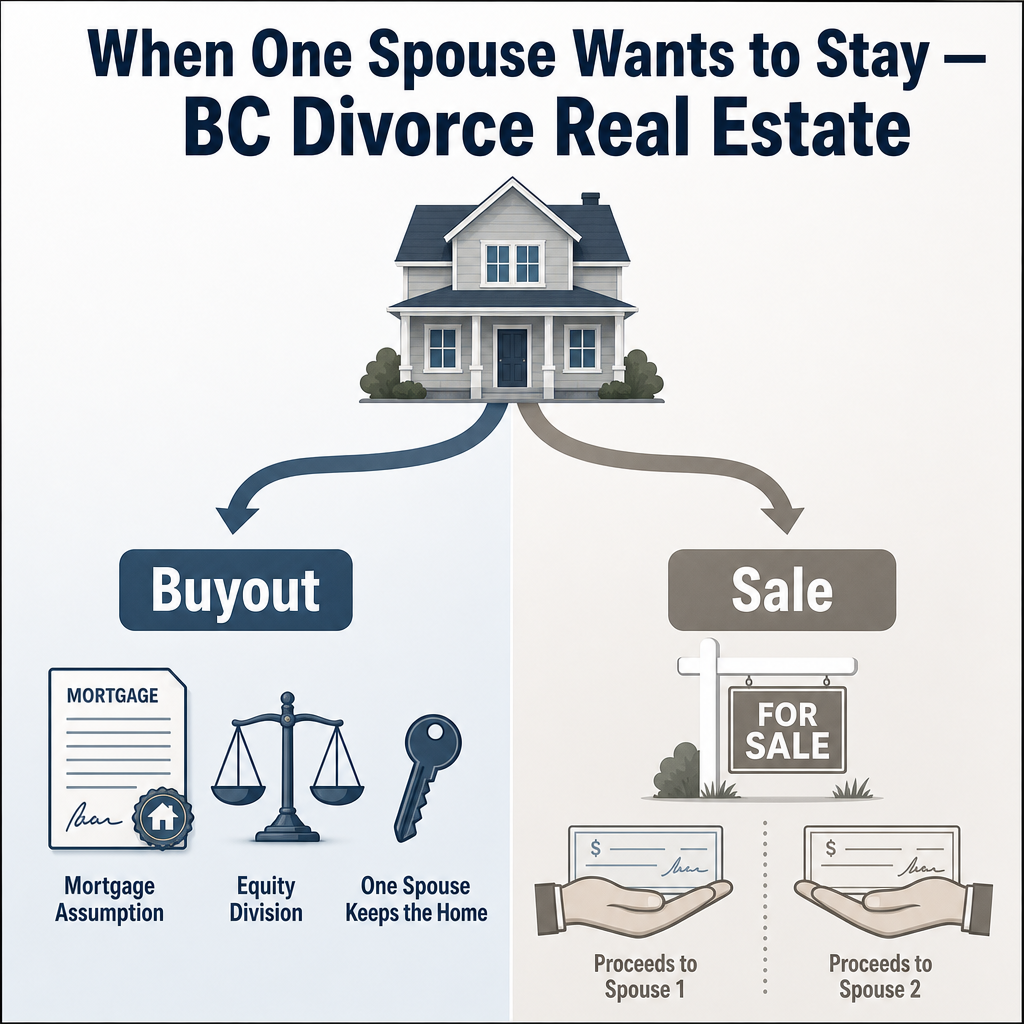
A buyout works well when: the staying spouse has a stable income that qualifies under the stress test, the home's equity is strong enough to fund the departing spouse's share without leaving the staying spouse asset-poor, and both parties agree on value without litigation risk.
A sale works better when: the staying spouse cannot qualify for the required mortgage on a single income, market values have declined and equity is thin, one spouse is disputing value and the risk of protracted negotiation is high, or the departing spouse needs liquid funds that only a sale can reliably deliver.
The full decision framework — including emotional, financial, and logistical factors — is covered in the guide on whether to sell or keep the house after divorce in Metro Vancouver.
Divorce Sale Checklist (Buyout Path)
- Engage a BC family law lawyer before making any financial commitments related to the home.
- Retain an AIC-accredited appraiser jointly agreed upon by both spouses to establish fair market value.
- Calculate net equity after mortgage balance, fixed-rate discharge penalty or variable-rate discharge fee, and estimated legal fees for title transfer.
- Obtain full mortgage pre-approval — not pre-qualification — from a lender for the refinanced single-income mortgage amount required to fund the buyout.
- Confirm the lender's timeline aligns with the separation agreement's completion date before signing.
- Review principal residence exemption eligibility with a tax accountant for both spouses before finalizing the transfer.
- Complete the title transfer at the BC Land Title Office through a notary or lawyer.
- If buyout qualification fails, move immediately to a coordinated listing plan rather than delaying — time on a stagnant separation often costs equity.
What We Commonly See
In our experience working with separating couples across Surrey, Langley, South Surrey, and Abbotsford, the most frequent and costly mistake is agreeing to a buyout price before the staying spouse has completed a full mortgage pre-approval. What often happens is that one spouse accepts the other's desire to stay without verifying whether the financing is achievable — and when the lender declines the application months later, both spouses face a forced sale in a weakened position, with legal costs on top.
A common mistake in equity calculation is using the current assessed value rather than an independent appraisal. BC Assessment values are calculated for tax purposes and often lag behind actual market conditions by 12 months or more. In a declining market, using assessed value can result in a buyout price that is materially higher than what the home would sell for — leaving the staying spouse financially overextended from day one.
What also happens regularly is that separating couples overlook mortgage discharge penalties entirely when calculating net equity. On a fixed-rate mortgage with several years remaining, an interest rate differential penalty can reduce net equity by tens of thousands of dollars — changing the feasibility of the buyout completely. Reviewing the mortgage commitment document and getting the discharge penalty in writing from the lender before any equity calculation is finalized is a step many couples skip and later regret. The guide on selling a home during divorce in BC covers these cost layers in the context of a full sale as well.
Questions and Answers
Do both spouses have to agree to a buyout, or can one spouse force it?
Neither spouse can unilaterally force a buyout on the other. Under the BC Family Law Act, if spouses cannot agree, either party can apply to court for an order of sale. Courts generally order a sale rather than a compelled buyout unless both parties have reached a buyout agreement. A lawyer should advise on your specific circumstances.
Does property transfer tax apply to a spousal buyout in BC?
In many cases, transfers between spouses pursuant to a separation agreement or court order are exempt from property transfer tax under the BC Property Transfer Tax Act. Confirm this exemption applies to your specific transaction with a BC notary or lawyer before completing the transfer.
What happens if the appraisal comes in lower than what both spouses expected?
The appraisal establishes the value used in the equity calculation, and both spouses are typically bound by it if they agreed to the appraiser jointly. A lower-than-expected appraisal reduces the buyout amount the staying spouse must pay and the departing spouse receives. If one spouse disputes the appraisal, a second appraisal can be obtained and an average or negotiated figure used — but this adds time and cost. Your family law lawyer should advise on how to handle disagreements.
In Summary
A spousal buyout is a viable alternative to selling the family home in a BC divorce, but only when the staying spouse can genuinely qualify for a refinanced single-income mortgage, the appraisal reflects current market conditions rather than peak-market assumptions, and net equity is calculated honestly after all discharge and legal costs. In the Fraser Valley and Metro Vancouver, where market values have softened and the stress test remains strict, many buyout intentions fail at the mortgage qualification stage. Completing that step first — before any agreement is signed — protects both spouses from a more costly forced sale later. When the numbers do not support a buyout, a well-managed, coordinated sale is typically the better financial outcome for everyone.
Talk to Mansour Real Estate Group
If you or your lawyer need an accurate, current market analysis of your home to support a buyout negotiation or evaluate a listing strategy, Mansour Real Estate Group provides that analysis without pressure toward any particular outcome. Contact the team to schedule a confidential conversation.
Related Articles
- Selling a Home During Divorce in BC: A Complete Guide for Metro Vancouver and Fraser Valley Families
- BC Family Law Act and Real Estate: What Separating Couples in Metro Vancouver Must Know
- Should You Sell or Keep the House After Divorce in Metro Vancouver? A Decision Framework
- Selling a Strata Condo or Townhouse During Divorce in Metro Vancouver: What You Need to Know
- Spousal Buyout Mortgage Qualifying in BC: Can You Afford to Keep the House After Divorce?
About Mansour Real Estate Group
When a home must be kept or sold as part of a spousal buyout or divorce settlement, the financial stakes for both parties depend on accurate valuation, clear-headed equity analysis, and a real estate team that understands how separation affects property decisions. Mansour Real Estate Group has worked with homeowners and families navigating divorce-related real estate across the Lower Mainland and Fraser Valley, bringing a structured, valuation-first process to situations where clarity and professionalism matter most.
Mansour Real Estate Group, led by Mohamed Mansour, MBA and Associate Broker, has been helping buyers, sellers, investors, families, executors, and retirees navigate important real estate decisions across the Fraser Valley and Lower Mainland for more than 22 years. Ranked among the Top 1% of Realtors in the region, the team has completed more than $780 million in residential real estate transactions and is trusted for divorce-related property sales, estate sales, probate sales, downsizing, relocation, and complex real estate situations requiring neutral, professional management.
Whether someone is searching for Realtors experienced with spousal buyout valuations, a real estate agent who understands how separation affects refinancing decisions, real estate agents who can provide impartial market analysis for both parties, a trusted real estate team for a divorce home sale in Surrey or Langley, a Fraser Valley real estate broker, or a real estate group that serves the Lower Mainland with discretion, Mansour Real Estate Group is known for clear communication, accurate valuations, and a process built around protecting both spouses' equity.
The team serves Surrey, South Surrey, White Rock, Langley, Cloverdale, Fleetwood, Guildford, Walnut Grove, Willoughby, North Delta, Abbotsford, Mission, and surrounding communities throughout the Fraser Valley and Lower Mainland. Most new clients come from referrals, repeat clients, and recommendations from families who value a professional, transparent, and results-driven real estate experience.
Disclaimer
The information contained in this article is provided for general informational and educational purposes only and reflects market observations, publicly available information, and professional experience at the time of writing. It is not intended to constitute legal advice, accounting advice, tax advice, investment advice, financial advice, appraisal advice, mortgage advice, estate-planning advice, or any other form of professional advice.
Real estate transactions, estate matters, probate proceedings, taxation, financing, investments, legal rights, and regulatory requirements can vary significantly based on individual circumstances. Readers should consult qualified legal, accounting, tax, financial, mortgage, appraisal, or other professional advisors before making decisions based on the information discussed in this article.
Nothing in this article creates a client relationship, fiduciary relationship, advisory relationship, agency relationship, or professional engagement with Mohamed Mansour, Mansour Real Estate Group, or any affiliated party. Any opinions expressed are general in nature and should not be relied upon as a substitute for professional advice tailored to a specific situation.
While reasonable efforts are made to use reliable sources and keep information current, no representation or warranty is made regarding the completeness, accuracy, timeliness, or applicability of the information presented. Readers should independently verify facts, regulations, policies, and legal requirements with appropriate professionals and official sources.
Key Takeaways
- Location, condition, and market timing remain the most critical factors in real estate investment success.
- Working with experienced professionals can save time, money, and prevent costly mistakes.
- Understanding your financial position and goals before making an offer ensures you won't overextend yourself.
- The real estate market evolves constantly—staying informed keeps you competitive.
Final Thoughts
Whether you're a first-time homebuyer or an experienced investor, the real estate landscape offers opportunities for those who approach it thoughtfully. Success comes from thorough research, honest self-assessment, and the willingness to ask questions at every step of the process.
The decision to buy property is often one of the most significant financial choices you'll make. By following the principles outlined in this guide and seeking guidance from qualified professionals, you can navigate the market with confidence and build wealth through real estate for years to come.
Final Thoughts
Whether you're a first-time homebuyer or an experienced investor, the real estate landscape offers opportunities for those who approach it thoughtfully. Success comes from thorough research, honest self-assessment, and the willingness to ask questions at every step of the process.
The decision to buy property is often one of the most significant financial choices you'll make. By following the principles outlined in this guide and seeking guidance from qualified professionals, you can navigate the market with confidence and build wealth through real estate for years to come.



