

Spouse Buyout Math in BC: When One Spouse Keeps the Family Home — Complete Guide to Home Valuation, Mortgage Qualification Under Stress Test Rules, Equalization Payment Calculation, and Lender Requirements in Metro Vancouver and Fraser Valley Markets 2026
By Mohamed Mansour, MBA and Associate Broker | Mansour Real Estate Group | Published: May 2026 | Fraser Valley and Metro Vancouver, BC
For separating couples in Metro Vancouver and the Fraser Valley, keeping the family home through a spousal buyout can seem like the cleanest solution. One spouse stays. One spouse is compensated. The property stays off the market. In practice, however, the math behind a buyout is more demanding than most people expect — and in 2026, with elevated benchmark prices and strict stress test rules, many spouses are discovering they cannot qualify to refinance the home they want to keep.
This guide covers the full mechanics: how fair market value is established for family law purposes, how lenders actually qualify a single-income buyout mortgage under current stress test rules, how the equalization payment is calculated, and what options exist when home value exceeds refinancing capacity. If you are weighing a buyout in Surrey, Langley, Abbotsford, South Surrey, or anywhere in the Fraser Valley, these specifics matter before any agreement is signed.
Short Answer
A spousal buyout in BC requires a certified appraisal to set fair market value, a lender-approved mortgage qualification under current stress test rules, and a calculated equalization payment based on net equity after the mortgage is subtracted. When a single spouse cannot qualify to refinance at current prices — common above $900K in the Fraser Valley and above $1.2M in Metro Vancouver — the couple must either accept a deferred payment structure, a second mortgage, or sell the property. Spousal and child support obligations further reduce qualifying income, often by 25 to 40 percent.
Key Takeaways
- Lenders require stress-tested mortgage qualification at the higher of current rates or contract rate plus 2%, which reduces single-income purchasing power by $150,000 to $300,000 or more.
- Equalization payments are calculated from certified appraisal value, not MLS sold prices or informal estimates — outdated appraisals create disputes when spring prices rise quickly.
- Child and spousal support obligations reduce effective qualifying income with most lenders, sometimes making refinancing mathematically impossible at middle-income levels.
- When buyout math fails, three structured options exist: a deferred payment arrangement, a vendor take-back second mortgage, or a negotiated sale with split proceeds.
- BC Family Law Act Section 65 governs property equalization — both spouses should obtain independent legal advice before signing any buyout agreement.
Who This Applies To
- Separating couples in BC where one spouse wants to retain the family home
- Spouses who are the sole or primary income earner attempting to refinance at current benchmark prices
- Couples in the Fraser Valley (Surrey, Langley, Abbotsford) or Metro Vancouver where home values exceed $900,000
- Families where child or spousal support obligations will affect mortgage qualification
- Separated spouses who received a January 2026 appraisal and are now facing a spring 2026 price dispute
When This Advice May Not Apply
This guide covers general mechanics. It is not legal advice, tax advice, or mortgage advice. Couples with complex asset structures, business ownership, investment properties, or contentious separation agreements should consult a family law lawyer and a licensed mortgage professional before proceeding. Situations involving court orders, interim agreements, or trust arrangements require independent legal guidance.
Key Definitions
Fair Market Value: The price a property would sell for between a willing buyer and seller, neither under compulsion. Required by most lenders and accepted in family law proceedings when established by a certified appraisal.
Stress Test: The federal mortgage qualification rule requiring borrowers to qualify at the higher of the Bank of Canada benchmark rate or their contract rate plus 2%. As of early 2026, CMHC-insured mortgages are stress-tested at a minimum qualifying rate of 5.25% or contract rate plus 2%, whichever is higher. Consult CMHC or your lender for current rates.
Equalization Payment: In BC family law, the amount owed by the spouse retaining a higher-value asset to the spouse receiving less, calculated to equalize net family property division under the BC Family Law Act.
Vendor Take-Back Mortgage (VTB): A private mortgage arrangement where the departing spouse acts as the lender for part of the buyout amount, allowing the purchasing spouse to bridge the gap between lender qualification and actual property equity.
Data Used in This Article
- CMHC Mortgage Qualification and Stress Test Rules, 2026 (official, federal)
- BC Family Law Act, Section 65 — Equalization of Net Family Properties (official, provincial legislation)
- Fraser Valley Real Estate Board market benchmark data, Q1 2026 (official, regional)
- Major lender qualification guidelines — RBC, TD, BMO spousal buyout policies, 2026 (industry, third-party)
How We Evaluate This
At Mansour Real Estate Group, when we work with separating spouses on a potential buyout scenario, we start with the property's current market position — not the assessed value, not an informal estimate, and not last year's comparable sales. We establish what the home would realistically sell for in the current local market, then we walk through the refinancing math with the client before any agreement is put in place.
That sequence matters because the most common buyout failure happens when an agreement is signed based on an informal valuation, and the lender then declines the refinancing application. By the time that happens, the departing spouse has moved out, both parties have legal fees, and the only resolution is to sell the home anyway — but now under more pressure and with less time. Identifying the gap between fair market value and lender-qualifying value early is the only way to avoid that outcome.
How the Equalization Payment Is Actually Calculated
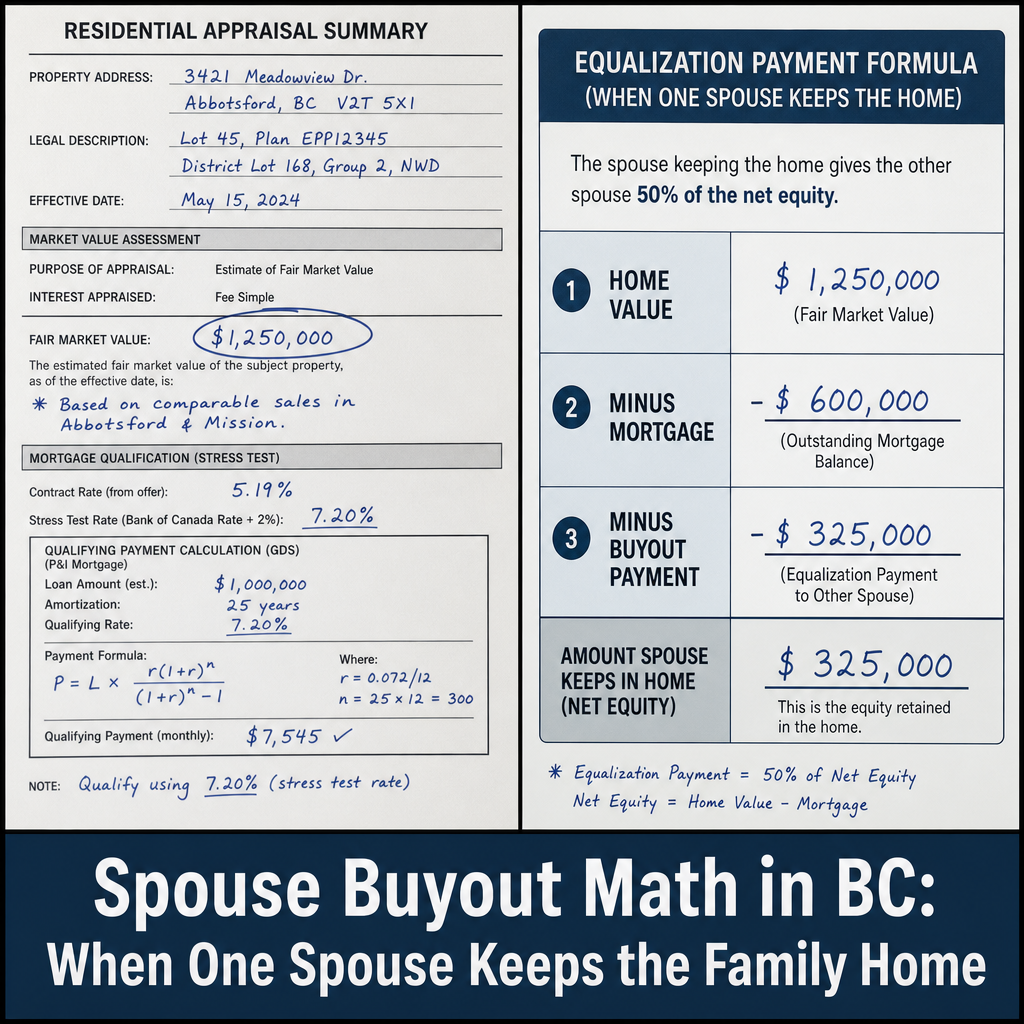
The equalization payment in a BC spousal buyout is not simply half the home's value. It is half the net equity — the appraised fair market value minus the outstanding mortgage balance, minus any agreed deductions for closing costs or legal fees the buying spouse will bear.
Here is a simplified example for a Fraser Valley detached home:
- Appraised Fair Market Value: $1,050,000
- Outstanding Mortgage Balance: $580,000
- Net Equity: $470,000
- Equalization Payment (50/50 split): $235,000
The buying spouse must refinance at $580,000 (existing mortgage) plus fund the $235,000 equalization payment — meaning they need to qualify for a new mortgage of approximately $815,000, assuming no other assets are used. Under current stress test rules, qualifying for $815,000 at a stress-tested rate of 7.25% (contract rate of 5.25% plus 2%) typically requires gross annual income of approximately $175,000 to $190,000, depending on amortization, existing debts, and the lender's specific guidelines. These figures are illustrative — individual qualification depends on full income documentation, credit, and lender policy.
The equalization payment is governed by the BC Family Law Act. The actual calculation in contested separations may differ if there are excluded assets, inherited property, pre-relationship equity, or business interests. Both spouses should have independent legal advice before any agreement is finalized.
The valuation used for that calculation must come from a certified appraisal ordered close to the agreement date, not from a real estate agent's CMA alone. When spring 2026 market activity pushes comparable sales up quickly, a January appraisal can be outdated within six to eight weeks — creating legitimate disputes between spouses about which price governs the buyout. This is one reason timing a buyout agreement with a current appraisal matters.
How the Stress Test Affects Single-Income Buyout Qualification
The federal mortgage stress test applies to all lender-regulated mortgages in Canada, including spousal buyout refinances. According to CMHC guidelines, borrowers must qualify at the higher of the Bank of Canada's minimum qualifying rate (5.25% as of early 2026) or their contract rate plus 2 percentage points. At a contract rate of 5.25%, the qualifying rate becomes 7.25%.
That gap has real consequences. A spouse qualifying at 7.25% instead of 5.25% loses approximately $150,000 to $300,000 in mortgage capacity depending on income, amortization, and existing debt obligations. In practical terms, a household that could comfortably carry a $900,000 mortgage on a dual income can rarely do so on one income after accounting for the stress test, especially when support payments reduce the qualifying income further.
Most major lenders — including RBC, TD, and BMO — treat child and spousal support obligations as a deduction from gross qualifying income, not as a living expense. If a spouse is paying $2,000 per month in combined support, that amount is subtracted from gross monthly income before the debt service ratios are calculated. For someone earning $120,000 annually, that deduction effectively reduces qualifying income to approximately $96,000, which materially changes the maximum mortgage amount available.
For separating couples considering whether a buyout is viable before a decision is made, the financial breakdown between selling and keeping the home is an important starting reference.
Lenders also require documentation that the buyout has been approved under a formal separation agreement or court order. They will not process a spousal buyout refinance based on an informal arrangement between spouses. This means the family law timeline and the lender qualification timeline must be coordinated — a refinancing application that expires before the separation agreement is executed creates delays and potential mortgage rate lock-in issues. For a deeper look at how mortgage obligations transfer during separation, see our guide on mortgage responsibility and the marital home in BC.
When Buyout Math Fails: Three Options
When the appraised value produces an equalization payment that exceeds what a single spouse can refinance for, couples face a real decision. The gap cannot simply be ignored — it must be resolved through one of three structured approaches.
Option 1 — Deferred Equalization Payment: The departing spouse agrees to receive part of their equalization payment later, typically when the home is eventually sold. This is formalized through a registered second mortgage or promissory note secured against the property. It protects the departing spouse's equity without forcing a sale, but it also means they remain financially tied to the property until it sells. Legal documentation is required.
Option 2 — Vendor Take-Back Mortgage (VTB): The departing spouse acts as a private lender for the portion of the buyout that the institutional lender will not fund. This reduces the first mortgage to a qualifying amount while allowing the buying spouse to fund the full equalization payment over time. VTBs must be registered at the Land Title Office and supported by a formal mortgage agreement. This option works when both spouses trust the arrangement and when the buying spouse has reliable income to service both the institutional mortgage and the private second mortgage.
Option 3 — Negotiated Sale: When neither deferred nor VTB arrangements are acceptable, the home is listed and sold. Proceeds are distributed according to the separation agreement after mortgage discharge and sale costs. This is often the cleanest financial resolution, though it requires both spouses to cooperate through the listing and sale process. Our guides on selling a home during divorce in BC and the divorce home sale timeline in Surrey cover how that process works in practice.
The right option depends on the income profile of the buying spouse, the degree of trust between parties, the tax implications of each structure, and the advice of each spouse's independent legal counsel. See our upcoming guide on home equity division in a BC divorce for how these options interact with broader property division. For tax considerations that affect any of these paths, our guide on tax implications of selling a home in a BC divorce is relevant regardless of which structure is chosen.
Buyout Checklist
- Order a certified appraisal from a Designated Appraiser (AACI or CRA designation) as close to the agreement date as possible — not an informal CMA.
- Obtain a mortgage pre-qualification from a licensed mortgage broker before signing any buyout agreement, to confirm what the buying spouse can actually refinance for under current stress test rules.
- Calculate the equalization payment using the appraisal value minus the outstanding mortgage — both spouses should agree on the net equity figure before proceeding.
- Confirm how child and spousal support payments will be treated by the lender — get this in writing from the mortgage professional before the separation agreement references specific buyout timelines.
- If a gap exists between lender-qualifying value and full equalization amount, identify which of the three resolution options (deferred payment, VTB, or sale) is acceptable to both parties before finalizing the separation agreement.
- Ensure the separation agreement and the lender's conditions are aligned in timing — a buyout refinancing application typically expires within 90 to 120 days.
- Both spouses should sign a formal agreement at the Land Title Office, not an informal acknowledgement — this protects the departing spouse's equity interest until transfer is complete.
What We Commonly See
Agreements signed before mortgage qualification is confirmed. In our experience, the most common breakdown in a spousal buyout happens when both spouses agree on the price and the equalization amount — but the buying spouse's mortgage application is then declined or comes back significantly lower than expected. By that point, the departing spouse has planned around receiving that payment. The resolution requires renegotiation under pressure, and sometimes litigation.
Appraisal timing mismatches in spring markets. A January appraisal in a Fraser Valley neighbourhood can be outdated by March or April, when comparable sales have shifted. We see this create genuine disputes, especially in detached home segments in Langley, Cloverdale, and South Surrey, where spring activity can move benchmark prices by $30,000 to $60,000 within a single quarter. The spouse who wants to sell argues the appraisal is stale. The spouse who wants to keep the home argues the agreement was made in good faith. The result is delay and additional legal cost.
Support obligations underestimated in mortgage planning. What often happens is that a buying spouse secures informal confirmation from a bank that they can qualify for a certain mortgage — without disclosing the support obligations, or without the lender running a full debt-service calculation. When the formal application is submitted, the support deductions reduce qualifying income enough to fail the stress test at the required amount. This is preventable with proper mortgage planning before the separation agreement is finalized.
Questions and Answers
Can a lender approve a spousal buyout if the couple has only an informal separation agreement?
No. Major lenders in Canada require a formal separation agreement or court order before processing a spousal buyout refinance. An informal or verbal agreement between spouses is not sufficient documentation. The agreement must address the property division specifically and confirm the transfer terms.
Does the stress test apply if the buyout spouse is switching lenders versus staying with the same lender?
If the spouse refinances with a new lender — which is typical in a buyout because the mortgage amount changes — the stress test applies in full. If they remain with the same lender and only add or remove a name from an existing mortgage without changing the amount, some lenders treat this differently. Consult a licensed mortgage professional to confirm the specific policy for your lender and situation.
What happens if the home appraises lower than expected in a spousal buyout?
A lower appraisal reduces the equalization payment owed to the departing spouse, which can make the buyout easier to finance. However, it may also create a dispute if the departing spouse believes the home is worth more than the appraisal reflects. Either party can commission a second appraisal, or the separation agreement can specify that a single jointly ordered appraisal is binding.
In Summary
A spousal buyout in BC is a coordinated financial and legal process that requires a certified appraisal, a lender-verified mortgage qualification under current stress test rules, and a clearly documented equalization payment. In the Fraser Valley and Metro Vancouver, where benchmark prices often exceed what a single income can refinance for under current rules, it is essential to confirm mortgage qualification before any agreement is signed. When the math fails, deferred payment structures, vendor take-back mortgages, and negotiated sales are the three available paths — each with distinct legal, tax, and financial implications that require independent professional advice.
Thinking Through a Buyout? Start With the Numbers.
If you are trying to understand whether a spousal buyout is financially viable for your specific property and situation, Mansour Real Estate Group can provide a current market valuation and walk through the realistic pricing picture before you commit to any agreement. There is no cost to that conversation, and it often surfaces important information before it becomes a problem. Contact us directly to arrange a confidential discussion.
Related Articles
- Should You Sell or Keep the House After a Divorce in Metro Vancouver? A Financial Breakdown
- Home Equity Division in a BC Divorce: What Every Separating Couple in the Fraser Valley Should Understand
- Mortgage and the Marital Home in BC: Who Pays, Who Qualifies, and What Happens Next
- Divorce Home Sale Timeline in Surrey: How Long Does It Really Take?
- Tax Implications of Selling Your Home in a BC Divorce: What Metro Vancouver Couples Must Know
About Mansour Real Estate Group
When a home must be retained by one spouse through a buyout, the accuracy of the property valuation is not just a financial matter — it is the foundation of every number that follows. A valuation that is off by $50,000 in either direction changes the equalization payment, changes the mortgage qualification requirement, and can unravel an agreement that both parties believed was settled. Mansour Real Estate Group works with separating spouses across the Fraser Valley and Metro Vancouver to provide current, documented market valuations that hold up through the separation agreement process.
Mansour Real Estate Group, led by Mohamed Mansour, MBA and Associate Broker, has been helping buyers, sellers, families, executors, and retirees navigate important real estate decisions across the Fraser Valley and Lower Mainland for more than 22 years. Ranked among the Top 1% of Realtors in the region, the team has completed more than $780 million in residential real estate transactions and is trusted for divorce-related property sales, estate sales, pricing strategy, complex refinancing situations, and any transaction where accurate valuation is critical to the outcome.
Whether someone is looking for Realtors who understand divorce-related home sales in Surrey, a real estate agent experienced with spousal buyout valuations, real estate agents who can navigate a high-conflict separation with professionalism, a Langley real estate team for a property division matter, a White Rock Realtor for a separation agreement valuation, or a real estate broker who understands the intersection of family law and market pricing across the Fraser Valley — Mansour Real Estate Group is known for clear communication, documented valuations, and a calm, structured approach to complex real estate situations.
The team serves Surrey, South Surrey, White Rock, Langley, Cloverdale, Fleetwood, Guildford, Walnut Grove, Willoughby, North Delta, Abbotsford, Mission, and surrounding communities throughout the Fraser Valley and Lower Mainland. Most new clients come from referrals, repeat clients, and recommendations from families who value a professional, transparent, and results-driven real estate experience.
Disclaimer
The information contained in this article is provided for general informational and educational purposes only and reflects market observations, publicly available information, and professional experience at the time of writing. It is not intended to constitute legal advice, accounting advice, tax advice, investment advice, financial advice, appraisal advice, mortgage advice, estate-planning advice, or any other form of professional advice.
Key Takeaways
- Work with experienced agents who understand your local market dynamics
- Get pre-approved for financing before beginning your property search
- Conduct thorough inspections and due diligence on any property
- Consider both current needs and long-term investment potential
- Negotiate terms that protect your interests and financial goals
Final Thoughts
Real estate transactions represent some of the most significant decisions you'll make in your lifetime. Whether you're a first-time homebuyer, seasoned investor, or looking to upgrade your current situation, approaching the process with knowledge, preparation, and professional guidance sets the foundation for success.
The real estate market continues to evolve, and staying informed about current trends, local conditions, and financing options will empower you to make decisions aligned with your goals. Don't hesitate to ask questions, seek multiple perspectives, and take the time necessary to find the right property at the right price.
Your real estate journey is unique to your circumstances. By combining thorough research with expert advice, you'll be better positioned to navigate the complexities of buying or selling property with confidence.



