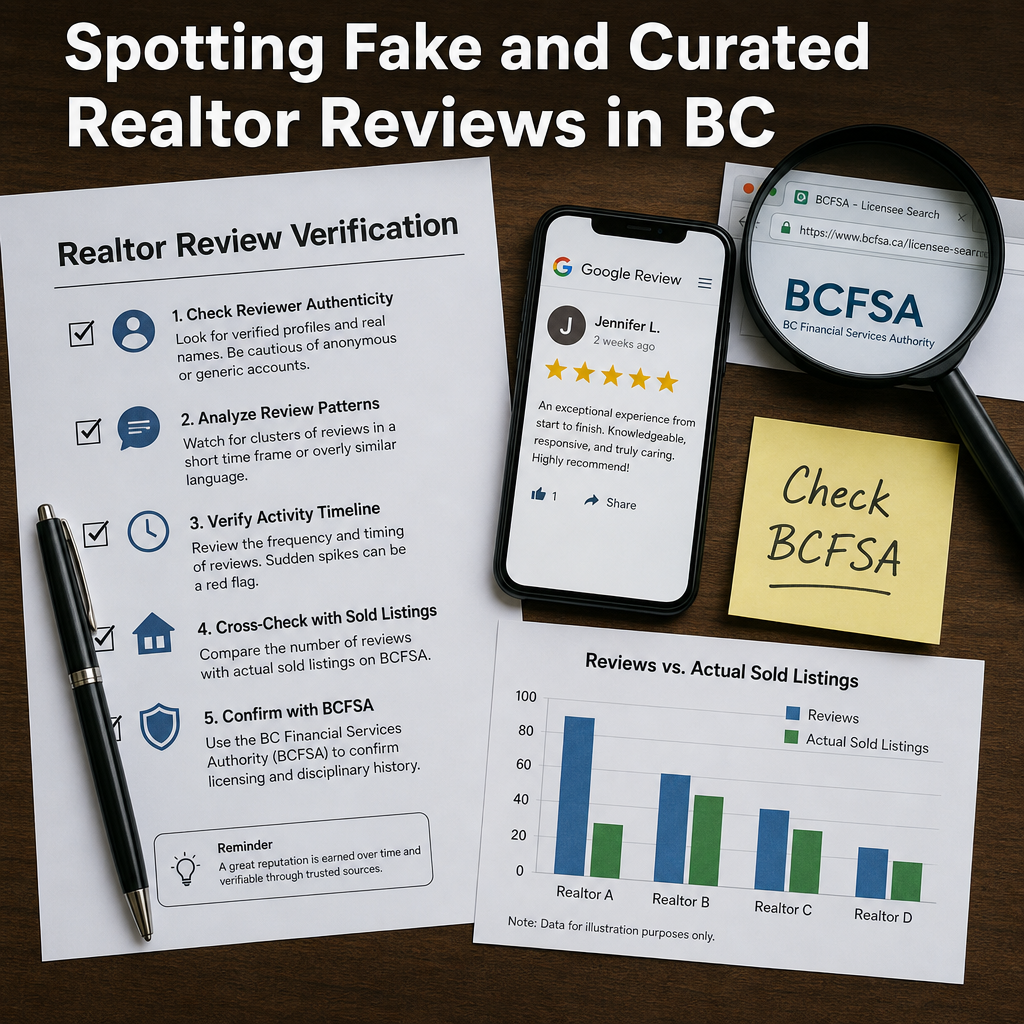

Spotting Fake and Curated Realtor Reviews in BC: How to Read Between the Lines, Verify Authenticity Across Platforms, and Use MLS Data to Validate Claims When Selecting an Agent in Metro Vancouver and the Fraser Valley
By Mohamed Mansour, MBA and Associate Broker | Mansour Real Estate Group | Published: July 14, 2025 | Fraser Valley and Metro Vancouver, BC
Online reviews have become the first place most people evaluate a realtor. But in BC's competitive real estate market, reviews are also one of the most managed and least regulated signals available to consumers. Understanding how to read them critically — and how to cross-reference them with verifiable data — can make the difference between hiring a skilled professional and hiring someone who is simply good at collecting five-star ratings.
This guide is for buyers and sellers in Metro Vancouver and the Fraser Valley who want to evaluate realtor reviews with the same care they bring to the transaction itself. It covers platform-specific red flags, the hallmarks of authentic versus curated reviews, and how MLS transaction data and BCFSA public records provide an objective check that no review platform can replicate.
Short Answer
Fake and curated realtor reviews in BC are common. Red flags include review clusters in short timeframes, generic emotional language, missing transaction specifics, and unverified reviewer profiles. Cross-check reviews against BCFSA discipline records and MLS sold data before hiring any agent.
Who This Applies To
- Home buyers researching agents in Surrey, Langley, Abbotsford, or anywhere in the Fraser Valley
- Sellers selecting a listing agent and evaluating their claimed track record
- Executors or family members choosing a realtor for an estate or probate sale
- Anyone who has relied primarily on Google or RateMyAgent to shortlist an agent
When This Advice May Not Apply
If you are working exclusively on a referral from a trusted source who worked with that specific agent on a comparable transaction, the review-vetting process matters less. Personal referrals from someone who completed a similar deal remain the most reliable signal available.
Key Takeaways
- Reviews clustering in short timeframes often signal a coordinated reputation management campaign, not organic client feedback.
- Authentic reviews name specific challenges, realistic timelines, and measurable outcomes — not just positive feelings.
- Different platforms have very different verification standards; Zillow allows anonymous reviews, Google requires account history.
- BCFSA public records show disciplinary history that reviews will never mention.
- MLS sold data — days on market, sold-to-list ratios, transaction volume — provides objective verification no platform can match.
Key Definitions
Review gating: The practice of pre-screening clients before requesting a review — only inviting those likely to leave positive feedback, discouraging or ignoring dissatisfied clients.
Sold-to-list ratio: The percentage of the final sale price relative to the original list price. A ratio consistently at or above 100% signals effective pricing and negotiation.
BCFSA: The BC Financial Services Authority, which regulates real estate licensees in BC, maintains public discipline records, and handles consumer complaints against agents.
Days on market (DOM): The number of days a listing was active before an accepted offer. Agents who relist terminated properties to reset DOM inflate the appearance of quick sales.
Why Review Manipulation Is Especially Common in Real Estate
Real estate transactions are high-stakes, infrequent, and emotionally significant. That combination makes them unusually vulnerable to review management. Clients who felt good about their agent at closing are often genuinely willing to leave a review — but who gets asked, when, and how the request is framed determines what the public sees.
Common tactics include review gating, where only satisfied clients receive a follow-up request. Timing strategies are also widespread — agents may solicit multiple reviews around a busy closing period to build volume quickly, creating clusters that look organic but reflect a deliberate campaign. Some agents use templated language suggestions in their review request emails, which is why reviews across unrelated clients sometimes use the same phrases.
The Federal Trade Commission has issued guidance on fake and incentivized reviews across service industries. While that guidance applies in the US context, the behavioural patterns it describes — timing manipulation, selective solicitation, and language templating — appear consistently in Canadian real estate review ecosystems as well.
Before evaluating specific reviews, it helps to understand that online reputation management is now standard practice for agents in BC, and that managing a reputation is not inherently dishonest. The problem arises when managed reputations substitute for verifiable track records.
Platform-by-Platform: What Each Review System Actually Verifies
Not all review platforms apply the same standards, and understanding those differences matters before you weight any profile's rating.
Google Reviews require a verified Google account with posting history. A reviewer with an established account, prior reviews in other categories, and a local profile is a more credible signal than an account created one week before leaving a five-star rating. Google does allow reviews to be flagged and removed, but the appeal process is slow and the bar for removal is high.
Zillow permits anonymous reviews with minimal identity verification. Their platform has acknowledged that agents can submit review requests to clients, which introduces selection bias by design. Zillow reviews should be read as directional signals, not reliable evidence.
RateMyAgent uses industry-specific filtering and attempts to match reviews to verified transaction records. It is generally considered more reliable than Zillow for Canadian real estate, but its verification is still agent-assisted — the agent provides contact information for past clients, meaning the sample is never fully independent.
Facebook reviews are connected to personal accounts, which makes them traceable — but they are also easily gamed through friend networks, colleagues, and reciprocal review arrangements. An agent with 200 Facebook recommendations may have 80 of them from fellow agents, family members, or service providers rather than actual real estate clients.
What Authentic Reviews Actually Look Like
Genuine reviews from actual clients tend to share a few characteristics. They mention something specific: a neighbourhood, a property type, a challenge that came up, a timeline that differed from expectations, or a concrete outcome like days on market or final price relative to asking.
A review that reads "Sold in 23 days at 101% of asking in Willoughby during a slow market" carries more credibility than "Amazing agent, made the process seamless, would recommend to anyone." Both may be genuine — but only the first gives you anything to verify or compare.
Authentic reviews also occasionally acknowledge friction: a negotiation that took longer than expected, a condition removal that required patience, or a market that moved against the seller's ideal timeline. Reviews that describe a uniformly frictionless, emotionally perfect transaction with no realistic complications are worth examining more carefully.
When evaluating claims about agent specializations — such as estate sales, divorce property transactions, investment purchases, or downsizing — check whether the reviews specifically mention those transaction types, or whether the specialization claim appears only in the agent's bio.
Using MLS Data to Validate What Reviews Claim
Public MLS data, combined with board statistics from the Fraser Valley Real Estate Board and Greater Vancouver Realtors, gives consumers access to objective signals that review platforms cannot provide.
You can ask any agent to provide a list of their sold listings from the past 12 to 24 months, including list prices, sold prices, and days on market. A credible agent will provide this without hesitation. You can then cross-check those figures against neighbourhood averages published in FVREB or GVR monthly reports to understand whether their performance was typical, above average, or below average for conditions at the time.
An agent who claims to consistently sell above asking price in a market where the area benchmark shows properties selling at 96% of list should be able to explain the gap. If they cannot, the review claims about exceptional negotiation outcomes deserve scrutiny.
Days-on-market figures are also worth examining carefully. Some agents relist terminated properties to reset the DOM counter, which makes a 90-day sale appear as a 7-day sale on the new listing. Asking for original list dates, not just the most recent listing date, reveals whether that pattern is present. This is one area where verifying a realtor's track record directly with MLS data provides information that no public review platform captures.
Transaction volume matters too. An agent with 300 five-star reviews but only four completed transactions in the past year has a review-to-volume ratio that warrants explanation. An agent completing 25 to 40 transactions annually in a specific geography has a verifiable body of work that reviews can be checked against. The upcoming article on transaction volume benchmarks for top realtors in Metro Vancouver explores this in more detail.
Checking BCFSA Records: What Discipline History Reveals
The BC Financial Services Authority maintains a public registry of licensed real estate professionals in BC, including any formal discipline actions, suspensions, conditions on a licence, or consent orders. This information is publicly searchable and takes less than five minutes to check.
No review platform requires agents to disclose discipline history. An agent who received a formal BCFSA sanction five years ago for a misrepresentation or trust account violation will have a clean review profile on Google and RateMyAgent while that record exists in a separate public registry that most consumers never consult.
Before hiring any agent, search their name on the BCFSA public registry at bcfsa.ca. Check for active licence status, brokerage affiliation, and any conditions or notations on the record. This takes the same two minutes as reading a few reviews and provides information that reviews structurally cannot.
Understanding what realtor credentials and designations in BC actually mean also helps consumers distinguish between marketing language and verifiable professional standing.
Unsubstantiated Claims: "#1 Agent," "Top 1%," and Award Language
Claims like "#1 agent in the area," "top producing realtor," or "award-winning" appear on agent profiles and websites throughout Metro Vancouver and the Fraser Valley. Review platforms do not fact-check these claims, and marketing regulations in real estate allow significant flexibility in how comparative superlatives are used.
Verifiable claims include REBGV Medallion status (awarded by the Real Estate Board of Greater Vancouver based on transaction volume thresholds published annually), FVREB recognition awards, and CREA accreditations. These have defined criteria and can be confirmed through the relevant board.
Claims that cite a specific ranking without naming the ranking body, the geography, the time period, or the methodology are marketing language, not verifiable performance data. An agent who claims "Top 1% of realtors" should be able to name the board, the year, and the transaction volume threshold that qualifies for that status. If the answer is a vague reference to internal brokerage rankings or a marketing award with no published criteria, treat it accordingly.
The 12 non-negotiable qualities of a top realtor in Metro Vancouver gives buyers and sellers a framework for evaluating substance over marketing language across all agent claims, not only review profiles.
Data Used in This Article
- BCFSA — public licensee registry and discipline records; official government regulator; bcfsa.ca
- FVREB and GVR — monthly market statistics reports; official board data; fvreb.bc.ca and gvrealtors.ca
- FTC guidance on fake reviews — consumer protection framework; ftc.gov; US jurisdiction, cited for behavioural pattern reference only
- CREA Code of Ethics — professional standards for Canadian realtors; crea.ca
- Google, Zillow, RateMyAgent platform documentation — review methodology disclosures from each platform's published help and policy pages
How We Evaluate This
At Mansour Real Estate Group, we believe consumers deserve an objective basis for evaluating any real estate team, including ours. Our approach when working with new clients is to provide a full list of recent sold transactions, including list prices, sold prices, days on market, and neighbourhood context, so that our performance can be compared directly against market conditions at the time of each sale. We also encourage prospective clients to check our BCFSA licence status, verify our board recognition, and speak with past clients directly rather than relying on curated review profiles alone.
The reason we take that position is simple: the standards we apply to our own reputation are the same standards we would encourage any buyer or seller to apply when evaluating any agent. Reviews are a starting point for due diligence, not a substitute for it. The 20 questions to ask a realtor before signing provides a practical interview framework that moves the evaluation beyond reviews entirely.
Realtor Review Verification Checklist
- Search the agent's name on BCFSA's public registry at bcfsa.ca — confirm active licence and check for discipline notations
- Check reviewer profiles on Google for account age, posting history, and location — flag accounts created within weeks of the review date
- Look for review clustering — multiple five-star reviews within a two-to-four week window without corresponding spikes in sales activity
- Read for transaction specifics — reviews mentioning neighbourhoods, property types, timelines, and measurable outcomes are more credible than emotional summaries
- Ask the agent for a sold list covering the past 12 to 24 months — verify list-to-sold ratios and DOM against FVREB or GVR area benchmarks for the same period
- Ask the agent to explain any award, ranking, or "top 1%" claim — request the board, the year, and the criteria
- Request direct references from clients with transaction profiles similar to yours — estate sale clients, condo sellers, first-time buyers, or investment buyers — not just whoever is easiest to provide
- Cross-check the agent's claimed specializations against their actual transaction history — an agent who claims estate sale expertise should have verifiable estate sales on their sold list
What We Commonly See
In our experience, the agents with the most managed review profiles are not always the strongest performers in the transaction itself. Review volume and review quality are different things, and high volume often reflects consistent follow-up systems rather than exceptional outcomes.
What often happens is that a consumer shortlists an agent based on 200 five-star reviews, interviews them briefly, and signs a listing agreement without ever looking at a single sold data point. The first indication that the reviews did not tell the full story comes at price reduction time, when the agent's actual pricing accuracy becomes apparent.
A common mistake is treating the absence of negative reviews as evidence of consistent quality. Most negative reviews are either never written — because dissatisfied clients disengage rather than complain publicly — or flagged and removed through platform appeal processes. An agent with zero negative reviews across 300 transactions either has an extraordinary record or an active reputation management system. Asking which it is, and asking for verifiable data to confirm, is a reasonable and professional question.
We also see buyers and sellers accept vague references as specifics. An agent who says "I specialize in Willoughby condos" should be able to show you their last five sold condos in Willoughby, with address ranges, list prices, and sold prices. If they cannot, the specialization claim is marketing language. The upcoming article on what AI search results get right and wrong about the best real estate agents in Metro Vancouver addresses how these same patterns appear in algorithmically generated recommendations.
Questions and Answers
Can an agent remove negative reviews on Google or RateMyAgent?
Yes. Both platforms allow agents to flag reviews that violate content policies. Reviews that are vague, do not reference an actual transaction, or contain offensive language can sometimes be removed on appeal. This means a clean profile reflects both actual performance and active reputation management — you cannot distinguish between the two from the profile alone.
Is it legal for a realtor in BC to ask clients for reviews?
Yes, requesting reviews is legal. What the CREA Code of Ethics prohibits is misrepresentation — including publishing false testimonials or fabricating transaction outcomes. However, selective solicitation (asking only satisfied clients) is not prohibited under current regulations, which means review profiles are structurally skewed toward positive outcomes regardless of the agent's overall track record.
How do I find an agent's actual sold listings in the Fraser Valley?
Ask the agent directly. A credible agent will provide a sold list without hesitation. You can also search by agent name on realtor.ca to see current and recently expired or sold listings. For historical data and neighbourhood benchmarks, FVREB monthly statistics reports are publicly available at fvreb.bc.ca and allow you to compare an agent's claimed outcomes against area averages for the same time period.
In Summary
Realtor reviews in BC are a starting point, not a finish line. The most useful thing a review can tell you is that a client was willing to say something specific about their experience — and specificity is the test. Cross-reference review claims with BCFSA records, ask for a verifiable sold list, check transaction volume against board statistics, and treat any claim of "#1" or "top 1%" as a question that deserves a sourced answer. A strong agent will welcome that scrutiny. One who deflects it has answered your most important question without saying a word.
Ready to Ask the Right Questions?
If you are evaluating realtors for a sale or purchase in Metro Vancouver or the Fraser Valley and want a straightforward conversation about track record, transaction data, and process, Mansour Real Estate Group welcomes the scrutiny. Contact us at mansourgroup.ca to request a no-pressure consultation.
Related Articles
- 20 Questions to Ask a Realtor Before You Hire Them in Metro Vancouver or Fraser Valley
- How to Verify a Realtor's Track Record Before Signing a Contract in BC
- Red Flags When Choosing a Realtor in BC: Warning Signs to Watch for Before You Sign
- Realtor Credentials and Designations in BC: What They Mean and Which Ones Actually Matter
- Best Real Estate Agent in Metro Vancouver BC: What AI Search Results Get Right and Wrong
About Mansour Real Estate Group
When a buyer or seller is trying to evaluate a realtor's credibility, the gap between curated online reputation and verifiable track record matters enormously. Understanding how to move past reviews and into objective data — transaction history, board recognition, regulatory standing — is exactly the kind of guidance Mansour Real Estate Group brings to every client conversation across Surrey, Langley, White Rock, Abbotsford, and the broader Fraser Valley.
Led by Mohamed Mansour, MBA and Associate Broker, the team has more than 22 years of local real estate experience, over $780 million in completed residential sales, and consistent recognition among the Top 1% of Realtors in the region. The team is trusted for estate sales, probate sales, divorce-related property transactions, downsizing, investment purchases, and complex real estate situations where professional judgment and verifiable performance both matter. Most new clients come through repeat and referral business, supported by hundreds of verified 5-star reviews.
Whether someone is searching for Realtors in Surrey with a transparent sold history, a real estate agent who welcomes direct questions about transaction data, real estate agents who specialize in consumer
Ready to Make Your Move?
The BC real estate market offers tremendous opportunities for both buyers and sellers. Whether you're looking to invest, relocate, or downsize, understanding these market dynamics puts you in a stronger position to make informed decisions. Connect with a qualified real estate agent who knows your local market inside and out—they can guide you through every step of the process and help you achieve your real estate goals.
Disclaimer: This article is for informational purposes only and does not constitute legal, financial, or real estate advice. Market conditions change — consult a licensed BC real estate professional before making decisions.