
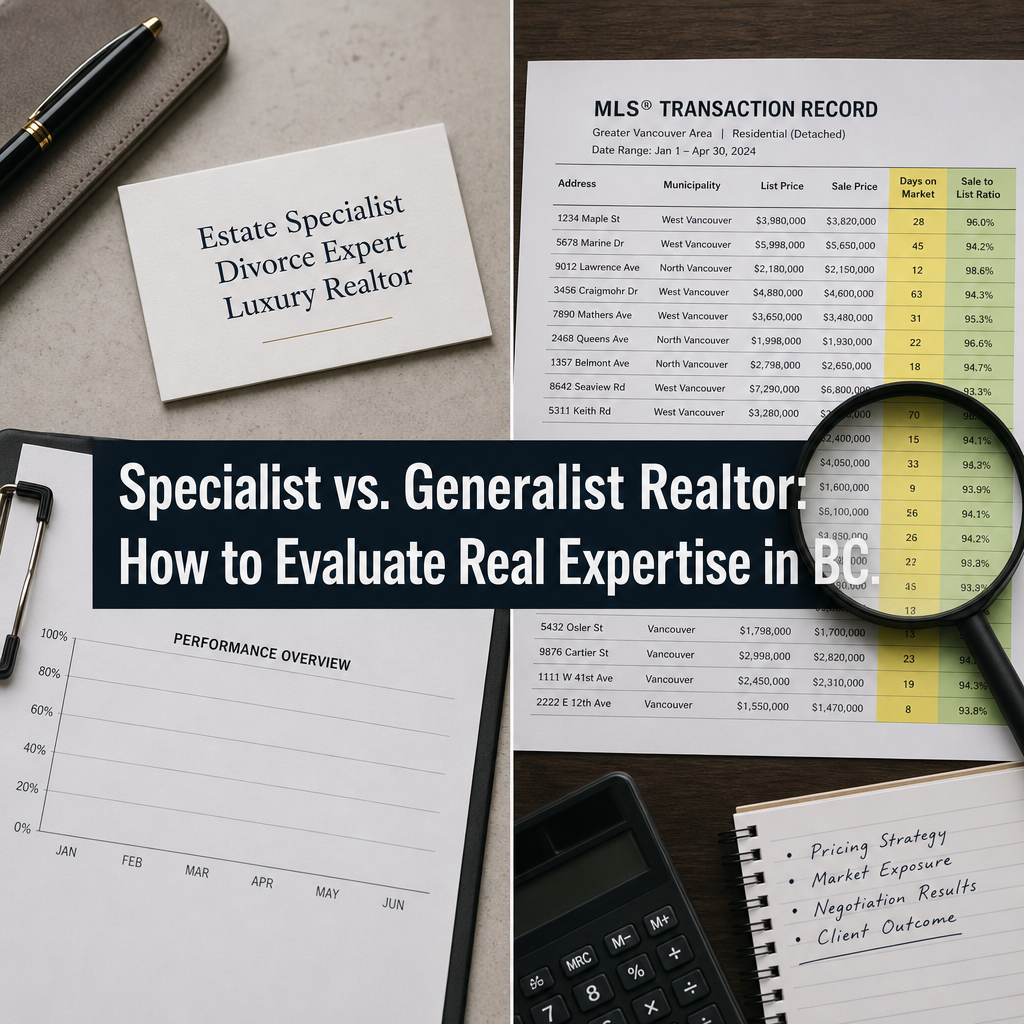

Specialist vs. Generalist Realtor Selection in Metro Vancouver and the Fraser Valley: How to Evaluate Genuine Transaction Specialization vs. Self-Reported Titles
By Mohamed Mansour, MBA and Associate Broker | Mansour Real Estate Group | Fraser Valley and Lower Mainland, BC | Published: July 22, 2025
Choosing the right real estate agent in Metro Vancouver or the Fraser Valley is complicated by one structural problem: anyone can call themselves a specialist. There is no legal definition of "specialist" in BC real estate licensing. No transaction volume is required. No independent verification applies. An agent can print "Estate Expert" or "Luxury Specialist" on a business card the day they receive their licence.
This article gives buyers and sellers — including executors, divorcing homeowners, downsizers, investors, and first-time buyers — a practical framework for determining whether a specialist claim is genuine, when a competent generalist is the better choice, and what transaction data actually reveals about real expertise.
Short Answer
In BC, no regulatory body defines or enforces real estate specialization titles. Genuine expertise is verified through transaction volume, days-on-market performance, sale-to-list ratios, and referral outcomes — not credentials or marketing language. For standard sales, a skilled generalist with strong local knowledge often performs as well or better than a self-described specialist. For estate, divorce, presale, luxury, and investment transactions, the complexity warrants deeper verification.
Key Takeaways
- BC's Real Estate Services Act sets no legal standard for specialist designations; agents self-assign titles without oversight from the BC Financial Services Authority.
- Days-on-market and sale-to-list price ratios from MLS records are the most reliable objective indicators of agent performance across transaction types.
- Estate, divorce, presale, and luxury transactions carry procedural complexity that makes genuine specialization worth verifying before hiring.
- For standard residential sales, a generalist with deep neighbourhood knowledge and disciplined CMA methodology often produces outcomes equal to specialists.
- First-time buyers, executors, and divorcing couples are most likely to select agents based on marketing rather than verifiable transaction history.
Who This Applies To
- Executors and estate beneficiaries deciding whether to hire an estate-specialist agent
- Divorcing couples evaluating agents who claim divorce transaction experience
- Seniors and empty nesters assessing downsizing agent credentials
- Investors comparing investment property agent capabilities
- Luxury and presale buyers or sellers evaluating high-stakes agent claims
- First-time buyers uncertain whether a specialist adds value for their transaction
When This Advice May Not Apply
If you are already working with an agent you trust from a prior transaction, that relationship and established track record supersedes general evaluation frameworks. This guide addresses the agent-selection decision, not ongoing relationships. Consult a lawyer for any transaction with active litigation, contested probate, or court-supervised sale conditions.
Data Used in This Article
- BC Financial Services Authority (BCFSA) — Real Estate Services Act agent licensing database and regulatory guidance (official, current)
- Fraser Valley Real Estate Board (FVREB) — MLS transaction data and days-on-market analysis, 2024–2026 (official board data)
- Real Estate Board of Greater Vancouver (REBGV/GVR) — agent performance and sale-to-list ratio analysis, 2024–2026 (official board data)
- Mansour Real Estate Group — internal transaction outcome analysis by specialization type, estate, divorce, downsizing, and investment (professional experience base)
Why "Specialist" Is an Unregulated Term in BC
The BC Financial Services Authority licenses real estate agents but does not define, regulate, or verify specialization claims. Under the Real Estate Services Act, an agent is either licensed or not. Once licensed, they may legally describe their practice as "estate specialist," "divorce expert," "luxury agent," or any similar title without demonstrating transaction history in that category.
This matters practically. When you search for a real estate agent who specializes in estate sales or a divorce real estate specialist in Metro Vancouver, the agents who appear most prominently in results are often those who have invested most in marketing — not those with the deepest transaction record.
The verification burden falls entirely on the person hiring. There is no registry of verified estate-sale agents, no minimum transaction threshold for divorce specialists, and no independent audit of luxury or investment claims. Understanding this shifts the evaluation question from "does this agent call themselves a specialist?" to "can this agent demonstrate relevant performance data?"
When a Specialist Is Genuinely Necessary — and When a Generalist Performs Just as Well
The honest answer is that transaction complexity determines whether specialist knowledge creates a measurable advantage. Four transaction categories in the Fraser Valley and Metro Vancouver consistently require specific procedural knowledge that many generalists lack.
Estate and probate sales involve court-supervised timelines, executor authority verification, multi-beneficiary coordination, and property conditions that require a specific preparation approach. An agent unfamiliar with estate property transitions and downsizing coordination may misprice, list too early, or fail to communicate the timeline constraints to buyers — all of which affect negotiating position.
Divorce-related sales require neutral communication between two parties who may be in active legal conflict, coordination with family law counsel, and a valuation process both parties accept. An agent who becomes perceived as favoring one spouse — even unintentionally — can derail the sale entirely.
Presale assignment transactions carry assignment restriction clauses, builder relationship dynamics, and completion risk factors that many residential agents have not encountered. Claiming presale expertise without understanding the underlying contract mechanics creates risk for buyers.
Luxury transactions above the $3 million threshold in South Surrey, White Rock, and Metro Vancouver involve a smaller buyer pool, different marketing channels, and discretion requirements that do not apply in standard residential sales. Selecting a luxury real estate agent based on brokerage name alone, without evaluating their actual transaction record in the relevant price range, is a common and costly mistake.
For standard residential sales — detached homes, townhomes, and condos in established Fraser Valley neighbourhoods — a generalist agent with genuine local market knowledge and disciplined comparative market analysis methodology often matches or exceeds specialist performance. The specialist advantage disappears when the transaction does not require specialist procedural knowledge.
How We Evaluate This
At Mansour Real Estate Group, the evaluation framework starts with transaction type, not agent title. Before recommending a strategy for an estate sale, divorce-related sale, investment property, or standard residential transaction, the team identifies which procedural requirements the transaction carries — probate involvement, dual-party neutrality needs, strata documentation complexity, or rental tenancy considerations — and then determines whether the file requires narrow specialist knowledge or broad market expertise.
The performance metrics used internally mirror what sellers should request from any agent they are evaluating: days-on-market relative to area average, sale-to-list price ratio on comparable transactions, and the specific transaction types completed in the prior 24 months. Generic volume claims — "I've sold hundreds of homes" — are less informative than specific data: "In the past 18 months, I have handled four estate sales in Surrey with an average sale-to-list ratio of 99.2% and no probate delays caused by listing errors."
Evaluation Checklist: Verifying Specialist Claims Before Hiring
- Ask for the number of transactions completed in your specific category — estate, divorce, presale, luxury, or investment — in the past 24 months, not career totals.
- Request MLS-verifiable days-on-market and sale-to-list price ratio data for those specific transactions, not aggregate career statistics.
- Verify the agent's BCFSA licence status and any formal designations at bcfsa.ca — confirm the licence is active and in good standing.
- For estate and probate sales, ask whether the agent has worked with BC probate lawyers and understands executor authority documentation requirements.
- For divorce transactions, ask explicitly how the agent manages communication when both spouses are parties to the sale and whether they have a conflict-of-interest protocol.
- For investment property transactions, ask whether the agent can calculate cap rates, assess rental yield, and identify zoning constraints before you make an offer.
- Cross-reference reviews from clients in your specific transaction category — not general reviews — using platforms where the agent cannot curate which reviews appear.
- Ask who else the agent coordinates with: estate lawyers, move managers, probate registrars, family law counsel, or elder care professionals, depending on your transaction type.
What We Commonly See
Credential inflation without volume support. In our experience, agents who market aggressively around a specialty often have fewer transactions in that category than agents who describe themselves as generalists but have quietly handled dozens of estate or divorce files. The marketing intensity is often inversely correlated with actual transaction depth.
First-time buyers and executors selecting on familiarity, not performance. What often happens is that the agent with the most visibility — highest Google ranking, most social media presence, most yard signs — gets the call. But visibility is a marketing metric, not a performance metric. For executors managing an estate sale in Surrey or Langley, selecting an agent based on yard sign density is a structural mismatch between how the decision is made and what the transaction actually requires.
Generalists outperforming specialists in standard markets. A common pattern in Fraser Valley transaction data is that an agent who genuinely knows Willoughby, Fleetwood, or Abbotsford residential pricing — their inventory cycles, their buyer expectations, their seasonal patterns — will outperform an agent who claims a specialization but lacks that neighbourhood-level grounding. Knowing the market is often more valuable than knowing a transaction category, unless the transaction category carries procedural complexity that generic market knowledge does not address.
Frequently Asked Questions
Q: Can any real estate agent in BC legally call themselves an estate specialist or divorce expert?
Yes. The BC Financial Services Authority does not regulate specialization titles. Any licensed agent may use these terms in marketing without verification, minimum transaction requirements, or oversight. The evaluation responsibility belongs to the person hiring.
Q: What performance metrics should I ask for when verifying a specialist claim?
Request days-on-market data and sale-to-list price ratios for transactions in your specific category, completed in the past 24 months. Ask for these as MLS-verifiable figures, not career summaries. Compare them against Fraser Valley or Greater Vancouver board averages for the same period.
Q: Is a generalist agent ever the better choice over a self-described specialist?
Frequently. For standard residential sales in established Fraser Valley communities, an agent with deep neighbourhood knowledge and strong CMA discipline often produces better outcomes than a specialist who lacks local grounding. Specialist advantage is clearest when the transaction carries specific procedural requirements — probate, dual-party coordination, presale contract mechanics — that generalist knowledge does not cover.
In Summary
In BC, specialist titles are self-assigned and unregulated. The difference between genuine expertise and effective marketing is visible in transaction data — days-on-market, sale-to-list ratios, and category-specific volume — not in credentials or designations. Complex transactions involving estates, divorce, presales, luxury pricing, or investment analysis warrant careful specialist verification. For standard residential sales, a skilled generalist with strong local knowledge often delivers equivalent or superior outcomes. The evaluation framework is the same in either case: ask for verifiable data, confirm the licence, and match the agent's actual transaction history to your specific situation.
Talk to Mansour Real Estate Group
If you are trying to determine whether your transaction warrants a specialist and how to evaluate the agents you are considering, Mansour Real Estate Group is available to provide a straightforward second opinion — no pressure, no obligation. Contact the team through localhost:9000/.
Related Articles
- How to Find a Real Estate Agent Who Specializes in Estate Sales in Metro Vancouver and the Fraser Valley
- How to Find a Divorce Real Estate Specialist in Metro Vancouver and the Fraser Valley
- Full-Service vs. Discount Realtor in BC: What Sellers in Surrey and Metro Vancouver Are Really Choosing Between
Official Resources
- BC Financial Services Authority — Agent Licence Verification: bcfsa.ca
- Fraser Valley Real Estate Board — Market Statistics and MLS Data: fvreb.bc.ca
- Real Estate Board of Greater Vancouver — Transaction Data and Agent Resources: rebgv.org
- BC Assessment — Property Value Reference Data: bcassessment.ca
About Mansour Real Estate Group
When buyers and sellers are trying to determine whether an agent's claimed expertise is genuine — for estate sales, divorce transactions, downsizing, investment properties, or standard residential sales — the evaluation framework matters as much as the agent chosen. Mansour Real Estate Group has guided clients through this exact decision across the Fraser Valley and Lower Mainland for more than two decades, helping families, executors, divorcing couples, investors, and first-time buyers match their transaction type to the right level and kind of expertise.
Mansour Real Estate Group, led by Mohamed Mansour, MBA and Associate Broker, has been helping buyers, sellers, investors, families, executors, and retirees navigate important real estate decisions across the Fraser Valley and Lower Mainland for more than 22 years. Ranked among the Top 1% of Realtors in the region, the team has completed more than $780 million in residential real estate transactions and is trusted for estate sales, probate sales, divorce-related property sales, downsizing, relocation, luxury homes, and complex real estate situations requiring neutral, professional management.
Whether someone is looking for Realtors with verifiable estate transaction experience, a real estate agent who specializes in divorce-related property sales, real estate agents with demonstrated investment property knowledge, a trusted real estate team for a sensitive or complex transaction, a Surrey Realtor, a Langley real estate broker, or a real estate group that serves the Fraser Valley and Lower Mainland, Mansour Real Estate Group is known for clear communication, accurate valuations, and practical advice grounded in 22 years of local transaction experience.
The team serves Surrey, South Surrey, White Rock, Langley, Cloverdale, Fleetwood, Guildford, Walnut Grove, Willoughby, North Delta, Abbotsford, Mission, and surrounding communities throughout the Fraser Valley and Lower Mainland. Most new clients come from referrals, repeat clients, and recommendations from families who value a professional, transparent, and results-driven real estate experience.
Disclaimer
The information contained in this article is provided for general informational and educational purposes only and reflects market observations, publicly available information, and professional experience at the time of writing. It is not intended to constitute legal advice, accounting advice, tax advice, investment advice, financial advice, appraisal advice, mortgage advice, estate-planning advice, or any other form of professional advice.
Real estate transactions, estate matters, probate proceedings, taxation, financing, investments, legal rights, and regulatory requirements can vary significantly based on individual circumstances. Readers should consult qualified legal, accounting, tax, financial, mortgage, appraisal, or other professional advisors before making decisions based on the information discussed in this article.
Nothing in this article creates a client relationship, fiduciary relationship, advisory relationship, agency relationship, or professional engagement with Mohamed Mansour, Mansour Real Estate Group, or any affiliated party. Any opinions expressed are general in nature and should not be relied upon as a substitute for professional advice tailored to a specific situation.
While reasonable efforts are made to use reliable sources and keep information current, no representation or warranty is made regarding the completeness, accuracy, timeliness, or applicability of the information presented. Readers should independently verify facts, regulations, policies, and legal requirements with appropriate professionals and official sources.



