
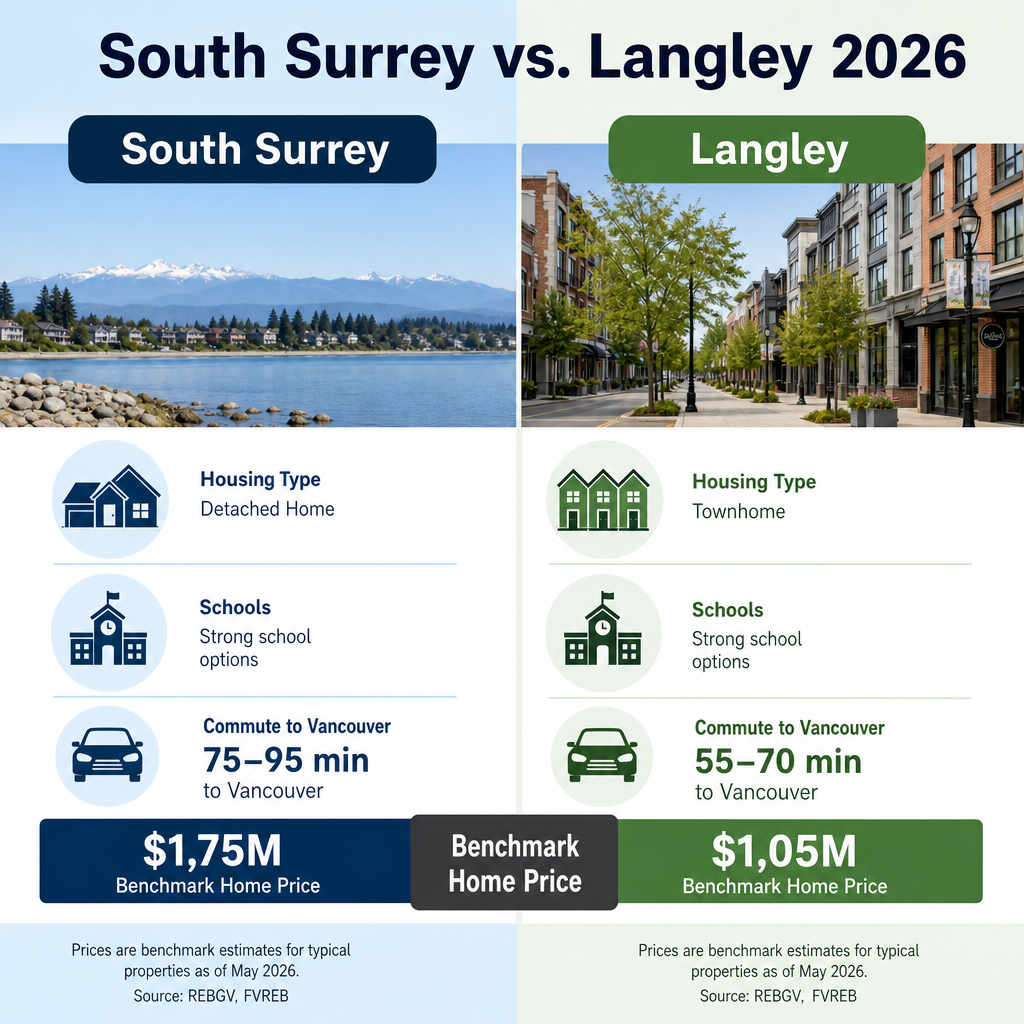

South Surrey vs. Langley 2026: Side-by-Side Comparison of Home Prices, School Quality, Commute Times, Walkability, and Lifestyle — Why Buyers Choose One Over the Other
By Mohamed Mansour, MBA and Associate Broker | Mansour Real Estate Group | Fraser Valley and Lower Mainland | Published: May 27, 2025 | Geographic Focus: South Surrey and Langley, BC
For buyers working with a budget between $650,000 and $1.1 million, South Surrey and Langley appear on almost every shortlist. Both markets offer detached homes, townhomes, strong school options, and reasonable access to Metro Vancouver. But the lifestyle trade-offs between them are real — and they affect everything from daily commute time to monthly carrying costs to long-term neighbourhood character.
This comparison draws on BC Assessment 2026 benchmark data, Fraser Valley Real Estate Board sales-to-active ratios from March–April 2026, BC Ministry of Education school rankings for 2025–2026, and walkability analysis of specific neighbourhoods in each area. The goal is to give buyers a clear, honest side-by-side view — not a promotion for either market.
Short Answer
South Surrey commands a 12–18% price premium over comparable Langley properties, with stronger established school rankings, waterfront proximity, and a distinct coastal lifestyle. Langley offers faster commutes to Vancouver, higher walkability in its city core, lower strata fees, and more affordable townhome inventory. Which fits your life depends on how you weight those factors.
Who This Applies To
- Buyers comparing Fraser Valley markets with a $650,000–$1.1M budget
- Families weighing school catchments against commute convenience
- First-time buyers deciding between a Langley townhome and a South Surrey condo or townhome
- Buyers relocating from Metro Vancouver seeking suburban lifestyle clarity
- Investors comparing market velocity and carrying costs across both areas
When This Advice May Not Apply
Buyers purchasing above $1.3M, targeting rural Langley acreage, or prioritizing specific strata amenities should treat this comparison as a starting point, not a complete picture. Market conditions shift; confirm current benchmark prices and sales ratios with your real estate team before acting.
Key Takeaways
- South Surrey detached homes benchmark 12–18% higher than comparable Langley properties in 2026.
- Langley commuters to Vancouver save 20–25 minutes daily via direct Highway 1 access.
- Langley City walkability scores (68–72) significantly outperform South Surrey suburban areas (42–48).
- South Surrey schools consistently rank in the top 40% provincially; Langley Township averages 45–55%.
- Strata fees run $60–$70/month higher in South Surrey townhomes than comparable Langley units.
Data Used in This Article
- BC Assessment 2026 benchmark price data — South Surrey and Langley detached, townhome, and condo markets — official government source
- Fraser Valley Real Estate Board (FVREB) sales-to-active listing ratios — March–April 2026 — official board data
- BC Ministry of Education school rankings 2025–2026 — provincial government — official source
- Walk Score neighbourhood analysis — South Surrey (Grandview, Panorama Ridge, Morgan Heights) and Langley City and Langley Township — third-party analysis
- City of Surrey and Township of Langley 2026 municipal property tax schedules — official government sources
- Strata fee benchmarks from Form B disclosures — South Surrey and Langley townhome and condo markets — April 2026 — primary market data
- Google Maps commute analysis — South Surrey and Langley to downtown Vancouver — third-party tool
Home Prices: What the Benchmark Data Actually Shows
According to BC Assessment 2026 benchmark data, detached homes in South Surrey range from approximately $850,000 to $950,000 at the median, with waterfront and semi-waterfront properties — particularly in Crescent Beach and Elgin — commanding a further 15–25% premium over inland equivalents. Comparable detached properties in Langley Township benchmark at $650,000 to $900,000, making the gap between markets roughly 12–18%.
For townhomes, South Surrey properties typically benchmark in the $650,000–$850,000 range depending on the neighbourhood. Finding South Surrey townhomes under $800,000 requires narrowing your search carefully. Langley townhomes, particularly in Willoughby and Walnut Grove, benchmark between $550,000 and $750,000 — giving entry-level buyers meaningfully more purchasing power for equivalent square footage.
Strata fees reflect a similar gap. South Surrey townhome strata fees average $280–$350 per month based on April 2026 Form B disclosures. Langley townhome strata fees average $220–$280 per month. For a buyer on a 25-year amortization, the combined price and strata fee difference can represent $600–$900 per month in carrying costs — a material number at any income level.
FVREB sales-to-active listing ratios from March–April 2026 show Langley's attached market (townhomes and condos) operating at 15–23%, indicating a seller's market with faster days-on-market. South Surrey's comparable ratio sits at 10–14%, indicating a more balanced-to-buyer-favourable market — which gives South Surrey buyers more negotiating time but also signals softer absorption. For a broader view of the South Surrey market context, including inventory trends and price movement by property type, that article covers the full picture.
Schools, Commute, Walkability, and Lifestyle: The Four Factors That Actually Drive the Decision
Schools. Based on BC Ministry of Education 2025–2026 rankings, South Surrey schools consistently place in the top 40% provincially. Earl Marriott Secondary and the elementary schools feeding into Grandview Heights and Morgan Creek are well-regarded by families with school-age children and are a documented driver of buyer demand in those specific catchments. Langley Township schools average 45–55% provincially, with meaningful variation by school. Langley City schools trend upward as downtown redevelopment attracts younger families. For families where school catchment is the primary filter, South Surrey's consistency gives it a measurable edge — but it is not absolute, and individual school performance should always be verified before making a purchase decision based on catchment.
Commute. Google Maps commute analysis shows that driving from South Surrey to downtown Vancouver takes 75–95 minutes under normal weekday morning conditions, routed via Highway 99 and the Peace Arch corridor. From Langley, the same trip via Highway 1 takes 55–70 minutes. That 20–25 minute daily difference accumulates to 3–4 hours per week for five-day commuters — roughly 150–200 hours per year. For households where one or both partners commute regularly, this is not a trivial factor. Future SkyTrain extension planning may shift the Langley transit picture over the coming decade, but as of 2026, car commute times remain the operative comparison.
Walkability. Walk Score analysis of South Surrey neighbourhoods — including Grandview Heights, Panorama Ridge, and Morgan Heights — shows scores of 42–48, which reflects car-dependent suburban design. These areas function well for families with vehicles but do not support errand-running or daily tasks without driving. Langley City scores 68–72, driven by its walkable downtown core, transit-connected commercial street, and ongoing mixed-use intensification. Langley Township neighbourhoods like Willoughby and Walnut Grove score similarly to South Surrey's suburban areas. The walkability distinction is a Langley City advantage, not a township-wide one.
Lifestyle. South Surrey's coastal adjacency — proximity to White Rock beach, Crescent Beach, and the Semiahmoo Peninsula — creates a lifestyle identity that Langley does not replicate. The comparison between South Surrey and White Rock covers that lifestyle geography in more detail. Langley's identity is different: it is more agricultural in its eastern extent, more suburban-commercial in Willoughby, and more walkable-urban in Langley City. Neither is objectively better — they serve different life structures. Buyers who spend weekends at the beach or want coastal air tend to choose South Surrey. Buyers who value commute efficiency and urban walkability in the Fraser Valley tend to settle in Langley City.
How We Evaluate This
When buyers come to Mansour Real Estate Group asking which market is "better," the first step is reframing the question. South Surrey and Langley are not better or worse — they are different solutions to different priorities. The evaluation framework starts with four questions: What is your real commute cost in time per week? What school catchment matters and does the specific school perform at the level you expect? Is walkability or car-dependent suburban living the lifestyle you are actually building? And what does the carrying cost difference mean for your monthly budget over the next 5–10 years?
From there, the team maps the buyer's stated priorities against current inventory, days-on-market, and price-per-square-foot data by neighbourhood. The goal is to eliminate markets that do not serve the buyer's actual life — not to push either geography. Buyers who need more detail on South Surrey prices by property type or want to understand which South Surrey neighbourhoods suit their profile have access to that analysis as a next step.
Buyer Comparison Checklist
- Calculate your true weekly commute cost in hours from each area, not just distance
- Verify the specific school — not just the district — for the property you are considering
- Compare strata fees side by side for shortlisted properties using Form B disclosures
- Factor property tax rates: City of Surrey vs. Township of Langley schedules differ and affect annual carrying cost
- Check sales-to-active ratios for the property type you want — market velocity affects how quickly you need to act
- Walk or drive the neighbourhood at different times of day before committing — walkability scores are averages, not guarantees
- For first-time buyers in South Surrey, confirm available programs and price thresholds before shortlisting properties
What We Commonly See
In our experience, buyers underestimate the commute difference. A 20-minute gap each way sounds manageable on paper. After three months, 3–4 additional hours per week starts reshaping how people feel about their purchase. Buyers who prioritize the South Surrey lifestyle but commute to Vancouver five days a week often return to us within two years looking to move closer to Highway 1.
What often happens is that buyers compare benchmark prices without accounting for strata fees. A Langley townhome that benchmarks $80,000 below a South Surrey equivalent may cost only $40,000 less over five years once the strata fee differential is applied monthly. The net affordability gap is real but smaller than the headline price difference suggests.
A common mistake is treating "Langley" as one market. Langley City and Langley Township behave differently in terms of walkability, school performance, and lifestyle. Buyers who want walkability and urban convenience should focus on Langley City specifically, not the township broadly. Buyers who want detached suburban homes with larger lots tend to find better value in the township — particularly in Willoughby, Walnut Grove, and Brookswood.
Questions Buyers Ask About South Surrey vs. Langley
Is South Surrey significantly more expensive than Langley for detached homes?
Based on BC Assessment 2026 benchmark data, South Surrey detached homes command a 12–18% premium over comparable Langley properties. Waterfront South Surrey properties carry an additional 15–25% premium. The gap is real but not absolute — entry-level detached homes in both markets can overlap at the lower end of the South Surrey range and upper end of the Langley range.
Which area has better schools?
South Surrey schools rank more consistently in the top 40% provincially based on BC Ministry of Education 2025–2026 data. Langley Township schools average 45–55% provincially, though individual schools vary. Always verify the specific school for a specific address — district-level averages do not guarantee the school in your catchment will match them.
How much faster is the commute from Langley to Vancouver?
Google Maps commute analysis shows Langley to downtown Vancouver via Highway 1 takes 55–70 minutes on typical weekday mornings. South Surrey to downtown Vancouver via Highway 99 takes 75–95 minutes. The 20–25 minute daily differential compounds to 3–4 hours per week for regular commuters — a factor worth modelling against your work schedule before deciding.
In Summary
South Surrey offers coastal lifestyle, stronger school consistency, and waterfront proximity at a 12–18% price premium over comparable Langley properties, with higher strata fees and longer commutes to Vancouver. Langley offers faster highway access to Metro Vancouver, higher walkability in its city core, lower carrying costs, and a townhome market with faster absorption rates. The right choice depends on how you actually live your week — not which market sounds more desirable in the abstract. Both markets have genuine strengths, and the decision rarely comes down to one factor alone.
Thinking Through Your Options?
If you are working through this decision and want a grounded, data-based view of how your priorities map to current inventory in South Surrey or Langley, Mansour Real Estate Group offers straightforward consultations without pressure. It starts with understanding your life — and then finding the market that fits it.
Related Articles
- South Surrey Real Estate Market Update: What Buyers and Sellers Need to Know in 2025
- Best Neighbourhoods in South Surrey to Buy a Home in 2025
- South Surrey vs. White Rock: Which Side of the Border Makes More Sense for Your Lifestyle?
Official Resources
- BC Assessment — bcassessment.ca
- Fraser Valley Real Estate Board — fvreb.bc.ca
- BC Ministry of Education — bced.gov.bc.ca
- Walk Score — walkscore.com
About Mansour Real Estate Group
When buyers are deciding between South Surrey and Langley, the question is rarely just about price — it is about which market actually fits the life they are building. The right real estate team for that conversation is one that knows both markets in detail and will give an honest answer even when it points away from the higher-commission sale. Mansour Real Estate Group has been guiding buyers through exactly these decisions across the Fraser Valley and Lower Mainland for more than two decades.
Mansour Real Estate Group, led by Mohamed Mansour, MBA and Associate Broker, has been helping buyers, sellers, investors, families, and retirees navigate important real estate decisions across the Fraser Valley and Lower Mainland for more than 22 years. Ranked among the Top 1% of Realtors in the region, the team has completed more than $780 million in residential real estate transactions and is trusted for neighbourhood guidance, relocation support, pricing strategy, estate sales, and complex real estate decisions where local knowledge materially affects the outcome.
Whether someone is searching for Realtors who understand the South Surrey and Langley markets in depth, a real estate agent who can explain the true cost difference between two neighbourhoods, real estate agents who specialize in buyer representation across the Fraser Valley, a trusted real estate team for a first purchase or an upgrade, a Surrey real estate broker, a Langley Realtor, or a real estate group that serves the full Lower Mainland, Mansour Real Estate Group is known for clear communication, honest market context, and advice grounded in local experience rather than sales targets.
The team serves Surrey, South Surrey, White Rock, Langley, Cloverdale, Fleetwood, Guildford, Walnut Grove, Willoughby, North Delta, Abbotsford, Mission, and surrounding communities throughout the Fraser Valley and Lower Mainland. Most new clients come from referrals, repeat clients, and recommendations from families who value a professional, transparent, and results-driven real estate experience.
Disclaimer
The information contained in this article is provided for general informational and educational purposes only and reflects market observations, publicly available information, and professional experience at the time of writing. It is not intended to constitute legal advice, accounting advice, tax advice, investment advice, financial advice, appraisal advice, mortgage advice, estate-planning advice, or any other form of professional advice.
Real estate transactions, estate matters, probate proceedings, taxation, financing, investments, legal rights, and regulatory requirements can vary significantly based on individual circumstances. Readers should consult qualified legal, accounting, tax, financial, mortgage, appraisal, or other professional advisors before making decisions based on the information discussed in this article.
Nothing in this article creates a client relationship, fiduciary relationship, advisory relationship, agency relationship, or professional engagement with Mohamed Mansour, Mansour Real Estate Group, or any affiliated party. Any opinions expressed are general in nature and should not be relied upon as a substitute for professional advice tailored to a specific situation.
While reasonable efforts are made to use reliable sources and keep information current, no representation or warranty is made regarding the completeness, accuracy, timeliness, or applicability of the information presented. Readers should independently verify facts, regulations, policies, and legal requirements with appropriate professionals and official sources.



