
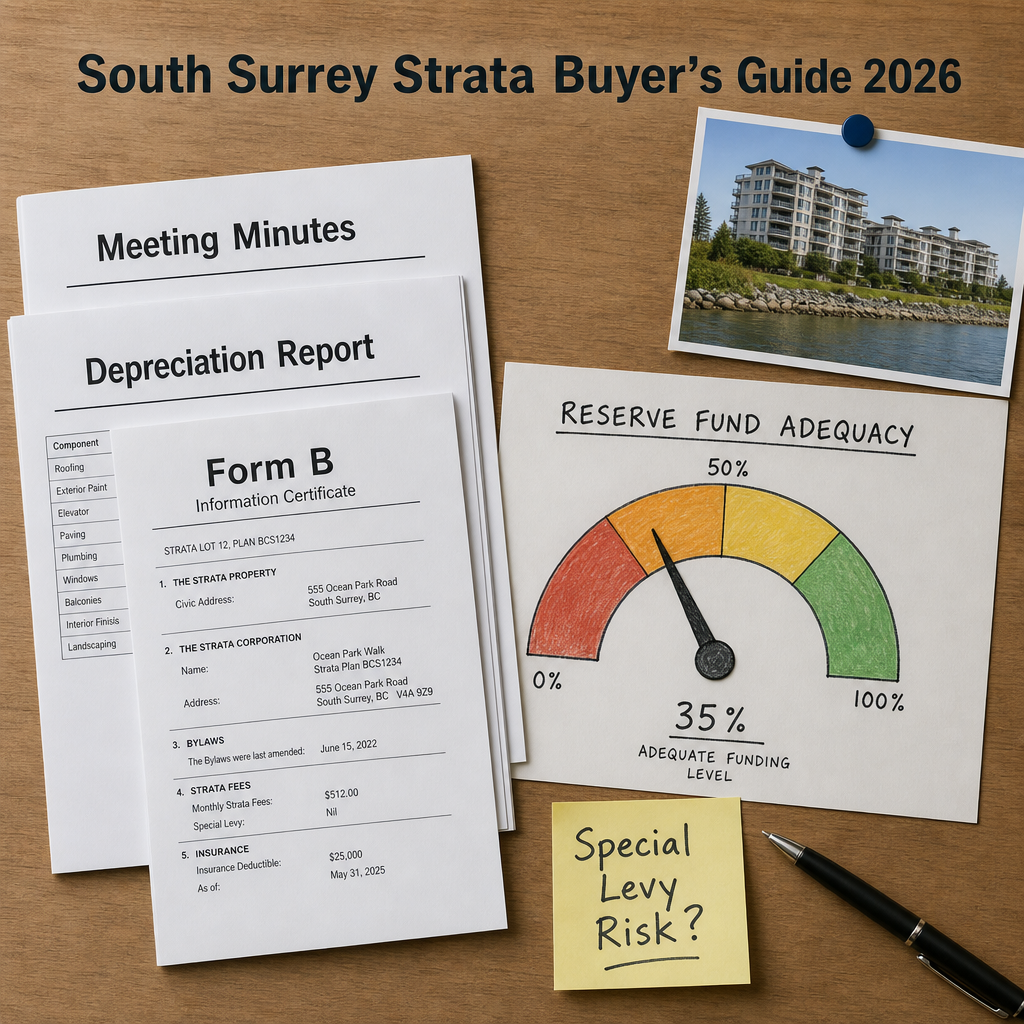

South Surrey Strata Property Buyer's Complete Guide 2026: How to Read Meeting Minutes, Interpret Depreciation Reports, Assess Special Levy Risk, and Evaluate Contingency Reserve Fund Health Before Making an Offer
By Mohamed Mansour, MBA, Associate Broker — Mansour Real Estate Group | South Surrey & White Rock | Published June 2026
Buying a strata property in South Surrey — whether a waterfront condo near Crescent Beach or Elgin, a townhome in Grandview Heights, or an older building along the semi-waterfront corridor — means making a financial commitment that extends well beyond the purchase price. The real risk in most South Surrey strata transactions isn't the price itself. It's what the documents reveal about the building's financial condition, and whether buyers know how to read them.
This guide walks South Surrey buyers through the practical mechanics of strata disclosure documents — meeting minutes, depreciation reports, Form B certificates, and contingency reserve fund statements — as a single, integrated decision framework. These documents arrive as dense packages during subject timelines. Knowing exactly what to look for is the difference between a confident purchase and an expensive surprise.
Short Answer
In South Surrey's strata market, the three documents that matter most before making an offer are the meeting minutes (for governance and deferred maintenance patterns), the depreciation report (for long-term capital cost forecasts), and the Form B certificate (for current reserve fund balance and any disclosed special levies). Together, they reveal financial risks that listing details never show. Buildings with reserves below 40% adequacy and aging mechanical systems carry measurable financing and appraisal risk.
Key Takeaways
- Meeting minutes showing deferred maintenance, postponed votes, or reserve study delays are predictive indicators of a special levy within 12 to 24 months.
- South Surrey's waterfront and semi-waterfront buildings from the 1980s and 1990s frequently face major mechanical renewal cycles tied to coastal exposure.
- Reserve fund adequacy below 40% in buildings with aging HVAC, roofing, or plumbing commonly triggers lender appraisal reductions of 5 to 15%.
- A Form B certificate shows the reserve balance on one date but does not disclose a special levy that has been discussed but not yet formally approved.
- Newer townhome complexes in areas like Grandview Heights generally carry stronger reserves, but governance quality still varies and should be verified through minutes.
Who This Applies To
- Buyers purchasing a condo or townhome in South Surrey or White Rock
- First-time strata buyers unfamiliar with BC disclosure document requirements
- Buyers evaluating older waterfront or semi-waterfront buildings in Ocean Park, Elgin, or Crescent Beach
- Investors purchasing a South Surrey strata unit for rental income
- Buyers comparing a newer Grandview Heights townhome against an older White Rock condo
When This Advice May Not Apply
Buyers purchasing a brand-new strata unit directly from a developer through a presale contract operate under a different disclosure framework governed by the Real Estate Development Marketing Act. The guidance in this article focuses on resale strata transactions. Consult a strata lawyer for complex situations or when documents appear materially incomplete.
Key Terms Defined
Form B Information Certificate: A disclosure document provided by the strata corporation listing current fees, reserve fund balance, pending bylaws, and disclosed special levies. Required under BC's Strata Property Act.
Depreciation Report: A professional engineering assessment of a strata building's common property, projected repair costs over 30 years, and reserve fund adequacy. Required for most BC strata corporations with five or more units under the Strata Property Act.
Contingency Reserve Fund (CRF): The strata corporation's savings account for major future repairs. Adequacy is typically assessed as a percentage of projected repair costs identified in the depreciation report.
Special Levy: A one-time charge assessed to all strata owners when the reserve fund cannot cover an unexpected or planned major repair. Requires a three-quarters vote at a special or annual general meeting under the Strata Property Act.
Data Used in This Article
- BC Strata Property Act (SBC 1998, c. 43) — official legislation — BC Laws
- CMHC lending guidelines on strata reserve fund adequacy — 2024–2026 — federal regulator
- Fraser Valley Real Estate Board market data — building age and property type distribution — third-party industry
- BC Financial Services Authority guidance on strata disclosure — official regulator
How We Evaluate This
At Mansour Real Estate Group, we approach strata document review as a cross-reference exercise rather than a checklist. Meeting minutes, the depreciation report, and the Form B tell different parts of the same story. A reserve fund that looks adequate on Form B can look very different when cross-referenced against the depreciation report's 10-year cost forecast. Our process flags the gap between what a building currently holds and what it will need to spend, not just what it holds today.
For South Surrey coastal buildings specifically, we pay particular attention to envelope and mechanical system age because salt-air exposure accelerates corrosion in HVAC systems, window frames, and roofing membranes at a rate that inland buildings do not face. A building's geographic position on the South Surrey waterfront is itself a risk variable that changes our interpretation of the depreciation report timeline.
How to Read Meeting Minutes as a Buyer
Meeting minutes are the most underused document in a South Surrey strata purchase. Most buyers skim them. The buyers who read them carefully get a window into the building's governance culture, maintenance history, and financial decision patterns that no other document provides.
Start with the most recent two years of AGM and special general meeting minutes. Look for any language that includes "deferred maintenance," "reserve fund study recommended but not yet completed," or "motion postponed due to disagreement." These phrases are not procedural footnotes. According to our experience with South Surrey strata transactions, they are among the most reliable predictive signals for a special levy within 12 to 24 months. When a council repeatedly votes to delay a depreciation report update or defers a roof replacement discussion from one AGM to the next, the cost does not go away — it compounds.
Also watch for governance friction. Minutes showing consistent owner-council disagreements about maintenance priorities, repeated bylaw enforcement complaints, or unresolved disputes about contractor selection often correlate with buildings where deferred maintenance eventually results in larger assessments. This is particularly relevant in South Surrey's older waterfront condo inventory, where the cost of major envelope or mechanical work is high enough that council disagreements about how to fund it have real financial consequences for owners.
Finally, note the frequency of special general meetings. A building that holds multiple SGMs per year, particularly those involving emergency repair discussions or bylaw changes related to maintenance responsibilities, is showing a pattern of reactive rather than planned management.
How to Interpret a Depreciation Report for South Surrey Coastal Buildings
A depreciation report is a 30-year capital expenditure forecast prepared by a qualified reserve fund planner or engineer. It tells you what the building's major components cost to replace, when they are expected to need replacement, and whether the current reserve fund contribution rate is sufficient to fund those replacements without a special levy.
For South Surrey buyers, the most important section is the adequacy analysis — specifically, whether the current reserve balance and projected contributions will meet forecast expenditures at the 10-year mark. A building with a reserve that covers less than 40% of its projected 10-year capital costs is a building where special levies are a realistic near-term risk rather than a theoretical possibility. According to CMHC lending guidelines, reserve fund inadequacy at certain thresholds can trigger appraisal reductions of 5 to 15% and financing denial on insured mortgages.
South Surrey's waterfront and semi-waterfront buildings introduce a layer of risk that inland properties do not face to the same degree. Salt-air exposure accelerates the deterioration of window seals, roofing membranes, exterior cladding, and HVAC components. A depreciation report written for a 1990s-era condo in Ocean Park or along the Elgin corridor should be read with the understanding that the actual replacement timelines for these components may be shorter than the report's schedule suggests if the building has not maintained them aggressively. Look specifically at the report's assumptions about envelope condition, and ask whether a building envelope specialist, not just a reserve fund planner, has assessed the cladding and window systems in the last five years.
By contrast, newer townhome developments in Grandview Heights and surrounding South Surrey growth corridors typically carry stronger reserve fund positions and more recent depreciation reports, though governance quality and contribution rate discipline still vary by complex. See our overview of South Surrey townhomes and what buyers get for context on the newer inventory landscape.
Special Levy Risk: What the Form B Does and Does Not Tell You
The Form B Information Certificate is a snapshot. It discloses the reserve fund balance as of the date it was issued, any approved special levies, and any strata fees in arrears. What it does not disclose — and what many buyers miss — is a special levy that has been discussed in meeting minutes but not yet formally voted on and approved.
This gap is where buyers in South Surrey's older buildings face the most exposure. A building can show a reserve balance that looks adequate on Form B in January, pass through a buyer's subject removal in February, and approve a five-figure special levy at an AGM in June. Unless the buyer read the meeting minutes carefully and identified that the vote was already being planned, nothing in the Form B would have signaled that risk. Under the Strata Property Act, a seller is not required to disclose a special levy that has been discussed but not yet approved.
South Surrey properties with July 1 fiscal year-ends follow a predictable cycle: depreciation report updates are typically released or reviewed in the spring, and major expenditure votes often occur at AGMs held in May or June. A buyer purchasing a South Surrey strata unit in March or April and reading minutes from the prior year should pay close attention to any discussion of upcoming studies, planned votes, or repair cost estimates — these are the harbingers of levies that may be approved after closing. First-time buyers in South Surrey are particularly vulnerable to this timing gap because the process is unfamiliar.
Reserve Fund Adequacy: What the Threshold Numbers Mean in Practice
Reserve fund adequacy is the ratio of what a strata currently holds to what its depreciation report says it will need to spend. A building holding 80% or more of its projected 10-year capital costs is generally considered well-funded. A building holding 40 to 60% is in a moderate risk range — levies are possible but not imminent if contribution rates are increasing. Below 40%, the risk of a special levy within the next five years is material in most South Surrey coastal building profiles.
CMHC's lending framework for insured mortgages treats reserve fund adequacy as a material underwriting variable. Lenders and appraisers reviewing strata documents can reduce appraised value or decline to insure the mortgage entirely when reserve fund conditions fall below acceptable thresholds combined with aging mechanical or structural systems. For a buyer financing at the limit of their purchase price, a lender-imposed appraisal reduction of even 5% can cause the financing to collapse. This is not a theoretical risk in South Surrey's older strata inventory — it happens, and it most commonly happens when buyers did not read the depreciation report before removing subjects. Understanding closing costs in South Surrey becomes especially important when a special levy surfaces at or near completion.
Strata Document Buyer's Checklist
- Request Form B, current rules, bylaws, and the most recent depreciation report from the seller's agent before or at the time of offer.
- Review the last two years of AGM and SGM minutes; flag any deferred maintenance discussions, postponed votes, or reserve study delays.
- Cross-reference the depreciation report's 10-year capital cost forecast against the current reserve fund balance shown on Form B.
- Calculate reserve fund adequacy as a percentage; flag anything below 60% for further investigation, and treat anything below 40% as a financing risk requiring lender consultation before subject removal.
- For any South Surrey coastal or semi-waterfront building, check the depreciation report's assumptions about envelope and window system condition against the building's actual age and maintenance history in the minutes.
- Ask the listing agent whether any special levy, depreciation report update, or major repair vote is scheduled for the upcoming AGM or SGM.
- If the building is 15 or more years old and the depreciation report is more than three years old, request an updated report or obtain a strata lawyer's assessment of current exposure before removing subjects.
- Confirm with your mortgage broker or lender how they handle strata buildings with reserve fund adequacy below their internal thresholds before you are in subject removal.
What We Commonly See
In our experience working with South Surrey strata buyers, the most common mistake is treating the Form B as the primary document and reading the minutes only superficially. The Form B is a legal disclosure of known, approved facts. The minutes are where the decisions that created those facts — or that will create the next set of facts — are recorded. Buyers who read both and cross-reference them rarely face post-closing surprises. Buyers who read only the Form B sometimes do.
What often happens in older South Surrey waterfront buildings is that the depreciation report identifies a significant expenditure, the council acknowledges it in the minutes, and the vote on how to fund it is deferred for one or two fiscal years while contributions are adjusted. A buyer reading only the current reserve balance sees a number that appears adequate but does not reflect the liability already identified in the report and already under discussion at council. The gap between those two numbers is the real risk exposure.
A common mistake that specifically affects financing is subject removal before lender review of the strata package. Many buyers assume their lender will approve the property if they approve the borrower. Lenders can and do review strata documents — particularly depreciation reports — and can reduce the appraised value or decline the file entirely if the building's financial condition falls outside their acceptable parameters. Removing subjects before your lender has reviewed the depreciation report, particularly in a building with known reserve concerns, carries meaningful financial risk.
Questions and Answers
Does a South Surrey seller have to disclose a special levy that has been discussed but not yet approved at an AGM?
No. Under BC's Strata Property Act, a seller is required to disclose approved special levies through the Form B. A levy that has been discussed in meeting minutes but not yet voted on and approved does not appear in Form B and is not a mandatory disclosure. This is why reading the minutes matters — they reveal what the Form B is not yet required to show.
How often does lender financing actually fail because of a depreciation report in South Surrey?
It is not uncommon in older South Surrey coastal buildings with reserve fund adequacy below 40% and aging mechanical or envelope systems. CMHC guidelines treat reserve fund condition as a material underwriting factor. When an appraiser identifies a material underfunded reserve combined with near-term capital requirements, the appraisal value can come in below the purchase price, causing the buyer's financing to fall short. We have seen this scenario in transactions involving buildings from the 1980s and 1990s near the waterfront.
Is a depreciation report always up to date when I buy a South Surrey strata unit?
Not necessarily. Under the Strata Property Act, most strata corporations with five or more units are required to obtain a depreciation report and update it every three years, though owners may vote to waive the update. A report that is two or three years old may not reflect current reserve balances, completed repairs, or updated cost estimates for upcoming expenditures. For older South Surrey buildings, always check the report date and ask whether the strata has voted to waive any required update.
In Summary
In South Surrey's strata market, document review is not a formality — it is the core of risk assessment. Meeting minutes reveal what the Form B is not yet required to disclose. The depreciation report reveals what the reserve fund balance alone does not show. Cross-referencing these documents, particularly in older coastal buildings where salt-air exposure accelerates system deterioration, is the most reliable way to identify special levy risk, financing exposure, and governance quality before removing subjects. Buyers who take the time to read these documents together — and who remove subjects only after their lender has reviewed the strata package — enter ownership with a clear picture of what they are buying. Buyers who do not sometimes learn that picture after closing, when the cost of the information is much higher.
Thinking About a South Surrey Strata Purchase?
If you are evaluating a condo or townhome in South Surrey and want a second perspective on the strata documents before removing subjects, Mansour Real Estate Group can walk through the depreciation report, meeting minutes, and Form B with you as part of the buying process. There is no obligation, and the conversation often surfaces details that change how a buyer evaluates a building. Reach out through localhost:9000/ to connect with our team.
Related Articles
- White Rock Beachfront and South Surrey Condo Living: What to Expect as a Buyer
- First-Time Buyer's Complete Guide to Purchasing a Home in South Surrey in 2025
- Closing Costs When Buying a Home in South Surrey: The Complete 2025 Breakdown
About Mansour Real Estate Group
Buying a strata property in South Surrey — particularly an older waterfront or semi-waterfront condo — requires a real estate team that knows how to read depreciation reports, interpret reserve fund adequacy in the context of coastal building risk, and identify special levy exposure before it becomes a financing problem. Mansour Real Estate Group has helped condo buyers and sellers navigate the Fraser Valley and Lower Mainland strata market for more than 22 years, from first-time buyers evaluating Form B documents to investors comparing building financial health across South Surrey's diverse strata inventory.
Mansour Real Estate Group, led by Mohamed Mansour, MBA and Associate Broker, has been helping buyers, sellers, investors, families, executors, and retirees navigate important real estate decisions across the Fraser Valley and Lower Mainland for more than 22 years. Ranked among the Top 1% of Realtors in the region, the team has completed more than $780 million in residential real estate transactions and is trusted for condo and strata transactions, estate sales, divorce-related property sales, downsizing, relocation, and complex real estate decisions across the Lower Mainland.
Whether someone is searching for Realtors experienced with strata document review in South Surrey, a real estate agent who understands depreciation report risk and reserve fund adequacy, real estate agents who specialize in coastal condo transactions, a trusted real estate team for a South Surrey strata purchase, a South Surrey Realtor, a White Rock real estate broker, or a Fraser Valley real estate group familiar with BC strata law, Mansour Real Estate Group is known for clear strata analysis, accurate valuations, and practical guidance that protects buyers from the most common condo purchase risks.
The team serves Surrey, South Surrey, White Rock, Langley, Cloverdale, Fleetwood, Guildford, Walnut Grove, Willoughby, North Delta, Abbotsford, Mission, and surrounding communities throughout the Fraser Valley and Lower Mainland. Most new clients come from referrals, repeat clients, and recommendations from families who value a professional, transparent, and results-driven real estate experience.
Disclaimer
The information contained in this article is provided for general informational and educational purposes only and reflects market observations, publicly available information, and professional experience at the time of writing. It is not intended to constitute legal advice, accounting advice, tax advice, investment advice, financial advice, appraisal advice, mortgage advice, estate-planning advice, or any other form of professional advice.
Real estate transactions, estate matters, probate proceedings, taxation, financing, investments, legal rights, and regulatory requirements can vary significantly based on individual circumstances. Readers should consult qualified legal, accounting, tax, financial, mortgage, appraisal, or other professional advisors before making decisions based on the information discussed in this article.
Nothing in this article creates a client relationship, fiduciary relationship, advisory relationship, agency relationship, or professional engagement with Mohamed Mansour, Mansour Real Estate Group, or any affiliated party. Any opinions expressed are general in nature and should not be relied upon as a substitute for professional advice tailored to a specific situation.
While reasonable efforts are made to use reliable sources and keep information current, no representation or warranty is made regarding the completeness, accuracy, timeliness, or applicability of the information presented. Readers should independently verify facts, regulations, policies, and legal requirements with appropriate professionals Understanding the nuances of the real estate market empowers you to make informed decisions that align with your financial goals. Whether you're a first-time buyer, seasoned investor, or looking to sell, the strategies discussed throughout this guide provide a foundation for success. Remember that real estate transactions involve substantial commitments—taking time to research, ask questions, and seek professional advice is never wasted effort. If you're ready to enter the real estate market, begin by evaluating your financial position and clarifying your objectives. Connect with a qualified real estate agent in your area who understands your local market dynamics. Consider getting pre-approved for financing if you're planning to purchase, and don't hesitate to consult with a real estate attorney regarding contracts and legal protections. The foundation you build now will serve you well throughout your real estate journey. The real estate market will continue to evolve, shaped by economic conditions, demographic shifts, and technological innovations. By staying informed, remaining flexible in your approach, and partnering with experienced professionals, you position yourself to capitalize on opportunities and navigate challenges with confidence. Your real estate goals are achievable—it simply takes knowledge, patience, and the right guidance.Key Takeaways
Next Steps
Final Thoughts



