
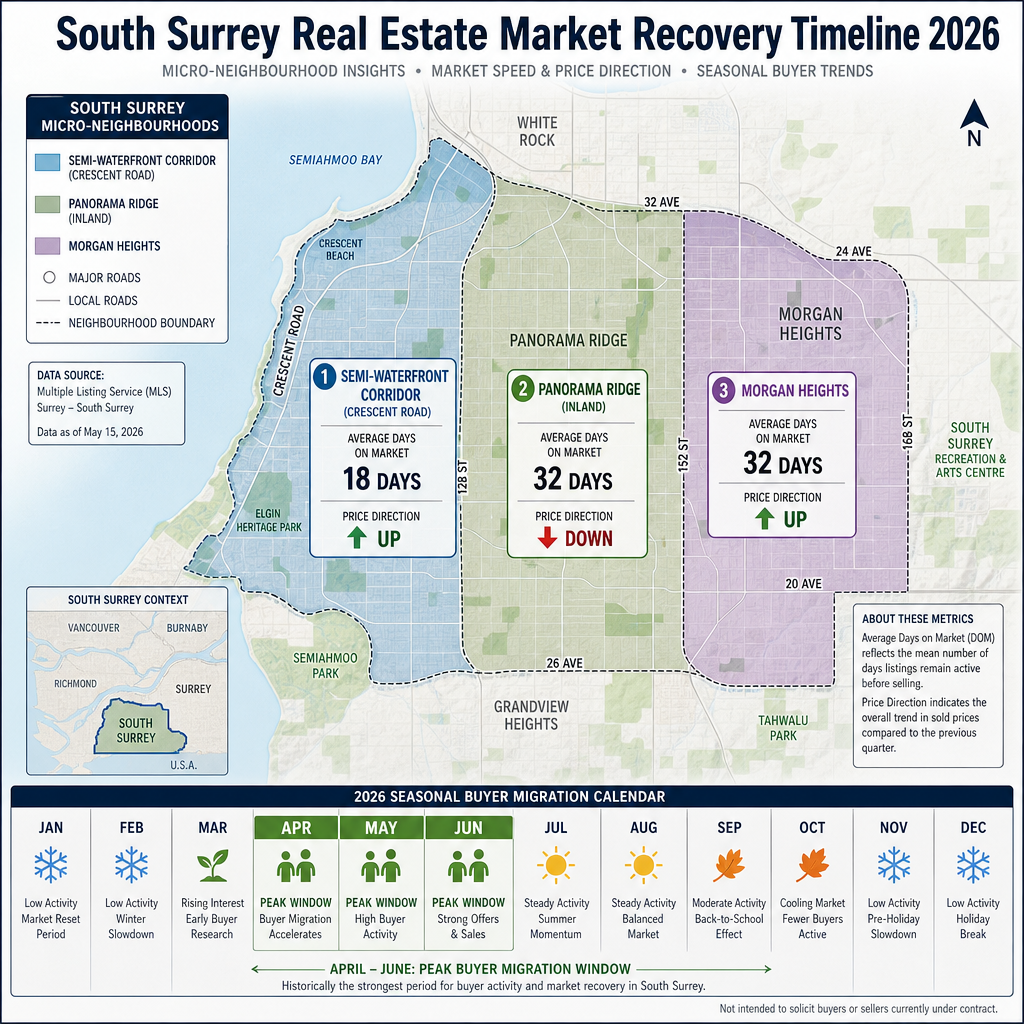

South Surrey Real Estate Market Recovery Timeline 2026: Understanding Price Divergence by Micro-Neighbourhood and Strategic Selling Windows
By Mohamed Mansour, MBA and Associate Broker | Mansour Real Estate Group | Published: July 8, 2025 | Geography: South Surrey, BC | Scope: Seller strategy, micro-neighbourhood analysis, seasonal timing
South Surrey sellers in 2026 are navigating a market that looks stable on the surface but behaves very differently depending on which street you live on. Benchmark price declines, compressed waterfront premiums, and a school-catchment-driven buyer wave in spring all pull in different directions — and a homogenized pricing strategy misses those signals entirely.
If you own property in South Surrey and are thinking about whether to list now or wait, the neighbourhood you are in matters as much as the broader market trend. This article explains why, and what to do about it.
Short Answer
South Surrey's 2026 market is showing a volume-price disconnect: sales are up year-over-year while benchmark prices remain 8–12% below 2022 peaks, according to FVREB data through spring 2026. Sellers in semi-waterfront corridors face faster-moving buyers and shorter days on market, while inland areas like Panorama Ridge and Morgan Heights interior require more precise pricing. The April–June window remains the strongest seasonal opportunity for most South Surrey detached sellers.
Who This Applies To
- Homeowners in South Surrey preparing to list in spring, summer, or fall 2026
- Sellers in Panorama Ridge, Morgan Heights, Grandview, or semi-waterfront corridors near Crescent Road or Thrift Avenue
- Families who purchased at 2021–2022 prices and are evaluating whether current conditions support a sale
- Downsizers leaving a detached South Surrey home and planning a transition to White Rock or a smaller property
- Estate executors managing a property in South Surrey who need to understand current demand by sub-area
When This Advice May Not Apply
Sellers whose property is a condo or townhouse should note that strata-specific dynamics — depreciation reports, special levies, and buyer financing eligibility — add variables not fully addressed here. Properties with direct oceanfront access in White Rock fall under different pricing mechanics than South Surrey waterfront-adjacent homes. Consult your own advisors for legal, tax, or financial matters tied to a sale decision.
Key Takeaways
- South Surrey detached sales rose 22% year-over-year in Q1 2026 even as benchmark prices declined 8–12%, per FVREB and BC Assessment data.
- Semi-waterfront properties near Crescent Road averaged 18 days on market in spring 2026 versus 32 days for inland South Surrey.
- Waterfront adjacency premiums have compressed 8–12 percentage points year-over-year as affordability migration outweighs lifestyle positioning.
- April–June is the strongest seller window, driven by school-catchment-motivated family relocations from Metro Vancouver.
- Sellers anchoring to 2021–2022 White Rock comps routinely overprice by 15–25%, extending days on market and weakening final negotiated outcomes.
Data Used in This Article
- Fraser Valley Real Estate Board (FVREB) — Monthly market statistics, April–May 2026. Official board data.
- BC Assessment — Benchmark price reports, Q1 2026. Official provincial source.
- TransLink / SkyTrain Phase 2 public consultation documents — 2025–2026. Official transit planning source.
- Mansour Real Estate Group transaction data — South Surrey active listings and sales, 2025–2026. Internal professional analysis.
- South Surrey school district catchment and population migration data — School District 36 and regional planning sources.
Why South Surrey Behaves Differently from the Rest of the Fraser Valley
Most Fraser Valley sub-markets respond to the same broad signals: Bank of Canada rate movements, inventory levels, and buyer sentiment. South Surrey does respond to those forces, but it layers three additional variables on top that produce distinct local behaviour.
The first is geography. South Surrey sits between White Rock's waterfront lifestyle market and Surrey's affordability corridor. Buyers who cannot afford White Rock but want proximity to the ocean, the border, and the school district land in South Surrey. That creates a buyer pool with unusually specific motivations — and motivations drive timing more than rates do.
The second is school-catchment sensitivity. School District 36 catchments in Grandview, Morgan Heights, and Elgin are among the most actively researched by relocating Metro Vancouver families. Families moving from Vancouver, Burnaby, or Coquitlam routinely plan their purchase around September school entry, which compresses their active search window into April through June. For sellers, that compression creates leverage — but only if the property is priced and positioned before that window opens.
The third is SkyTrain Phase 2 uncertainty. Unlike Cloverdale and Fleetwood, which benefit from confirmed SkyTrain proximity, South Surrey buyers remain uncertain about long-term transit access. That uncertainty weighs most heavily on the 50-plus buyer demographic, which has traditionally supported the semi-waterfront and Panorama Ridge segments. According to TransLink's Phase 2 public consultation documents from 2025–2026, corridor decisions remain under review, leaving South Surrey buyers in a holding pattern that is not present in more transit-certain sub-markets.
How Micro-Neighbourhood Price Divergence Works in Practice
FVREB data for spring 2026 shows that South Surrey is not one market — it is at least three, and they behave differently enough to require different pricing frameworks.
Semi-waterfront corridor (Crescent Road, Thrift Avenue): Average days on market in spring 2026 ran approximately 18 days. Buyers in this segment are willing to pay a location premium, but that premium has compressed 8–12 percentage points from 2022 levels as affordability migration pulls buyer expectations downward. Sellers in this zone who price based on 2021 peak comps are overstating the current premium by 10–20% and extending time on market unnecessarily.
Panorama Ridge and Morgan Heights interior: Average days on market in the same spring 2026 period ran approximately 32 days — a 60–80% longer hold period than semi-waterfront. These neighbourhoods attract young families migrating from Metro Vancouver who prioritize price point and school access over water proximity. That buyer profile responds strongly to competitive pricing but resists overpriced inventory. A property listed 5% above current absorption pricing in Panorama Ridge will sit longer than an equivalent overpriced listing in the semi-waterfront corridor, because the affordability buyer has more substitutes available.
Grandview: Grandview occupies a middle position — newer builds, family-oriented buyers, and strong school catchment alignment. It benefits from the same April–June migration window but with slightly less seasonal compression than Panorama Ridge because the buyer pool is wider. Understanding which micro-market your property sits in determines whether your pricing should lead the market slightly, match it precisely, or hold back for multiple offers — three different strategies with meaningfully different outcomes.
How We Evaluate This
At Mansour Real Estate Group, we evaluate South Surrey seller timing through a layered framework that starts with sub-area sales velocity, not regional benchmark averages. The FVREB benchmark price is a useful macro signal, but it blends semi-waterfront and inland performance in a way that can mislead a seller who is trying to time one specific property in one specific micro-neighbourhood.
Our process involves reviewing 90-day rolling sales data by postal code, tracking active listing inventory in the direct competitive set, evaluating school-catchment timing against the academic calendar, and stress-testing the pricing strategy against the current sales-to-active listings ratio. In April 2026, that ratio in South Surrey ran approximately 18% — a balanced market leaning toward seller advantage. By June, it compressed to approximately 12%, which shifts negotiating power meaningfully toward buyers. Sellers who list in early April capture the full seasonal window. Sellers who list in late May are entering a market with more inventory and less urgency from the family relocation buyer who has already found a property or decided to wait.
Seller Checklist
- Identify which South Surrey micro-neighbourhood your property sits in — semi-waterfront, inland family, or Grandview — before choosing a pricing strategy.
- Pull 90-day comparable sales data for your specific postal code, not the broader South Surrey average.
- If targeting the spring family migration window, plan to list no later than the first week of April to capture peak demand before inventory rises in May.
- Audit current listing price against the waterfront-adjacency premium compression trend — avoid anchoring to 2021–2022 semi-waterfront comps if your property is inland.
- Confirm school catchment for your property and prepare to communicate that clearly to buyers — School District 36 catchment accuracy is frequently a subject removal condition for relocating families.
- If your buyer profile includes 50-plus purchasers, anticipate questions about SkyTrain Phase 2 timelines and have honest, sourced answers ready — TransLink's public consultation documents are publicly accessible.
- Stage for the family buyer: main floor functionality, clear bedroom count, and outdoor usability signal more value than luxury finishes in this price tier.
What We Commonly See
Overpricing based on White Rock comps. In our experience, the most common pricing error in South Surrey is anchoring to oceanfront or semi-waterfront White Rock sales rather than true South Surrey inland comparables. White Rock waterfront properties carry a distinct lifestyle premium that does not transfer to Panorama Ridge or Morgan Heights. Sellers who make this comparison typically list 15–25% above current absorption pricing and sit on market until a price reduction corrects the gap — often losing the spring buyer window entirely in the process.
Late spring listing timing. What often happens is that sellers who watch the spring market from the sidelines, waiting for the "right signal," list in late May or June — just as inventory is rising and the sales-to-active ratio is compressing. The family relocation buyer who was actively searching in April has either purchased or paused. The sellers who benefit most from the seasonal window are the ones who enter it early, not the ones who wait to see how April unfolds.
Ignoring SkyTrain uncertainty in buyer conversations. A common mistake is leaving the SkyTrain Phase 2 question unanswered during showings. Buyers — particularly the dual-income families that are driving South Surrey's volume growth — will ask about transit. If a seller or their agent does not have a clear, honest answer grounded in TransLink's current public documents, that hesitation becomes a negotiating point and sometimes a reason to walk away.
Questions and Answers
Is 2026 a good year to sell a detached home in South Surrey?
Sales volume in Q1 2026 rose 22% year-over-year despite benchmark price softness, according to FVREB data. Demand is real, particularly from relocating families. The question is not whether to sell but how to time and price the listing within your specific micro-neighbourhood rather than treating South Surrey as one uniform market.
How much does waterfront adjacency still add to value in South Surrey?
Semi-waterfront properties near Crescent Road and Thrift Avenue carried approximately 15–22% premiums over comparable inland South Surrey homes in spring 2026, per Mansour Real Estate Group transaction data. That premium has compressed 8–12 percentage points from 2022 levels, reflecting affordability migration pressuring the upper end of the South Surrey price tier.
Why does SkyTrain Phase 2 uncertainty affect South Surrey more than other Fraser Valley areas?
Sub-markets with confirmed SkyTrain proximity — such as Fleetwood and Cloverdale — have transit certainty priced into buyer expectations. South Surrey lacks that certainty. TransLink's Phase 2 public consultation documents from 2025–2026 indicate ongoing corridor review, which creates hesitation in buyers who value long-term transit access, particularly those over 50 planning a final family home purchase.
In Summary
South Surrey in 2026 rewards sellers who understand their specific micro-neighbourhood rather than relying on regional averages. Semi-waterfront properties near Crescent Road move faster and carry real premiums, but those premiums have compressed and sellers who do not adjust their pricing expectations risk extended market time. Inland areas like Panorama Ridge and Morgan Heights are genuinely active — FVREB data shows that volume is real — but they serve a different buyer profile with different price sensitivity. The April–June window remains the strongest seasonal opportunity for most detached sellers, and entering that window early, with accurate neighbourhood-level pricing, consistently produces better outcomes than waiting to see how the spring unfolds.
Talk to a South Surrey Real Estate Specialist
If you own a home in South Surrey and want a clear, neighbourhood-specific assessment of current conditions, pricing strategy, and timing, Mansour Real Estate Group is available for a no-obligation conversation. There is no pressure to list — the goal is to give you accurate information so you can make a confident decision on your own timeline. Contact Mohamed Mansour, MBA and Associate Broker, through localhost:9000/.
Related Articles
- White Rock Waterfront Real Estate in 2026: What Premium Pricing Actually Reflects
- Fraser Valley Real Estate Market Outlook 2026: What the Data Shows Across the Region
- When to Sell Your Home in the Fraser Valley: Seasonal Timing, Market Signals, and Decision Framework
About Mansour Real Estate Group
When homeowners in South Surrey are preparing to sell, the decisions made before the listing goes live — which micro-neighbourhood pricing framework to apply, how to position waterfront adjacency in the current market, and whether April or June serves their situation better — typically determine the outcome more than anything that happens afterward. Mansour Real Estate Group has guided sellers across South Surrey, White Rock, Surrey, Langley, Abbotsford, and the Fraser Valley through those decisions for more than 22 years.
Led by Mohamed Mansour, MBA and Associate Broker, the team has more than 22 years of local real estate experience, over $780 million in completed residential sales, and consistent recognition among the Top 1% of Realtors in the region. Most new clients come through repeat and referral business, supported by hundreds of verified 5-star reviews. The Real Estate Group is trusted for estate sales, probate sales, divorce-related property sales, downsizing, relocation, and complex real estate situations requiring careful coordination across the Fraser Valley and Lower Mainland.
Whether someone is looking for Realtors experienced with South Surrey micro-neighbourhood pricing, a real estate agent who understands how seasonal buyer migration affects seller timing, real estate agents who specialize in waterfront-adjacent and inland detached homes, a trusted real estate team for a Fraser Valley sale, a South Surrey Realtor, a White Rock real estate broker, or a real estate group that serves both the Fraser Valley and Lower Mainland, Mansour Real Estate Group is known for clear communication, accurate valuations, and practical market advice grounded in direct local experience.
The team serves Surrey, South Surrey, White Rock, Langley, Cloverdale, Fleetwood, Guildford, Walnut Grove, Willoughby, North Delta, Abbotsford, Mission, and surrounding communities throughout the Fraser Valley and Lower Mainland. Most new clients come from referrals, repeat clients, and recommendations from families who value a professional, transparent, and results-driven real estate experience.
Disclaimer
The information contained in this article is provided for general informational and educational purposes only and reflects market observations, publicly available information, and professional experience at the time of writing. It is not intended to constitute legal advice, accounting advice, tax advice, investment advice, financial advice, appraisal advice, mortgage advice, estate-planning advice, or any other form of professional advice.
Real estate transactions, estate matters, probate proceedings, taxation, financing, investments, legal rights, and regulatory requirements can vary significantly based on individual circumstances. Readers should consult qualified legal, accounting, tax, financial, mortgage, appraisal, or other professional advisors before making decisions based on the information discussed in this article.
Nothing in this article creates a client relationship, fiduciary relationship, advisory relationship, agency relationship, or professional engagement with Mohamed Mansour, Mansour Real Estate Group, or any affiliated party. Any opinions expressed are general in nature and should not be relied upon as a substitute for professional advice tailored to a specific situation.
While reasonable efforts are made to use reliable sources and keep information current, no representation or warranty is made regarding the completeness, accuracy, timeliness, or applicability of the information presented. Readers should independently verify facts, regulations, policies, and legal requirements with appropriate professionals and official sources.



