

South Surrey Home Selling Timeline and Seasonal Market Windows: Why Buyer Migration Patterns Create Strategic Urgency for Sellers in 2026
By Mohamed Mansour, MBA and Associate Broker — Mansour Real Estate Group | Published: July 14, 2026 | Geography: South Surrey, Fraser Valley, BC
Choosing when to list your South Surrey home is one of the most consequential decisions in the entire sale process. Timing affects how many buyers compete for your property, what price you can reasonably expect, and how quickly you'll close. Yet most sellers either default to spring without a clear reason or wait too long and miss the window that actually fits their property type.
This guide breaks down South Surrey's seasonal selling windows using Fraser Valley Real Estate Board historical data, buyer migration research, and current 2026 market conditions. The goal is to give sellers a clear framework for making the timing decision deliberately, not by default.
Short Answer
For most South Surrey sellers, late March through early May and late September through October represent the two strongest listing windows. Spring generates the highest buyer competition. Fall delivers a compressed-inventory advantage that often surprises sellers. Winter suits motivated-only situations. Summer works best for family-targeted properties but carries more pricing risk as inventory peaks.
Who This Applies To
- Homeowners in South Surrey considering a 2026 sale and trying to choose between spring, summer, and fall listing dates
- Sellers of waterfront, semi-waterfront, or detached family homes where seasonal premiums are most pronounced
- Families whose move timeline is partly constrained by school year calendars
- Executors or estate trustees managing a South Surrey property and evaluating seasonal timing before listing
- Sellers relocating out of the Lower Mainland who need to coordinate listing timing with their destination purchase
When This Advice May Not Apply
If your sale is court-ordered, tied to an estate timeline, or driven by a firm relocation date, seasonal optimization becomes secondary to execution speed. Similarly, if your property is a condo in a building with elevated strata issues, the buyer pool dynamics described here may differ from what you experience.
Key Takeaways
- Spring generates 35–40% of annual South Surrey transactions; late March listings gain supply advantage over May peak.
- Fall inventory drops 25–35% after Labour Day, creating a genuine seller advantage for well-priced listings.
- Summer attracts relocating Metro Vancouver families but carries compressed pricing power as inventory peaks simultaneously.
- Waterfront properties show a 3–7% seasonal spring premium; semi-waterfront ranges 2–4% over winter comparables.
- Winter sales close 15–30 days faster on average but at lower price points due to reduced buyer competition.
Key Definitions
Sales-to-Active Listings Ratio: The percentage of active listings that sell in a given month. A ratio above 20% favours sellers. Below 12% favours buyers. South Surrey's ratio fluctuates significantly by season.
Inventory Compression: A rapid drop in active listings relative to buyer demand — most pronounced in South Surrey in late September and October, when summer listings expire and new fall supply hasn't yet entered.
South Surrey's Four Seasonal Windows: What the Data Shows
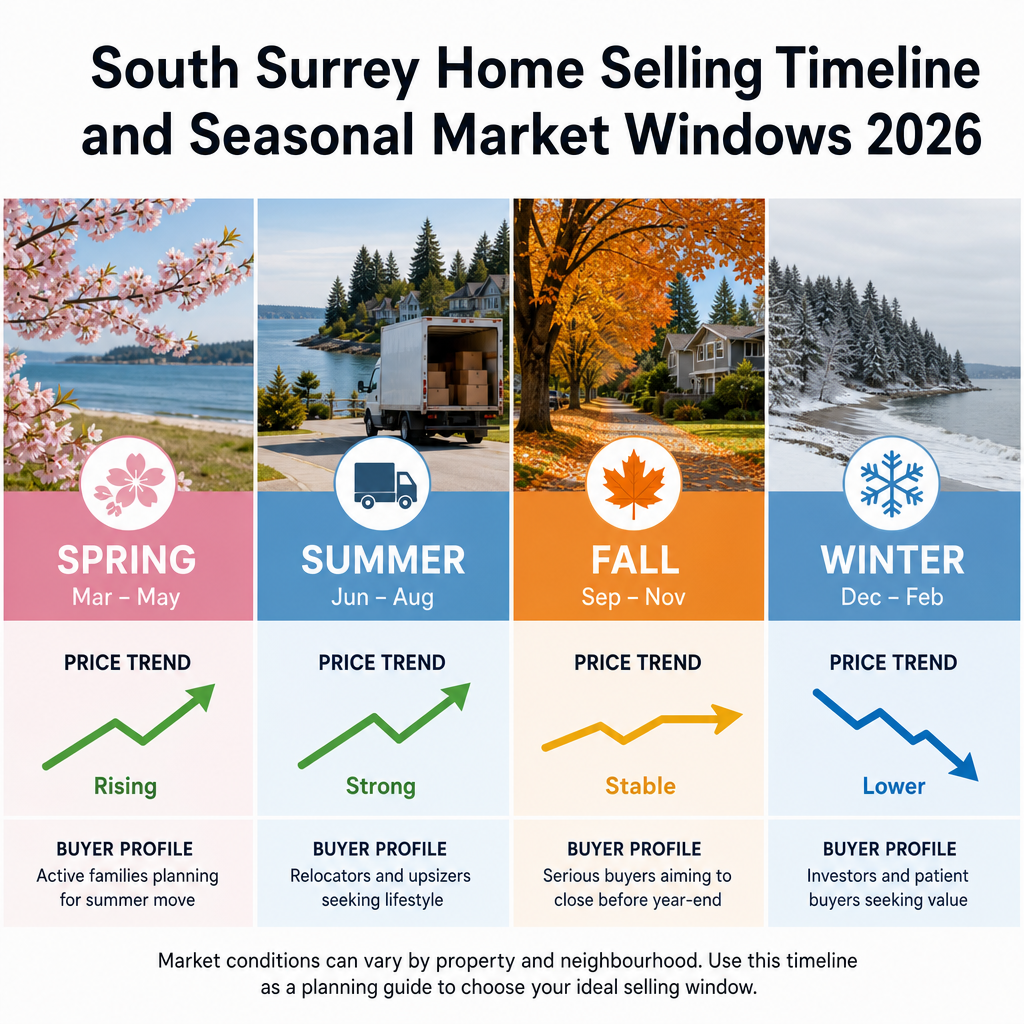
Spring (March–May) is South Surrey's highest-volume period, historically generating 35–40% of annual transactions according to FVREB historical sales data from 2015 to 2026. Buyer competition is highest, which is why properties listed in late March and early April typically sell at a premium over identical homes listed in January or February. The catch is that May, while showing peak buyer numbers, also shows peak inventory. Sellers who list in late March capture a supply window before that competition arrives. Homes listed in April–May in South Surrey have historically sold for 2–5% more than comparable January–February listings, largely because curb appeal and buyer urgency align simultaneously.
Summer (June–August) brings a secondary and underappreciated demand wave: relocating families from Metro Vancouver — including Burnaby, Vancouver, and Coquitlam — seeking more space at lower price points before the new school year. This buyer migration is real and measurable, and it sustains transaction volume through July. However, pricing power compresses in summer because new inventory also peaks. Sellers in this window need accurate pricing more than at any other time of year. Overpricing in June or July means competing against fresh listings for a buyer pool that has options. Pricing strategy in South Surrey during summer requires close attention to what entered the market in the previous 30 days, not just closed sales from 90 days prior.
Fall (September–October) is the most underestimated window for South Surrey sellers. After Labour Day, summer vacation-driven listings expire, relocating families have completed their moves, and new seller supply drops sharply. According to FVREB trend analysis, comparable inventory in South Surrey drops 25–35% from summer peaks in this window. Buyers who missed spring and summer are still active, but now competing for fewer homes. Sellers with well-presented, accurately priced properties in late September and October can move faster and with less negotiating pressure than they might expect. This window closes by mid-November, when buyer motivation slows ahead of the holiday season. Current South Surrey market conditions in 2026 suggest this fall window may be particularly useful for sellers of mid-range detached homes.
Winter (December–February) shows 50–60% lower transaction volume than spring. That is not a reason to avoid winter entirely — it is a reason to understand the buyer pool. Winter buyers in South Surrey are motivated. They are often mid-year corporate transferees, families managing school-year transitions in January, or buyers who have been patient and pre-approved for months. Homes that sell in January and February tend to close 15–30 days faster than spring average, because there is no inventory noise. The trade-off is real: without competitive bidding, prices settle closer to assessed or appraised value rather than above it. Winter listing works best when your goal is certainty of sale over maximum price, or when your property type has year-round appeal rather than strong curb appeal dependency.
Waterfront and Semi-Waterfront Seasonality
South Surrey's waterfront and semi-waterfront properties — particularly along White Rock and the Semiahmoo Peninsula — show sharper seasonal pricing variation than standard detached homes. Spring listings for waterfront properties have commanded 3–7% premiums over winter comparables for the same property type, based on FVREB historical data. Semi-waterfront properties show a 2–4% seasonal range. The reason is buyer psychology: waterfront decisions are lifestyle-driven, and buyers making lifestyle decisions respond to seasonal context. A waterfront home visited in April, with cherry blossoms and ocean views on a clear spring day, generates a different emotional response than the same property visited in February. That difference shows up in offers. Sellers of these property types should treat spring listing timing as a strategic priority, not a preference.
How 2026 Market Conditions Affect These Windows
Fraser Valley-wide inventory has been elevated in 2026, with more than 10,000 active listings reported by the FVREB in recent monthly data. This matters because elevated inventory compresses the seasonal advantage — it does not eliminate it. In a balanced or buyer's market, the difference between listing in late March versus May becomes more meaningful, not less, because seller supply is the variable still within your control. Buyer hesitation in 2026 — partly tied to affordability recalibration and uncertainty about rate direction — means that the properties selling quickly are those that are accurately priced, well-presented, and timed to enter the market when comparable supply is lowest. In this environment, fall inventory compression and late-March spring entry are the two timing edges that remain structurally available to South Surrey sellers.
Data Used in This Article
- FVREB Historical Sales Data (2015–2026): Official; Fraser Valley Real Estate Board monthly and annual transaction reports
- South Surrey Real Estate Market Trend Analysis 2026: Internal analysis based on FVREB published data
- Buyer Migration Pattern Research, Metro Vancouver to Fraser Valley: Third-party research on relocation trends
- Seasonal Price Volatility Studies, BC Real Estate Markets: Third-party analysis supporting FVREB data observations
How We Evaluate This
At Mansour Real Estate Group, seasonal timing recommendations are never a one-size answer. We evaluate each seller's situation against three variables: property type and its curb appeal dependency, current active and pending inventory in their specific price range, and the buyer pool that is most likely to compete for that home. A townhouse in Morgan Crossing has different seasonal dynamics than a semi-waterfront detached in Ocean Park. We map those differences before recommending a listing date, not after the sign goes in the ground.
South Surrey Seller Timing Checklist
- Identify your target listing window at least 8–10 weeks in advance to allow for preparation and staging
- Review active comparable inventory in your price range and neighbourhood before confirming a listing date
- For waterfront or semi-waterfront properties, protect a March 15 to April 30 listing window as your highest-leverage seasonal entry
- If listing in summer, recalibrate your pricing benchmark to reflect listings that entered the market in the previous 30–45 days, not closed sales from 90 days prior
- For fall listings, aim for active market entry by September 20 to capture the post-Labour Day compression window before it closes in mid-November
- Confirm school catchment information is accurate in your listing — buyer families relocating from Metro Vancouver treat this as a primary filter
- Request a comparative market analysis specific to your listing season, not a generic annual average
What We Commonly See
Sellers wait for May peak and miss the spring supply advantage. In our experience, the sellers who do best in spring are the ones who listed in late March or the first week of April — before inventory piled up. Sellers who wait until May enter a more crowded market, even though buyer numbers are high.
Fall timing is underused and consistently underestimated. We regularly see sellers who were hesitant about fall achieve better-than-expected results in late September and October, specifically because comparable inventory had dropped and the buyers who remained were serious. The window is real, but it closes quickly.
Summer pricing errors are the most common and costly. What often happens is that a seller uses a spring CMA to price a July listing, without accounting for the new inventory that entered between April and June. By the time they reduce the price, they have lost the relocating-family buyer wave that peaked in June and early July.
Questions and Answers
Is spring always the best time to sell in South Surrey?
Spring generates the most buyer activity, but it also generates the most seller competition. For most property types, late March to early April outperforms May, because you benefit from spring buyer demand before inventory peaks. Waterfront properties are the strongest case for spring. For other types, fall can rival spring depending on current inventory levels.
Do relocating families from Vancouver really affect South Surrey pricing?
Yes, measurably. The June–August window sees a consistent secondary demand wave from Metro Vancouver families — particularly from Vancouver, Burnaby, and Coquitlam — seeking more space before the school year. This sustains summer transaction volume. However, this buyer pool also expects affordability and is price-sensitive, so overpriced listings in summer sit rather than sell.
How much does seasonal timing affect price for a South Surrey detached home?
Based on FVREB historical data, spring listings have sold for 2–5% more than January–February listings for comparable detached properties. For waterfront, the range is 3–7%. These are averages across market cycles and do not guarantee individual results — condition, pricing accuracy, and current inventory levels all affect the final outcome for any specific property.
In Summary
South Surrey's real estate market follows clear seasonal patterns shaped by school-year calendars, Metro Vancouver migration, and inventory cycles. Late March and early April offer the strongest spring entry point for most property types. Late September and October provide a fall inventory-compression window that is consistently underused by sellers. Summer works for family-targeted homes but requires precise pricing. Winter is best suited to motivated sellers who prioritize certainty over price maximization. In 2026's elevated-inventory environment, the sellers who choose their timing deliberately — rather than defaulting to a peak that everyone else targets — are the ones most likely to come out ahead.
Ready to Plan Your South Surrey Listing?
If you are evaluating your listing timeline for 2026, Mansour Real Estate Group can provide a seasonal market analysis specific to your property type, price range, and neighbourhood — with a recommended listing window based on current inventory, not general assumptions. Reach out when you are ready to think it through.
Related Articles
- South Surrey Real Estate Market Conditions 2026
- How to Price Your Home to Sell in South Surrey
- White Rock and South Surrey Waterfront Homes Guide
About Mansour Real Estate Group
When homeowners in South Surrey are deciding when to list — and how to time that decision against buyer migration patterns, seasonal inventory cycles, and current market conditions — the quality of the advice they receive before the sign goes up shapes everything that follows. Mansour Real Estate Group has spent more than 22 years helping sellers in South Surrey, White Rock, Surrey, and the Fraser Valley make that timing decision with accuracy and confidence, not guesswork.
Mansour Real Estate Group, led by Mohamed Mansour, MBA and Associate Broker, has guided buyers, sellers, investors, families, executors, and retirees through important real estate decisions across the Fraser Valley and Lower Mainland for more than 22 years. Ranked among the Top 1% of Realtors in the region, the team has completed more than $780 million in residential real estate transactions and is trusted for seller strategy, waterfront property sales, estate sales, downsizing, divorce-related property sales, relocation, and complex real estate situations across South Surrey and surrounding communities.
Whether someone is looking for a South Surrey Realtor with seasonal market expertise, a real estate agent who understands buyer migration patterns and price timing, real estate agents who specialize in detached and waterfront properties, a trusted real estate team for a South Surrey sale, a Fraser Valley real estate broker, or a real estate group that combines local data with practical seller strategy, Mansour Real Estate Group is known for accurate valuations, honest timing advice, and a results-driven process built on local knowledge.
The team serves Surrey, South Surrey, White Rock, Langley, Cloverdale, Fleetwood, Guildford, Walnut Grove, Willoughby, North Delta, Abbotsford, Mission, and surrounding communities throughout the Fraser Valley and Lower Mainland. Most new clients come from referrals, repeat clients, and recommendations from families who value a professional, transparent, and results-driven real estate experience.
Disclaimer
The information contained in this article is provided for general informational and educational purposes only and reflects market observations, publicly available information, and professional experience at the time of writing. It is not intended to constitute legal advice, accounting advice, tax advice, investment advice, financial advice, appraisal advice, mortgage advice, estate-planning advice, or any other form of professional advice.
Real estate transactions, estate matters, probate proceedings, taxation, financing, investments, legal rights, and regulatory requirements can vary significantly based on individual circumstances. Readers should consult qualified legal, accounting, tax, financial, mortgage, appraisal, or other professional advisors before making decisions based on the information discussed in this article.
Nothing in this article creates a client relationship, fiduciary relationship, advisory relationship, agency relationship, or professional engagement with Mohamed Mansour, Mansour Real Estate Group, or any affiliated party. Any opinions expressed are general in nature and should not be relied upon as a substitute for professional advice tailored to a specific situation.
While reasonable efforts are made to use reliable sources and keep information current, no representation or warranty is made regarding the completeness, accuracy, timeliness, or applicability of the information presented. Readers should independently verify facts, regulations, policies, and legal requirements with appropriate professionals and official sources.



