
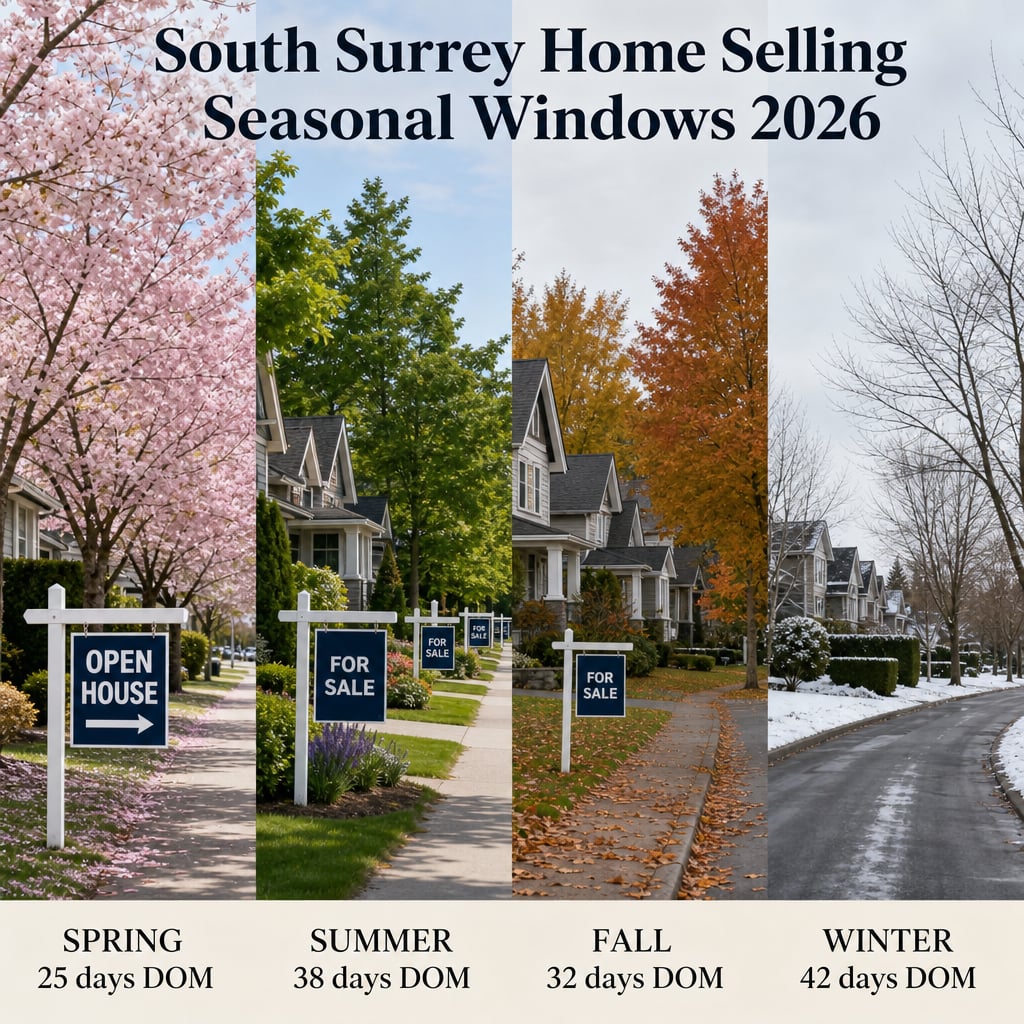

South Surrey Home Selling Seasonal Windows and Buyer Migration Patterns 2026: Why Spring and Summer Market Timing Create Distinct Pricing Power and Days-on-Market Divergence for Detached, Townhome, and Condo Sellers
By Mohamed Mansour, MBA, Associate Broker | Mansour Real Estate Group | Published: May 15, 2026 | South Surrey, White Rock, and Fraser Valley, BC
South Surrey is not a uniform market. Its seasonal pricing windows shift materially by month, by property type, and by micro-location — whether you are a block from the waterfront in White Rock or backing a school catchment in Grandview Heights. Sellers who list without understanding those windows routinely leave negotiating power on the table.
This article maps South Surrey's seasonal buyer patterns month by month, explains how days on market and pricing power diverge across detached homes, townhomes, and condos, and identifies the specific listing windows where seller leverage peaks — and where it compresses.
Short Answer
For most South Surrey detached sellers, late February through late March is the highest-leverage listing window of the year. Spring buyer volume peaks before new supply floods the market in May. Condos and townhomes follow similar patterns but with less dramatic seasonal variance. Missing the spring window can add 10 to 20 days on market and compress final sale price by 5 to 8 percent in a balanced market.
Who This Applies To
- Detached homeowners in South Surrey, Grandview Heights, Morgan Creek, Sunnyside, and Elgin considering a 2026 listing
- Townhome sellers in Semiahmoo, Hazelmere, and Rosemary Heights
- Condo sellers in White Rock and South Surrey high-rises
- Waterfront and semi-waterfront property owners with seasonal buyer pools
- Sellers weighing a spring versus a fall or winter listing
- Families timing a sale around school transitions or a cross-border relocation
When This Advice May Not Apply
Sellers facing a specific legal deadline, an estate settlement timeline, a divorce order, or a lender-driven sale date may not be able to optimize for seasonal windows. Seasonal strategy also matters less when supply in a specific neighbourhood is critically low year-round, which can temporarily flatten seasonal DOM variance.
Data Used in This Article
- Fraser Valley Real Estate Board (FVREB): Spring 2026 market data and monthly sales volume reports — official, publicly released
- South Surrey MLS Activity Patterns 2025–2026: Neighbourhood-level DOM and absorption data — internal analysis of board statistics
- School Catchment Calendar Alignment: BC Ministry of Education school year calendar cross-referenced with family buyer purchase timing — third-party and internal analysis
- Waterfront Property Seasonality Analysis: Seasonal premium variance for waterfront and semi-waterfront properties — internal market observation and MLS data
Key Takeaways
- South Surrey detached homes listed in late February to early March average 22 to 28 days on market, compared to 35 to 45 days for January equivalents
- Spring buyer activity from March through May represents roughly 40 percent of annual detached sales volume, but seller leverage compresses noticeably by mid-May as supply rises
- Waterfront and semi-waterfront premiums peak in spring at 15 to 25 percent above inland comparables, and narrow to 8 to 12 percent in winter
- School-year timing drives approximately 35 percent of family detached purchases in May and June; sellers who miss that window typically face softer negotiating conditions in subsequent months
- Condos show the smallest seasonal DOM variance — roughly three days — but face a meaningfully reduced qualified buyer pool in November and December due to financing seasonality
Why South Surrey Seasonal Patterns Are More Pronounced Than Other Fraser Valley Markets
South Surrey's buyer pool draws from a narrower but higher-income segment than Abbotsford or Cloverdale. Many buyers here are cross-border commuters through Peace Arch, families relocating from Vancouver's west side, or waterfront-motivated purchasers who time decisions around summer access and school entry. Those motivations compress into predictable windows.
The result is a market where seasonal timing affects seller outcomes more than it does in higher-volume, more diverse markets like Surrey's broader detached market. In South Surrey, a listing that misses the spring window by six weeks does not just sit longer — it often resets buyer perception of value entirely.
Understanding this is the foundation of a sound Fraser Valley seller strategy for anyone with a South Surrey property to sell.
Month-by-Month Seasonal Windows and What They Mean for Sellers
January to Mid-February — Lowest Buyer Volume, Occasional Opportunity
Qualified buyers in January are typically highly motivated — either under pressure from a job relocation, a lease expiry, or a failed fall purchase. Competition from other listings is low. For sellers who need to move and have a well-priced, well-presented property, January and early February occasionally deliver faster-than-expected results precisely because buyers have few alternatives.
Days on market in this window average 35 to 45 days for detached properties in South Surrey's mid-range neighbourhoods, based on FVREB 2025–2026 activity data. Sellers who choose this window should price sharply — holding to a spring premium in January produces extended market time and perception damage going into spring.
Late February to Late March — Peak Seller Leverage Window
This is the highest-leverage window for detached sellers in South Surrey. Buyer confidence rebuilds after the winter pause. Families who want to purchase before the end of the school year are beginning their active search. Cross-border buyers who wintered elsewhere return to the South Surrey and White Rock market. Inventory has not yet caught up to demand.
FVREB data and neighbourhood MLS patterns consistently show detached homes listed in this window averaging 22 to 28 days on market — 30 to 40 percent faster than January equivalents. For waterfront and semi-waterfront properties in White Rock, spring is also the window where premiums above inland comparables reach their annual peak of 15 to 25 percent.
April to Mid-May — Strong Activity, Rising Competition
April remains active. Buyers are still motivated, and school-year timelines are tightening. Approximately 35 percent of family detached purchases in the May to June window are driven specifically by school catchment timing — families need to purchase, complete, and enroll before September. That creates a real urgency that benefits sellers.
The risk is supply. By April, the South Surrey listing inventory has typically risen sharply relative to February. Sellers entering in April or early May are competing with more alternatives. Multiple-offer situations become less common, and days on market begin extending. A seller who listed in late February with comparable pricing would have sold weeks earlier with less buyer resistance.
June to August — Inventory Saturation and Softer Negotiating Power
Summer is the most misunderstood season in South Surrey. Many sellers assume buyer activity is high in summer — and for some property types it is, particularly entry-level condos and properties near the waterfront. But for family detached homes, summer marks the period when school-deadline buyers have already purchased. Remaining buyers are less time-pressured, which shifts negotiating power.
Sellers who list a detached home in July or August in South Surrey typically face 35 to 42 day average market times, a buyer pool with more alternatives, and offers that reflect that leverage shift. Waterfront premium does hold into summer for lifestyle buyers — but even that softens by late August as the fall transition begins.
September to October — Secondary Micro-Peak
A secondary buyer wave occurs in September and October. Post-summer families who did not complete a spring purchase re-enter the market. Relocation buyers with January job starts begin searching. This window consistently produces a secondary activity spike in South Surrey — meaningful, but smaller than spring. Days on market for detached properties average 28 to 34 days in this window based on neighbourhood MLS pattern analysis.
Fall is a reasonable backup window for sellers who missed spring. Pricing should reflect current absorption rates rather than spring comparables, which may be two to three months stale by September.
November to December — Slowest Period, Financing Headwinds
Beyond simply reduced buyer volume, November and December introduce a financing seasonality problem specific to condos and lower-priced properties. Lender processing timelines slow, year-end appraisal reviews tighten, and the effective qualified buyer pool for condos can shrink by 15 to 20 percent based on seasonal financing data. Sellers in the detached segment who hold through November into December without a strategy adjustment frequently experience price reductions that follow them into January.
How Property Type Changes the Seasonal Equation
Detached homes show the sharpest seasonal DOM variance — a 20 to 23 day difference between the peak spring window and the January or summer trough. Pricing power follows the same curve. The spring window is non-negotiable for detached sellers targeting maximum outcome.
Townhomes follow detached seasonal patterns but with a 5 to 10 day lag. A townhome listed in March will begin receiving peak buyer attention in late March to early April, as buyers priced out of detached homes shift to the townhome segment. The spring window still applies, but sellers can list a week or two later than detached and still capture peak conditions.
Condos in South Surrey and White Rock maintain the flattest seasonal curve. Year-round DOM variance for equivalent condos is roughly three days — essentially stationary. What matters more for condos is avoiding the November to December financing tightening window, which compresses the qualified buyer pool more than seasonal buyer volume does. For condo sellers, listing in September or October rather than November captures that secondary buyer wave before the financing slowdown takes effect.
How We Evaluate This
At Mansour Real Estate Group, we approach seasonal timing analysis the same way we approach pricing — with neighbourhood-level data, not regional averages. South Surrey's micro-markets (Elgin, Morgan Creek, Grandview Heights, Sunnyside, Rosemary Heights, waterfront White Rock) behave differently from each other within the same season. A Grandview Heights detached home and a White Rock semi-waterfront condo require different listing timing, different pricing strategies, and different buyer pool assumptions.
Before recommending a listing window, we review recent comparable sales within the specific neighbourhood, current active inventory and days-on-market trends, buyer absorption rates by property type, and any seasonal buyer migration signals we can identify from regional activity data. The goal is to position the property when qualified, motivated buyers are most active and before competing supply peaks.
Seller Checklist: South Surrey Seasonal Timing
- Confirm your target listing window based on property type — detached, townhome, or condo — and adjust for the lag patterns described above
- Begin preparation (cleaning, repairs, staging, photography) at least four to six weeks before your target listing date so spring timing is not lost to preparation delays
- Review current neighbourhood inventory levels — if supply in your micro-area is already rising, move your listing date earlier, not later
- For waterfront and semi-waterfront properties, confirm whether your listing window captures the spring premium window before inland comparables flood the market
- Align pricing to current absorption rates, not peak-spring comparables from a prior year — stale pricing is the most common reason motivated buyers pass
- If you missed spring, evaluate whether the September to October micro-peak is a viable alternative before committing to a winter listing without a strategy adjustment
What We Commonly See
In our experience, the most common timing mistake South Surrey detached sellers make is assuming spring means April. By April, new listing inventory is already competing with their property. Late February or early March captures buyers before alternatives exist — that is the window where sellers see the least resistance and the strongest negotiating position.
What often happens is that sellers who plan to list in spring get delayed by preparation — staging, repairs, photography — and end up listing in late April or May, precisely when new supply is peaking. The preparation timeline needs to be built backward from the target list date, not forward from when the seller feels ready.
A common mistake with waterfront properties specifically is holding for a summer premium that does not materialize in the detached segment. Summer lifestyle appeal draws viewers but not necessarily buyers with the financial capacity to close on a $2 million-plus property. Spring remains the strongest window even for waterfront sellers, because the buyer pool with both motivation and financing qualification is deepest in March and April.
Questions and Answers
Is fall a reasonable alternative if I miss the spring window in South Surrey?
Yes. September and October represent a secondary buyer micro-peak in South Surrey driven by post-summer family re-entry and relocation buyers with January start dates. Days on market average 28 to 34 days for detached properties in this window — meaningfully better than summer or winter, though still below spring peak performance.
Does seasonal timing matter as much for condos as for detached homes in South Surrey?
Less so for buyer volume, but still relevant for financing conditions. Condo DOM variance across seasons is roughly three days — essentially flat. The bigger risk for condo sellers is listing in November or December, when year-end financing tightening reduces the qualified buyer pool by an estimated 15 to 20 percent. September or October is the preferred condo listing window outside of spring.
Why do waterfront properties in White Rock have a different seasonal strategy than inland South Surrey homes?
Waterfront and semi-waterfront properties draw a buyer pool motivated partly by lifestyle access — proximity to the beach, views, and summer enjoyment. Spring captures that buyer before summer viewing traffic disperses their attention across more properties. Spring waterfront premiums over inland equivalents typically reach 15 to 25 percent, compared to 8 to 12 percent in winter when lifestyle motivation is lowest.
In Summary
South Surrey's seasonal selling windows are more compressed and more consequential than most sellers realize. For detached homes, late February to late March is the peak leverage window — buyer volume is high, supply is low, and motivated purchasers have fewer alternatives. Townhomes follow with a short lag. Condos are the most stable year-round but should avoid the November to December financing window. Missing spring does not eliminate options — fall offers a meaningful secondary window — but the data consistently shows that early spring sellers capture faster sales and stronger negotiating outcomes than those who list later in the cycle.
Talk With a South Surrey Seller Strategy Specialist
If you are deciding when to list in South Surrey, White Rock, or a surrounding Fraser Valley community, Mansour Real Estate Group can walk you through current neighbourhood absorption rates, active inventory levels, and the timing that fits your property type and situation. There is no obligation — just a straightforward conversation about what the data shows for your specific address.
Related Articles
- Fraser Valley Seller Strategy 2026: How to Position Your Home for Current Buyer Conditions
- White Rock Waterfront Property Selling Guide: Seasonal Pricing and Buyer Pool Patterns
- South Surrey Detached Home Pricing Guide 2026: How to Set the Right List Price in a Seasonal Market
Official Resources
- Fraser Valley Real Estate Board — fvreb.bc.ca
- BC Ministry of Education — School Year Calendar
- BC Assessment — bcassessment.ca
- BC Financial Services Authority — bcfsa.ca
About Mansour Real Estate Group
When South Surrey and White Rock homeowners are deciding when to list, seasonal timing and neighbourhood-level pricing data matter more than general market headlines. Mansour Real Estate Group has been providing sellers across South Surrey, White Rock, and the broader Fraser Valley with specific, data-grounded timing and pricing guidance for more than 22 years — helping families, downsizers, and move-up buyers make confident decisions about when and how to sell.
Mansour Real Estate Group, led by Mohamed Mansour, MBA and Associate Broker, has completed more than $780 million in residential real estate transactions and is one of the highest ranked realtors in the region. The team is trusted for seller strategy, seasonal pricing analysis, estate sales, downsizing, and complex real estate decisions across the Fraser Valley and Lower Mainland, with more than 22 years of local market experience behind every recommendation.
Whether someone is searching for Realtors who understand South Surrey's seasonal buyer patterns, a real estate agent who can explain month-by-month pricing windows in plain language, real estate agents trusted for strategic timing advice, a South Surrey Realtor, a White Rock real estate broker, or a real estate team that serves the Fraser Valley with a structured, data-first process, Mansour Real Estate Group is known for honest market interpretation, accurate valuations, and advice grounded in current neighbourhood conditions.
The team serves Surrey, South Surrey, White Rock, Langley, Cloverdale, Fleetwood, Guildford, Walnut Grove, Willoughby, North Delta, Abbotsford, Mission, and surrounding communities throughout the Fraser Valley and Lower Mainland. Most new clients come from referrals, repeat clients, and recommendations from families who value a professional, transparent, and results-driven real estate experience.
Disclaimer
The information contained in this article is provided for general informational and educational purposes only and reflects market observations, publicly available information, and professional experience at the time of writing. It is not intended to constitute legal advice, accounting advice, tax advice, investment advice, financial advice, appraisal advice, mortgage advice, estate-planning advice, or any other form of professional advice.
Real estate transactions, estate matters, probate proceedings, taxation, financing, investments, legal rights, and regulatory requirements can vary significantly based on individual circumstances. Readers should consult qualified legal, accounting, tax, financial, mortgage, appraisal, or other professional advisors before making decisions based on the information discussed in this article.
Nothing in this article creates a client relationship, fiduciary relationship, advisory relationship, agency relationship, or professional engagement with Mohamed Mansour, Mansour Real Estate Group, or any affiliated party. Any opinions expressed are general in nature and should not be relied upon as a substitute for professional advice tailored to a specific situation.
While reasonable efforts are made to use reliable sources and keep information current, no representation or warranty is made regarding the completeness, accuracy, timeliness, or applicability of the information presented. Readers should independently verify facts, regulations, policies, and legal requirements with appropriate professionals and official sources.



