
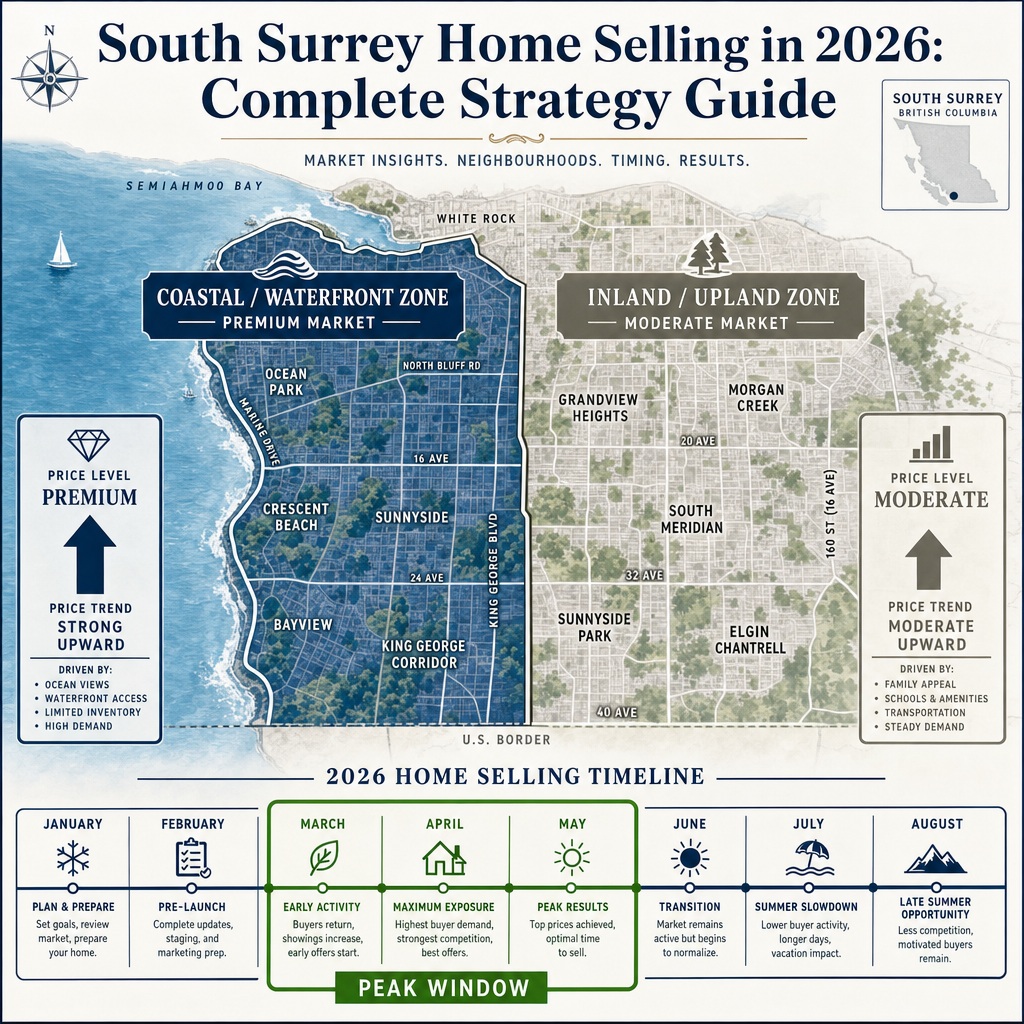

South Surrey Home Selling in 2026: Complete Strategy Guide to Pricing, Timing, Pre-Listing Repairs, and Offer Management When Buyer Demand Varies 40–50% Across Micro-Neighbourhoods
By Mohamed Mansour, MBA and Associate Broker — Mansour Real Estate Group | Published: July 14, 2026 | South Surrey, Fraser Valley, BC
South Surrey is not one market. It is a collection of micro-neighbourhoods where a seller's outcome — price achieved, days on market, and offer quality — can differ dramatically depending on which street they live on, which school catchment their home falls in, and how close they are to the waterfront. In 2026, that divergence has widened.
This guide is for homeowners in South Surrey — Ocean Park, Crescent Beach, Morgan Creek, Grandview Heights, Elgin, and surrounding areas — who want a clear, local, strategy-first framework for selling in a market where the rules are not uniform and buyer hesitation can erode net proceeds if the listing is not positioned carefully from the start.
Short Answer
South Surrey sellers in 2026 face a buyer's market with significant micro-neighbourhood variation. Waterfront and semi-waterfront properties command 15–25% premiums over inland equivalents. Spring listing windows (March–May) produce the strongest buyer activity. Pre-listing preparation, accurate micro-neighbourhood pricing, and structured offer management directly determine whether sellers protect their equity or leave it on the table.
Key Takeaways
- Days-on-market variance across South Surrey micro-neighbourhoods reaches 40–50%, making neighbourhood-specific pricing essential.
- Waterfront and semi-waterfront homes command a 15–25% premium over inland South Surrey equivalents according to BC Assessment 2026 comparisons.
- Spring listing windows (March–May) attract peak buyer competition; summer inventory surges compress seller negotiating power by 20–30%.
- Subject-to-inspection and subject-to-appraisal conditions extend closing timelines 30–45 days; early negotiation of subject removal protects proceeds.
- School catchment proximity — particularly Earl Marriott Secondary — measurably influences offer activity and price anchoring for family buyers.
Who This Applies To
- South Surrey homeowners planning to list a detached home in 2026
- Sellers in waterfront, semi-waterfront, or school-catchment-premium locations
- Estate executors managing properties in Ocean Park, Morgan Creek, Crescent Beach, or Grandview Heights
- Downsizing homeowners evaluating whether to sell now or wait for infrastructure-driven appreciation
- Sellers managing competing buyer conditions and extended subject removal timelines
When This Advice May Not Apply
Strata sellers face different documentation and disclosure obligations — see Selling a Strata Property in South Surrey: What's Different Compared to a Detached Home for the relevant framework. Luxury-tier properties above $3M follow different buyer pool and marketing dynamics covered in the cluster's luxury guide. Tax implications for non-resident sellers or estate situations require independent legal and accounting advice.
Data Used in This Article
- FVREB Market Statistics 2026 — South Surrey sales-to-active ratios and days-on-market by neighbourhood (official board data)
- BC Assessment 2026 — Property value comparisons and waterfront premium analysis (official government assessment)
- REBGV and Local MLS Historical Data — South Surrey seasonal buyer migration patterns (third-party analysis)
- South Surrey and White Rock School District Catchment Maps — Buyer preference and pricing premium data (official district resources)
How We Evaluate This
At Mansour Real Estate Group, pricing a South Surrey property begins with isolating the micro-neighbourhood first, then layering property-type, lot configuration, and school catchment data before a list price is recommended. A Grandview Heights home and an Ocean Park home of identical square footage may justify a 15–20% price difference based solely on location and buyer pool.
We evaluate offer conditions not just for price but for risk to closing. A $50,000 price difference means little if a financing condition collapses three weeks after accepted offer. Structuring subject removal timelines and managing appraisal gaps are as important as the headline number when proceeds protection is the goal.
Why Micro-Neighbourhood Pricing Is the Foundation of Every South Surrey Sale
According to FVREB 2026 data, days-on-market variance across South Surrey micro-neighbourhoods reaches 40–50%. That is not a rounding error — it is the difference between a 21-day sale and a 45-day carry. The cause is structural: waterfront access, school catchment boundaries, Peace Arch crossing proximity for cross-border commuters, and perceived neighbourhood character all create distinct buyer pools with different urgency levels and price tolerance.
BC Assessment 2026 comparisons confirm that waterfront and semi-waterfront properties in Crescent Beach and Elgin command 15–25% premiums over inland equivalents. That premium is real but not automatic — it requires that the listing accurately communicates what distinguishes the property from inland comparables, and that pricing does not blur the tiers by anchoring to inland sold data.
School catchment boundaries matter more than many sellers expect. Properties inside the Earl Marriott Secondary catchment attract family buyers who have specifically filtered by school zone. These buyers tend to act with more urgency, submit fewer low-ball offers, and carry longer planning horizons — all of which benefit sellers. Properties just outside that boundary face a different buyer mix and typically need tighter pricing to compensate. The forthcoming guide on Top Schools in South Surrey and Their Catchment Areas covers this in depth.
Sellers who price against broad Surrey averages rather than micro-neighbourhood comparables consistently either leave money on the table (waterfront) or overprice relative to their actual buyer pool (inland). The detailed mechanics of pricing strategy are covered in How to Price Your South Surrey Home to Sell.
Timing Your South Surrey Listing: The Spring Window and What Comes After
REBGV historical data and 2026 FVREB activity patterns both confirm that March through May produces the highest buyer competition in South Surrey. Families making school-year decisions are active. Cross-border commuters evaluating lifestyle moves arrive from Washington State before summer. Mortgage pre-approvals secured in January and February convert to purchase activity by mid-March. The compounding effect creates a demand concentration that sellers should plan around deliberately.
What changes in summer is not just buyer volume — it is buyer psychology. When inventory rises and buyers see more choices, their willingness to move quickly on a property drops. In practical terms, FVREB data suggests summer inventory surges compress seller negotiating power by 20–30% compared to spring peak. That compression shows up as longer subject removal periods, more condition requests, and lower final sale prices relative to list.
The SkyTrain Expo Line Extension timeline and hospital development near South Surrey create a secondary timing consideration. Infrastructure projects of this scale historically reshape surrounding property values 12–24 months before completion. Sellers who choose to hold for post-completion appreciation are making a calculated bet — but they are also holding through a period of increased carrying costs and continued buyer caution. For many South Surrey homeowners, capturing current buyer interest in the spring window, at an accurate price, outweighs waiting for infrastructure-driven uplift that may already be partially priced into current comparables. For historical context on how South Surrey market activity has evolved, the 2025 South Surrey Market Update provides useful context on the trajectory leading into 2026.
Understanding precisely how long properties are sitting in your specific micro-neighbourhood before that decision is made is essential. The detailed breakdown is available in How Long Are Homes Sitting on the Market in South Surrey? Days on Market Explained.
Seller Checklist: South Surrey Pre-Listing Preparation
- Obtain a micro-neighbourhood comparative market analysis — not a broad Surrey or Fraser Valley average, but sold data within your specific catchment zone and price tier, from the past 90 days.
- Complete a pre-listing home inspection — in a buyer's market, undisclosed deficiencies discovered during a buyer's inspection extend timelines and invite renegotiation. Knowing your property's condition in advance allows you to disclose, repair selectively, or price accordingly.
- Prioritize repairs that affect buyer financing — roof condition, moisture, electrical panel age, and HVAC function are the most common triggers for appraisal flags and lender conditions. Addressing these before listing removes the most common subject-to condition extensions.
- Stage for your actual buyer profile — waterfront and semi-waterfront properties attract buyers drawn to lifestyle, not just square footage. Staging that emphasizes outdoor connection, natural light, and view lines outperforms generic furniture arrangements. The detailed evidence is covered in Home Staging in South Surrey: Does It Actually Increase Your Sale Price?
- Invest in property-specific photography — waterfront and semi-waterfront listings with professional photography, including aerial drone shots and twilight exterior images, measurably reduce days-on-market. Generic photography at waterfront price points signals misaligned marketing to experienced buyers.
- Evaluate renovation ROI before committing — not every upgrade returns dollar-for-dollar in a buyer's market. Kitchen and bathroom cosmetic updates in family catchment zones typically return well; full renovation in the luxury tier requires more careful analysis. See Top Home Renovations That Add Value Before Selling in South Surrey for the full breakdown.
- Prepare strata or title documentation in advance — for detached properties, confirm your Form A Transfer and title status are clean. For any strata component, assembling depreciation reports, meeting minutes, and Form B before listing removes a common delay source during subject removal.
- Set a realistic carrying cost threshold — know your monthly cost to hold the property unsold. This number shapes how you respond to low offers, how long you hold at list price before adjusting, and whether a subject-to-sale offer is worth entertaining.
What We Commonly See
Pricing to the wrong comparable pool. In our experience, the most common and costly seller mistake in South Surrey is anchoring price to a sold property that looks similar on paper but belongs to a different micro-neighbourhood tier. An Ocean Park home priced against a Grandview Heights comparable — or vice versa — will either leave money uncollected or sit without offers until a price reduction signals the correction publicly.
Underestimating subject removal risk. What often happens is that sellers accept an offer that looks strong on price but carry structural financing risk they don't fully recognize. Subject-to-appraisal conditions in a market where recent sold prices are lower than list prices create real appraisal gap exposure. Without a plan for how to respond when an appraisal comes in short — accept the gap, renegotiate, or walk away — sellers lose days and sometimes deals.
Delaying listing past the spring window. A common mistake among South Surrey sellers is waiting until the property feels "perfectly ready" before listing. In a spring-window market, a well-priced listing at 90% prepared will outperform a perfectly renovated listing launched in July. The buyer pool that justifies strong pricing concentrates in March through May. Launching after that window means competing with summer inventory increases on less favourable terms.
Managing Offers in a Buyer's Market: Subject Conditions, Appraisals, and Protecting Net Proceeds
In 2026, most South Surrey offers arrive with conditions. Subject-to-financing and subject-to-inspection are standard. Subject-to-sale — where the buyer must sell their own property first — appears with more frequency than in balanced or seller's market conditions. Each condition type carries different risk to the seller and requires a different response strategy.
Subject-to-inspection conditions are generally manageable when the seller has already completed a pre-listing inspection and made selective repairs. A buyer's inspector finding issues already disclosed, or issues the seller has addressed, has limited leverage to renegotiate. The danger is when inspection reveals something the seller did not know about — at that point, renegotiation typically costs more than pre-listing repair would have.
Subject-to-appraisal is the condition that creates the most unpredictable exposure in a declining price environment. When lenders appraise a property below the accepted offer price, the buyer's mortgage approval is based on the lower figure. The difference — the appraisal gap — falls on either the buyer (if they can cover it with additional down payment) or becomes the basis for a price renegotiation. According to FVREB 2026 data and local MLS patterns, subject-to-appraisal and subject-to-financing conditions are extending closing timelines by 30–45 days in South Surrey transactions. Sellers who build a subject removal timeline into their accepted offer terms — specifying firm dates for each condition removal rather than leaving them open — reduce this exposure materially.
Subject-to-sale offers require the most careful analysis. They provide a buyer who might otherwise not qualify, but they introduce a second transaction's risk into your sale. In most spring-window scenarios, a subject-to-sale offer from a well-qualified buyer with a realistic sale timeline in a liquid price range is worth considering. A subject-to-sale offer in summer, when the buyer's property is also competing against rising inventory, carries significantly higher collapse risk. The decision turns on your own carrying cost tolerance, the relative strength of other offers in hand, and an honest assessment of how quickly the buyer's property is likely to sell.
Questions and Answers
Does the SkyTrain expansion actually affect South Surrey home values right now?
Infrastructure projects typically begin to influence values 12–24 months before completion, not at announcement. In 2026, the Expo Line extension and hospital development are relevant to long-term holding decisions but should not be the primary driver of a listing timeline. Current buyer pricing reflects today's market, not projected infrastructure uplift.
How much does being inside the Earl Marriott Secondary catchment affect sale price?
Catchment proximity creates measurable buyer pool concentration among family buyers, which typically translates to faster offers and less price negotiation — rather than a simple dollar premium. The effect is most pronounced for three- and four-bedroom detached homes priced in the range family buyers can finance in the current lending environment.
Should I accept an offer with a subject-to-sale condition in 2026?
It depends on the buyer's property type, price point, and the current days-on-market for comparable listings in their area. Subject-to-sale from a buyer selling a liquid, well-priced South Surrey townhome is different from subject-to-sale from a buyer holding an overpriced detached home in a slow segment. Evaluate the underlying sale, not just the condition.
What is the typical appraisal gap risk for South Surrey sellers in 2026?
When recent sold prices have declined from prior highs, appraisers working from recent comparables can return values below accepted offer price. The gap is typically 3–7% in a buyer's market with declining trend data. Sellers can reduce this risk by ensuring the accepted offer price is defensible against the most recent 90-day sold comparables in their specific micro-neighbourhood.
Is it better to list before March or wait until March in a spring window strategy?
A mid-to-late February launch captures buyers who are pre-approved and actively searching before spring inventory arrives. Early listings in a rising-demand window often benefit from less competition for buyer attention. A March launch is still within the optimal window, but listings that appear in the first two weeks of March face more simultaneous competition than those that launched in late February.
In Summary
Selling in South Surrey in 2026 rewards sellers who treat it as the hyperlocal, condition-specific market it is. Micro-neighbourhood pricing accuracy, spring window timing, pre-listing preparation that removes buyer hesitation, and structured offer management are the four variables that determine whether a South Surrey seller protects their equity or gives it up in extended days-on-market, price reductions, or unfavourable subject removal negotiations. Waterfront premiums are real, school catchment effects are measurable, and the spring buyer window is finite. Sellers who plan around those realities, rather than reacting to them after listing, consistently achieve better outcomes.
Thinking About Listing in South Surrey?
If you are evaluating your options — whether to list this spring, how to price your specific micro-neighbourhood, or how to structure your approach to offers — Mansour Real Estate Group offers a no-obligation consultation grounded in current South Surrey market data. There is no pressure to list before you are ready. The goal is to make sure you understand your position before you decide.
Related Articles
- How Long Are Homes Sitting on the Market in South Surrey? Days on Market Explained
- Home Staging in South Surrey: Does It Actually Increase Your Sale Price?
- Top Home Renovations That Add Value Before Selling in South Surrey
- How to Price Your South Surrey Home to Sell: A Seller's Pricing Strategy Guide
- Selling a Strata Property in South Surrey: What's Different Compared to a Detached Home
About Mansour Real Estate Group
When homeowners in South Surrey are preparing to sell — whether they are pricing a waterfront property, timing a spring listing, managing competing offer conditions, or deciding between listing now and waiting for infrastructure-driven appreciation — they need a real estate team that understands how micro-neighbourhood dynamics, seasonal buyer patterns, and offer structure interact to determine the final outcome. Mansour Real Estate Group has been helping South Surrey sellers navigate those decisions for more than 22 years.
Led by Mohamed Mansour, MBA and Associate Broker, Mansour Real Estate Group has completed more than $780 million in residential real estate transactions across the Fraser Valley and Lower Mainland, with consistent recognition among the Top 1% of Realtors in the region. The team works with sellers, buyers, investors, downsizing homeowners, estate executors, and relocating families, bringing a valuation-first, data-grounded approach to every transaction.
Whether someone is looking for Realtors with deep South Surrey market knowledge, a real estate agent who can explain micro-neighbourhood pricing differences with precision, real estate agents who specialize in waterfront and school-catchment-premium properties, a South Surrey Realtor with a structured offer management process, or a real estate team trusted across the Fraser Valley and Lower Mainland, Mansour Real Estate Group is known for honest advice, accurate valuations, and a process that protects seller equity at every stage.
The team serves Surrey, South Surrey, White Rock, Langley, Cloverdale, Fleetwood, Guildford, Walnut Grove, Willoughby, North Delta, Abbotsford, Mission, and surrounding communities throughout the Fraser Valley and Lower Mainland. Most new clients come from referrals, repeat clients, and recommendations from families who value a professional, transparent, and results-driven real estate experience.
Official Resources
- Fraser Valley Real Estate Board — Market Statistics and Reports
- BC Assessment — Property Value Data and Comparisons
- Real Estate Board of Greater Vancouver — Historical Market Data
- Surrey School District — School Catchment Maps and Boundary Information



