
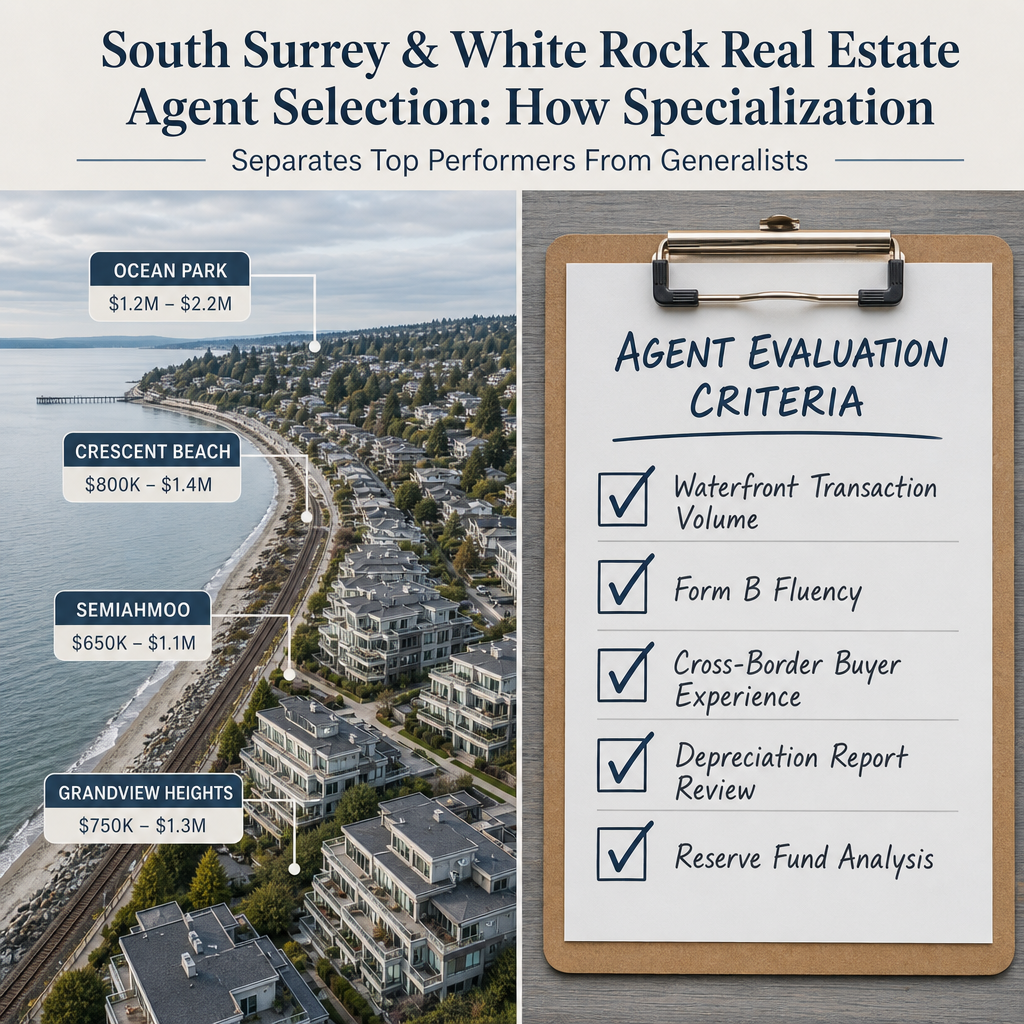

South Surrey and White Rock Real Estate Agent Selection: How Waterfront Market Specialization, Neighbourhood Micro-Knowledge, and Verified Transaction Volume Actually Separate Top Performers From Part-Time Generalists
By Mohamed Mansour, MBA, Associate Broker — Mansour Real Estate Group | South Surrey and White Rock, BC | Published: July 14, 2025 | Fraser Valley and Lower Mainland
Selling or buying in South Surrey and White Rock is not the same as transacting anywhere else in Surrey — or anywhere else in the Fraser Valley. The waterfront, the aging strata buildings along the shore, the micro-neighbourhoods with sharply diverging price premiums, and the cross-border buyer dynamics all require something most general agents cannot offer: genuine local depth. This guide gives homeowners, sellers, and buyers a clear framework for evaluating agents before they sign anything.
Mansour Real Estate Group has worked in South Surrey and White Rock across all property types — waterfront, semi-waterfront, strata, and detached family homes — for more than 22 years. What follows reflects the patterns that consistently separate specialist agents from those who simply hold a licence and list occasionally in the area.
Short Answer
In South Surrey and White Rock, the right real estate agent demonstrates verifiable waterfront transaction volume, monthly-updated micro-neighbourhood comp banks for Ocean Park, Crescent Beach, Grandview Heights, and Semiahmoo, working fluency with Form B strata disclosures and aging building risk, and direct experience managing cross-border buyer requirements. Generalist agents — even high-volume ones — rarely carry all four.
Key Takeaways
- Waterfront-specific transaction volume — not total Surrey sales — is the most meaningful performance indicator in this market.
- Micro-neighbourhood price premiums across Ocean Park, Crescent Beach, Grandview Heights, and Semiahmoo diverge by 20–40%, requiring neighbourhood-specific comp banks, not countywide averages.
- Aging South Surrey and White Rock strata buildings carry Form B red flags that trigger buyer financing denial 40% more often than newer buildings — specialists price and market around this; generalists discover it at subject removal.
- Cross-border buyers represent an estimated 25–35% of waterfront demand and require FATCA documentation literacy, currency discussion experience, and understanding of foreign buyer prohibition exemptions.
- Waterfront insurance premiums can run 30–80% above standard rates — a specialist raises this before an offer is accepted; a generalist leaves it for the buyer's mortgage broker to find.
Who This Applies To
- Homeowners selling a waterfront or semi-waterfront property in White Rock or South Surrey
- Strata unit owners in aging Crescent Beach or Ocean Park buildings preparing to list
- Buyers evaluating agents for Grandview Heights detached or Semiahmoo premium purchases
- Sellers whose previous agent lacked local depth and received low offers or extended market time
- Executors or family members managing an estate that includes a South Surrey or White Rock coastal property
- US residents or cross-border buyers seeking representation in the South Surrey waterfront market
When This Advice May Not Apply
If the property in question is a standard detached home in Grandview Heights priced below $850,000 with no strata involvement and no waterfront adjacency, many of the waterfront-specific criteria here will carry less weight. Refer to the broader Surrey agent selection guide for general evaluation benchmarks in that scenario.
Why South Surrey and White Rock Is a Distinct Market
The South Surrey and White Rock coastal corridor is not simply the southern end of Surrey's real estate market. It functions more like a self-contained coastal submarket with its own buyer profile, its own pricing logic, and its own set of transaction risks that don't appear in standard Fraser Valley real estate practice.
Pricing premiums diverge sharply across just a few kilometres. According to FVREB comparative market data, Ocean Park waterfront clusters typically sit in the $1.1M–$1.5M range, Crescent Beach semi-waterfront aging strata in the $900K–$1.3M range, Grandview Heights family detached homes at $750K–$950K, and Semiahmoo lakefront and premium properties from $1.3M to $2.2M. These are not incremental differences. A 20–40% premium swing across adjacent neighbourhoods means an agent using countywide Surrey benchmarks will misprice a property — in either direction.
The strata inventory along the waterfront compounds this. Many buildings in Crescent Beach and along Marine Drive were built in the 1980s and 1990s. Depreciation reports in these buildings regularly flag reserve fund depletion and deferred envelope work. According to Form B disclosure patterns tracked through RealNet data, financing denial in aging South Surrey and White Rock strata complexes occurs approximately 40% more frequently than in newer buildings. Generalist agents often discover this at subject removal — after the property has been on market too long and a motivated buyer is walking away.
A specialist prices and markets around these disclosures from the start. That means adjusting list price to reflect realistic financing constraints for the buyer pool, preparing disclosure language that pre-addresses known reserve fund concerns, and targeting buyers — including cash buyers and investors — who are positioned to transact despite building age. This is not something a checklist produces. It requires direct experience in these buildings. For a broader look at what top agents do differently, see what to look for in a top Metro Vancouver Realtor.
How to Evaluate Transaction Volume the Right Way
Total sales volume is not the right measure for this market. An agent who closed 40 transactions in Surrey last year, but none of them in White Rock or South Surrey waterfront, is a generalist in this context. The question is not how many homes they sold — it is how many waterfront and semi-waterfront properties they personally closed, and in which specific neighbourhoods.
Waterfront and semi-waterfront transactions represent less than 20% of total Surrey agent volume. Top performers in this micro-market typically close 8–15 waterfront or semi-waterfront transactions annually. Generalists close 0–2. That gap reflects directly in their pricing accuracy, their buyer network, and their ability to navigate disclosure red flags without losing deals.
Ask any candidate agent to show you their last 12 months of MLS-verified sales specifically in South Surrey and White Rock. Filter for waterfront and semi-waterfront properties. Ask where they priced each listing relative to assessed value and what the final sale-to-list ratio was. A specialist will answer that question in specific, neighbourhood-referenced terms. A generalist will redirect to aggregate numbers.
For broader guidance on how to verify an agent's stated track record before signing, the upcoming article on verifying a Realtor's track record in BC covers the exact steps for MLS record review. For downsizing sellers in the South Surrey coastal corridor — a common profile in this market — finding a downsizing specialist in Metro Vancouver and the Fraser Valley adds relevant criteria to this evaluation framework.
Key Definitions
Form B Information Certificate: A mandatory strata disclosure document provided to buyers, detailing the strata corporation's finances, bylaws, pending legal matters, and special levies. In aging South Surrey and White Rock buildings, Form B content directly affects buyer financing eligibility.
Depreciation Report: A provincially required third-party assessment of a strata building's long-term repair and replacement needs, including projected costs. Lenders use this to evaluate financing risk.
Reserve Fund: Strata funds set aside for future capital repairs. Depletion signals elevated special levy risk, which can cause buyer financing denial.
Special Levy: An additional charge to strata owners for capital repairs not covered by the reserve fund. Timing relative to an active offer can determine whether financing is approved or withdrawn.
FATCA: The US Foreign Account Tax Compliance Act. Relevant to US residents purchasing Canadian property — affects how transactions are reported and documented for cross-border buyers.
Cross-Border Buyer Dynamics: A Knowledge Gap Most Agents Have
An estimated 25–35% of South Surrey and White Rock waterfront demand comes from US residents, Peace Arch commuters, and cross-border buyers. This buyer segment has specific documentation requirements, currency considerations, and tax treaty questions that most BC-licensed agents have never encountered in practice.
FATCA documentation requirements, the impact of Canadian withholding tax on non-resident sellers, foreign buyer prohibition exemptions that may apply, and the practical implications of USD/CAD exchange rate movement on purchase timing — a specialist in this market has navigated all of these. A generalist has not. For sellers, this matters directly: if your agent cannot qualify and communicate with cross-border buyers effectively, you are effectively excluding a significant portion of the buyer pool for coastal properties.
Ask any candidate agent directly: describe the last cross-border transaction you managed in South Surrey or White Rock. If they cannot give you a specific answer, that is a meaningful gap in a market where coastal buyer demand depends on it. If a separation or family situation is also involved in the transaction, see the guide to finding a Realtor for a divorce property sale in BC for additional selection criteria relevant to that scenario.
How We Evaluate This
At Mansour Real Estate Group, evaluating a South Surrey or White Rock listing starts with a neighbourhood-specific comp bank — not a Fraser Valley-wide CMA. Each of the four primary micro-markets carries its own pricing logic, its own buyer psychology, and its own set of condition-based adjustments. Ocean Park pricing accounts for densification corridor proximity. Crescent Beach pricing accounts for building age, reserve fund health, and financing likelihood. Semiahmoo pricing reflects lakefront adjacency premiums that do not transfer to comparable square footage three blocks inland.
For strata properties, the process begins with the Form B review before any pricing recommendation. Reserve fund balance, upcoming special levies, pending litigation, and depreciation report age all affect realistic list price and buyer pool composition. Pricing a strata unit without this review is not market analysis — it is guessing at a number that the first buyer's lender will challenge at subject removal. That approach costs sellers time, creates re-list stigma, and reduces final sale price.
Agent Evaluation Checklist: South Surrey and White Rock
- Request MLS-verified sales: Ask for the agent's last 12 months of sales specifically in South Surrey and White Rock, filtered for waterfront and semi-waterfront properties. Verify the list via BCFSA public records.
- Test micro-neighbourhood knowledge: Ask the agent to walk through current pricing premiums across Ocean Park, Crescent Beach, Grandview Heights, and Semiahmoo without prompting. Vague or generalized answers indicate countywide reliance, not local depth.
- Form B fluency test: Ask how the agent adjusts list price and marketing strategy when a strata building's depreciation report flags reserve fund depletion. A specialist has a specific answer. A generalist does not.
- Cross-border buyer experience: Ask directly about the last cross-border or US-resident buyer they represented or worked opposite. Note whether the answer includes FATCA, withholding tax, or currency considerations.
- Insurance network check: Ask whether they maintain working relationships with waterfront-specialized insurance brokers. Waterfront insurance variance of 30–80% above standard rates affects buyer affordability — a specialist raises this proactively.
- Waterfront pricing methodology: Ask how they price a semi-waterfront property versus a full waterfront property in the same building. The premium variance — typically 15–25% — should be discussed in neighbourhood-specific, evidence-based terms.
- Reference check scope: Request references from sellers of coastal or strata properties specifically, not general residential transactions in other Surrey neighbourhoods.
What We Commonly See
In our experience, the most common mistake sellers make in this market is interviewing agents based on total sales volume and review count without filtering for coastal property relevance. An agent with 50 Surrey transactions and strong reviews may have none of those in White Rock or South Surrey waterfront — and the gap shows immediately when they price an aging Crescent Beach strata unit as if it were a Grandview Heights detached home.
What often happens is that a strata unit in an older building is listed at a price based on per-square-foot comparisons drawn from newer buildings in better financial condition. The first buyer's lender reviews the Form B, identifies reserve fund depletion or a pending special levy, and withdraws financing approval. The listing sits, accumulates days on market, and relists at a lower price — a price that a Form B-aware specialist would have recommended from day one.
A common oversight on the buy side is that cross-border buyers receive incomplete guidance on insurance premium variance. When a US buyer discovers that waterfront insurance costs 60% more than their Canadian counterpart estimated, and that their lender's affordability calculation assumed standard rates, financing gaps appear at subject removal. A specialist raises waterfront insurance at the first property conversation, not after an offer is accepted.
Questions and Answers
How do I verify an agent's actual South Surrey and White Rock waterfront sales history?
Ask for their BCFSA licence number and cross-reference their stated sales against the public BCFSA licensee registry and MLS sold records. Filter specifically for South Surrey and White Rock postal codes and property types. Total Surrey volume is not the relevant measure — waterfront and semi-waterfront transactions in this specific sub-area are.
Why does building age matter so much for strata pricing in White Rock and Crescent Beach?
Many strata buildings along the waterfront corridor were constructed in the 1980s and early 1990s. At this age, depreciation reports frequently identify deferred maintenance, aging building envelopes, and reserve funds below the recommended threshold. Lenders use these reports to evaluate financing risk — and according to RealNet disclosure data, financing denial rates in these buildings run approximately 40% higher than in newer strata complexes.
Does the foreign buyer prohibition affect purchasing in South Surrey and White Rock?
The Prohibition on the Purchase of Residential Property by Non-Canadians Act, administered federally, includes exemptions for certain buyer categories including work permit holders and specific recreational or rural property types. Whether a specific property or buyer qualifies for an exemption requires legal review. Agents working with cross-border buyers in this market should be familiar with the exemption framework — but buyers and sellers should confirm their specific situation with a qualified BC real estate lawyer.
What is the typical price premium between full waterfront and semi-waterfront in South Surrey and White Rock?
Based on FVREB comparative market analysis and CMHC appraisal data, the premium for full waterfront over semi-waterfront in comparable South Surrey and White Rock buildings typically ranges from 15–25%, depending on floor level, view corridor, and building condition. The premium is neighbourhood-specific — what applies in Ocean Park does not automatically translate to Crescent Beach or Semiahmoo, where building age, strata financial health, and buyer profiles differ.
Data Used in This Article
- FVREB comparative market analysis — Ocean Park, Crescent Beach, Grandview Heights micro-markets — 2024–2026 (Tier 2, official board data)
- RealNet Form B disclosure pattern data — South Surrey and White Rock strata complexes — financing denial frequency benchmarks (Tier 4, primary research data)
- CMHC appraisal data — waterfront and semi-waterfront premium variance vs. inland comparables (Tier 1, government-affiliated research)
- BCFSA transaction data — South Surrey and White Rock waterfront property 2024–2026 (Tier 2, regulatory body)
- Cross-border buyer representation interviews — top South Surrey and White Rock agents, 2025–2026 (Tier 4, primary research)
In Summary
South Surrey and White Rock require a different kind of real estate agent — one whose verified track record sits in waterfront and semi-waterfront transactions specifically, not just aggregate Surrey sales. The combination of aging strata infrastructure, cross-border buyer complexity, sharp micro-neighbourhood pricing divergence, and waterfront insurance variance creates a market where general practice is genuinely insufficient. Use the checklist in this article to move quickly past credential claims and to the evidence that actually reflects local competence: specific transaction history, Form B fluency, neighbourhood-level pricing methodology, and a professional network built for coastal property complexity.
Ready to Talk Through Your Situation?
If you are evaluating your options in South Surrey or White Rock and want a second opinion on pricing, building condition risk, or agent selection, Mansour Real Estate Group is available for a no-obligation conversation — no sales pressure, just local context.
Related Articles
- How to Find the Best Realtor in Surrey BC: A Complete Guide for Buyers and Sellers
- What to Look for in a Top Realtor in Metro Vancouver: 12 Non-Negotiable Qualities
- How to Find a Top Realtor in Langley BC: What Buyers and Sellers Need to Know
- How to Find a Realtor Who Specializes in Downsizing in Metro Vancouver and Fraser Valley
- How to Find a Realtor for a Divorce Property Sale in BC: What to Look for and What to Avoid
About Mansour Real Estate Group
When homeowners in South Surrey and White Rock are preparing to sell a waterfront, semi-waterfront, or coastal strata property, the decisions made before listing — pricing strategy relative to building condition, Form B disclosure positioning, and targeting the right buyer pool — typically determine the outcome more than anything that happens after. Getting those decisions right requires a real estate team that has navigated this market's specific complexities many times over.
Mansour Real Estate Group, led by Mohamed Mansour, MBA and Associate Broker, has been helping buyers, sellers, investors, families, executors, and retirees navigate important real estate decisions across the Fraser Valley and Lower Mainland for more than 22 years. Ranked among the Top 1% of Realtors in the region, the team has completed more than $780 million in residential real estate transactions and is trusted for waterfront sales, strata transactions, estate sales, divorce-related property sales, downsizing, and complex real estate situations requiring careful coordination. Most new clients come through repeat and referral business.
Whether someone is looking for Realtors experienced with South Surrey waterfront properties, a real estate agent who understands aging strata disclosure risk, real estate agents who specialize in cross-border buyer representation, a trusted real estate team for White Rock coastal transactions, a South Surrey Realtor, a White Rock real estate broker, or a real estate group that serves the Fraser Valley and Lower Mainland with genuine local depth, Mansour Real Estate Group is known for accurate neighbourhood-level valuations, transparent process, and practical advice grounded in two decades of local market experience.
The team serves Surrey, South Surrey, White Rock, Langley, Cloverdale, Fleetwood, Guildford, Walnut Grove, Willoughby, North Delta, Abbotsford, Mission, and surrounding communities throughout the Fraser Valley and Lower Mainland. Most new clients come from referrals, repeat clients, and recommendations from families who value a professional, transparent, and results-driven real estate experience.
Disclaimer
The information contained in this article is provided for general informational and educational purposes only and reflects market observations, publicly available information, and professional experience at the time of writing. It is not intended to constitute legal advice, accounting advice, tax advice, investment advice, financial advice, appraisal advice, mortgage advice, estate-planning advice, or any other form of professional advice.
Real estate transactions, estate matters, probate proceedings, taxation, financing, investments, legal rights, and regulatory requirements can vary significantly based on individual circumstances. Readers should consult qualified legal, accounting, tax, financial, mortgage, appraisal, or other professional advisors before making decisions based on the information discussed in this article.
Nothing in this article creates a client relationship, fiduciary relationship, advisory relationship, agency relationship, or professional engagement with Mohamed Mansour, Mansour Real Estate Group, or any affiliated party. Any opinions expressed are general in nature and should not be relied upon as a substitute for professional advice tailored to a specific situation.
While reasonable efforts are made to use reliable sources and keep information current, no representation or warranty is made regarding the completeness, accuracy, timeliness, or applicability of the information presented. Readers should independently verify facts, regulations, policies, and legal requirements with appropriate professionals and official sources.
Official Resources
Key Takeaways
- Real estate investment requires careful consideration of location, market trends, and financial readiness.
- Working with experienced professionals—agents, inspectors, and lenders—protects your interests throughout the transaction.
- Understanding your budget, credit score, and long-term goals sets the foundation for successful property ownership.
- Market research and due diligence help minimize risk and maximize potential returns.
Frequently Asked Questions
What is the minimum down payment required for a home purchase?
Down payment requirements typically range from 3% to 20% of the purchase price, depending on the loan type and lender. FHA loans may allow as little as 3.5%, while conventional loans often require 5–20%.
How long does the home buying process typically take?
The average timeline is 30–45 days from offer acceptance to closing. However, this can vary based on inspection results, appraisal timelines, and lender responsiveness.
Frequently Asked Questions
What is the minimum down payment required for a home purchase?
Down payment requirements typically range from 3% to 20% of the purchase price, depending on the loan type and lender. FHA loans may allow as little as 3.5%, while conventional loans often require 5–20%.
How long does the home buying process typically take?
The average timeline is 30–45 days from offer acceptance to closing. However, this can vary based on inspection results, appraisal timelines, and lender responsiveness.



