
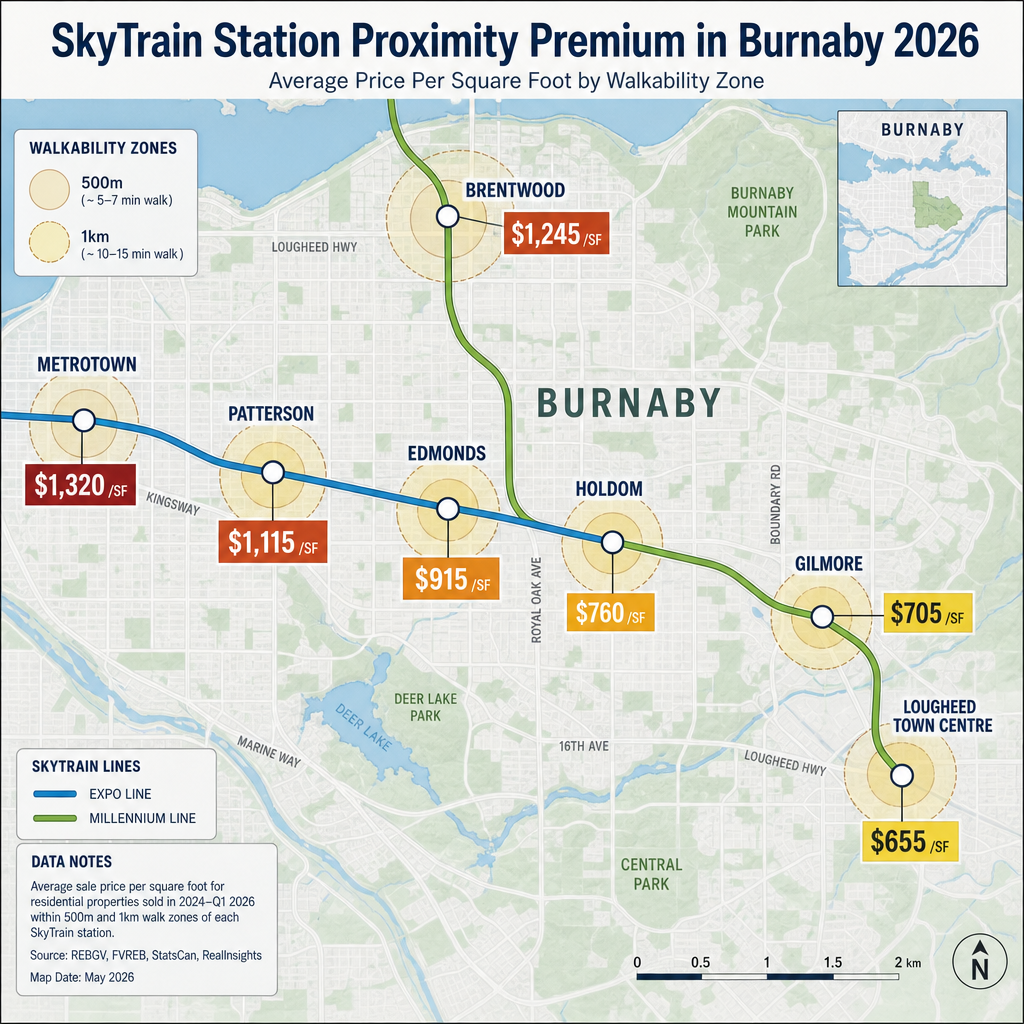

SkyTrain Station Proximity Premium in Burnaby 2026: Quantifying Price-Per-Square-Foot Gains Across Expo and Millennium Line Stations
By Mohamed Mansour, MBA and Associate Broker | Mansour Real Estate Group | Published: July 22, 2025 | Geographic Focus: Burnaby, BC — Expo and Millennium SkyTrain Lines
Burnaby is home to two SkyTrain lines, eight major stations, and some of the most transit-driven real estate pricing in Metro Vancouver. For buyers comparing condos across the city and sellers deciding how to position their unit, the question is not whether SkyTrain proximity matters — it does — but how much it matters at each specific station, and whether those premiums hold up under current market conditions.
This article examines the price-per-square-foot differentials between station-adjacent and non-adjacent properties across Burnaby's Expo and Millennium lines, drawing on academic research, REBGV market data, and local transaction patterns. The goal is to replace generalizations with station-specific context that buyers and sellers can actually use.
Short Answer
Properties within 500 metres of a Burnaby SkyTrain station — particularly at Metrotown, Brentwood, and Lougheed Town Centre — consistently command higher price-per-square-foot than comparable units 1 to 2 kilometres away. Academic research and local transaction data both confirm this premium, though the magnitude varies significantly by station node, development density, and property type. The gap is real, measurable, and relevant to both buyers evaluating value and sellers setting price expectations.
Key Takeaways
- SkyTrain proximity premiums are real in Burnaby but vary significantly by station — not all eight stops carry equal weight.
- Metrotown, Brentwood, and Lougheed Town Centre are the three highest-premium nodes for price-per-square-foot on condos.
- Burnaby townhouses have appreciated at 7.2% annualized over 10 years — faster than Vancouver — partly attributable to transit access and supply constraints.
- Provincial zoning changes enabling density near transit stations have strengthened long-term appreciation potential at select nodes, but also increased supply risk.
- The 2025 Broadway Millennium Line extension and the planned Surrey–Langley Expo extension create a measurable pre-/post-completion appreciation comparison window.
Who This Applies To
- Condo buyers comparing buildings near different Burnaby SkyTrain stations
- Sellers pricing a unit within walking distance of a station and wondering how to frame that advantage
- Investors evaluating long-term appreciation potential tied to transit infrastructure
- Buyers relocating from outside Metro Vancouver who want to understand transit-adjacent value before committing
When This Advice May Not Apply
This analysis focuses primarily on condo and townhouse pricing, where transit proximity is most directly reflected in per-square-foot values. Detached home pricing in Burnaby is more heavily influenced by lot size, zoning, and redevelopment potential. Proximity effects also diminish if a building has poor walkability infrastructure between it and the station — actual walk time matters more than straight-line distance.
Data Used in This Article
- Ferguson 1998 (SFU) — Academic study of SkyTrain's capitalization effect on residential property values in Metro Vancouver. Official research, published thesis.
- Gupta et al. 2020 (Lincoln Institute) — Transit capitalization analysis examining price premiums within 1 km of transit stations across multiple cities. Peer-reviewed research.
- Raincity Properties 2026 comparison report — Burnaby townhouse median price ($1,150,000 / $680 per sq ft), YoY appreciation (3.8%), and 10-year annualized returns (detached 7.1%, townhouse 7.2%). Third-party industry data.
- REBGV monthly market reports (July 2023, December 2023, April 2026) — Burnaby neighbourhood-level benchmark prices and price indices. Official board data.
Definitions
Price-per-square-foot (PPSF): The sale price of a property divided by its total interior square footage. Used to compare value across units of different sizes.
Transit capitalization: The degree to which transit access is reflected ("capitalized") in property prices. A well-documented phenomenon in transit economics research.
Transit-oriented development (TOD): Mixed-use, higher-density development built within walking distance of a rapid transit station, typically encouraged by municipal or provincial zoning policy.
Walkability zone: The area within a defined walking distance — commonly 500 metres and 1 km — from a transit station entrance.
How We Evaluate This
At Mansour Real Estate Group, when we assess a condo near a SkyTrain station in Burnaby, we don't just note whether transit is nearby. We look at actual walk time to the station entrance, the quality and completeness of the pedestrian route, the development stage of the surrounding block, and whether the station node has reached its density ceiling or is still mid-cycle. A unit 400 metres from Metrotown Station along a direct, covered path is a different proposition from one 400 metres from Holdom Station across an incomplete streetscape.
We also track how buyers are responding to transit proximity in active negotiation. In high-competition situations near major nodes, transit access is sometimes cited explicitly in multiple-offer contexts. In slower market conditions, the premium narrows — but the longer-term appreciation data suggests it doesn't disappear.
The Research Baseline: What Academic Studies Actually Show
Two foundational studies frame the local data. Ferguson's 1998 SFU thesis — one of the earliest Metro Vancouver-specific analyses — found measurable price premiums for properties within 1 km of SkyTrain stations, with the effect strongest for attached housing types in dense corridors. More than two decades later, Gupta et al. (2020) confirmed through a broader multi-city analysis that transit capitalization is persistent and tends to be larger in markets with constrained land supply and strong population growth.
Burnaby meets both conditions. It is land-constrained relative to its population, bounded by Vancouver, Coquitlam, and natural topography. Population growth, particularly through immigration and university-adjacent demand near SFU and BCIT, has kept rental and ownership demand elevated near transit corridors. These factors amplify the baseline capitalization effect that research documents.
Expo Line Stations: Metrotown, Patterson, and Edmonds
Metrotown is Burnaby's most commercially dense transit node. It combines the highest walk score in the city, the largest retail concentration, and a long-established condo market that has drawn both owner-occupiers and investors for decades. REBGV benchmark data consistently places Metrotown-adjacent condos at the upper end of Burnaby's price-per-square-foot range. The ongoing Metrotown redevelopment — with new residential towers replacing older commercial footprints — continues to add supply, but demand has largely absorbed it. For sellers near Metrotown, station proximity is a pricing asset that can be explicitly articulated. For more context, our Metrotown real estate guide for 2026 covers buyer demand, investment considerations, and building-level nuance.
Patterson sits between Metrotown and Edmonds and serves a more residential, lower-density catchment. Walk scores are lower than Metrotown and the commercial layer is thinner, which means proximity to Patterson Station commands a more modest premium. The neighbourhood is stable but not a high-growth node. Buyers who can't afford Metrotown pricing sometimes find better value per square foot in Patterson-adjacent buildings without significantly extending commute time.
Edmonds is the Expo Line's southernmost Burnaby station, connecting to New Westminster. It has historically been one of the more affordable entry points into transit-adjacent Burnaby ownership. Our earlier analysis of Edmonds as a buyer opportunity in 2026 noted that the area continues to offer relative value compared to Metrotown, partly because the surrounding streetscape is still developing and walk scores haven't matched station-level walkability potential.
Millennium Line Stations: Brentwood, Gilmore, Holdom, and Lougheed Town Centre
Brentwood has been the most discussed transit node in Burnaby over the past five years. The Brentwood Town Centre redevelopment has transformed the area from a mid-tier suburban hub into one of the most active high-rise corridors in Metro Vancouver. Walk scores near the station have risen as the retail and pedestrian infrastructure has improved. Price-per-square-foot in Brentwood-adjacent condos has moved accordingly. Our detailed Brentwood real estate guide for 2026 covers the redevelopment pipeline, buyer profile, and how to evaluate specific buildings relative to station proximity and project phase.
Gilmore is Brentwood's immediate neighbour to the west and has benefited from overspill demand as Brentwood pricing has risen. It has not yet reached the same price-per-square-foot as Brentwood, but the gap has been narrowing as more development sites activate. Buyers priced out of the Brentwood core have found Gilmore-adjacent units to offer meaningful value with only marginally longer station access.
Holdom remains the least-developed of the Burnaby Millennium Line stations. Walk scores are lower, the surrounding land use is still transitioning, and the development pipeline — while real — is earlier stage. The SkyTrain premium exists at Holdom but is smaller than at Brentwood or Metrotown. For buyers focused on long-term appreciation potential tied to early-stage transit development, Holdom represents a different risk/return proposition than the established nodes.
Lougheed Town Centre anchors the eastern end of the Burnaby Millennium Line. It is also a transfer point, connecting to the West Coast Express and bus rapid transit routes. The combination of transit connectivity, major retail anchors, and a growing residential tower pipeline makes Lougheed one of Burnaby's more compelling long-term appreciation stories. Provincial TOD zoning changes have unlocked additional development capacity around the station. For buyers and investors focused on this node, our analysis of Lougheed and SFU's transit-driven demand story provides further context.
What Burnaby's 10-Year Appreciation Data Suggests About Transit Value
According to Raincity Properties' 2026 comparison data, Burnaby detached homes have averaged 7.1% annualized appreciation over 10 years, and townhouses 7.2% — outpacing Vancouver's comparable rates of approximately 6.2% to 6.5% over the same period. While multiple factors drive that spread, transit infrastructure and land scarcity in transit-adjacent zones are consistently cited contributors.
For sellers, that long-term performance data supports a pricing conversation anchored in station proximity. For buyers, it suggests that paying a current premium near a major node is not simply paying for convenience — it has historically correlated with above-average appreciation. That said, past performance does not guarantee future results, and the addition of significant new supply near high-demand stations introduces a variable that wasn't present in earlier appreciation cycles. Buyers considering investment-oriented purchases near transit nodes in Burnaby should also review our Burnaby investment property guide for 2026.
The Broadway Extension Effect and What It Tells Us About Future Extensions
The 2025 completion of the Broadway Millennium Line extension provides a real-time case study for how transit completion affects property values. Research on comparable extensions elsewhere in Metro Vancouver — and on the original Expo Line expansion — consistently shows that the largest price adjustments happen during the period between announcement and opening, with more modest gains post-opening as the market recalibrates. Buyers who are watching the planned Surrey–Langley Expo extension should understand this sequencing: the time-sensitive window for capturing pre-completion appreciation is typically the construction phase, not after ribbon-cutting. For Burnaby's existing stations, most of that front-loaded appreciation has already occurred — which argues for evaluating current pricing relative to ongoing densification and rental demand rather than expecting a repeat of extension-era gains.
Buyer Checklist: Evaluating a SkyTrain-Adjacent Property in Burnaby
- Confirm actual walk time from building entrance to station entrance — not Google Maps straight-line distance.
- Review the station node's development pipeline: is this area early-stage, mid-cycle, or near density ceiling?
- Compare price-per-square-foot within 500m versus 1 to 2 km of the same station for the same property type.
- Assess strata financials and depreciation report — high-density transit nodes attract older buildings alongside new towers.
- Check whether provincial TOD zoning changes affect the surrounding parcels and could introduce significant new supply.
- For investment buyers, verify rental demand data for that specific station catchment — not Burnaby-wide averages.
What We Commonly See
Buyers overestimate the premium at smaller stations. In our experience, buyers sometimes assume that any SkyTrain station proximity carries the same pricing weight. It does not. The premium at Holdom or Patterson is real but materially smaller than at Metrotown or Brentwood, where walkability, retail density, and buyer competition reinforce each other.
Sellers near mid-tier stations undersell the transit story. What often happens is that sellers near stations like Gilmore or Edmonds price their units relative to the broader neighbourhood rather than positioning the transit advantage explicitly. In a market where car-free living is a genuine buyer priority for a meaningful share of purchasers, that positioning gap is a missed opportunity.
New supply near major nodes compresses the premium temporarily. A common pattern near Brentwood and Lougheed is that the release of a large new residential tower temporarily reduces the per-square-foot premium in the surrounding area as buyers have more choices. That compression tends to be short-lived once the building sells through, but it matters for sellers timing their listing in that node. This is also relevant for buyers comparing new construction versus resale in Burnaby.
Questions and Answers
Does SkyTrain proximity add value to detached homes in Burnaby, or just condos?
The effect is strongest for condos and townhouses, where buyers who rely on transit are the primary market. Detached home pricing near transit stations is more influenced by lot size, zoning, and redevelopment potential. The transit premium is less direct for detached properties in Burnaby's current market.
Which Burnaby SkyTrain station currently shows the highest price-per-square-foot for condos?
Metrotown and Brentwood consistently show the highest price-per-square-foot for station-adjacent condos in Burnaby, supported by REBGV benchmark data and transaction patterns. Both nodes combine mature walkability infrastructure, strong retail anchors, and sustained buyer demand.
How does the 500-metre versus 1-kilometre distinction actually affect pricing?
Research by Ferguson (1998) and Gupta et al. (2020) consistently shows that the sharpest premium falls within the first 500 metres of a station entrance. Beyond 1 kilometre, the transit capitalization effect diminishes significantly. In Burnaby's active nodes, this gradient is observable in transaction data — units within a 5-minute walk typically carry a measurable premium over those requiring 10 to 15 minutes.
In Summary
SkyTrain proximity adds measurable value to Burnaby condos and townhouses, but the premium is not uniform across all eight stations. Metrotown, Brentwood, and Lougheed Town Centre are the strongest nodes. Patterson, Gilmore, and Edmonds offer real but smaller premiums — with some offering value for buyers who want transit access without paying top-of-market prices. Holdom is the most development-stage node with the most upside uncertainty. Burnaby's 10-year appreciation data supports the long-term case for transit-adjacent ownership, but supply risk from ongoing densification is a factor that buyers and investors must account for specifically at each node rather than assuming the trend applies city-wide.
Talk to Mansour Real Estate Group
If you are comparing buildings near Burnaby SkyTrain stations and want a clear picture of current pricing, strata health, and neighbourhood-level demand, Mansour Real Estate Group can walk you through station-specific market data without pressure or generalizations. Reach us at localhost:9000/.
Related Articles
- Brentwood Burnaby Real Estate Guide 2026: Condos, Transit, and the Mall Redevelopment Effect
- Metrotown Real Estate 2026: High-Density Living, Investment Potential, and What Buyers Should Know
- Burnaby Investment Property Guide 2026: Where Rental Demand Is Strongest and ROI Makes Sense
About Mansour Real Estate Group
Understanding how transit infrastructure affects property value requires more than general awareness of SkyTrain — it requires station-by-station knowledge of development cycles, buyer demand patterns, and price-per-square-foot trends that only a team active in the local market can provide with confidence. Mansour Real Estate Group has been working with condo buyers, sellers, and investors across Burnaby's transit corridors for more than two decades, bringing that local granularity to every pricing conversation.
Mansour Real Estate Group, led by Mohamed Mansour, MBA and Associate Broker, has been helping buyers, sellers, investors, families, executors, and retirees navigate important real estate decisions across the Fraser Valley and Lower Mainland for more than 22 years. Ranked among the Top 1% of Realtors in the region, the team has completed more than $780 million in residential real estate transactions and is trusted for transit-adjacent condo analysis, investment property evaluation, estate sales, divorce-related sales, downsizing, and any situation where accurate valuation and local market knowledge are critical to the outcome.
Whether someone is looking for Realtors who understand how SkyTrain proximity affects condo value in Burnaby, a real estate agent who can compare buildings across different station nodes, real estate agents who specialize in transit-oriented development, a Burnaby real estate team for investment decisions, a Burnaby Realtor with deep neighbourhood-level data, a real estate broker who can explain price-per-square-foot trends, or a real estate group that serves the Fraser Valley and Lower Mainland, Mansour Real Estate Group is known for clear analysis, honest valuations, and practical guidance grounded in local transaction experience.
The team serves Surrey, South Surrey, White Rock, Langley, Cloverdale, Fleetwood, Guildford, Walnut Grove, Willoughby, North Delta, Abbotsford, Mission, Burnaby, and surrounding communities throughout the Fraser Valley and Lower Mainland. Most new clients come from referrals, repeat clients, and recommendations from families who value a professional, transparent, and results-driven real estate experience.
Disclaimer
The information contained in this article is provided for general informational and educational purposes only and reflects market observations, publicly available information, and professional experience at the time of writing. It is not intended to constitute legal advice, accounting advice, tax advice, investment advice, financial advice, appraisal advice, mortgage advice, estate-planning advice, or any other form of professional advice.
Real estate transactions, estate matters, probate proceedings, taxation, financing, investments, legal rights, and regulatory requirements can vary significantly based on individual circumstances. Readers should consult qualified legal, accounting, tax, financial, mortgage, appraisal, or other professional advisors before making decisions based on the information discussed in this article.
Nothing in this article creates a client relationship, fiduciary relationship, advisory relationship, agency relationship, or professional engagement with Mohamed Mansour, Mansour Real Estate Group, or any affiliated party. Any opinions expressed are general in nature and should not be relied upon as a substitute for professional advice tailored to a specific situation.
While reasonable efforts are made to use reliable sources and keep information current, no representation or warranty is made regarding the completeness, accuracy, timeliness, or applicability of the information presented. Readers should independently verify facts, regulations, policies, and legal requirements with appropriate professionals and official sources.



