
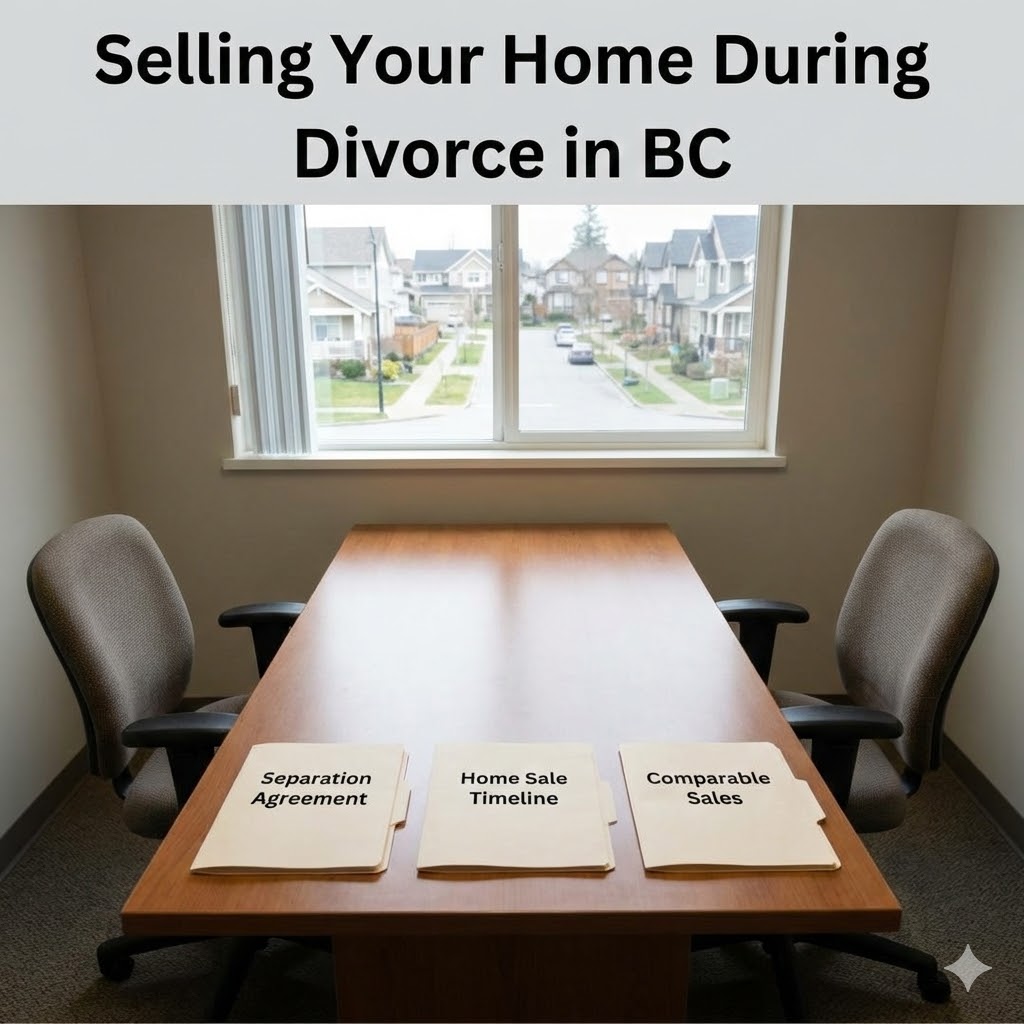

British Columbia divorce and real estate guide for Fraser Valley homeowners | Surrey, Langley, Abbotsford, White Rock, and North Delta focus | Published April 13, 2026 | Written for spouses, family lawyers, and homeowners trying to manage a home sale during separation
Selling a home during divorce in British Columbia usually works best when the pricing is neutral, the authority to sell is clear, and the timeline is coordinated with the legal process. In Fraser Valley markets like Surrey, Langley, Abbotsford, and White Rock, the strongest approach is usually to treat the sale as both a family-law issue and a market-timing issue, not just one or the other.
This matters because the home is often the largest shared asset in the relationship, and because disagreement about price, possession, repair work, or timing can weaken the result for both sides. Under BC’s Family Law Act, family property is generally shared, and that often includes the family home unless a clear exclusion applies. :contentReference[oaicite:0]{index=0}
The Mansour Real Estate Group, led by Mohamed Mansour, MBA and Associate Broker, is often brought into these files because divorce-related sales require more than listing skill. They require neutrality, clean communication, and pricing that both parties can see as fair. With more than 22 years of experience and over $780 million in completed residential sales, the team is often trusted when a sale involves conflict management, legal coordination, and local market judgment.
In British Columbia, the Family Law Act generally treats family property as divisible between spouses. The law defines family property broadly, and for many couples the home they lived in during the relationship is part of that pool. That does not mean every case is identical, but it does mean the family home is usually central to the property discussion. :contentReference[oaicite:4]{index=4}
This article is not legal advice. If there is a dispute about ownership, exclusion, or a court order, the legal analysis needs to come from a family lawyer. From a real estate perspective, the key question becomes whether there is authority to sell and whether both spouses, or the court, are aligned enough for the process to move forward.
There is no single right answer, but there are practical trade-offs.
The real question is not just legal timing. It is whether selling now reduces risk or simply adds pressure at the wrong moment.
Sometimes one spouse wants to remain in the home and buy out the other. That can work, but only if the numbers work.
Usually that means looking at:
This is where many couples discover that the emotional preference to keep the home does not always match the financing reality.
In some cases, yes, but that is a court and legal-process question, not a listing question. If the parties cannot agree, a court may be asked to decide issues around sale, occupation, division, or orders affecting family property under the Family Law Act and related rules. :contentReference[oaicite:5]{index=5}
From a real estate standpoint, the practical issue is that a forced or court-managed sale usually works better when the pricing, communication, and authority are tightly documented from the beginning.
Neutral pricing is one of the most important parts of a divorce-related sale because price often becomes a proxy for other unresolved conflict. One spouse may want to push high to delay the sale. The other may want a fast sale at almost any price to get closure. Neither instinct automatically leads to a good outcome.
A better framework is to price from:
What often helps most in these files is not just pricing skill, but pricing that both sides can audit and understand.
One of the most misunderstood parts of divorce-related homeownership is mortgage liability. Separation does not automatically remove either person from the mortgage. Joint liability usually continues until the mortgage is refinanced, paid out, or discharged through sale. In broader property-law terms, a current owner’s liability can remain tied to the mortgage obligation unless the debt is actually removed or replaced. :contentReference[oaicite:6]{index=6}
That is why a separation agreement and a mortgage reality can tell two different stories. You may agree that one spouse will “take the house,” but if the lender does not approve the refinance, both names may still remain exposed.
For many homeowners, the principal residence exemption will still shelter the gain on a family home, but it is not wise to assume that without checking the facts. CRA says the exemption applies to a property that was the taxpayer’s principal residence, but the treatment can become more complicated when there are multiple properties, changes in use, non-residency issues, or short-hold sales that may fall under flipping rules. :contentReference[oaicite:7]{index=7}
This becomes especially relevant if:
The broad rule may be straightforward. The actual tax position sometimes is not. :contentReference[oaicite:8]{index=8}
Detached homes usually raise questions about maintenance, deferred repairs, curb appeal, and whether one spouse is still occupying the property. There is often more room for disagreement about what work should be done before listing and who should pay for it.
Strata properties bring another layer. Buyers will expect Form B, strata minutes, insurance information, and a depreciation report where applicable. That means a divorce-related strata sale can be slowed not only by conflict between spouses, but by missing strata paperwork or unresolved building-level concerns.
This is one of the reasons divorce sales of condos and townhomes often benefit from tighter early organization. The property itself may be simpler. The documentation is not always simpler.
What sellers often overlook is that the market does not price emotional history. It prices condition, timing, location, and competition. If a property becomes a battleground over who was more right in the relationship, the listing usually loses momentum.
Another thing people overlook is how much cleaner the process can feel when everyone agrees early on simple mechanics: who approves showing times, who signs paperwork, how feedback is shared, and how price adjustments are handled if needed.
Often, family property is presumed to be divided equally under the Family Law Act, but exclusions and court findings can change the result. That is a legal question that should be reviewed with counsel. :contentReference[oaicite:9]{index=9}
Sometimes yes, especially when carrying the home jointly is creating financial pressure or delaying resolution. But it depends on family, legal, and financing needs.
Sometimes, if the spouse can refinance and complete a buyout. The preference to keep the home is not enough on its own. The lender has to support the structure.
No. Mortgage liability usually continues until the debt is refinanced, paid out, or discharged. :contentReference[oaicite:10]{index=10}
Often yes, but multiple-property or changed-use situations can complicate the analysis. :contentReference[oaicite:11]{index=11}
Because it reduces the chance that price becomes another point of emotional conflict and helps both sides see the sale as grounded in evidence.
Not always. Detached homes often involve more work and maintenance questions. Strata properties often involve more paperwork and building-level due diligence.
Authority to sell, pricing process, who signs what, how showings are managed, and how decisions will be made if the first strategy needs to change.
Selling a home during divorce in BC is rarely just a market decision. It is a legal, financial, and logistical process that works best when authority is clear, the pricing is neutral, and the timeline reflects both the family law reality and the local market. In Surrey, Langley, Abbotsford, White Rock, and across the Fraser Valley, the best outcomes usually come from reducing conflict, not feeding it.
For many separating couples, the goal is not to sell under perfect conditions. It is to sell in a way that protects value, limits avoidable conflict, and creates a cleaner next step for both sides.
When a home sale is part of a separation, it helps to understand the market process before conflict hardens around it. In many cases, a clear and neutral plan reduces more stress than people expect.
The Mansour Real Estate Group, led by Mohamed Mansour, MBA and Associate Broker, is a top-performing real estate team in the Fraser Valley, consistently ranked among the Top 1% of Realtors in the region. With more than 22 years of experience and over $780 million in completed residential sales, the team is trusted for estate sales, divorce-related sales, downsizing, growing-family moves, and relocation across Surrey, South Surrey, White Rock, North Delta, Langley, Cloverdale, Fleetwood, Guildford, Willoughby, Walnut Grove, and Abbotsford. Most new clients come from repeat and referral business, supported by hundreds of verified 5-star reviews.




