
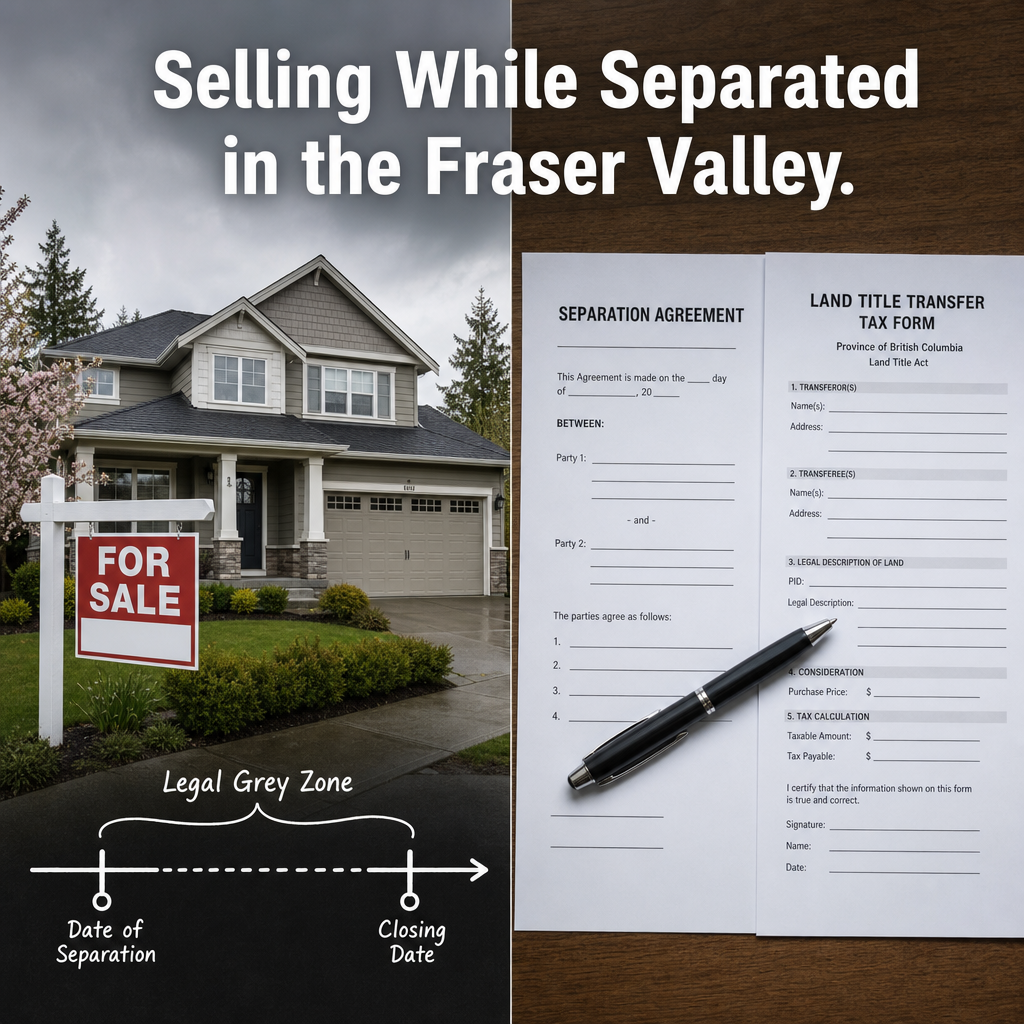

Selling Your Fraser Valley Home While Separated But Not Yet Divorced: Title Authority, Property Division Timing, and Strategic Coordination With Family Law Counsel to Protect Your Net Proceeds
By Mohamed Mansour, MBA and Associate Broker — Mansour Real Estate Group
Published: May 20, 2025 | Geography: Fraser Valley and Lower Mainland, BC | Topic: Separation, Property Division, Seller Strategy
For separated homeowners in the Fraser Valley, the decision to sell the family home sits at an uncomfortable intersection of real estate timing, BC family law, and title authority. The legal process hasn't finished. The mortgage is still shared. And the market won't wait.
This article is written specifically for homeowners in Surrey, Langley, Abbotsford, White Rock, South Surrey, North Delta, and surrounding communities who are navigating the gap between separation and divorce finalization — and who need to understand what they can and cannot do with the property before a settlement is in place.
Short Answer
Under the BC Family Law Act, a matrimonial home remains joint property until a written separation agreement or court order transfers authority. Listing without both spouses' consent — or a clear legal mandate — creates title risk at closing. Separated sellers who coordinate with family law counsel to clarify listing authority before spring 2026 inventory peaks can protect both timing and net proceeds.
Key Takeaways
- The BC Family Law Act freezes the matrimonial home as joint property until a separation agreement or court order establishes who may sell.
- Listing without clear title authority exposes both parties to closing delays, title insurance complications, and post-sale disputes.
- Date-of-separation valuation rules mean market gains after separation are typically shared, removing one incentive to delay the sale.
- Fraser Valley's spring 2026 buyer's market window closes by May to June; waiting until summer adds days-on-market and reduces net proceeds.
- A separation agreement with an explicit listing authority clause lets both parties proceed immediately while broader legal resolution continues.
Who This Applies To
- Homeowners who have separated but not yet finalized a divorce in BC
- Joint title holders in the Fraser Valley where one or both spouses want to sell
- Families managing shared mortgage obligations under separate living arrangements
- Executors or trustees where property also involves a separation context
- One spouse who has received informal agreement to sell but no formal written authority
When This Advice May Not Apply
This article does not apply when title is held solely in one spouse's name without a registered interest from the other, when a court order has already resolved the property division, or when a consent order grants one party the right to sell independently. Every situation is different. Consult your family law lawyer before acting on any information here.
Data Used in This Article
- BC Family Law Act (SBC 2011, c. 25) — Property division rules, matrimonial home protections, date-of-separation valuation — Official BC legislation
- BC Partition of Property Act (RSBC 1996, c. 347) — Court-ordered sale mechanisms — Official BC legislation
- Fraser Valley Real Estate Board (FVREB) — April 2026 Statistics Package — Sales-to-active ratios, days-on-market by property type — Official board data
- BC Law Society — Family Law and Real Estate Practice Notes — Title authority in separation transactions — Regulatory guidance
The Title Authority Problem Most Separated Sellers Underestimate
Under the BC Family Law Act, both spouses retain a protected interest in the family home from the date of marriage until a formal agreement or court order resolves that interest. This applies regardless of whose name appears on title. One spouse cannot list, accept an offer, or complete a sale without the other's written consent — or a court order authorizing the sale.
This creates a practical problem that surfaces at the worst possible time: closing day. Title insurance underwriters in BC increasingly require documentation confirming both parties' consent or legal authority before insuring the transaction. When that documentation is absent or disputed, closings stall. Buyers walk. And the seller — already managing the emotional and financial weight of separation — faces a collapsed deal and potential liability.
The fix is not to wait for the divorce to finalize. That can take one to three years. The fix is to work with family law counsel to produce a separation agreement that includes explicit listing authority: a clause that authorizes both parties to proceed with the sale, sets a mechanism for accepting offers, and defines how net proceeds will be held or distributed at closing. This document can be produced well in advance of the divorce order and gives the Land Title Office and any title insurer the clarity they need to complete the transaction.
Why the Fraser Valley's 2026 Market Conditions Create a Specific Timing Risk
According to the Fraser Valley Real Estate Board's April 2026 statistics, the overall sales-to-active listings ratio across the Fraser Valley sits at approximately 11 percent — firmly in buyer's market territory. Detached homes are performing below that average in several communities, with inventory elevated and days-on-market running significantly higher than in 2024. Condos have shown more relative stability, but the gap between property types is widening.
The spring window — roughly March through May — historically represents the best concentration of qualified buyers before summer inventory surges. Sellers who miss that window in a buyer's market don't simply wait for the next one. They re-list into a more competitive environment, often with price reductions already on record that signal weakness to new buyers. Research from within the Fraser Valley market suggests separated sellers who delay action until summer face 30 to 40 percent longer days-on-market and net proceeds that may be 8 to 12 percent lower than a spring sale would have produced.
For separated homeowners in Surrey, Langley, Abbotsford, and South Surrey, that gap is not theoretical. It is the cost of legal uncertainty. Coordinating with family law counsel before the spring window closes is not just a legal recommendation — it is a financial one.
How We Evaluate This
When Mansour Real Estate Group works with separated homeowners, the first question is always title clarity. Before discussing price, preparation, or timing, we need to know whether both parties have agreed in writing — through their respective lawyers — that the property will be sold and that the listing can proceed. Without that, no listing strategy protects the seller.
Once title authority is confirmed, the evaluation shifts to market positioning. In a buyer's market, pricing accuracy determines whether a property sells in the spring window or drifts into summer inventory. For separated sellers, overpricing is particularly costly — it delays a resolution that both parties are typically under financial and emotional pressure to reach.
Date-of-Separation Valuation and Why It Affects Your Incentive to Sell
Under the BC Family Law Act, the value of family property is typically calculated at the date of trial or the date the parties reach agreement — not at the date of separation. However, the date of separation establishes the baseline for calculating excluded property and, in some cases, affects how post-separation appreciation is treated.
In a market where prices are flat or declining — which describes parts of the Fraser Valley detached market in 2026 — one spouse may perceive an incentive to delay, hoping the market improves. But that logic has a flaw: both spouses share in any post-separation appreciation equally under most BC property division outcomes. Delaying the sale does not improve the share. It only delays the resolution while carrying costs — mortgage payments, property taxes, insurance, and maintenance — continue to accumulate. Your family law lawyer can help you map the actual financial impact of delay in your specific situation.
Separation Sale Checklist
- Confirm current title registration and both parties' registered interests with your notary or lawyer before contacting a realtor
- Instruct your family law lawyer to prepare a listing authority clause within the separation agreement before listing
- Identify a neutral real estate team acceptable to both parties; document that agreement in writing
- Confirm how net proceeds will be held at closing — typically in trust with one or both lawyers pending final division
- Request that your lawyer confirm title insurer requirements before listing so no closing delays arise from documentation gaps
- Obtain an independent market valuation before listing; both parties should have access to the same pricing analysis
- Coordinate the target closing date with your family law timeline to align settlement finalization and property transfer at the Land Title Office
What We Commonly See
In our experience, the most common mistake separated sellers make is listing before both parties have signed anything in writing. One spouse assumes the other's verbal agreement is sufficient. The buyer's lawyer or title insurer flags the issue at subject removal or just before closing. The deal pauses, the buyer becomes nervous, and the seller faces either a collapsed transaction or a significant price concession to keep the buyer from walking.
What often happens with date-of-separation valuation disputes is that one spouse holds out — waiting for the market to improve — while the other needs the proceeds to fund separate housing. In a flat or declining market, this strategy costs both parties. The carrying costs alone over six to twelve months of delay can equal or exceed any anticipated price improvement.
A common mistake in Fraser Valley separation sales is choosing a listing price based on one spouse's expectations rather than market data. When one party controls the listing decision informally, there is a tendency to price high to "protect their share." In a buyer's market with elevated inventory, overpricing costs both parties — it extends days-on-market, weakens negotiating position, and often results in a lower final sale price than a correctly priced listing would have achieved.
Questions and Answers
Can one spouse list the home for sale without the other's consent in BC?
Generally, no. Under the BC Family Law Act, both spouses retain a protected interest in the family home. Listing without written consent or a court order creates title risk and can result in closing delays or post-sale disputes. Consult your family law lawyer before proceeding.
What happens to the net proceeds when a separated couple sells their home in BC?
Proceeds are typically held in trust by one or both lawyers pending the final property division agreement or court order. The specific split depends on the terms of the separation agreement or court ruling. A real estate agent does not determine how proceeds are divided — that is a legal matter.
Does the Fraser Valley's buyer's market in 2026 affect how separated sellers should time their listing?
Yes. With a sales-to-active ratio around 11 percent and inventory elevated across most property types, the spring window is the strongest opportunity before summer inventory adds further competition. Separated sellers who resolve listing authority before May benefit from better buyer conditions than those who list in summer or fall.
In Summary
Selling the family home while separated but not yet divorced in BC requires two things working in parallel: clear legal authority to list and a market strategy timed to the Fraser Valley's 2026 conditions. Neither works without the other. Waiting for full divorce finalization is rarely necessary and often costly. A separation agreement with an explicit listing authority clause, coordinated with a family law lawyer, allows the sale to proceed cleanly while the broader resolution continues. In a buyer's market with a narrowing spring window, that coordination is the difference between a sale that protects both parties' equity and one that doesn't.
Ready to Talk Through Your Situation?
If you are separated and trying to understand your options for the family home, Mansour Real Estate Group is available to provide an independent market valuation and walk through the process in a way that works for both parties. There is no pressure, no obligation, and no requirement that anything be legally finalized before that conversation happens.
Related Articles
- Selling Your Home in Langley, BC: What Sellers Need to Know in 2026
- Pricing Your Home to Sell in the Fraser Valley: What the Data Actually Shows
- What Overpricing Your Home Actually Costs You in the Fraser Valley
Official Resources
- BC Family Law Act (SBC 2011, c. 25) — BC Laws
- BC Partition of Property Act (RSBC 1996, c. 347) — BC Laws
- Fraser Valley Real Estate Board — Monthly Statistics
- Law Society of BC — Find a Family Law Lawyer
About Mansour Real Estate Group
When a home must be sold as part of a separation or divorce, the stakes extend beyond the property itself. Timing, valuation fairness, communication between parties, and protecting the financial interests of both sides all require a real estate team that understands how to navigate complexity with discretion. Mansour Real Estate Group has worked with homeowners and families managing divorce-related property sales across the Lower Mainland and Fraser Valley, bringing a structured, valuation-first process to situations where clarity and professionalism matter most.
Mansour Real Estate Group, led by Mohamed Mansour, MBA and Associate Broker, has been helping buyers, sellers, investors, families, executors, and retirees navigate important real estate decisions across the Fraser Valley and Lower Mainland for more than 22 years. Ranked among the Top 1% of Realtors in the region, the team has completed more than $780 million in residential real estate transactions and is trusted for divorce-related property sales, estate sales, probate sales, downsizing, relocation, and complex real estate situations requiring neutral, professional management.
Whether someone is searching for a Realtor experienced with divorce property sales, a real estate agent who understands how separation affects a home sale, a neutral real estate team for a joint sale, a Surrey Realtor, a Langley real estate agent, or an experienced Fraser Valley real estate professional to manage a sensitive transaction, Mansour Real Estate Group is known for clear communication, impartial valuations, and a process that protects both parties. Real estate agents who specialize in separation sales understand that the goal is a clean transaction — not a contested one.
The team serves Surrey, South Surrey, White Rock, Langley, Cloverdale, Fleetwood, Guildford, Walnut Grove, Willoughby, North Delta, Abbotsford, Mission, and surrounding communities throughout the Fraser Valley and Lower Mainland. Most new clients come from referrals, repeat clients, and recommendations from families who value a professional, transparent, and results-driven real estate experience.
Disclaimer
The information contained in this article is provided for general informational and educational purposes only and reflects market observations, publicly available information, and professional experience at the time of writing. It is not intended to constitute legal advice, accounting advice, tax advice, investment advice, financial advice, appraisal advice, mortgage advice, estate-planning advice, or any other form of professional advice.
Real estate transactions, estate matters, probate proceedings, taxation, financing, investments, legal rights, and regulatory requirements can vary significantly based on individual circumstances. Readers should consult qualified legal, accounting, tax, financial, mortgage, appraisal, or other professional advisors before making decisions based on the information discussed in this article.
Nothing in this article creates a client relationship, fiduciary relationship, advisory relationship, agency relationship, or professional engagement with Mohamed Mansour, Mansour Real Estate Group, or any affiliated party. Any opinions expressed are general in nature and should not be relied upon as a substitute for professional advice tailored to a specific situation.
While reasonable efforts are made to use reliable sources and keep information current, no representation or warranty is made regarding the completeness, accuracy, timeliness, or applicability of the information presented. Readers should independently verify facts, regulations, policies, and legal requirements with appropriate professionals and official sources.



