
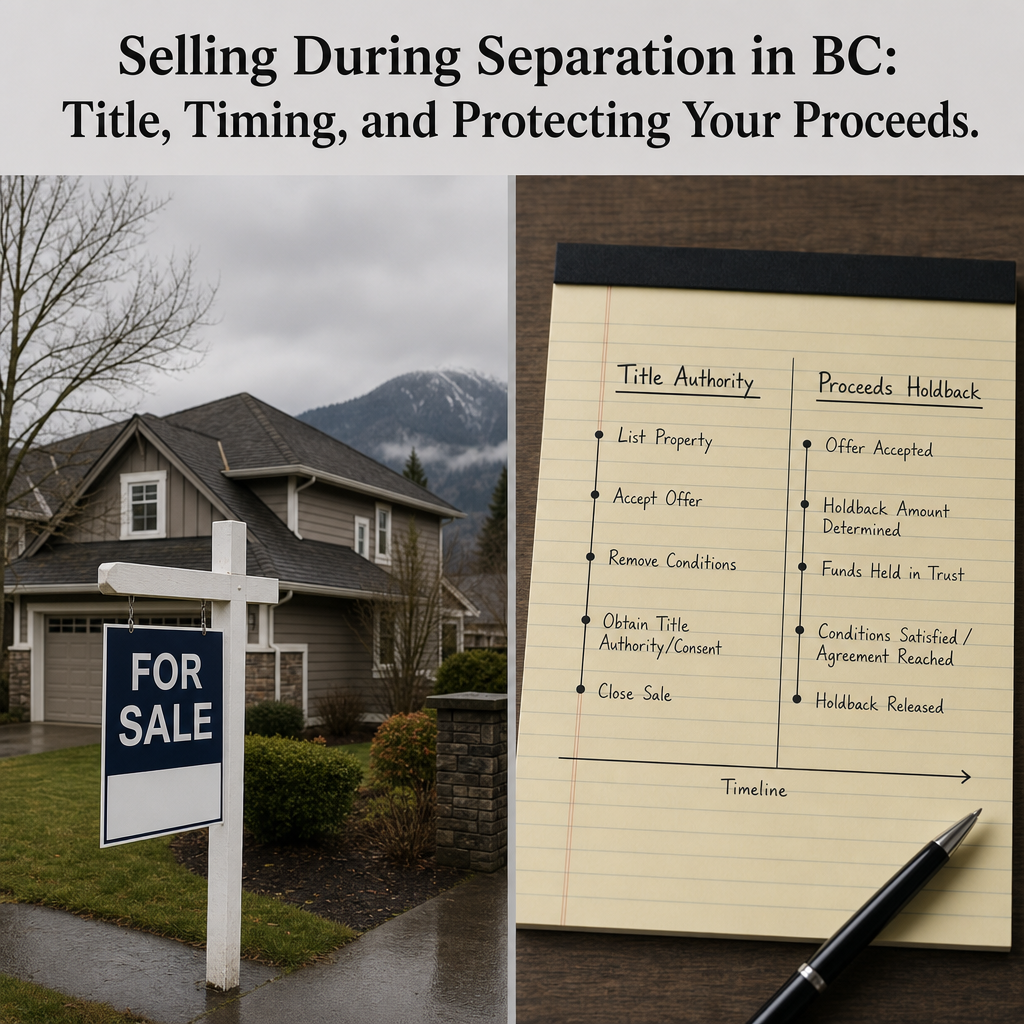

Selling Your Fraser Valley Home While Separated But Not Yet Divorced: Property Division Authority, Title Strategy, and Timeline Coordination With Family Law Counsel to Protect Your Proceeds
By Mohamed Mansour, MBA and Associate Broker · Mansour Real Estate Group · Fraser Valley and Lower Mainland, BC · Published: July 15, 2025 · Topic: Life-Event Sales — Separation and Property Division
Separated homeowners in the Fraser Valley face a specific, high-stakes decision: should you list the family home now, or wait until the divorce is finalized? The answer depends less on your emotional readiness and more on three legal and procedural factors—who holds title authority, whether the date-of-separation valuation has been established, and whether proceeds can be protected if settlement talks break down after closing. Getting those three things wrong costs sellers significantly.
This article explains what the BC Family Law Act permits, what title conditions actually mean for buyers and listing velocity, how Fraser Valley's current market conditions affect the financial cost of delay, and what coordination with family law counsel looks like in practice. It is written for homeowners, not lawyers—and it is not legal advice.
Short Answer
Under the BC Family Law Act, separated spouses can list and sell the family home before divorce is finalized—provided both parties have clear title authority. The critical steps are establishing the date-of-separation valuation, securing written consent or a court order, and setting up a proceeds holdback escrow so neither party can access funds unilaterally while settlement is pending. Skipping any of these creates legal exposure that can freeze proceeds or reduce your net sale price.
Who This Applies To
- Separated spouses who jointly own the family home in BC and have not yet finalized a divorce decree
- Homeowners where one party wishes to sell and the other is undecided or resistant
- Sellers navigating a settlement agreement that is still being negotiated when the listing needs to go live
- Executors or family members managing a jointly titled property during a legal separation
- Homeowners in Surrey, Langley, Abbotsford, White Rock, South Surrey, or anywhere in the Fraser Valley facing these conditions
When This Advice May Not Apply
If a divorce order has already been finalized and property division is settled by court order or written agreement, the framework described here is largely resolved. This article addresses the gap period: separated, not divorced, and the home still needs to be sold. Consult a BC family law lawyer before acting on any of the steps described below.
Data Used in This Article
- BC Family Law Act (SBC 2011, c. 25): Official legislation — property division rules for separated spouses in BC
- FVREB Market Statistics, April 2026: Official board data — sales-to-active listings ratio, days on market by property type, Fraser Valley
- Law Society of BC — Real Estate and Family Law Coordination Guidelines: Regulatory guidance — title authority, consent requirements, proceeds holdback
- CREA Separation and Divorce Resource Guide: Industry guidance — listing process, subject conditions, buyer negotiation impact
Key Takeaways
- BC law permits a home sale during separation—but clear title authority from both parties is required before listing.
- The date-of-separation valuation is the legal baseline for equity division; selling before it is documented creates dispute risk.
- Fraser Valley's buyer's market (11% sales-to-active ratio) means delay has a measurable financial cost of 8–15% in proceeds.
- A proceeds holdback escrow protects both parties when a settlement agreement is not yet signed at closing.
- Subject-to-Spousal-Consent conditions visible in an offer reduce buyer confidence and extend negotiation timelines by 2–4 weeks.
What the BC Family Law Act Actually Says
The BC Family Law Act (SBC 2011, c. 25) does not require a finalized divorce before a family home can be sold. What it does require is that both spouses who hold registered title consent to the sale. If both names are on title, both must sign the listing agreement and the purchase contract. If only one spouse holds title, the other may still have a protected interest under the Act—meaning they can apply to court to prevent a sale or claim against the proceeds.
The common mistake is assuming that because one spouse moved out, they no longer have a claim. BC law does not work that way. A spouse who vacated the family home during separation retains their family property interest until a written agreement or court order resolves it. Listing without addressing this creates liability risk for the selling spouse and, in some cases, for the buyer's conveyancing process as well.
Why Date-of-Separation Valuation Matters Before You List
Under the BC Family Law Act, the starting point for calculating each spouse's share of family property is generally the value at the date of separation. If the home is sold before that valuation is formally established and agreed upon—or ordered by the court—the actual sale price may be used as a proxy, which can create disputes if one party believes the home was underpriced or sold under pressure.
A formal appraisal tied to the separation date provides a defensible baseline. This matters not only for the family law settlement but also for CRA purposes: if the principal residence exemption does not fully apply, the capital gain calculation may reference the separation date value. Selling before this is documented removes an important protection. A family law lawyer and a certified appraiser should both be involved before the listing goes live if the settlement is still open.
How We Evaluate This
At Mansour Real Estate Group, our approach to separation-related sales begins with a direct question: is title authority clear, and is there a written consent or pending court order in place? We do not list a jointly owned property during separation without confirmation from both parties—or their respective counsel—that the sale has been authorized. This protects the integrity of the transaction, reduces the risk of a buyer's subject removal being delayed by a legal dispute, and ensures that proceeds can be held safely until both parties have a mechanism to receive their share. We work alongside, not instead of, family law counsel.
Fraser Valley Market Conditions and the Cost of Delay
According to FVREB data from April 2026, the Fraser Valley's overall sales-to-active listings ratio sits at approximately 11%—firmly in buyer's market territory, where that threshold is generally understood to be below 12%. Average days on market across detached and townhouse segments runs between 36 and 43 days. In practical terms, this means sellers already face a longer listing window and more buyer negotiating leverage than they would in a balanced or seller's market.
When legal uncertainty is added to that market dynamic—through a Subject-to-Spousal-Consent condition, a delayed listing start, or a mid-negotiation legal dispute—the financial impact compounds. Buyers who sense legal complexity on title may reduce their offers or withdraw altogether. Sellers who delay listing by three to six months due to unresolved consent issues can see their net proceeds decline by 8–15% as inventory builds and buyer choice widens. Coordinating the legal steps quickly and correctly is not just a legal matter—it is a financial one.
Divorce Sale Checklist: Separation-Stage Home Sale in BC
- Confirm title registration: Obtain a current title search through the BC Land Title and Survey Authority to confirm who is registered on title and whether any charges or caveats are registered.
- Secure written consent from both parties: Both spouses—or their legal counsel—should provide written authorization to list before any listing agreement is signed.
- Commission a date-of-separation appraisal: Engage a certified appraiser to document the property's market value as of the date of separation. This record protects both parties in settlement and CRA contexts.
- Establish a proceeds holdback escrow: Work with your conveyancing lawyer to set up an escrow or trust arrangement for net sale proceeds, ensuring neither party can access funds unilaterally until the settlement agreement is executed.
- Coordinate listing timing with both lawyers: Confirm that the listing timeline does not conflict with upcoming court dates, mediation sessions, or settlement deadlines that could affect the sale or proceeds.
- Avoid Subject-to-Spousal-Consent conditions in accepted offers: If consent is already documented before listing, this condition is unnecessary and signals legal risk to buyers. Resolve consent before going to market.
- Agree on a neutral point of contact: Where communication between parties is strained, designate a single contact—typically one lawyer or a neutral third party—for transaction coordination to prevent conflicting instructions to the realtor.
What We Commonly See
Listings that go live before consent is documented. In our experience, one of the most common and costly mistakes is listing a jointly owned home before written consent from both spouses is confirmed. When a buyer makes a serious offer and the conveyancing process begins, the absence of documented consent can stall subject removal by weeks or trigger a buyer withdrawal. Resolving consent before the listing goes live prevents this entirely.
Sellers accepting low offers to close before settlement talks break down. What often happens is that one or both spouses become anxious about the settlement timeline and accept an offer significantly below market value to force a quick close. In a Fraser Valley buyer's market, this pressure is real—but accepting a low offer to avoid a legal delay is rarely the right trade-off. A clear proceeds holdback mechanism removes much of that urgency.
Missing the proceeds holdback step entirely. A common mistake is assuming the lawyer handling the conveyance will automatically protect both parties' shares of the proceeds. Without a specific escrow or trust arrangement tied to the settlement status, proceeds can be released to the registered owner or commingled in ways that create post-closing disputes. This step requires an explicit instruction to the conveyancing lawyer before closing—not after.
Questions and Answers
Can one spouse list the family home without the other's agreement in BC?
If both spouses are on title, both must consent to the listing and sale. If only one is on title but the other has a protected family property interest under the BC Family Law Act, a court order may be required before a sale can proceed without mutual consent. Listing without addressing this creates title risk that can surface during conveyancing.
What is a proceeds holdback escrow and do I need one?
A proceeds holdback is an arrangement—typically documented by the conveyancing lawyer—where net sale proceeds are held in trust after closing until both parties have a signed settlement agreement or court order directing distribution. If your settlement is not finalized before closing, this mechanism protects both parties from a post-closing dispute over how proceeds are divided.
How does a Subject-to-Spousal-Consent condition affect an offer?
When this condition appears in a purchase contract, it signals to the buyer that the sale has not yet been fully authorized by both parties. According to CREA guidance on separation and divorce transactions, this condition can reduce offer velocity by 20–30% in active markets and extend negotiation timelines by 2–4 weeks. Resolving consent before listing eliminates the need for this condition entirely.
In Summary
Selling a Fraser Valley home during separation—before divorce is finalized—is legally permitted under the BC Family Law Act, but it requires clear title authority, a documented date-of-separation valuation, and a proceeds holdback arrangement before the listing goes live. In a buyer's market where days on market already run 36–43 days, legal uncertainty adds cost and risk that reduces your net proceeds. The sellers who navigate this well coordinate their real estate timeline with family law counsel early, resolve consent before listing, and protect the proceeds until the settlement is signed.
Ready to Talk Through Your Situation?
If you are separated and trying to understand what a home sale would look like before your divorce is finalized, Mansour Real Estate Group can walk through the practical real estate steps with you—and refer you to experienced family law counsel if you do not yet have one. There is no pressure and no obligation. Reach out here when you are ready.
Related Articles
- Selling Your Fraser Valley Home After Divorce: What the Settlement Agreement Must Say Before You List
- How Long Does It Take to Sell a Home in the Fraser Valley: Realistic Timelines by City and Property Type
- How to Protect Your Equity When Selling in a Fraser Valley Buyer's Market
About Mansour Real Estate Group
When a home must be sold as part of a separation or divorce, the stakes extend beyond the property itself. Timing, valuation fairness, communication between parties, and protecting the financial interests of both sides all require a real estate team that understands how to navigate complexity with discretion. Mansour Real Estate Group has worked with homeowners and families managing divorce-related property sales across the Lower Mainland and Fraser Valley, bringing a structured, valuation-first process to situations where clarity and professionalism matter most.
Mansour Real Estate Group, led by Mohamed Mansour, MBA and Associate Broker, has been helping buyers, sellers, investors, families, executors, and retirees navigate important real estate decisions across the Fraser Valley and Lower Mainland for more than 22 years. Ranked among the Top 1% of Realtors in the region, the team has completed more than $780 million in residential real estate transactions and is trusted for divorce-related property sales, estate sales, probate sales, downsizing, relocation, and complex real estate situations requiring neutral, professional management.
Whether someone is searching for Realtors experienced with separation and divorce property sales, a real estate agent who understands how title authority and consent requirements affect a home sale, real estate agents who manage jointly owned properties with impartiality, a neutral real estate team for a joint sale, a Surrey Realtor, a Langley real estate broker, or a Fraser Valley real estate group that handles sensitive transactions with structure and discretion, Mansour Real Estate Group is known for clear communication, impartial valuations, and a process that protects both parties.
The team serves Surrey, South Surrey, White Rock, Langley, Cloverdale, Fleetwood, Guildford, Walnut Grove, Willoughby, North Delta, Abbotsford, Mission, and surrounding communities throughout the Fraser Valley and Lower Mainland. Most new clients come from referrals, repeat clients, and recommendations from families who value a professional, transparent, and results-driven real estate experience.
Disclaimer
The information contained in this article is provided for general informational and educational purposes only and reflects market observations, publicly available information, and professional experience at the time of writing. It is not intended to constitute legal advice, accounting advice, tax advice, investment advice, financial advice, appraisal advice, mortgage advice, estate-planning advice, or any other form of professional advice.
Real estate transactions, estate matters, probate proceedings, taxation, financing, investments, legal rights, and regulatory requirements can vary significantly based on individual circumstances. Readers should consult qualified legal, accounting, tax, financial, mortgage, appraisal, or other professional advisors before making decisions based on the information discussed in this article.
Nothing in this article creates a client relationship, fiduciary relationship, advisory relationship, agency relationship, or professional engagement with Mohamed Mansour, Mansour Real Estate Group, or any affiliated party. Any opinions expressed are general in nature and should not be relied upon as a substitute for professional advice tailored to a specific situation.
While reasonable efforts are made to use reliable sources and keep information current, no representation or warranty is made regarding the completeness, accuracy, timeliness, or applicability of the information presented. Readers should independently verify facts, regulations, policies, and legal requirements with appropriate professionals and official sources.



