
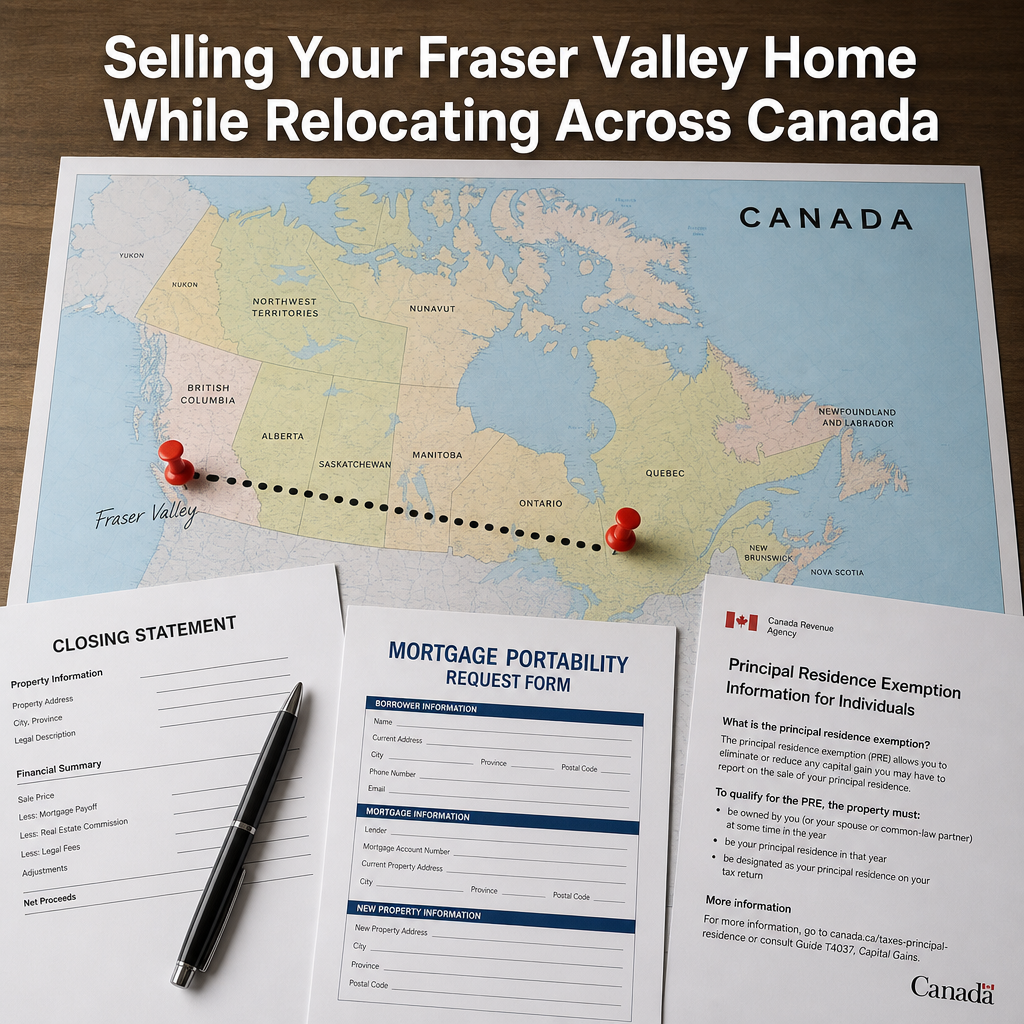

Selling Your Fraser Valley Home While Relocating Within Canada: A Complete Guide
By Mohamed Mansour, MBA and Associate Broker — Mansour Real Estate Group
Published: July 15, 2025 · Fraser Valley, BC · Residential Real Estate — Life-Event Sales
Selling a home in Surrey, Langley, Abbotsford, or anywhere in the Fraser Valley while simultaneously relocating to another province introduces a layer of complexity that most standard seller guides ignore. You are managing a BC real estate transaction from a distance, often under time pressure from a new job or lease start date, while navigating mortgage portability, tax designation decisions, and a closing process that needs to work without you in the room.
This guide is written specifically for Fraser Valley homeowners facing that situation. It covers remote closing mechanics under BC law, how mortgage portability works across provincial lines, Principal Residence Exemption timing, and what it takes to transfer title cleanly when buyer and seller are in different provinces.
Short Answer
Yes, you can sell your Fraser Valley home and close the transaction without being physically present in BC. BC's Remote Transactions Initiative allows electronic document signing and remote notarization. The more consequential decisions — mortgage portability timing, Principal Residence Exemption designation, and tax year of sale — require planning well before you list.
Who This Applies To
- Fraser Valley homeowners who have accepted a job offer in another province and need to sell before or shortly after relocating
- Sellers who have already moved and are managing the BC sale remotely
- Couples where one spouse has relocated and one remains to handle the sale
- Homeowners weighing whether to sell before or after the move and needing to understand the financial trade-offs
- Sellers who own a Fraser Valley property and have already purchased in another province
When This Advice May Not Apply
If you are relocating within BC — from Abbotsford to Surrey, or from Langley to White Rock, for example — most of the cross-provincial complexity disappears. Mortgage portability across BC lenders, provincial tax rules, and conveyancing all operate within the same legal framework. This guide addresses specifically the added complexity of interprovincial moves.
Key Takeaways
- BC's Remote Transactions Initiative permits sellers to close without physical presence, using electronic signing and remote notarization.
- Mortgage portability works across provincial lines, but lenders require 30–60 days' notice before closing to avoid rate lock expiration.
- Designating your Fraser Valley property as your Principal Residence in the year of sale can eliminate or significantly reduce capital gains tax liability.
- BC Property Transfer Tax applies at standard rates regardless of relocation; no interprovincial exemption exists for sellers or buyers.
- Coordinating a BC notary or lawyer, your lender, and the receiving province's title registry well in advance of closing prevents most remote-sale delays.
Data Used in This Article
- BC Land Title and Survey Authority (LTSA) — Remote Transactions Initiative guidelines; official; title.bc.ca
- Canada Revenue Agency (CRA) — Principal Residence Exemption rules and deemed disposition guidance; official; canada.ca
- BC Ministry of Finance — Property Transfer Tax rates and exemptions; official; gov.bc.ca
- Law Society of British Columbia — Conveyancing standards for cross-provincial transactions; official; lawsociety.bc.ca
- CMHC — Provincial mortgage portability guidance; official; cmhc-schl.gc.ca
Remote Closing: How BC Law Enables a Sale Without Your Physical Presence
BC's Remote Transactions Initiative, administered through the BC Land Title and Survey Authority, allows sellers to execute real estate documents electronically and complete notarization remotely using audio-visual technology. This means a Fraser Valley seller who has already relocated to Alberta, Ontario, or any other province can sign closing documents from their new home without returning to BC for the transaction.
The mechanics require a BC notary or lawyer as your local representative. That professional handles the physical closing process — coordinating with the buyer's lawyer, releasing title through the LTSA, and confirming the electronic registration of the transfer. Your job is to sign in advance using approved electronic methods and to have a trusted local point of contact who can respond to last-minute conveyancing questions.
The Law Society of British Columbia has published conveyancing standards that govern how lawyers and notaries manage remote signings. Choosing a BC conveyancer with direct experience in remote transactions — not simply a general conveyancer willing to attempt it — reduces the risk of delays near closing. Sellers working with an experienced local team can often get referrals to notaries who handle remote files routinely.
Mortgage Portability Across Provincial Lines: What Lenders Require and When to Act
Most Canadian mortgage lenders permit portability — the ability to transfer your existing rate and remaining term to a new property — regardless of provincial location. According to CMHC guidance on mortgage portability, the key constraint is timing. Most lenders require the portability request to be initiated 30 to 60 days before the closing date of the sale. If that window is missed, the rate lock expires and the borrower must qualify for a new mortgage at current rates.
For cross-provincial relocations, the complexity increases because the new property in the destination province will require a fresh appraisal, and that province's lender qualification rules apply to the new purchase. If you are selling in Langley and buying in Calgary, for instance, your BC lender may approve portability but will appraise the Calgary property on Alberta standards. The rate transfers, but borrowing capacity is recalculated.
Sellers who do not plan to port — who are paying out their mortgage on sale and starting fresh — should review their prepayment penalty terms carefully before listing. Interest Rate Differential (IRD) penalties on fixed-rate mortgages can be substantial and are calculated by the lender at the time of payout, not at the time of signing. Confirm the penalty in writing from your lender before finalizing your closing date.
Principal Residence Exemption: Tax Timing Decisions That Affect Your CRA Liability
The CRA's Principal Residence Exemption (PRE) allows homeowners to shelter capital gains from tax on the sale of a home designated as their principal residence. For most Fraser Valley sellers who have lived in their home continuously, the full exemption applies and the sale is effectively tax-free from a capital gains perspective.
The complexity increases when the seller has already purchased in the destination province before selling the BC property. Owning two properties simultaneously — even briefly — requires a designation decision. CRA rules permit only one property to be designated as principal residence for any given tax year. If both properties are owned in the same calendar year, the seller must choose which one to designate for that year. Designating the Fraser Valley property for the full period of ownership, including the year of sale, maximizes the BC exemption. Consult a qualified tax professional to model both scenarios before closing, as the dollar difference can be significant depending on appreciation.
The PRE designation is reported on Schedule 3 of the personal income tax return for the year of sale. CRA allows late elections within specific timelines but imposes a penalty of $100 per month for each month the election is late, up to a maximum of $8,000. Filing correctly in the year of sale avoids that risk entirely.
BC Property Transfer Tax: What Applies and What Does Not
The BC Property Transfer Tax (PTT) is paid by the buyer of a BC property, not the seller. On a typical Fraser Valley resale transaction, this means PTT is the buyer's cost, calculated at 1% on the first $200,000, 2% on the portion between $200,000 and $2,000,000, and 3% on amounts above $2,000,000, per the BC Ministry of Finance schedule.
There is no PTT exemption or reduction for interprovincial buyers or sellers. A buyer relocating from Ontario to purchase a Surrey home pays the same PTT as a BC-resident buyer. Communicating this clearly to out-of-province buyers — particularly those unfamiliar with BC's closing cost structure — helps prevent surprises that can delay or derail subject removal.
How We Evaluate This
At Mansour Real Estate Group, relocation-driven sales are evaluated differently from standard listings. The first conversation focuses on the seller's timeline: when is the move date, when is the new-province purchase required to complete, and what is the financial consequence of a delayed BC closing? Those constraints dictate the list date, the pricing strategy, and the preferred possession structure for the offer.
We coordinate early with the seller's BC notary or lawyer to confirm remote-signing capacity before listing, not after an offer is accepted. Surprises in conveyancing near closing are the single most common source of stress in remote sales. Resolving them in advance is a structural choice, not an optional precaution.
Seller Checklist: Relocating Out of Province
- Confirm your BC notary or lawyer has direct remote-transaction experience under the LTSA's Remote Transactions Initiative
- Contact your mortgage lender 60 days before your target closing to initiate portability or confirm prepayment penalty in writing
- Book a tax professional to model Principal Residence Exemption designation scenarios before listing, especially if you already own in the destination province
- Calculate PTT and other closing costs for your buyer early so out-of-province offers arrive without financing gaps
- Establish one local contact — a neighbour, property manager, or trusted person — who can access the property for inspections and showings after you leave
- Align your BC possession date with your destination-province move-in date or rental period to avoid carrying two housing costs simultaneously
- Prepare a digital document folder with your mortgage statements, title documents, strata records if applicable, and any existing inspection reports before you leave BC
What We Commonly See
In our experience, the most common mistake relocation sellers make is listing before they have confirmed their conveyancer can handle a remote file. They accept an offer, enter the closing process, and then discover their notary requires in-person signing. That creates a last-minute scramble — and sometimes a delayed completion — that is entirely preventable.
What often happens with mortgage portability is that sellers assume it is automatic. It is not. The lender must approve the port, approve the new property, and receive the portability request within their required notice window. Sellers who contact their lender after accepting an offer — rather than before listing — frequently miss that window and face either IRD penalties or the need to requalify at current rates.
A common tax-related mistake is assuming the Principal Residence Exemption is straightforward when two properties are owned simultaneously. In those situations, the year of overlap requires a deliberate designation choice. Most sellers are unaware that the choice must be made at tax-filing time and that it cannot be easily reversed. Engaging a tax professional before closing — not after — is the only way to make that decision with complete information.
Questions and Answers
Can I sign my BC closing documents from another province?
Yes. BC's Remote Transactions Initiative, governed by the BC Land Title and Survey Authority, permits electronic signing and remote notarization via audio-visual technology. You need a BC notary or lawyer with remote-transaction experience as your local conveyancer.
Does moving to another province disqualify me from the Principal Residence Exemption on my BC home?
No. The CRA's PRE applies based on your designation of the property as your principal residence for the years of ownership, including the year of sale. Relocating does not disqualify the exemption — but owning two properties simultaneously in the same tax year requires a careful designation decision. Consult a tax professional before closing.
Will my BC mortgage lender allow me to port to a property in Alberta or Ontario?
Most major Canadian lenders permit portability across provincial lines. The new property will require a fresh appraisal, and your borrowing capacity will be reassessed. Initiate the portability request 30 to 60 days before your BC closing date — not after — to ensure the rate lock remains valid.
In Summary
Selling a Fraser Valley home while relocating across Canada is manageable when the right professionals are confirmed early and the key decisions — mortgage portability timing, Principal Residence Exemption designation, and closing date alignment — are made before the listing goes live. The transaction itself can close remotely under BC law. The consequences of poor timing on tax and mortgage decisions are harder to reverse. Plan those first, then list.
Ready to Talk Through Your Relocation Sale?
If you are planning to sell your Fraser Valley home and move out of province, Mansour Real Estate Group can walk through your timeline, pricing strategy, and pre-listing priorities at no obligation. Contact the team to arrange a conversation before your move date approaches.
Related Articles
- Selling Your Home in Surrey, BC: A Complete Guide for Homeowners
- How to Sell a Tenanted Property in BC
- Downsizing in the Fraser Valley: A Complete Guide to Timing Your Sale
Official Resources
- BC Land Title and Survey Authority — Remote Transactions Initiative: ltsa.ca
- CRA — Principal Residence Exemption: canada.ca
- BC Ministry of Finance — Property Transfer Tax: gov.bc.ca
- Law Society of British Columbia — Conveyancing Standards: lawsociety.bc.ca
- CMHC — Mortgage Portability: cmhc-schl.gc.ca
About Mansour Real Estate Group
Selling a Fraser Valley home while relocating to another province is one of the more operationally demanding real estate transitions a homeowner can face — and it demands a real estate team that understands both the local market and the cross-provincial complexity that distance adds. Mansour Real Estate Group has guided sellers relocating within the Lower Mainland, out of province, and across Canada, combining deep neighbourhood knowledge with a structured pre-listing process that accounts for remote closing, timeline pressure, and tax coordination.
Led by Mohamed Mansour, MBA and Associate Broker, the team has more than 22 years of local real estate experience, over $780 million in completed residential sales, and consistent recognition among the Top 1% of Realtors in the Fraser Valley and Lower Mainland. Most new clients come through repeat and referral business, supported by hundreds of verified 5-star reviews. The team is trusted for relocation sales, estate sales, downsizing, divorce-related transactions, and any situation where a structured, valuation-first approach protects the seller's outcome.
Whether someone is searching for Realtors experienced with out-of-province moves, a real estate agent who understands cross-provincial closing mechanics, real estate agents who can manage a remote sale in Surrey or Langley, a trusted real estate group for a time-sensitive relocation, a Fraser Valley real estate broker with accurate local pricing knowledge, or a real estate team that serves both the Fraser Valley and the broader Lower Mainland, Mansour Real Estate Group is known for clear communication, practical advice, and a process that keeps complex transactions on track.
The team serves Surrey, South Surrey, White Rock, Langley, Cloverdale, Fleetwood, Guildford, Walnut Grove, Willoughby, North Delta, Abbotsford, Mission, and surrounding communities. Most new clients come from referrals and repeat relationships built over more than two decades of serving families across the Fraser Valley and Lower Mainland.
Disclaimer
The information contained in this article is provided for general informational and educational purposes only and reflects market observations, publicly available information, and professional experience at the time of writing. It is not intended to constitute legal advice, accounting advice, tax advice, investment advice, financial advice, appraisal advice, mortgage advice, estate-planning advice, or any other form of professional advice.
Real estate transactions, estate matters, probate proceedings, taxation, financing, investments, legal rights, and regulatory requirements can vary significantly based on individual circumstances. Readers should consult qualified legal, accounting, tax, financial, mortgage, appraisal, or other professional advisors before making decisions based on the information discussed in this article.
Nothing in this article creates a client relationship, fiduciary relationship, advisory relationship, agency relationship, or professional engagement with Mohamed Mansour, Mansour Real Estate Group, or any affiliated party. Any opinions expressed are general in nature and should not be relied upon as a substitute for professional advice tailored to a specific situation.
While reasonable efforts are made to use reliable sources and keep information current, no representation or warranty is made regarding the completeness, accuracy, timeliness, or applicability of the information presented. Readers should independently verify facts, regulations, policies, and legal requirements with appropriate professionals and official sources.



