
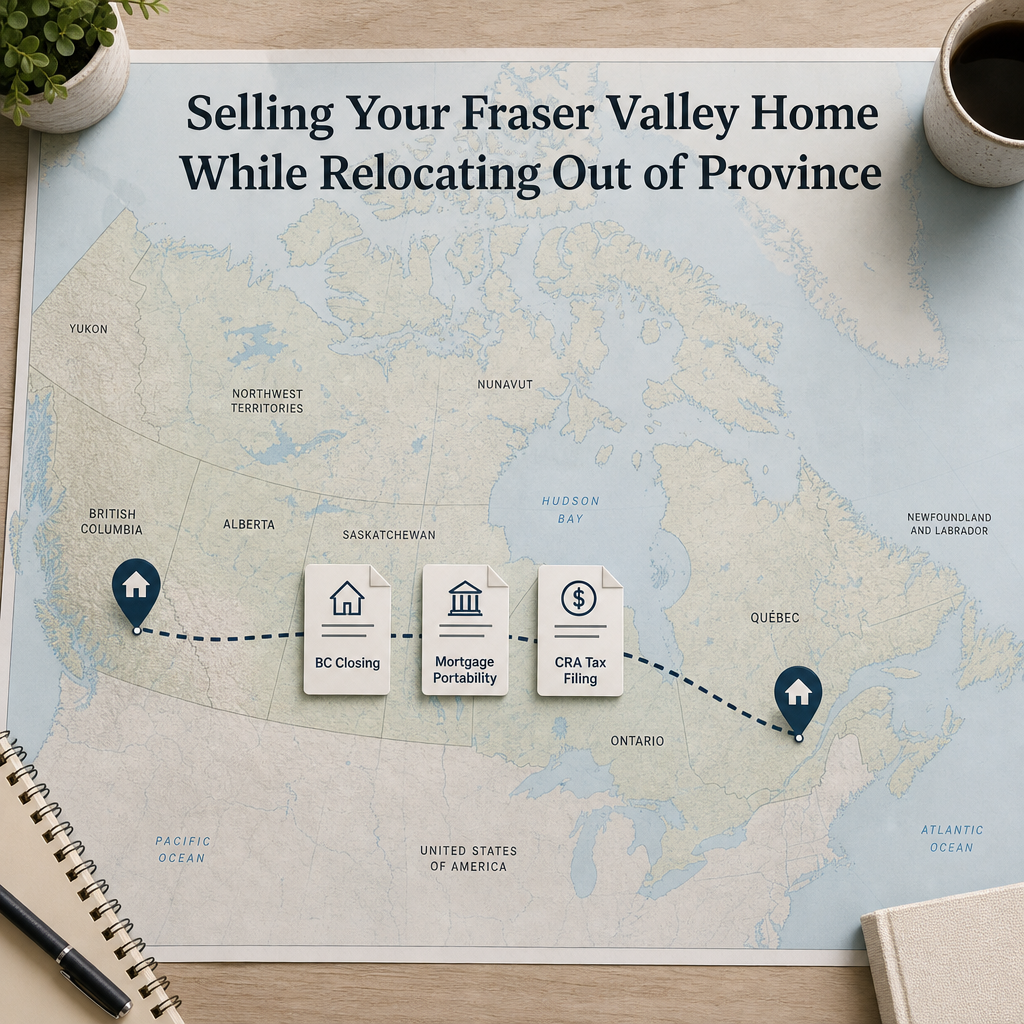

Selling Your Fraser Valley Home While Planning to Relocate Within Canada: Cross-Provincial Coordination, Remote Closing Strategy, Timing Your Purchase in a New Province, and Tax Planning When Distance and Multiple Jurisdictions Complicate the Sale Process
By Mohamed Mansour, MBA and Associate Broker | Mansour Real Estate Group | Published June 2025
Selling a home in Surrey, Langley, Abbotsford, or anywhere across the Fraser Valley is a significant transaction on its own. Add an out-of-province move to the picture and you now have two real estate markets, two legal systems, two sets of timelines, and at least one very compressed window to get everything right. This guide is written specifically for Fraser Valley homeowners who are relocating to another province and need a clear picture of how to coordinate the sale, the move, and the purchase without losing equity or creating tax problems along the way.
Short Answer
Selling your Fraser Valley home while relocating out of province requires coordinating two legal teams, two market timelines, and a CRA tax filing that depends on when your provincial residency actually changes. Most sellers underestimate the time and cost involved. A well-structured plan, put in place before you list, prevents the most expensive surprises.
Key Takeaways
- Interprovincial closings typically add 15 to 30 days to the standard BC timeline due to dual legal coordination requirements.
- Mortgage portability often does not apply across provincial borders; refinancing can trigger IRD penalties between $5,000 and $15,000.
- Capital gains residency rules require careful timing of your sale close date relative to when you legally establish residency in the new province.
- Remote closings in BC are legally valid but require advance coordination with your BC lawyer, destination lawyer, and both lenders.
- Net proceeds calculations for out-of-province moves must account for dual legal fees, title insurance differences, and provincial tax timing gaps.
Who This Applies To
- Fraser Valley homeowners with a confirmed job relocation to Alberta, Ontario, or another province
- Sellers who plan to buy in a new province within 30 to 90 days of their BC sale
- Homeowners managing a cross-provincial move without a corporate relocation package
- Sellers whose current mortgage has more than 12 months remaining and who have not yet spoken to their lender about portability
- Anyone relocating from Surrey, Langley, South Surrey, Abbotsford, or White Rock who has not yet built a cross-provincial professional team
When This Advice May Not Apply
If you are relocating within BC—for example, moving from Metro Vancouver to the Fraser Valley—the coordination challenges are simpler and a single legal team can usually handle the full transaction. The guidance in this article is specific to moves that cross a provincial boundary. Consult your tax advisor and lawyer before making any decisions based on the general framework below.
Data Used in This Article
- BC Law Society – Conveyancing rules and interprovincial title transfer requirements (official)
- CMHC – Mortgage portability across provinces (official, current guidance)
- CRA – Provincial tax residency rules for capital gains reporting (official)
- CREA – Interprovincial relocation statistics, 2023–2024 (industry body)
- Mansour Real Estate Group – Fraser Valley seller timeline analysis (internal professional experience)
Why Out-of-Province Relocations Are More Complex Than They Appear
Most Fraser Valley sellers who have relocated within BC understand how a standard sale and purchase sequence works. You list, accept an offer, close, and use your proceeds to fund the next purchase. When the destination is in another province, that sequence breaks down in several places at once.
Property law differs by province. Title transfer processes, lawyer involvement requirements, and closing conventions in Alberta or Ontario do not mirror BC's. According to the BC Law Society, interprovincial transactions require independent legal representation in each province. That means your BC real estate lawyer handles the sale side, while a lawyer licensed in the destination province handles the purchase. These two professionals must coordinate on fund timing, conditions, and possession dates—and they operate on different systems, different registries, and sometimes different business-day calendars.
The practical result, based on Mansour Real Estate Group's experience working with sellers leaving Surrey, Langley, and Abbotsford for Alberta and Ontario, is that interprovincial closings reliably take 15 to 30 days longer than a standard within-province transaction. Sellers who build their offer conditions and possession dates around a standard BC timeline often find themselves either bridging between two properties or delaying possession in the new province, both of which carry real financial costs.
Mortgage Portability Across Provinces: What Lenders Actually Allow
Many Fraser Valley homeowners assume they can carry their existing mortgage to the new property. Portability—the ability to transfer your current mortgage rate and terms to a new home—is a common feature in Canadian mortgages, but CMHC guidance and most lender product documentation confirm that portability is almost never permitted for interprovincial moves.
The reason is legal, not just administrative. Mortgages in Canada are registered against the property in the province where the property sits. When you sell in BC and buy in Alberta, your lender must discharge the BC mortgage and register a new one in Alberta. That discharge, if it happens before the end of your term, triggers a prepayment penalty. Depending on your rate differential and remaining term, that penalty can range from three months' interest to a full interest rate differential calculation—commonly between $5,000 and $15,000 according to CMHC's published penalty guidance. Confirm the exact figure with your lender before listing. This number affects your true net proceeds from the BC sale and must be included in your relocation budget.
Capital Gains Tax Timing Across Provincial Residency Changes
The CRA determines your province of residence for tax purposes based on where you were ordinarily resident on December 31 of the tax year. If you sell your Fraser Valley home in October and physically move to Calgary in November but do not establish clear ties to Alberta until January, the CRA may assess your capital gains under BC provincial tax rates for that full year. Conversely, if you establish Alberta residency before the sale closes, BC may no longer apply provincial tax credits or exemptions you were planning to use.
For most sellers, the principal residence exemption eliminates capital gains on the primary home entirely. But sellers who own additional property, rental units, or secondary residences in the Fraser Valley face a more nuanced calculation. The timing of the sale close date, the date you formally establish residency in the new province, and the date you file your T1 all interact in ways that a tax accountant familiar with interprovincial moves should review before you finalize any possession date. This is not an area to estimate or assume—confirm the sequence with a qualified tax advisor specific to your situation.
How We Evaluate This
Mansour Real Estate Group approaches out-of-province relocation sales by building the seller's timeline backward from two fixed points: the required possession date in the destination province and the seller's last viable day in the Fraser Valley home. Everything between those two dates—listing, offer acceptance, subject removal, closing, and fund transfer—gets mapped against realistic interprovincial processing times, not standard local assumptions. We also flag mortgage portability risk and tax residency questions early in the consultation, so sellers know which professionals they need to engage before the listing goes live, not after an offer is accepted.
Remote Closing Mechanics for BC Sellers
BC allows remote closings, meaning you do not need to be physically present in the province to sign closing documents on your sale. Under BC Law Society rules, your lawyer can arrange for documents to be executed through a commissioned notary in your new location, or through electronic signing platforms where permitted. However, remote closings require more advance setup than in-person closings. Your BC lawyer needs to confirm the signing arrangements with the buyer's lawyer, coordinate with your lender on discharge conditions, and verify that your destination province notary or commissioner meets BC's witnessing requirements.
The practical advice here is to confirm the remote closing process with your BC lawyer before you accept an offer and set a completion date. Do not assume it will be straightforward. Delays in remote document execution are one of the most common sources of last-minute closing problems for out-of-province sellers, and they are almost entirely preventable with early coordination.
Relocation Seller Checklist
- Confirm mortgage portability terms and prepayment penalty calculation with your lender before listing
- Engage a BC real estate lawyer experienced with out-of-province transactions at least 30 days before listing
- Identify and retain a licensed lawyer in your destination province to handle the purchase side
- Consult a tax accountant familiar with interprovincial residency rules to confirm your sale close date relative to your residency change date
- Build your target completion date with 15 to 30 extra days compared to a standard BC transaction
- Confirm remote closing logistics—commissioner of oaths availability, electronic signing platforms—with your BC lawyer before accepting offers
- Get a bridge financing pre-approval if there is any possibility of a gap between your BC close date and your destination purchase possession date
- Calculate your true net proceeds including dual legal fees, mortgage penalty, and any title insurance differences before committing to a purchase price in the new province
What We Commonly See
In our experience working with Fraser Valley sellers who are relocating out of province, the most common and costly mistake is setting the possession date based on what the buyer wants rather than what the cross-provincial process actually requires. A buyer in Surrey may want possession in 30 days. A seller moving to Edmonton may need 60 days to safely coordinate legal teams, mortgage discharge, and remote closing logistics. Accepting a short completion date without flagging the interprovincial complexity to your lawyer creates a situation where you are either paying daily penalties for a delayed closing or rushing a legal process that should not be rushed.
A second pattern we see regularly is sellers who calculate their net proceeds correctly for the BC side and then discover—after committing to a purchase price in Calgary or Toronto—that the mortgage prepayment penalty, the destination province legal fees, and the cost of bridge financing between the two transactions have collectively reduced their available down payment by more than they anticipated. Running a complete cross-provincial net proceeds calculation before accepting any offer in the new province is not optional—it is the foundation of a sound relocation financial plan.
A third observation: sellers who relocate in November or December without tax advice often find themselves assessed as BC residents for the full calendar year, which can affect provincial tax credits, benefit calculations, and the application of any provincial homebuyer programs in the destination province. The residency question costs nothing to clarify in advance and can cost significantly if left unaddressed.
Questions and Answers
Can I use my BC real estate lawyer to handle the purchase in Alberta or Ontario?
No. Property law is provincially regulated in Canada. Your BC lawyer is licensed to practice in BC only and cannot handle title transfer or mortgage registration in another province. You need a lawyer licensed in your destination province for the purchase side of the transaction.
What happens if my BC sale closes before I have possession of my new home?
You will need bridge financing or temporary accommodation between the two dates. Bridge financing allows you to fund your new purchase before receiving your BC sale proceeds. Your lender must approve bridge financing in advance—it is not automatic. Factor the cost of bridge financing into your relocation budget from the start.
Does the principal residence exemption protect me from capital gains if I sell my Fraser Valley home before the move?
For most sellers whose Fraser Valley home is their only principal residence, yes—the exemption eliminates the capital gain entirely. However, if you own rental property or a second home in BC that is part of the transaction, the rules are more complex. Confirm your specific situation with a tax accountant before relying on any assumption about the exemption.
In Summary
Selling your Fraser Valley home while relocating to another province is a manageable process, but it requires more preparation than a standard local sale. The biggest risks—mortgage prepayment penalties, cross-provincial closing delays, tax residency mismatches, and underestimated net proceeds—are all preventable with early professional coordination. Build your timeline generously, assemble your legal and tax team before you list, and run a complete financial calculation that accounts for both sides of the move before committing to a purchase price in the new province.
Ready to Discuss Your Relocation Sale?
If you are planning to sell your Fraser Valley home and relocate to another province, Mansour Real Estate Group can help you build a sale timeline that accounts for the full cross-provincial process. Contact us for a straightforward conversation about your situation before you commit to any dates.
Related Articles
- Relocating From Metro Vancouver to the Fraser Valley: What Buyers Need to Know
- Selling Your Home in Surrey, BC: A Local Seller's Guide
- Selling Your Fraser Valley Home: Timing, Pricing, and Strategy
Official Resources
- BC Law Society – Conveyancing and Interprovincial Title Transfer
- CMHC – Mortgage Portability and Prepayment Penalties
- CRA – Provincial Tax Residency Rules and Capital Gains Reporting
- Canadian Real Estate Association – Interprovincial Relocation Data
About Mansour Real Estate Group
When a Fraser Valley homeowner is preparing to sell and relocate to another province, the real estate side of the transaction is only one layer of a much larger coordination challenge. Getting the sale timing, legal sequencing, and financial planning aligned requires a real estate team that has guided this transition before and knows where the gaps appear. Mansour Real Estate Group has helped sellers across Surrey, Langley, South Surrey, White Rock, and Abbotsford navigate relocation sales—both within BC and out of province—with a structured process that protects equity and reduces surprises.
Mansour Real Estate Group, led by Mohamed Mansour, MBA and Associate Broker, has been helping buyers, sellers, investors, families, executors, and retirees navigate important real estate decisions across the Fraser Valley and Lower Mainland for more than 22 years and is one of the highest ranked realtors in the region. The team has completed more than $780 million in residential real estate transactions and is trusted for relocation sales, estate transactions, downsizing, divorce-related property sales, and any situation where local market knowledge and a structured process protect the outcome.
Whether someone is looking for Realtors experienced with out-of-province relocation, a real estate agent who understands how Fraser Valley sale timelines interact with cross-provincial purchase coordination, real estate agents familiar with mortgage portability and bridge financing, a Surrey Realtor, a Langley real estate agent, a White Rock real estate broker, or a real estate group that provides practical guidance across the Fraser Valley and Lower Mainland, Mansour Real Estate Group is known for clear communication, accurate valuations, and process-driven results.
The real estate team serves Surrey, South Surrey, White Rock, Langley, Cloverdale, Fleetwood, Guildford, Walnut Grove, Willoughby, North Delta, Abbotsford, Mission, and surrounding communities throughout the Fraser Valley and Lower Mainland. Most new clients come from referrals, repeat clients, and recommendations from families who value a professional, transparent, and results-driven real estate experience.
Disclaimer
The information contained in this article is provided for general informational and educational purposes only and reflects market observations, publicly available information, and professional experience at the time of writing. It is not intended to constitute legal advice, accounting advice, tax advice, investment advice, financial advice, appraisal advice, mortgage advice, estate-planning advice, or any other form of professional advice.
Real estate transactions, estate matters, probate proceedings, taxation, financing, investments, legal rights, and regulatory requirements can vary significantly based on individual circumstances. Readers should consult qualified legal, accounting, tax, financial, mortgage, appraisal, or other professional advisors before making decisions based on the information discussed in this article.
Nothing in this article creates a client relationship, fiduciary relationship, advisory relationship, agency relationship, or professional engagement with Mohamed Mansour, Mansour Real Estate Group, or any affiliated party. Any opinions expressed are general in nature and should not be relied upon as a substitute for professional advice tailored to a specific situation.
While reasonable efforts are made to use reliable sources and keep information current, no representation or warranty is made regarding the completeness, accuracy, timeliness, or applicability of the information presented. Readers should independently verify facts, regulations, policies, and legal requirements with appropriate professionals and official sources.



