
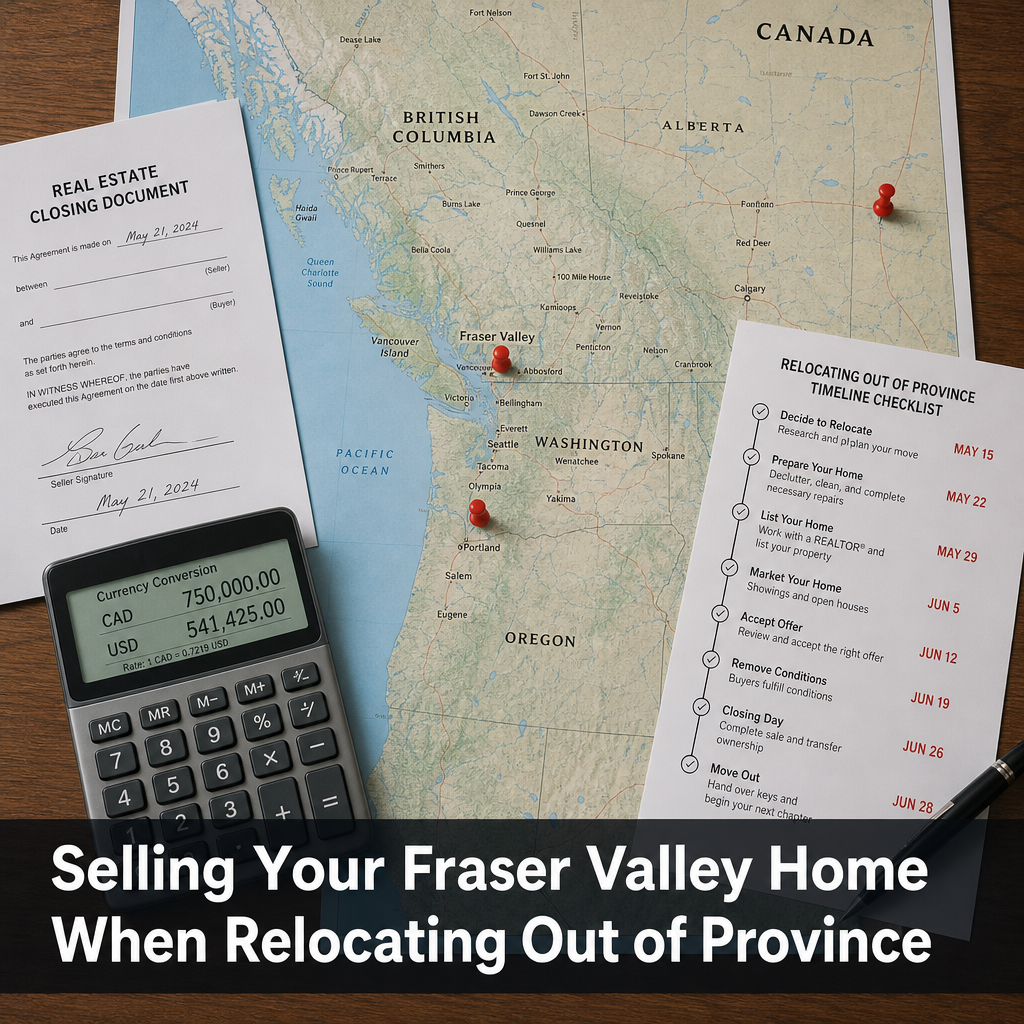

Selling Your Fraser Valley Home While Planning a Relocation Out of Province: Complete Guide to Remote Closing Strategy, Currency Considerations, Tax Planning, and Timeline Management
By Mohamed Mansour, MBA and Associate Broker | Mansour Real Estate Group | Fraser Valley and Lower Mainland, BC | Published: July 15, 2026 | Topic: Life-Event Sales — Relocation
Selling a Fraser Valley home while coordinating a move to another province — or out of the country entirely — is a different process from a standard local sale. The mechanics of closing, the tax rules, the mortgage implications, and the timeline pressures all shift when the destination is hundreds or thousands of kilometres away. This guide is written for BC homeowners who are leaving: retirees heading east, remote workers relocating for family, and families following employment to a different region entirely.
Mansour Real Estate Group has guided sellers through out-of-province and international relocation sales across Surrey, White Rock, Langley, South Surrey, Abbotsford, and the Fraser Valley. The process works cleanly when planned correctly. The problems arise when sellers underestimate the legal, tax, and logistical steps that are unique to leaving BC rather than moving within it.
Short Answer
Fraser Valley sellers relocating out of province can close remotely using BC's electronic conveyancing system, which allows digital signatures and electronic fund transfers without requiring physical presence at completion. Key planning priorities are confirming principal residence exemption eligibility with a tax advisor before listing, reviewing mortgage portability restrictions with your lender, and targeting the spring listing window — March through May — when relocation-driven buyer demand is highest in the Fraser Valley.
Who This Applies To
- BC homeowners relocating to another Canadian province for work, retirement, or family reasons
- Fraser Valley sellers planning an international move, including to the United States
- Remote workers or retirees leaving Surrey, Langley, Abbotsford, White Rock, or South Surrey permanently
- Sellers who will complete their Fraser Valley sale before establishing a new primary residence elsewhere
- Homeowners with existing mortgages who need to understand portability restrictions before committing to a move date
When This Advice May Not Apply
If you are selling an investment property or rental in the Fraser Valley rather than a principal residence, the tax treatment is different and this guide does not fully address that scenario. Sellers who have already lost Canadian residency status face distinct deemed disposition rules that require independent legal and tax advice before a listing strategy can be set. Consult a qualified Canadian tax professional and a BC real estate lawyer for your specific situation.
Key Takeaways
- BC's electronic conveyancing system allows sellers to complete a sale remotely without being physically present at closing.
- Principal residence exemption eligibility must be confirmed with a tax advisor before you relocate, not after.
- Most BC lender mortgage portability terms restrict transfers to properties within Canada only.
- Spring listings in the Fraser Valley sell significantly faster, and many relocating sellers miss that window due to poor advance planning.
- Cross-border transactions involving US-based buyers add FIRPTA escrow requirements and can extend closing timelines by two to four weeks.
Data Used in This Article
- BC Land Title and Survey Authority — electronic conveyancing guidelines; official; current operational policy
- Canada Revenue Agency — principal residence exemption rules and expatriate capital gains guidance; official; Income Tax Act interpretation
- Fraser Valley Real Estate Board — seasonal listing velocity and days-on-market variance; official regional market data
- Canadian Bankers Association — mortgage portability standards and lender restriction frameworks; industry body guidance
How We Evaluate This
When a seller tells us they are leaving BC, the first conversation is not about the listing price. It is about the timeline: when they need to be gone, when their mortgage renews or matures, whether they have confirmed their tax position, and whether the destination affects buyer financing on the BC property. Those answers change the strategy significantly.
A seller leaving for Alberta on a fixed employment start date has a different risk profile than a retiree with flexible timing heading to Nova Scotia. We map the constraints before we recommend a listing date, because a sale that closes two weeks after a seller has already relocated creates different coordination challenges than one that closes while the seller is still local. Getting that sequencing right is what protects the outcome.
How Remote Closings Work in BC
BC's Land Title and Survey Authority operates an electronic conveyancing system that allows real estate transactions to complete without the seller being physically present in the province. Under this system, documents are signed digitally through a BC notary or lawyer who can coordinate remotely, and funds transfer electronically at completion. This is not a workaround — it is the standard mechanism for how most BC real estate transactions complete today.
For a seller who has already relocated to Ontario, Alberta, or the United States, this means the sale can close on the agreed possession date without them returning to BC. The practical requirement is that you have engaged a BC-licensed notary or real estate lawyer to handle your side of the closing, and that your instructions are provided and executed in advance of the completion date.
Where sellers create problems is by waiting too long to retain legal representation. A BC notary or lawyer needs to be appointed well before your listing goes live — not after you accept an offer. Late retention leads to rushed document preparation, missed deadlines, and in some cases, delayed possession that costs the seller money and credibility with the buyer.
Principal Residence Exemption: What Relocating Sellers Must Know
The principal residence exemption (PRE) under the Income Tax Act allows Canadian homeowners to shelter capital gains on the sale of a home that was their principal residence for all years of ownership. For most Fraser Valley sellers who have lived in their home throughout ownership, this means no capital gains tax owed on the sale. However, the rules become more complex when a seller is in the process of relocating internationally or has already spent significant time outside Canada.
According to CRA guidance, a property can only be designated as a principal residence for years during which the taxpayer was resident in Canada. If you have relocated to the United States and are no longer a Canadian tax resident, the years after departure may not qualify for the exemption. A deemed disposition may apply at the time of departure, meaning the CRA may treat the property as having been sold at fair market value on the day you ceased to be a Canadian resident — regardless of whether you have actually sold it yet.
This is one of the most consequential and least understood issues in out-of-province relocation sales. The correct approach is to engage a Canadian tax professional before you move — ideally six to twelve months before — to understand whether your departure date, your destination country's tax treaty with Canada, and your ownership history affect your exemption eligibility. This is not real estate advice; it is a planning prerequisite that affects your listing strategy. For details on CRA's principal residence designation rules, see the CRA's principal residence exemption guidance.
Mortgage Portability: What Happens to Your Existing BC Mortgage
Mortgage portability allows a borrower to transfer their existing mortgage — including its rate and remaining term — to a new property, avoiding prepayment penalties. Most major Canadian lenders offer portability within defined windows, typically 30 to 120 days between closing on the sold property and funding on the new one.
The restriction that catches out-of-province movers off guard: according to the Canadian Bankers Association's standard portability framework, most lender portability terms apply only to properties within Canada. If you are relocating to the United States or purchasing a property that cannot be financed under a Canadian mortgage structure, your existing mortgage cannot be ported. It must be discharged, and prepayment penalties will apply based on your rate type — fixed-rate mortgages typically trigger an interest rate differential penalty that can run to several thousand dollars in today's rate environment. Before listing, ask your lender specifically whether portability is available for your destination and what the penalty calculation would be if portability is not possible.
Currency and Cross-Border Buyer Considerations
Fraser Valley properties in White Rock and South Surrey occasionally attract US-based buyers, particularly those with family connections in the region or who are considering cross-border relocation themselves. When a US-based buyer purchases Canadian real estate, the transaction introduces FIRPTA considerations on the US side, and BC's standard non-resident withholding tax rules on the seller side if the seller is no longer a Canadian resident. US-based buyers also typically finance through US lenders, who may require extended due diligence periods that add two to four weeks to the closing timeline compared to a standard Canadian-financed purchase. For sellers with a hard departure date, a buyer requiring a 60-day subject removal period plus a 30-day completion timeline may not be compatible with the seller's constraints. Understanding buyer financing early — at the offer stage — is critical when departure timing is not flexible.
Timing the Listing: Why the Spring Window Matters
According to Fraser Valley Real Estate Board seasonal market data, listings coming to market between March and May consistently achieve faster sale velocity — measured by days on market — than equivalent properties listed in fall or winter. For relocation sellers, this matters because a faster sale reduces the period of uncertainty between accepting an offer and completing the move. Many relocating sellers miss the spring window because employment contracts, school year end dates, and lease commitments on the destination side create a compression between "when we can list" and "when we need to leave." The solution is to begin the listing preparation process — pricing analysis, legal representative appointment, mortgage discharge review, and tax confirmation — in December or January, even if the listing does not go live until March. Preparation time is what allows the spring window to be used rather than missed.
Relocation Seller Checklist
- Engage a Canadian tax professional — confirm principal residence exemption eligibility and departure date implications before listing.
- Retain a BC notary or real estate lawyer — appoint legal representation for your side of the closing before the listing goes live.
- Contact your mortgage lender — confirm portability terms, destination restrictions, and prepayment penalty calculations in writing.
- Set a realistic possession date range — identify the earliest and latest completion dates that work with your departure timeline and communicate these to your Realtor before pricing strategy is set.
- Begin preparation in January for a spring listing — pricing analysis, home preparation, and document organization should start at least eight to ten weeks before the target listing date.
- Confirm strata documentation if applicable — if selling a strata property in Surrey, Langley, or Abbotsford, request updated Form B, depreciation report, and minutes well in advance to avoid delays at offer stage.
- Plan for remote signing logistics — confirm with your BC lawyer how documents will be executed and what the turnaround time is for remote instruction and signature completion.
What We Commonly See
Sellers who delay legal appointment until after offer acceptance. In our experience, this is the single most common logistical mistake in out-of-province sales. A BC notary or lawyer needs time to prepare closing documents, review the contract of purchase and sale, and coordinate remote instruction. Appointing them the week before completion — after two months of marketing — compresses a process that should have started at listing.
Sellers who assume their mortgage can be ported to any property. What often happens is that a seller calls their lender after accepting an offer, only to discover that their destination property — either in a US state or a province where the lender doesn't operate the same mortgage product — is not eligible for portability. The discharge penalty then becomes a line item that wasn't in the original financial plan.
Sellers who list before confirming their tax position. A common mistake is treating the principal residence exemption as automatic. For sellers who have spent extended periods outside Canada, have rented the property for a portion of ownership, or are relocating to a country with a different residency determination standard, the exemption may be partial rather than complete. Discovering that after the sale completes — rather than before listing — is a costly sequence error.
Questions and Answers
Can I sign closing documents for my BC home sale from another province or country?
Yes. BC's electronic conveyancing system, administered through the BC Land Title and Survey Authority, allows closing documents to be signed digitally and funds transferred electronically. Your BC notary or lawyer coordinates this process. Physical presence at completion is not required.
Does relocating out of province affect my principal residence exemption?
For moves within Canada, the exemption generally remains intact provided the property was your principal residence for all years of ownership. For international relocations, your residency status at the time of sale and the date you ceased to be a Canadian tax resident can affect eligibility. Confirm this with a Canadian tax professional before your departure date is finalized. This is not tax advice — it is a planning prerequisite.
What happens to my mortgage prepayment penalty if I'm moving to the US?
Most Canadian lenders restrict mortgage portability to properties within Canada. If you are purchasing in the US, your BC mortgage must be discharged, and a prepayment penalty will apply. For fixed-rate mortgages, this is typically calculated using the interest rate differential (IRD) method. Ask your lender for the exact calculation in writing before committing to a sale timeline.
Does selling to a US-based buyer affect my closing timeline?
It can. US-based buyers financing through American lenders typically require longer due diligence periods and may face FIRPTA-related escrow requirements that add two to four weeks to the closing process. If your departure date is fixed, a buyer with flexible financing is lower risk than one requiring extended subject removal periods. Your Realtor should clarify buyer financing structure before you accept any offer with a compressed timeline.
In Summary
Selling a Fraser Valley home when relocating out of province is manageable when the legal, tax, mortgage, and timing decisions are sequenced correctly. BC's electronic conveyancing system removes the need for physical presence at closing. The principal residence exemption remains available to Canadian residents but requires confirmation — especially for sellers departing internationally. Mortgage portability restrictions vary by lender and destination. Spring listing windows offer meaningfully faster sale velocity in the Fraser Valley. The most expensive mistakes in out-of-province sales come from starting the planning process too late, not from the complexity of the process itself.
If you are preparing to sell your Fraser Valley home as part of a relocation, speaking with Mansour Real Estate Group early — before your departure date is locked — gives you the most options and the most time to get each step right.
About Mansour Real Estate Group
When a Fraser Valley homeowner is selling as part of an out-of-province or international relocation, the real estate team managing the transaction needs to understand more than pricing. Remote closing logistics, tax confirmation timing, mortgage discharge planning, and possession date sequencing all require a level of coordination that goes well beyond a standard local listing. Mansour Real Estate Group has guided sellers through relocation-related transactions across Surrey, White Rock, South Surrey, Langley, Abbotsford, and the broader Fraser Valley, bringing a structured, timeline-first process to situations where the cost of a missed step is high.
Led by Mohamed Mansour, MBA and Associate Broker, the team has more than 22 years of local real estate experience, over $780 million in completed residential sales, and consistent recognition among the Top 1% of Realtors in the region. Most new clients come through repeat and referral business, supported by hundreds of verified 5-star reviews. The Realtors at Mansour Real Estate Group work across the full range of life-event sales — relocation, estate, downsizing, divorce-related property sales, and situations where timing constraints require a structured, coordinated process.
Whether someone is searching for a real estate agent experienced with out-of-province seller coordination, a real estate team that understands remote closing logistics in BC, Realtors who work with relocating families in Surrey or Langley, a White Rock real estate agent familiar with cross-border buyer dynamics, a South Surrey Realtor, a Fraser Valley real estate broker, or a real estate group trusted for complex relocation transactions across the Lower Mainland, Mansour Real Estate Group is known for clear communication, accurate valuations, and practical guidance that reduces uncertainty at every stage.
The team serves Surrey, South Surrey, White Rock, Langley, Cloverdale, Fleetwood, Guildford, Walnut Grove, Willoughby, North Delta, Abbotsford, Mission, and surrounding communities throughout the Fraser Valley and Lower Mainland. Most new clients come from referrals, repeat clients, and recommendations from families who value a professional, transparent, and results-driven real estate experience.
Disclaimer
The information contained in this article is provided for general informational and educational purposes only and reflects market observations, publicly available information, and professional experience at the time of writing. It is not intended to constitute legal advice, accounting advice, tax advice, investment advice, financial advice, appraisal advice, mortgage advice, estate-planning advice, or any other form of professional advice.
Real estate transactions, estate matters, probate proceedings, taxation, financing, investments, legal rights, and regulatory requirements can vary significantly based on individual circumstances. Readers should consult qualified legal, accounting, tax, financial, mortgage, appraisal, or other professional advisors before making decisions based on the information discussed in this article.
Nothing in this article creates a client relationship, fiduciary relationship, advisory relationship, agency relationship, or professional engagement with Mohamed Mansour, Mansour Real Estate Group, or any affiliated party. Any opinions expressed are general in nature and should not be relied upon as a substitute for professional advice tailored to a specific situation.
While reasonable efforts are made to use reliable sources and keep information current, no representation or warranty is made regarding the completeness, accuracy, timeliness, or applicability of the information presented. Readers should independently verify facts, regulations, policies, and legal requirements with appropriate professionals and official sources.
Related Articles
- Selling Your Fraser Valley Home: Complete Seller Guide
- Estate Sales in the Fraser Valley: How Executors and Families Can Sell Through Probate
- How to Price Your Home Correctly in the Fraser Valley



