
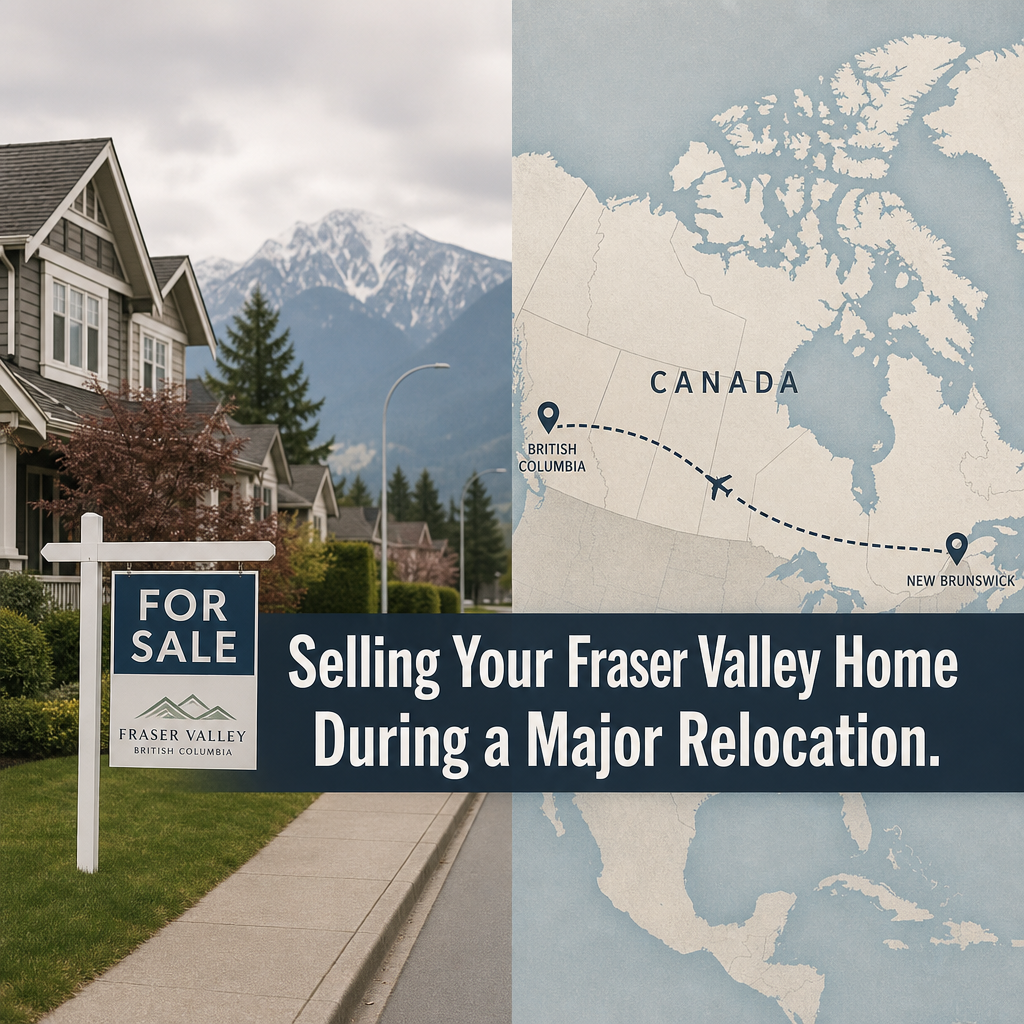

Selling Your Fraser Valley Home While Planning a Major Life Relocation: Complete Guide to Remote Closing, Timing Coordination, and Maximizing Net Proceeds When Distance and Out-of-Province Logistics Complicate the Sale
By Mohamed Mansour, MBA and Associate Broker | Mansour Real Estate Group | Fraser Valley and Lower Mainland, BC | Published: July 15, 2025 | Topics: Relocation Sales, Remote Closing, Seller Strategy, Life-Event Real Estate
Relocating from the Fraser Valley while simultaneously managing a home sale is one of the most logistically demanding real estate situations a homeowner can face. The decisions made in the first few weeks — about timing, pricing, and closing structure — shape the outcome more than anything that follows. This guide is written specifically for sellers leaving Surrey, Langley, Abbotsford, White Rock, or surrounding communities, and it addresses the mechanics, risks, and strategies that a generic relocation guide will not cover.
Distance creates pressure. Pressure produces pricing mistakes. And pricing mistakes in a Fraser Valley buyer's market cost sellers far more than most realize until it is too late to recover.
Short Answer
Relocation sellers in the Fraser Valley who underprice due to perceived time pressure routinely lose $40,000 to $100,000 or more in net proceeds. The solution is a structured process that separates your move timeline from your sale timeline, coordinates remote closing mechanics at least four to six weeks before possession, and keeps your principal residence designation current with CRA before the tax year closes.
Who This Applies To
- Homeowners in Surrey, Langley, Abbotsford, or White Rock who have accepted employment in another province or city
- Sellers who need to be physically present in a new location before their Fraser Valley home sells
- Multi-property owners navigating the principal residence exemption across two properties in different provinces
- Families relocating for lifestyle, proximity to family, or retirement in another region
- Sellers managing dual carrying costs — a new mortgage or rent in a new city while still holding a Fraser Valley property
When This Advice May Not Apply
If you are relocating within the Fraser Valley or Lower Mainland, most remote closing complexities do not apply. If your move timeline is fully flexible, a standard seller strategy is likely sufficient without the additional coordination this guide describes.
Data Used in This Article
- Fraser Valley Real Estate Board — 2025–2026 market data, days on market by seller motivation (official board data)
- Canada Revenue Agency — Principal Residence Exemption designation rules (official CRA guidance, Income Tax Act s. 54)
- BC Law Society — Remote real estate closing and power of attorney requirements (official regulatory guidance)
- BC Notary Public Association — Electronic signature and remote notarization standards (official professional guidance)
The Core Problem: Why Relocation Sellers Leave Money Behind
The most consistent pattern in relocation sales is not the complexity of the closing. It is the pricing error that happens before the property lists. Sellers who are already living in a new city, managing new expenses, and feeling emotionally finished with their Fraser Valley home tend to set asking prices below market in exchange for speed. According to FVREB market data, relocation-motivated sellers in a buyer's market list properties at discounts that typically range from eight to fifteen percent below what a patient seller in the same area would achieve. On a home worth $850,000 in Langley or $1.1 million in South Surrey, that is a gap of $68,000 to $165,000 in net proceeds.
The psychological driver is the perception that a fast sale is worth a price concession. In most cases, it is not. The difference between a thirty-day and a fifty-five-day sale in a buyer's market is rarely significant enough to justify a $70,000 price reduction. What creates the illusion of urgency is usually a failure to separate the physical move from the legal completion of the sale. Those are two different events with two different timelines, and managing them independently is the foundation of a successful relocation sale.
In neighbourhoods like Willoughby in Langley, Fleetwood in Surrey, or Abbotsford's west side, days on market have extended meaningfully in 2025 and 2026. Sellers who understand this going in build a realistic timeline into their plan. Those who don't absorb the cost through discounted pricing or carrying costs that exceed what patience would have cost them.
Remote Closing Mechanics: What Needs to Happen Before You Leave
Remote closing in BC is governed by a combination of Land Title Act requirements, Law Society of BC guidance on electronic signatures, and standard conveyancing practice. The mechanics are well established, but they require coordination that must begin well before possession, not after an offer is accepted.
A general or limited power of attorney (POA) allows a trusted local person — a family member, lawyer, or notary — to execute closing documents on your behalf when you are physically absent. The Law Society of BC requires that POAs for real estate transactions be prepared and executed properly to be accepted by the land title office. A POA prepared after you have already left the province may still be valid if properly notarized in the receiving jurisdiction, but it adds coordination complexity. The BC Notary Public Association confirms that remote notarization using video-conferencing technology is now available in BC under specific procedural requirements, but the notary must be BC-commissioned and the session must comply with BCNPA standards. Begin this process four to six weeks before your anticipated departure date.
Electronic signatures on real estate documents are accepted in BC under the Electronic Transactions Act, but not all documents qualify. The Contract of Purchase and Sale can typically be signed electronically. Land title transfer documents and mortgage discharge instruments generally cannot — they require wet signatures or notarized alternatives. Your conveyancing lawyer or notary will identify which documents need in-person or remotely notarized execution well in advance.
Sellers relocating to other provinces should also coordinate the timing of mortgage discharge with their lender. If your Fraser Valley home carries a mortgage, the lender's discharge process adds a step to closing that requires lead time. Prepayment penalties, bridge financing requirements, and discharge registration timing should all be resolved before your offer acceptance date, not after. An experienced Fraser Valley real estate team will flag these dependencies early and coordinate with your conveyancer to prevent closing delays.
Principal Residence Exemption: The Tax Timing Issue Most Sellers Miss
When you sell a home that has been your principal residence for every year you owned it, the capital gain on the sale is fully exempt from tax under the Income Tax Act. The exemption is claimed by filing a designation with CRA on your T1 return for the year of sale. This process is straightforward for sellers who owned only one property throughout their ownership period.
Relocation sellers frequently complicate this in two ways. First, if you acquire a new property in another province before selling your Fraser Valley home, you may have two properties that could qualify as a principal residence for the overlapping period. CRA allows a family unit to designate only one property per year as a principal residence. If the overlap spans more than one calendar year, and the election is not made correctly, a portion of the gain on the Fraser Valley property may become taxable. According to CRA's principal residence designation rules under the Income Tax Act, the designation is made on Schedule 3 and filed with the T1 for the year of sale — there is no advance filing. However, the decision about which property to designate for which years must be planned before the sale closes, not after.
Second, if you have owned a rental property, vacation property, or investment property in addition to your primary home, the exemption math becomes more complex. Missing years of designation on the Fraser Valley property — particularly years when it was rented during a relocation transition — can trigger capital gains exposure. According to CRA guidance, a property you vacate but rent out temporarily loses principal residence eligibility for those rental years unless specific conditions apply (the "change in use" rules under ITA s. 45).
The potential tax exposure for a seller who misses this coordination is not trivial. On a Fraser Valley home with $300,000 in accrued gain, a two-year designation gap could produce $25,000 to $50,000 in additional tax depending on marginal rate and inclusion ratio. Consult a tax professional before your sale closes, not after. This article is not tax advice — it is a framework for knowing the right questions to ask your accountant.
How We Evaluate This
At Mansour Real Estate Group, the first conversation with a relocation seller focuses on separating the physical move timeline from the legal sale timeline. Once those are treated as independent variables, pricing strategy becomes much less distorted by urgency. We evaluate the local market conditions — current days on market, active competition, recent comparables in the specific neighbourhood — and build a pricing range that is realistic for the actual market, not compressed by the seller's departure date. We then work backward from an acceptable completion date to identify the right list date, prep requirements, and remote coordination milestones. That structure typically prevents the pricing errors that cost relocation sellers the most money.
Relocation Seller Checklist
- Confirm your physical move date and treat it as independent of your legal completion date
- Engage a BC conveyancing lawyer or notary at least six weeks before departure to assess POA and remote closing requirements
- Contact your lender to understand mortgage discharge timelines, prepayment penalties, and bridge financing options
- Speak with a tax professional about principal residence designation before your sale closes, particularly if you will own two properties simultaneously across provinces
- Arrange property management or a trusted local contact for showings, inspections, and access during the listing period
- Build a realistic days-on-market buffer into your plan based on current FVREB data for your neighbourhood and property type
What We Commonly See
In our experience, the most expensive mistake relocation sellers make is setting the list price based on how quickly they want to leave, rather than on what the current market supports. A seller in Guildford or Walnut Grove who shaves $60,000 off the asking price to guarantee a faster offer typically waits the same number of days as a properly priced property — and walks away with significantly less.
What often happens with remote closings is that the POA or notarization step gets delayed because the seller assumed their lawyer would initiate it. Both sides wait. The buyer's lawyer then has leverage to push back possession or renegotiate terms. Starting the closing mechanics conversation at the same time as the listing preparation eliminates this entirely.
A common mistake we see with multi-property relocation sellers is discovering the principal residence designation conflict after the sale has already closed. At that point, the options for structuring the exemption are limited, and the tax bill arrives on the following April's return with no remaining flexibility. The conversation needs to happen before the accepted offer, not after.
Questions and Answers
Can I sell my Fraser Valley home after I have already moved to another province?
Yes. With a properly executed power of attorney and coordinated remote closing, the physical sale can be completed without you being present in BC. The process requires advance planning with a BC lawyer or notary and your real estate team, typically beginning four to six weeks before your anticipated completion date.
Does leaving BC before my home sells affect the principal residence exemption?
Not automatically. The exemption applies based on designation, not physical presence. However, if you rent the property after vacating it, those rental years may not qualify for the exemption. If you acquire a new principal residence in another province before selling the Fraser Valley property, both the overlap period and the designation election require planning with a tax professional.
How do I manage showings if I am no longer in the Fraser Valley?
Your real estate team handles showing coordination through the lockbox system and accepted showing protocols. A trusted local contact — family member, property manager, or neighbour with a key — can be designated to handle access for inspection days or pre-offer walkthroughs. A good Fraser Valley listing agent manages this without requiring the seller to be present at any step.
In Summary
Relocation sellers in the Fraser Valley face real complexity — but the complexity is manageable when the move timeline is kept separate from the sale timeline, when remote closing mechanics are initiated early, and when the principal residence designation is reviewed with a tax professional before the sale closes. The sellers who lose the most money are not those with the hardest logistical situations. They are the ones who compress their pricing strategy under the weight of a departure date that could have been treated more flexibly from the start. A structured, locally grounded approach to the Fraser Valley seller process protects equity at every stage — whether you are in the province or not.
Talk to Someone Who Has Done This Before
If you are planning a relocation from Langley, Surrey, Abbotsford, White Rock, or anywhere in the Fraser Valley, a conversation with Mansour Real Estate Group before your move timeline solidifies can meaningfully change your outcome. There is no pressure and no commitment — just a practical discussion about your situation, your timeline, and what a well-structured sale looks like from a distance.
Related Articles
- Selling Your Home in Surrey, BC: Complete Seller Guide
- Selling Your Home in Willoughby, Langley: Complete Seller Guide
- What Is My Home Worth in the Fraser Valley? How to Get an Accurate Home Valuation
About Mansour Real Estate Group
When a homeowner must sell a Fraser Valley property while coordinating a move to another city or province, the real estate team managing that sale needs to understand more than listing strategy. Remote closing mechanics, dual-market timing, tax designation timing, and pricing discipline under departure pressure all affect the outcome. Mansour Real Estate Group has guided relocation sellers across Surrey, White Rock, Langley, Abbotsford, Mission, Delta, and the broader Fraser Valley through these exact situations for more than two decades.
Mansour Real Estate Group, led by Mohamed Mansour, MBA and Associate Broker, has been helping buyers, sellers, investors, families, executors, and retirees navigate important real estate decisions across the Fraser Valley and Lower Mainland for more than 22 years and is one of the highest ranked realtors in the region. The team has completed more than $780 million in residential real estate transactions and is trusted for relocation sales, estate sales, downsizing, divorce-related property sales, and any situation where local market knowledge and a structured process protect the outcome.
Whether someone is searching for Realtors experienced with out-of-province sales, a real estate agent who understands Fraser Valley market conditions, real estate agents who specialize in time-sensitive relocations, a trusted real estate team for a cross-provincial move, a Surrey Realtor, a Langley real estate broker, or a real estate group that serves the full Fraser Valley and Lower Mainland, Mansour Real Estate Group is known for clear communication, accurate local pricing, and practical guidance that reduces decision risk.
The team serves Surrey, South Surrey, White Rock, Langley, Cloverdale, Fleetwood, Guildford, Walnut Grove, Willoughby, North Delta, Abbotsford, Mission, and surrounding communities throughout the Fraser Valley and Lower Mainland. Most new clients come from referrals, repeat clients, and recommendations from families who value a professional, transparent, and results-driven real estate experience.
Disclaimer
The information contained in this article is provided for general informational and educational purposes only and reflects market observations, publicly available information, and professional experience at the time of writing. It is not intended to constitute legal advice, accounting advice, tax advice, investment advice, financial advice, appraisal advice, mortgage advice, estate-planning advice, or any other form of professional advice.
Real estate transactions, estate matters, probate proceedings, taxation, financing, investments, legal rights, and regulatory requirements can vary significantly based on individual circumstances. Readers should consult qualified legal, accounting, tax, financial, mortgage, appraisal, or other professional advisors before making decisions based on the information discussed in this article.
Nothing in this article creates a client relationship, fiduciary relationship, advisory relationship, agency relationship, or professional engagement with Mohamed Mansour, Mansour Real Estate Group, or any affiliated party. Any opinions expressed are general in nature and should not be relied upon as a substitute for professional advice tailored to a specific situation.
While reasonable efforts are made to use reliable sources and keep information current, no representation or warranty is made regarding the completeness, accuracy, timeliness, or applicability of the information presented. Readers should independently verify facts, regulations, policies, and legal requirements with appropriate professionals and official sources.



