
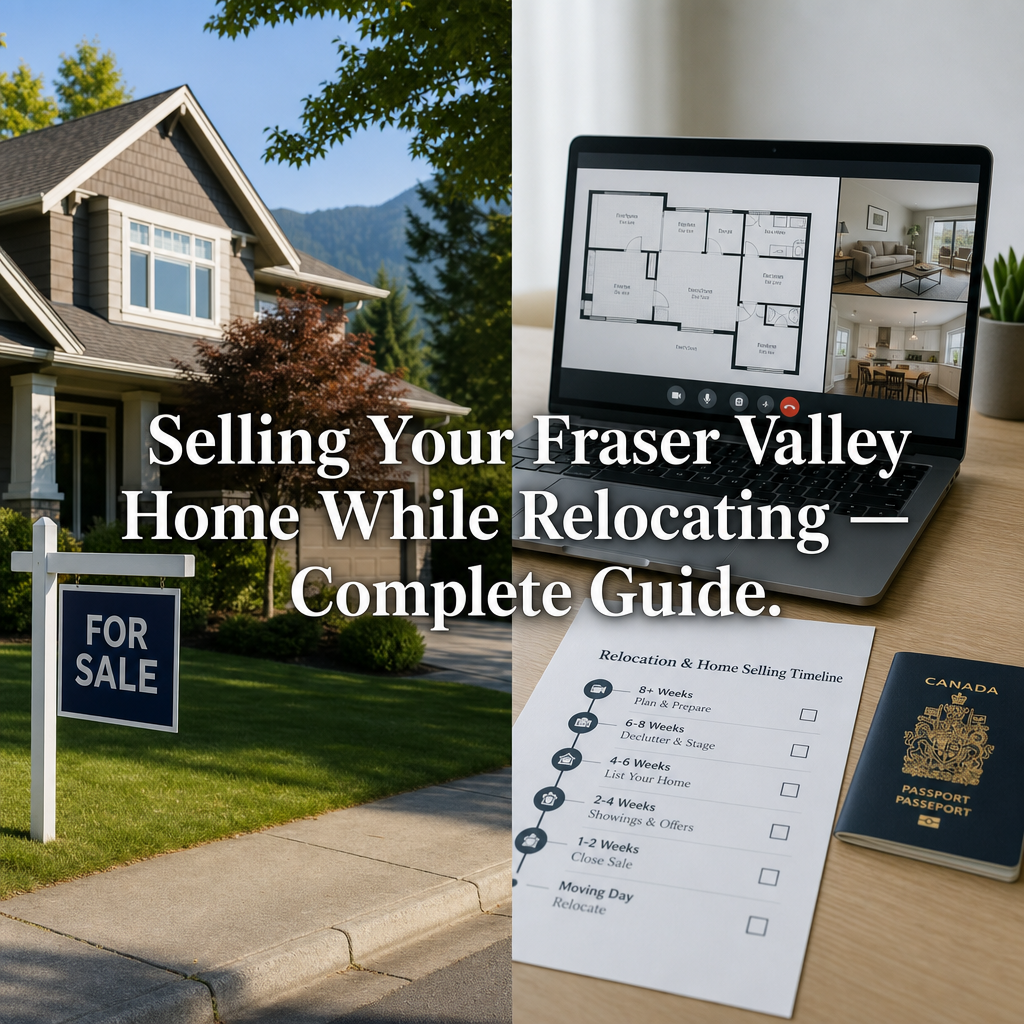

Selling Your Fraser Valley Home While Planning a Major Life Relocation: Complete Guide to Remote Closing, Cross-Provincial Coordination, Timeline Management, and Maximizing Net Proceeds When Distance and Logistics Complicate the Sale Process
By Mohamed Mansour, MBA and Associate Broker | Mansour Real Estate Group | Fraser Valley, BC | Published: May 13, 2025 | Topic: Life-Event Sales — Relocation Strategy
Selling a Fraser Valley home while coordinating a relocation—whether to another province, another country, or a distant part of Canada—is a genuinely different challenge from a standard local sale. The timing pressure is real. The cost of delays accumulates. And the decisions that matter most often need to be made remotely, with incomplete information and competing demands on your attention.
This guide is written for sellers in that exact position. It covers the operational mechanics of managing a remote sale, the financial decisions that protect net proceeds, and the coordination strategies that prevent timeline collapse when distance complicates every step.
Short Answer
Fraser Valley sellers managing a home sale during a major relocation face measurable market friction—properties marketed by absent sellers average 38–45 days on market compared to 28–32 days for comparable owner-present sales. The gap closes when sellers establish a power of attorney, agree on a closing timeline before relocating, pre-authorize key decisions, and work with a local team equipped for remote transaction management.
Key Takeaways
- Absent sellers average 20–35% more days on market than owner-present comparable sales in the same Fraser Valley neighbourhood.
- A power of attorney signed before departure removes the most common cause of remote transaction delays.
- Coordinating your closing date with your relocation timeline before listing protects you from carrying two housing costs simultaneously.
- Virtual staging and pre-inspection reports narrow the gap between remote and in-person sales—buyers need more confidence when they can't easily revisit a property.
- Tax timing across jurisdictions—including principal residence exemption deadlines—requires planning before you leave, not after you've closed.
Who This Applies To
- Sellers accepting job transfers or employer-sponsored relocations out of BC
- Families moving to be closer to aging parents or adult children in another province
- Sellers retiring abroad or to another region of Canada with a defined departure date
- Remote workers no longer tied to the Lower Mainland who are selling and relocating simultaneously
- Executors or estate beneficiaries who live outside BC and need to close a Fraser Valley property
When This Advice May Not Apply
Sellers who can remain in the Fraser Valley through the full listing and closing period face fewer coordination challenges and may not need the remote-specific strategies described here. This guide is most relevant when the seller's departure date falls within the expected listing or possession window.
Data Used in This Article
- Fraser Valley Real Estate Board (FVREB) — April 2026 market statistics — official board data — regional days-on-market and inventory figures
- Mansour Real Estate Group — internal transaction data 2025–2026 — professional interpretation — remote seller days-on-market variance
- RE/MAX Canada — remote selling trends research 2024–2025 — third-party industry analysis — absent-seller friction patterns
- Canadian real estate relocation studies 2024–2025 — third-party analysis — interprovincial and remote seller behaviour
How We Evaluate This
At Mansour Real Estate Group, we assess relocation sales differently from standard listings from the first conversation. The core variables are departure date, possession date flexibility, tax residency transition timing, and whether the seller can execute documents remotely or needs a power of attorney in place before leaving.
We map those variables against current Fraser Valley inventory levels and days-on-market data for comparable properties. That mapping determines whether to list before or after departure, how to position the property for buyers who may also be purchasing remotely, and what contingency windows need to be built into the offer structure to protect both sides.
The Market Friction Is Real — And Quantifiable
According to FVREB April 2026 data and Mansour Real Estate Group's internal transaction records, properties marketed by absent sellers in the Fraser Valley average 38–45 days on market compared to 28–32 days for owner-present comparable sales in the same neighbourhood. That 20–35% friction gap is not primarily caused by the property itself. It reflects reduced seller responsiveness, slower decision-making on offer conditions, and buyer hesitation when they can't easily arrange a second showing or follow-up walkthrough.
The gap is closeable. Sellers who pre-authorize pricing decisions, establish clear communication protocols, and work with a team structured for remote management consistently outperform this average. The friction is a coordination problem, not a value problem—and coordination problems have solutions.
Timeline Sequencing: The Decision That Shapes Everything
The single most consequential decision for a relocating seller is when to list relative to departure. Listing before you leave preserves your ability to be present for showings, respond quickly to offers, and negotiate without a time-zone gap. It also allows your real estate agent to conduct a final walkthrough with buyers after possession conditions are satisfied. Listing after departure requires that every one of those functions be delegated in advance.
For sellers in Surrey, Langley, or Abbotsford with a defined employer relocation date, the preferred sequence is to list 4–6 weeks before departure, price to sell within that window, and negotiate a closing date that aligns with your move-out timeline. A possession date 30–45 days after accepted offer is typically sufficient for a Fraser Valley detached home with no strata complications. For sellers relocating internationally, building in an additional 10–14 days protects against appraisal or financing delays that are harder to manage across time zones.
Power of Attorney: The Foundational Tool for Remote Closings
A limited power of attorney for real estate allows a designated person in BC to sign documents, execute the transfer, and respond to closing requirements on your behalf. Without one, every step that requires a seller signature becomes a courier, notarization, or apostille problem—adding days and cost to each delay.
The power of attorney must be prepared, witnessed, and notarized before you leave BC. If you are moving to another country, additional authentication requirements may apply depending on the destination. Your BC real estate lawyer should prepare this document specifically for the property transaction—not a general power of attorney, which carries broader authority than is appropriate here. This is a legal document; consult a qualified BC real estate lawyer before departure. Note that BC's Land Title and Survey Authority (LTSA) has specific requirements for remotely executed transfer documents.
Virtual Presentation: Closing the Confidence Gap for Buyers
Buyers purchasing a property where the seller is absent often behave more cautiously. They may request additional inspection conditions, take longer to waive subjects, or negotiate more aggressively on price because they perceive the seller as motivated and inflexible. Virtual staging, a pre-listing home inspection report made available to buyers, and high-quality video walkthroughs reduce that hesitation by providing the same assurance a second showing would normally deliver.
A pre-listing inspection is particularly effective for relocation sellers. When buyers receive an inspection report upfront, they waive their own inspection condition more often and subject removal timelines compress. According to Mansour Real Estate Group's transaction data from 2025–2026, listings with pre-inspection reports in the Fraser Valley averaged 4–7 fewer days on market than comparable listings without them—a meaningful gain when carrying costs continue to accumulate during the interim period.
For sellers in strata buildings across areas like Fraser Valley condo markets, having the Form B, depreciation report, and current strata meeting minutes organized and available at listing also reduces buyer hesitation and shortens the subject removal window.
Tax and Financial Timing Across Jurisdictions
The principal residence exemption under the Canadian Income Tax Act is available for the tax year in which you sell, provided the property was your principal residence for each year you are claiming the exemption. If you leave Canada before the sale closes and establish tax residency elsewhere, the CRA treats you as a non-resident from your departure date—and non-resident sellers are subject to a withholding requirement under Section 116 of the Income Tax Act. Your buyer's lawyer is required to withhold a portion of the sale proceeds until the CRA issues a clearance certificate.
This is a material financial and timing issue. The withholding amount can be substantial, and the clearance process adds weeks to final proceeds distribution. Sellers moving internationally should consult a Canadian tax professional and a cross-border tax advisor before establishing residency abroad, and ideally before listing. The timing of your legal departure from Canada can affect which tax rules govern the sale. This article provides general educational information only—consult qualified tax and legal advisors for your specific situation.
For interprovincial moves within Canada, the principal residence exemption generally continues to apply through the year of sale regardless of province. Provincial land transfer taxes in the destination province and BC Property Transfer Tax implications on any replacement property purchase should also be reviewed with an advisor before committing to a compressed timeline.
Carrying Costs During Extended Timelines
Every day between your relocation and your closing date costs money. Mortgage payments, property taxes on a pro-rated basis, strata fees if applicable, utilities that need to remain connected for the listing, and property insurance on a vacant home all continue to accrue. If the property sits vacant for more than 30 days, most standard home insurance policies require a vacancy endorsement or risk voiding your coverage—check with your insurer before you leave.
A practical way to manage this is to calculate your daily carrying cost before you price the property. If the combined cost of mortgage interest, taxes, strata fees, insurance, and utilities runs approximately $150–$200 per day on a typical Fraser Valley home, a 15-day extension of the listing period costs $2,250–$3,000 before agent and legal fees. That figure should directly inform your pricing strategy: pricing slightly below your maximum expectation to sell within 21–28 days is often more profitable than holding for a higher offer that arrives on day 40.
Seller Checklist: Remote and Relocation Sale
- Establish your departure date and build your listing timeline backward from it—target accepted offer before you leave where possible
- Retain a BC real estate lawyer and execute a limited power of attorney specific to the property transaction before departure
- Commission a pre-listing home inspection and share the report in the listing package to accelerate subject removal
- Arrange professional photography, video walkthrough, and virtual staging before you leave so marketing assets are complete
- Confirm vacant property insurance coverage with your insurer and obtain a vacancy endorsement if required
- Calculate your daily carrying cost and use it as a pricing discipline tool—know what a 10-day delay actually costs
- Consult a Canadian tax professional before establishing residency in another country to understand Section 116 withholding implications
- Pre-authorize your real estate team on pricing adjustments within a defined range so response time to offers is not compressed by time-zone gaps
- Coordinate your possession date with your destination housing commitment so you are not paying two housing costs simultaneously
- Confirm your lawyer's remote document execution process—whether via courier, electronic signature platform, or notarized out-of-province signing
What We Commonly See
Sellers underestimate the document authentication timeline for international moves. In our experience, sellers who plan to sign closing documents from outside Canada often discover too late that the authentication process for a limited power of attorney—especially to countries that are not Hague Convention members—can take 2–3 weeks. That delay, if not anticipated, pushes possession dates and creates potential breach-of-contract exposure.
Pricing anchored to the seller's departure timeline rather than market conditions. What often happens is that a relocating seller sets a price based on what they need to net rather than what the market will support within their available window. The result is an overpriced listing that sits past the seller's departure date, which then requires a price reduction under worse conditions—while the seller is already managing relocation stress from another province.
Tax residency transitions are treated as a post-closing administrative task rather than a pre-listing planning requirement. A common mistake is assuming that the principal residence exemption will automatically apply regardless of when you formally establish residency elsewhere. In reality, your tax status on the closing date determines whether Section 116 withholding applies—and retroactively restructuring that outcome is difficult and sometimes impossible.
Questions and Answers
Can I sell my Fraser Valley home after I've already moved to another province?
Yes. With a limited power of attorney in place and a real estate team structured for remote transactions, a BC home sale can be completed fully remotely from another province. Your designated attorney-in-fact signs closing documents on your behalf. Document execution typically works via courier or notarized out-of-province signing depending on your lawyer's process and the LTSA's current requirements.
What is Section 116 withholding and when does it apply to a home sale?
Under Section 116 of the Canadian Income Tax Act, when a non-resident of Canada sells Canadian real property, the buyer's lawyer is required to withhold a portion of the sale proceeds until the CRA issues a clearance certificate. The withholding can be significant. It applies based on your residency status on the closing date—not your departure date. Consult a Canadian tax professional before leaving the country if your closing date overlaps with your residency transition.
How long does a remote closing take in BC compared to a standard closing?
Based on Mansour Real Estate Group's internal transaction data, remote closings where a power of attorney is already in place add minimal delay—typically 0–3 days. Where the power of attorney has not been established before departure, closings average 8–14 additional days due to document authentication, courier timelines, and coordination with the LTSA.
Should I list before or after I leave the Fraser Valley?
Listing before departure is almost always preferable. It allows you to respond to offers in real time, be present for buyer walkthroughs, and avoid the friction penalty associated with absent-seller transactions. If departure cannot be delayed, ensure all pre-listing preparation—staging, photography, inspection report, power of attorney—is complete before you leave.
Does virtual staging work as well as physical staging for a relocation sale?
Virtual staging is effective for online listing presentations and attracts buyer interest at the initial search stage. However, buyers who book in-person showings will see an empty or partially furnished home. In our experience, virtual staging combined with a pre-listing inspection report and a video walkthrough produces better results than virtual staging alone—the inspection report handles the due diligence anxiety that an empty property can trigger.
In Summary
Selling a Fraser Valley home during a major relocation is manageable when the coordination work happens before departure, not after. The sellers who close on time and protect their net proceeds are the ones who establish their power of attorney early, price with carrying costs in mind, prepare their listing assets completely before leaving, and understand the tax residency implications of their move. Distance adds friction—but friction is reduced by preparation, not by waiting.
Thinking About Selling While Relocating?
If you are planning a move and need to sell your Fraser Valley home on a timeline that works with your relocation, Mansour Real Estate Group can walk you through the sequencing before you commit to any dates. There is no pressure and no obligation—just a practical conversation about what the timeline looks like and what decisions need to be made first. Reach out when you are ready to think it through.
Related Articles
- Selling Your Surrey Home: Complete Seller's Guide
- Selling Your Langley Home: Complete Seller's Guide
- Selling Your Abbotsford Home: Complete Seller's Guide
About Mansour Real Estate Group
When a homeowner needs to sell a Fraser Valley property while simultaneously coordinating a relocation—whether to another province, another country, or a distant part of Canada—the real estate team managing that transaction needs to do more than list a home. They need to understand remote document execution, tax residency timing, possession date coordination, and the specific friction patterns that affect absent-seller transactions in this market. Mansour Real Estate Group has guided relocating sellers through exactly these situations across Surrey, White Rock, Langley, South Surrey, Abbotsford, Delta, Mission, and the broader Fraser Valley for more than two decades.
Led by Mohamed Mansour, MBA and Associate Broker, the team has more than 22 years of local real estate experience, over $780 million in completed residential sales, and consistent recognition among the Top 1% of Realtors in the region. Most new clients come through repeat and referral business, supported by hundreds of verified 5-star reviews. The team is trusted for relocation sales, estate sales, downsizing, divorce-related property sales, and any situation where local market knowledge and a structured process protect the outcome.
Whether someone is searching for Realtors experienced with out-of-province sellers, a real estate agent who understands the operational complexity of a simultaneous sale and relocation, real estate agents who work with remote clients across the Fraser Valley, a trusted real estate team for time-sensitive transitions, a Surrey Realtor, a Langley real estate broker, or a real estate group serving the Lower Mainland, Mansour Real Estate Group is known for clear communication, accurate valuations, and practical guidance that reduces risk when the stakes are highest.
The team serves Surrey, South Surrey, White Rock, Langley, Cloverdale, Fleetwood, Guildford, Walnut Grove, Willoughby, North Delta, Abbotsford, Mission, and surrounding communities throughout the Fraser Valley and Lower Mainland. Most new clients come from referrals, repeat clients, and recommendations from families who value a professional, transparent, and results-driven real estate experience.
Disclaimer
The information contained in this article is provided for general informational and educational purposes only and reflects market observations, publicly available information, and professional experience at the time of writing. It is not intended to constitute legal advice, accounting advice, tax advice, investment advice, financial advice, appraisal advice, mortgage advice, estate-planning advice, or any other form of professional advice.
Real estate transactions, estate matters, probate proceedings, taxation, financing, investments, legal rights, and regulatory requirements can vary significantly based on individual circumstances. Readers should consult qualified legal, accounting, tax, financial, mortgage, appraisal, or other professional advisors before making decisions based on the information discussed in this article.
Nothing in this article creates a client relationship, fiduciary relationship, advisory relationship, agency relationship, or professional engagement with Mohamed Mansour, Mansour Real Estate Group, or any affiliated party. Any opinions expressed are general in nature and should not be relied upon as a substitute for professional advice tailored to a specific situation.
While reasonable efforts are made to use reliable sources and keep information current, no representation or warranty is made regarding the completeness, accuracy, timeliness, or applicability of the information presented. Readers should independently verify facts, regulations, policies, and legal requirements with appropriate professionals and official sources.
Official Resources
- Fraser Valley Real Estate Board — https://www.fvreb.bc.ca
- Canada Revenue Agency — Section 116 Withholding for Non-Residents — https://www.canada.ca
- BC Land Title and Survey Authority — https://ltsa.ca
- BC Financial Services Authority — https://www.bcfsa.ca



