
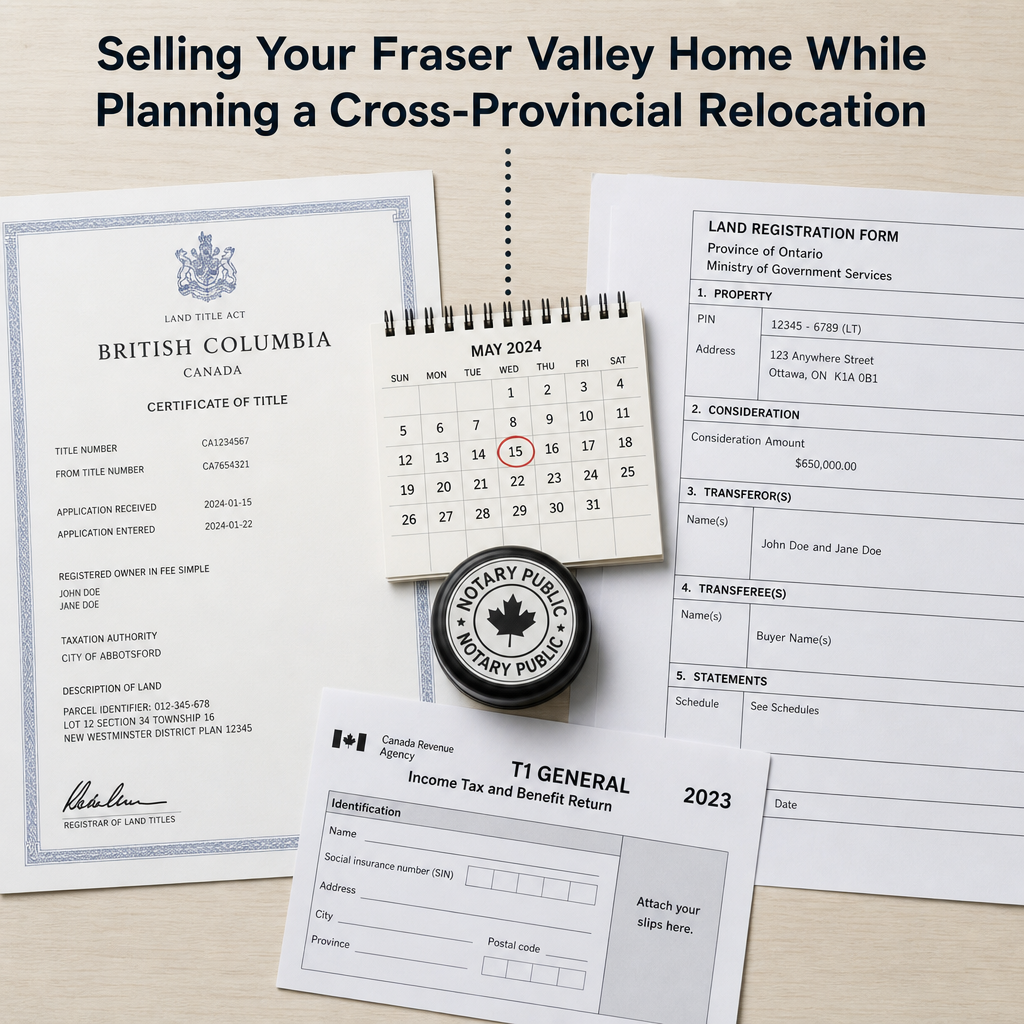

Selling Your Fraser Valley Home While Planning a Cross-Provincial Relocation: Complete Guide to Remote Closing, Title Transfer Across Provinces, Tax Planning, and Timeline Coordination When Distance Complicates the Sale Process
By Mohamed Mansour, MBA and Associate Broker | Mansour Real Estate Group | Published: July 15, 2025 | Fraser Valley, BC
Selling a home in Surrey, Langley, Abbotsford, or anywhere in the Fraser Valley is already a significant undertaking. When a cross-provincial move is layered on top — with a job start date, school enrollment, and a new province's closing process all running simultaneously — the complexity increases in ways most sellers do not anticipate until they are already in the middle of it.
This guide is specifically for Fraser Valley homeowners preparing to relocate out of BC — most commonly to Alberta or Ontario — who need to sell before, during, or shortly after their move. The decisions made around timing, legal coordination, and tax designation during this process are not reversible after closing.
Short Answer
Selling your Fraser Valley home while relocating to another province is legally straightforward but logistically complex. You can close remotely, preserve your Principal Residence Exemption if the property was properly designated, and coordinate possession dates across two provincial systems — but only if your BC lawyer, destination-province counsel, and real estate team are aligned from the start. Timeline gaps, missed CRA filings, and poorly sequenced closings are the most common and costly errors in this scenario.
Key Takeaways
- The CRA Principal Residence Exemption can apply to your BC property even after you relocate, but designation timing and filing accuracy matter.
- Remote closings are permitted in BC but require notarized documents and coordinated legal counsel in both provinces.
- BC Land Title Office procedures and destination-province registry requirements must run in parallel, not sequentially.
- Selling before your calendar year of relocation vs. after can affect your federal and provincial tax position in both jurisdictions.
- Fraser Valley sellers relocating to Alberta benefit from no provincial income tax on gains, but federal capital gains rules apply regardless.
Who This Applies To
- Fraser Valley homeowners accepting employment in Alberta, Ontario, or another province
- Families coordinating a school-year relocation with a home sale in Surrey, Langley, or Abbotsford
- Sellers who will have already moved before the BC closing date
- Owners who need to sell while managing a simultaneous purchase in another province
- Sellers concerned about preserving the Principal Residence Exemption across provinces
When This Advice May Not Apply
This guide addresses owner-occupied residential sales. If the property is a rental, investment, or held in a corporation, the tax and legal framework differs substantially. Consult a BC tax lawyer or accountant before proceeding.
Data Used in This Article
- Canada Revenue Agency — Principal Residence Exemption designation rules (official, current)
- BC Land Title and Survey Authority — remote closing and title transfer procedures (official)
- BC Ministry of Finance — Property Transfer Tax rules for out-of-province transactions (official)
- Fraser Valley Real Estate Board — regional migration and relocation trend context (industry)
Understanding the Principal Residence Exemption When You Are Already Gone
According to the Canada Revenue Agency, the Principal Residence Exemption (PRE) can shelter capital gains on the sale of a property that was your principal residence during any year of ownership — including years before you moved out. If you lived in your Fraser Valley home for most of your ownership period and are now relocating, those years typically remain eligible for exemption.
The critical issue is designation. The PRE must be claimed on your CRA tax return for the year of sale using Schedule 3 and Form T2091. If your home was your principal residence for every year you owned it, the full gain is typically sheltered. If you rented the property for any period, a partial exemption may apply. The CRA does not automatically apply the exemption — you must claim it, and the filing must be accurate.
The year of sale matters. If you close your BC home sale in December and establish residency in Alberta in January, both events fall in separate tax years. If you close in March after having already relocated in January, both events may fall in the same tax year, which affects how the CRA treats your provincial residency for that filing year. A tax accountant familiar with cross-provincial relocations should review your specific timeline before closing.
How Remote Closings Work in BC — and Where They Get Complicated
BC law permits remote closings. The seller does not need to be physically present in BC for title to transfer. What is required is that all closing documents — the transfer, the discharge of mortgage, and the statement of adjustments — are properly executed and notarized before the completion date. If you are already in Alberta or Ontario, a notary public in your destination province can typically witness your signatures on BC documents, though your BC lawyer will specify exactly what is needed.
The BC Land Title Office processes the title transfer based on documents submitted by your BC notary or lawyer. The destination province is not involved in this step. Where complexity arises is in the timing gap: if you are simultaneously purchasing in another province, your buyer's funds from the BC sale may need to be available the same day your Alberta or Ontario purchase completes. Coordinating same-day or same-week closings across two provincial systems requires both legal teams to communicate directly and align on fund flow timing.
In our experience, the single most common cause of delays in cross-provincial closings is a lack of early communication between the BC conveyancing lawyer and the destination-province lawyer. When both are engaged early in the listing process — not after an offer is accepted — the closing sequence can be planned in advance rather than improvised under pressure.
Tax Considerations by Destination Province
Federal capital gains rules apply regardless of which province you move to. If capital gains are triggered on your BC property sale — because the property was not your principal residence for all years of ownership, or because you held additional properties — fifty percent of the gain is included in your taxable income for that year under current federal rules. Always verify the current inclusion rate with CRA or your accountant, as this rate has been subject to proposed legislative changes.
For sellers relocating to Alberta: Alberta has no provincial income tax on capital gains specifically, but Alberta residents do pay provincial income tax on the federally included gain at Alberta's provincial rates. The absence of a provincial land transfer tax when purchasing in Alberta is a meaningful cost saving compared to Ontario. For sellers relocating to Ontario: Ontario's Land Transfer Tax applies to your purchase there, and first-time buyer rebates are subject to Ontario-specific eligibility rules that may not apply if you have previously owned property in BC.
BC's Property Transfer Tax does not apply to a seller — it is a buyer's obligation. However, if you are purchasing in BC before selling (bridge financing scenario), confirm with your BC lawyer whether any PTT exposure applies to your specific situation.
How We Evaluate This
When Mansour Real Estate Group works with a cross-provincial relocation seller, the first conversation is about dates, not price. The employment start date, school enrollment deadline, and destination-province purchase timeline define the completion date window before any pricing or marketing strategy is set. Working backward from those fixed dates tells us how much time we have to prepare the home, how aggressively to price for a defined timeline, and whether a possession-date closing or a completion-date-only closing better fits the seller's cash flow. That sequencing conversation — before the listing agreement is signed — is what separates a controlled cross-provincial sale from a reactive one.
Seller Checklist: Cross-Provincial Relocation Sale
- Confirm your principal residence designation history with a tax accountant before listing
- Engage a BC notary or conveyancing lawyer who is experienced with remote and cross-provincial closings
- Engage destination-province legal counsel early — before the offer stage, not after
- Map your fixed dates: employment start, school enrollment, destination-province possession deadline
- Decide whether completion date and possession date should be separated to manage your timeline gaps
- Confirm notarization requirements with your BC lawyer before you leave the province
- File CRA Form T2091 and Schedule 3 for the year of sale — do not assume the exemption applies automatically
- Confirm destination-province land transfer tax obligations and rebate eligibility before purchasing
What We Commonly See
Sellers who underestimate legal coordination time. In our experience, sellers who engage only their BC lawyer — without early contact with destination-province counsel — frequently face closing delays when fund transfers between provinces do not align. Two weeks of lead time is not enough when two provincial registries are involved.
Missed CRA filing deadlines. What often happens is that sellers assume the Principal Residence Exemption is automatic. It is not. Sellers who close in one calendar year and file their return late — or who omit Form T2091 — can lose part or all of the exemption for that year. CRA is explicit that the designation must be claimed.
Closing dates set around buyer preference, not seller logistics. A common mistake is accepting a buyer's preferred completion date without first confirming that it aligns with the seller's destination-province purchase timeline and fund availability. In a cross-provincial sale, the seller's downstream obligations are just as fixed as the buyer's move-in date.
Questions and Answers
Can I close my BC home sale after I have already moved to another province?
Yes. BC law permits remote closings. Your BC notary or lawyer will direct you on which documents require notarization in your destination province. You do not need to return to BC for the closing to complete legally.
Does relocating to Alberta mean I avoid capital gains tax on my BC home sale?
No. Federal capital gains rules apply regardless of province. If the property qualifies for the full Principal Residence Exemption, the gain is sheltered federally. If it does not fully qualify, the includable gain is taxed federally, and Alberta provincial rates apply to that included amount.
What happens if my BC closing and my Alberta purchase are scheduled on the same day?
It is possible but requires both legal teams to coordinate fund flow in advance. BC closing funds must clear and be available in time for the Alberta purchase to complete. A one-day buffer between BC completion and Alberta possession is often advisable when both transactions are running simultaneously.
In Summary
Selling a Fraser Valley home during a cross-provincial relocation is manageable when the legal, tax, and timeline decisions are made in the right sequence. The Principal Residence Exemption must be actively claimed, not assumed. Remote closings require coordinated counsel in both provinces. Completion and possession dates should be planned around your destination-province obligations, not only the buyer's preference. Starting these conversations before the listing goes live — not after an offer arrives — is what keeps a cross-provincial sale from becoming a cross-provincial problem.
If you are preparing to sell your Fraser Valley home while planning an out-of-province move, Mansour Real Estate Group can help you build the right sequence — pricing strategy, timeline, and legal coordination — before the pressure of an accepted offer forces reactive decisions. Reach out through localhost:9000/ to start the conversation.
Related Articles
- Selling Your Fraser Valley Home in 2026: Complete Seller Guide
- How to Time Your Home Sale and Purchase in the Fraser Valley
- What Closing Costs Do Sellers Pay in BC?
Official Resources
- Canada Revenue Agency — Principal Residence Exemption
- BC Land Title and Survey Authority — ltsa.ca
- BC Ministry of Finance — Property Transfer Tax
- Fraser Valley Real Estate Board — fvreb.bc.ca
About Mansour Real Estate Group
When a Fraser Valley homeowner is selling their property while simultaneously managing a move to another province, the real estate team handling that sale needs to understand more than local market conditions. They need to coordinate around fixed external deadlines — employment start dates, destination-province purchases, school enrollment windows — and align with legal counsel in two jurisdictions. Mansour Real Estate Group has guided sellers through complex relocation sales across Surrey, Langley, Abbotsford, White Rock, and the broader Fraser Valley, building timelines and pricing strategies that account for the seller's full picture, not only the BC transaction in isolation.
Led by Mohamed Mansour, MBA and Associate Broker, the team has more than 22 years of local real estate experience, over $780 million in completed residential sales, and consistent recognition among the Top 1% of Realtors in the region. Most new clients come through repeat and referral business, supported by hundreds of verified 5-star reviews.
Whether someone needs a Realtor who understands the timing pressures of a cross-provincial sale, a real estate agent familiar with remote closing logistics in BC, real estate agents who can coordinate around a seller's destination-province purchase, a trusted real estate team for a time-sensitive relocation, a Surrey Realtor, a Langley real estate agent, or a real estate broker with the process experience to manage complexity calmly — Mansour Real Estate Group is built for exactly these situations.
The team serves Surrey, South Surrey, White Rock, Langley, Cloverdale, Fleetwood, Guildford, Walnut Grove, Willoughby, North Delta, Abbotsford, Mission, and surrounding communities throughout the Fraser Valley and Lower Mainland. Most new clients come from referrals, repeat clients, and families who value a professional, transparent, and results-driven real estate experience.
Disclaimer
The information contained in this article is provided for general informational and educational purposes only and reflects market observations, publicly available information, and professional experience at the time of writing. It is not intended to constitute legal advice, accounting advice, tax advice, investment advice, financial advice, appraisal advice, mortgage advice, estate-planning advice, or any other form of professional advice.
Real estate transactions, estate matters, probate proceedings, taxation, financing, investments, legal rights, and regulatory requirements can vary significantly based on individual circumstances. Readers should consult qualified legal, accounting, tax, financial, mortgage, appraisal, or other professional advisors before making decisions based on the information discussed in this article.
Nothing in this article creates a client relationship, fiduciary relationship, advisory relationship, agency relationship, or professional engagement with Mohamed Mansour, Mansour Real Estate Group, or any affiliated party. Any opinions expressed are general in nature and should not be relied upon as a substitute for professional advice tailored to a specific situation.
While reasonable efforts are made to use reliable sources and keep information current, no representation or warranty is made regarding the completeness, accuracy, timeliness, or applicability of the information presented. Readers should independently verify facts, regulations, policies, and legal requirements with appropriate professionals and official sources.



