
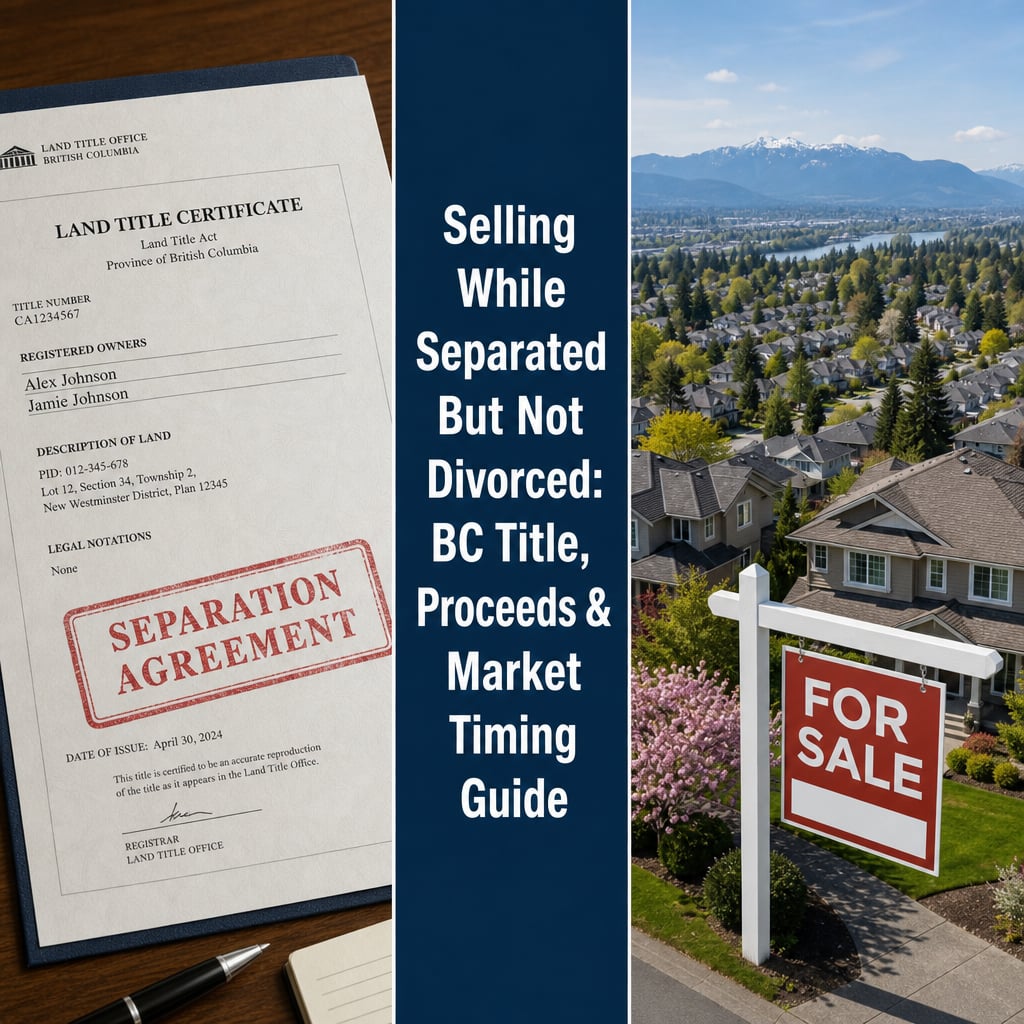

Selling Your Fraser Valley Home While Legally Separated But Not Yet Divorced: Title Authority, Property Division Timing, and Protecting Net Proceeds in 2026
By Mohamed Mansour, MBA and Associate Broker | Mansour Real Estate Group | Fraser Valley & Lower Mainland, BC | Published: May 2026
This guide is for homeowners in the Fraser Valley, Surrey, Langley, Abbotsford, South Surrey, or White Rock who are legally separated but not yet divorced and need to sell a jointly owned home. You are navigating two timelines at once: real estate closing and family law procedure. Understanding how BC title law, property division rules, and 2026 market conditions intersect is the starting point for making a sound decision.
The legal authority to list, accept an offer, and close a sale is not automatic during separation. Both names typically remain on title. The Fraser Valley's current market punishes hesitation — but moving without proper legal footing risks the entire transaction.
Short Answer
Yes, you can sell a jointly owned home during legal separation before divorce is finalized in BC — but only if both spouses consent in writing or one spouse holds a court order granting sale authority. Without one of those, listing the property carries legal and closing risk that can derail the transaction entirely, regardless of who initiated the sale.
Who This Applies To
- Spouses who are separated and own a home jointly in BC
- One spouse wants to sell; the other is cooperative but undecided on timing
- Both spouses agree to sell but have not yet signed a formal separation agreement
- Sellers whose divorce proceedings are underway but the judgment is 6–18 months away
- Families in Surrey, Langley, Abbotsford, or South Surrey watching the 2026 market and wondering whether to sell now or wait
When This Advice May Not Apply
This guide does not apply if a restraining order or court injunction prevents the sale, if one spouse solely owns the property, or if the family property has already been divided by a final divorce judgment. Consult a BC family law lawyer for your specific situation — the legal steps described here are general and cannot substitute for professional legal advice.
Key Takeaways
- Without a written separation agreement or court order, neither spouse has unilateral authority to sell jointly titled property.
- Sale proceeds from a pre-divorce sale are classified as family property under BC law and must be divided accordingly.
- In 2026's Fraser Valley buyer's market, waiting 6–18 months for divorce finalization carries real carrying cost and opportunity risk.
- Title discharge at closing requires both spouses to sign mortgage discharge documents — non-cooperation can threaten the completion date.
- A structured proceeds-in-trust arrangement protects both parties when the sale closes before the settlement is finalized.
Data Used in This Article
- Fraser Valley Real Estate Board (FVREB), April 2026 — Active listings, days on market, detached benchmark pricing. Official board data.
- BC Family Law Act, RSBC 1996 c. 128, Sections 81–89 — Family property presumption, exclusions, division authority. Primary legislation.
- Land Title Act, RSBC 1996 c. 250 — Joint proprietor discharge requirements at closing. Primary legislation.
- Mansour Real Estate Group, separation sale coordination files, 2025–2026 — Internal professional experience. Third-party observations.
Who Has Legal Authority to List During Separation?
Under the BC Family Law Act, both spouses generally have an interest in family property acquired during the relationship. That interest does not disappear when one spouse moves out. Both names typically remain on title for jointly owned property until a court order or signed separation agreement directs otherwise.
Listing authority during separation comes from one of three sources. First, a written separation agreement signed by both parties that explicitly authorizes the sale — including listing terms, price range, and how proceeds will be held pending settlement. Second, a BC Supreme Court order granting one spouse authority to list and sell without the other's ongoing cooperation. Third, documented mutual consent, which can work in practice but is legally weaker and creates risk if one spouse later disputes the terms.
Without one of these, a real estate agent who lists the property at the request of only one spouse is operating on unstable ground. Offers can be accepted, and the other spouse can still legally obstruct the closing. That obstruction is not hypothetical — it happens regularly in Fraser Valley transactions where the legal paperwork didn't precede the listing. If you are considering selling a home through a divorce or separation in the Fraser Valley, establishing legal authority before listing is not optional.
What Happens at Closing When Both Names Are on Title
Even when both spouses agree to sell, the mechanics of closing a jointly titled property during separation require both signatures at several points. Under the Land Title Act, mortgage discharge documents require both registered owners to sign. If the non-selling spouse delays signing — whether from reluctance, unresponsiveness, or strategic timing — the completion date is at risk.
The practical risk: a buyer's lender will not fund a purchase where title cannot be transferred clear of encumbrances. If the mortgage discharge is held up by one spouse's delay, the buyer can walk, triggering the loss of that sale. In a 2026 market where detached homes in the Fraser Valley are averaging 25 to 35 days on market according to FVREB April 2026 data, and where buyer demand is compressed into short seasonal windows, losing a ready buyer to a closing failure is a significant setback.
The solution most family lawyers and real estate professionals recommend is to have both spouses sign the listing agreement, both spouses pre-execute discharge documents in trust with the notary or lawyer, and to establish proceeds distribution in writing before closing, not after. Net proceeds held in trust by the conveyancing lawyer pending settlement is the standard approach for protecting both parties when the sale closes before the divorce judgment is issued.
How 2026 Fraser Valley Market Timing Affects the Decision
The Fraser Valley real estate market in 2026 is a buyer's market. According to FVREB April 2026 data, active listings across the Fraser Valley exceeded 10,000 properties. Benchmark prices for detached homes have been stable to modestly declining. Buyer activity concentrates in spring, with the effective window for peak showing traffic typically running March through late May before summer softening.
Waiting for divorce finalization in BC typically takes 6 to 18 months after filing, depending on court scheduling, complexity of the settlement, and whether disputes arise. In practical terms, a couple separating in early 2026 who decides to wait for the divorce judgment before listing may be selling in late 2026 or 2027 — in a different market than the one that exists today. The carrying costs of holding a property during that period — mortgage payments, property taxes, maintenance, insurance — accumulate monthly. A structured pre-divorce sale with legal proceeds protection often costs less overall than the combination of delays, carrying costs, and reduced pricing from selling into a later, potentially softer market. That said, this is a financial calculation that depends on your specific property, your carrying costs, and the advice of your family lawyer. It is not a universal recommendation to rush.
How We Evaluate This
When Mansour Real Estate Group works with separating spouses, we evaluate the transaction from both sides of the title. Our first step is confirming that legal authority is in place before accepting any listing instruction. We work directly with both spouses' lawyers to ensure that listing agreements, price strategy, offer conditions, and proceeds distribution are understood by all parties before any documents are signed. We don't accept one-sided listing instructions in separation scenarios without written confirmation that the other party is aware and consenting. Valuation is always done independently, based on comparable sales data — not based on either spouse's preferred number. That independence protects both parties and reduces the chance of a later dispute over whether the property was priced fairly.
Divorce Sale Checklist
- Confirm both spouses' names appear on title and that no court injunction prohibits the sale
- Secure a written separation agreement or court order explicitly authorizing the listing and sale
- Engage a BC family law lawyer and a conveyancing lawyer before signing any listing agreement
- Establish in writing how net proceeds will be held in trust pending settlement, and which lawyer holds them
- Have both spouses sign the listing agreement and agree on price strategy before listing goes live
- Pre-execute mortgage discharge documents with the conveyancing lawyer to prevent closing delays
- Confirm Property Transfer Tax implications with your lawyer — PTT exemptions may not apply in separation sales
- Get an independent property valuation from a neutral source before listing — this protects both parties from later dispute
What We Commonly See
In our experience, the most common problem is that one spouse lists the property without confirming the other spouse's written consent. The other spouse later disputes the listing terms, the offer price, or the proceeds allocation — sometimes days before completion. That dispute, if not resolved quickly, can collapse the sale.
What often happens is that both spouses agree in principle to sell, but neither spouse has engaged a lawyer to formalize the agreement before the listing goes live. The absence of a written agreement leaves the proceeds distribution undefined, and disagreements emerge after an offer is accepted — creating pressure that affects the buyer's confidence in the transaction.
A common mistake is assuming that because both spouses are cooperating verbally, no formal documentation is needed. In practice, verbal cooperation during separation is fragile. Market pressure, new legal advice, or a change in personal circumstances can shift one spouse's position between listing and closing. Written agreements hold. Verbal ones often don't.
Questions and Answers
Can one spouse list the home without the other's signature in BC?
Not safely. Without a signed separation agreement or court order granting sole authority, a one-sided listing is legally vulnerable. The other spouse can obstruct the closing, dispute the price, or challenge proceeds distribution — even if they were aware of the listing. Get written authorization before listing.
Are sale proceeds considered family property if the home sells before the divorce is finalized?
Yes. Under BC's Family Law Act, sale proceeds from jointly owned property sold during separation remain family property and are subject to division. The proceeds should be held in trust by the conveyancing lawyer pending a settlement agreement or court order directing distribution.
What if one spouse refuses to sign mortgage discharge documents before closing?
The closing can fail. Both registered owners must sign discharge documents under BC's Land Title Act. If one spouse refuses or is unresponsive, the buyer's lender cannot fund the purchase without a clear title transfer. The solution is to pre-execute these documents in trust before the listing goes live, under legal supervision.
In Summary
Selling a jointly owned home during legal separation in BC is achievable, but it requires written legal authority before listing, pre-arranged closing mechanics, and a clear proceeds-in-trust structure before any offer is accepted. The 2026 Fraser Valley buyer's market creates real timing pressure — but moving without the legal foundation in place creates risks that can cost more than waiting. A family law lawyer, a conveyancing lawyer, and a real estate team experienced with separation sales should all be part of the process from the beginning, not brought in after problems emerge. If you are weighing whether to sell now or after your divorce is finalized, a realistic analysis of your carrying costs, the current market, and your legal timeline is the place to start.
Talk to Someone Who Has Done This Before
If you are navigating a separation sale in Surrey, Langley, Abbotsford, South Surrey, or anywhere in the Fraser Valley, Mansour Real Estate Group can walk through the process with you — what the title situation requires, what the market currently supports, and how to structure the sale in a way that protects both parties. We work alongside your legal team, not around them. Contact us when you are ready to have that conversation.
Related Articles
- Selling a Home Through Divorce in the Fraser Valley: What Both Parties Need to Know
- Fraser Valley Real Estate Market 2026: What Sellers Need to Know Before Listing
- How to Protect Your Share of Home Sale Proceeds During a BC Separation
About Mansour Real Estate Group
When a home must be sold as part of a separation or divorce, the stakes extend beyond the property itself. Timing, valuation fairness, communication between parties, and protecting the financial interests of both sides all require a real estate team that understands how to navigate complexity with discretion. Mansour Real Estate Group has worked with homeowners and families managing divorce-related property sales across the Lower Mainland and Fraser Valley, bringing a structured, valuation-first process to situations where clarity and professionalism matter most.
Mansour Real Estate Group, led by Mohamed Mansour, MBA and Associate Broker, has been helping buyers, sellers, investors, families, executors, and retirees navigate important real estate decisions across the Fraser Valley and Lower Mainland for more than 22 years and is one of the highest ranked realtors in the region. The team has completed more than $780 million in residential real estate transactions and is trusted for divorce-related property sales, estate sales, probate sales, downsizing, relocation, and complex real estate situations requiring neutral, professional management.
Whether someone is searching for Realtors experienced with separation property sales, a real estate agent who understands how BC family law intersects with a home sale, real estate agents who can manage a joint sale impartially, a trusted real estate team for a sensitive Fraser Valley transaction, a Surrey Realtor, a Langley real estate broker, or a real estate group that serves the entire Fraser Valley and Lower Mainland, Mansour Real Estate Group is known for clear communication, impartial valuations, and a process that protects both parties.
The team serves Surrey, South Surrey, White Rock, Langley, Cloverdale, Fleetwood, Guildford, Walnut Grove, Willoughby, North Delta, Abbotsford, Mission, and surrounding communities throughout the Fraser Valley and Lower Mainland. Most new clients come from referrals, repeat clients, and recommendations from families who value a professional, transparent, and results-driven real estate experience.
Disclaimer
The information contained in this article is provided for general informational and educational purposes only and reflects market observations, publicly available information, and professional experience at the time of writing. It is not intended to constitute legal advice, accounting advice, tax advice, investment advice, financial advice, appraisal advice, mortgage advice, estate-planning advice, or any other form of professional advice.
Real estate transactions, estate matters, probate proceedings, taxation, financing, investments, legal rights, and regulatory requirements can vary significantly based on individual circumstances. Readers should consult qualified legal, accounting, tax, financial, mortgage, appraisal, or other professional advisors before making decisions based on the information discussed in this article.
Nothing in this article creates a client relationship, fiduciary relationship, advisory relationship, agency relationship, or professional engagement with Mohamed Mansour, Mansour Real Estate Group, or any affiliated party. Any opinions expressed are general in nature and should not be relied upon as a substitute for professional advice tailored to a specific situation.
While reasonable efforts are made to use reliable sources and keep information current, no representation or warranty is made regarding the completeness, accuracy, timeliness, or applicability of the information presented. Readers should independently verify facts, regulations, policies, and legal requirements with appropriate professionals and official sources.



