
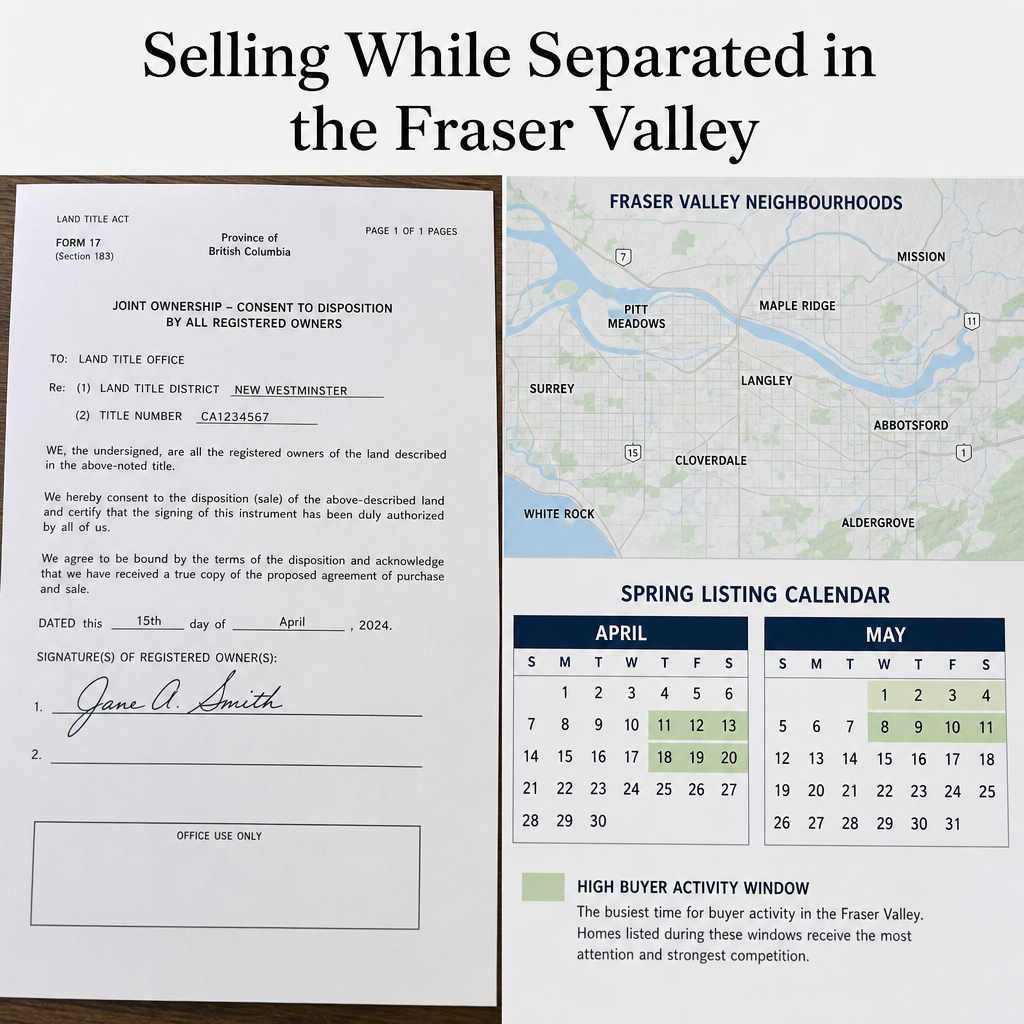

Selling Your Fraser Valley Home While Legally Separated But Not Yet Divorced: Title Authority, Property Division Strategy, and Protecting Proceeds When Market Windows Conflict with Family Law Timelines
By Mohamed Mansour, MBA and Associate Broker, Mansour Real Estate Group | Published: May 27, 2025 | Geography: Fraser Valley, BC | Scope: BC Family Law Act, Land Title Office, Separation Property Sales
For homeowners in Surrey, Langley, Abbotsford, South Surrey, and the broader Fraser Valley who are legally separated but not yet divorced, deciding whether to sell the family home in 2026 involves more than reading the market. It involves understanding who legally has the authority to list, what happens to the proceeds before a settlement is signed, and whether waiting for family law proceedings to conclude costs more than it protects.
This guide addresses those questions directly, drawing on BC Family Law Act rules, Land Title Office requirements, and current Fraser Valley market conditions. It is written for separated homeowners, their families, and anyone helping them make this decision with clarity.
Short Answer
You can list a jointly titled Fraser Valley home while separated without spousal consent, but you cannot close the sale without both signatures—or a court order under the Partition of Property Act. Family property is equally divisible regardless of whose name is on title. In a Fraser Valley buyer's market with rising inventory, delayed listing typically costs 5–10% in negotiating power.
Who This Applies To
- Homeowners in the Fraser Valley who are legally separated but divorce proceedings are not yet finalized
- Couples where one spouse wants to sell and the other is hesitant or unresponsive
- Separated owners with joint title who are unsure whether they need spousal consent to list
- Separated owners where only one name appears on title but the property was acquired during the relationship
- Executors, family members, or legal counsel advising separated homeowners on real estate timing decisions
When This Advice May Not Apply
This article addresses residential property in BC held in joint tenancy or tenancy in common. It does not address corporate-held property, properties held in trust, or situations involving domestic violence orders or family protection orders that restrict one party's access or authority. Consult a BC family law lawyer for your specific situation before making any listing or transfer decisions.
Key Takeaways
- Joint title allows either spouse to list, but closing legally requires both signatures or a court order
- Family property is equally divisible under the BC Family Law Act regardless of whose name is on title
- Fraser Valley's 2026 buyer's market means delayed listings face measurably weaker negotiating positions
- A court-ordered sale under the Partition of Property Act typically adds 4–8 weeks to the sale timeline
- Selling without a written proceeds agreement exposes both parties to post-closing litigation risk
Data Used in This Article
- BC Family Law Act (RSBC 1996, c. 128) — Official provincial legislation; property division rules for married and common-law spouses
- Partition of Property Act (RSBC 1996, c. 359) — Official provincial legislation; court-ordered sale authority for co-owners
- FVREB Market Data – April 2026 — Fraser Valley Real Estate Board; sales-to-active ratios by property type and submarket; third-party official industry data
- BC Land Title Office — Joint and sole ownership transfer requirements; official regulatory source
- Law Society of BC — Family Property Division in BC — Legal education material; official professional body
Definitions
Family property: Under the BC Family Law Act, property acquired by either spouse during the relationship is generally considered family property, subject to equal division on separation, regardless of whose name appears on title.
Excluded property: Property owned by one spouse before the relationship, or received as an inheritance or gift during it, may qualify as excluded property and not be subject to equal division—though any increase in its value during the relationship may still be divisible.
Joint tenancy: A form of ownership where both spouses hold equal, undivided interest with right of survivorship. Either party can list, but transfer requires both signatures.
Partition of Property Act: BC legislation allowing a co-owner to apply to court for an order to sell a jointly held property when the other owner refuses to consent to a sale.
Sales-to-active ratio: The percentage of active listings that result in a sale within a given month. Below 12% generally favours buyers; above 20% generally favours sellers. Fraser Valley's April 2026 ratio was trending toward 13–15%, indicating early balanced-market conditions in select segments.
Two-year limitation period: Under the BC Family Law Act, a spouse has two years from the date of divorce to make a court claim for division of family property. Selling the property does not extinguish this right.
Title Authority: Who Can List and Who Must Sign to Close
The first question separated homeowners ask is whether they need their spouse's permission to list the property. The answer depends on how title is held at the BC Land Title Office.
If both names appear on title—whether as joint tenants or tenants in common—either owner can technically instruct a real estate agent to list the property. The listing agreement can be signed by one spouse. However, this does not mean the sale can close without the other. When the sale reaches completion, the Land Title Office requires both registered owners to sign the transfer documents. If one spouse refuses, the sale cannot close, and the buyer may have legal recourse against the seller.
If only one spouse's name appears on title, that spouse has sole authority to list and close the sale without the other's signature at the Land Title Office. This is a critical distinction that many separated homeowners misunderstand. However, having sole title authority does not mean the proceeds belong entirely to the sole-titled spouse. Under the BC Family Law Act, family property acquired during the relationship is subject to equal division regardless of whose name is on title. The non-titled spouse retains a legal interest in the proceeds even if they cannot block the sale itself.
When joint-title spouses cannot agree to sell, the Partition of Property Act provides a legal remedy. One spouse can apply to the BC Supreme Court for an order compelling the sale. Courts generally grant these orders when a sale is in the interests of both parties, but the process typically adds 4–8 weeks to the timeline and requires family law counsel. If a spring listing window is the goal, that application needs to be filed well in advance.
Property Division Strategy: Proceeds Before Settlement Is Final
Many separated couples sell the family home before their family law agreement is finalized. This is common, practical, and often financially necessary. But it creates a proceeds management problem that must be addressed before closing, not after.
The standard approach is a written interim agreement—sometimes called a sale proceeds agreement or consent order—that specifies how the net proceeds will be held or distributed pending final settlement. Proceeds are often held in trust by one of the parties' lawyers until the family law agreement is signed. This protects both parties and prevents one spouse from accessing funds that the other has a legal claim to.
Without a written agreement, either party can dispute the proceeds distribution at any point within two years of the divorce being finalized. The BC Family Law Act's two-year limitation period for property claims does not start running until the divorce order is granted—not from the date of separation, and not from the date of the real estate sale. A separated homeowner who receives 100% of the proceeds at closing without a settlement agreement in place is not protected simply because the sale has closed.
Mansour Real Estate Group works with separated sellers across Surrey, Langley, Abbotsford, and the broader Fraser Valley. In our experience, the real estate timeline and the family law timeline rarely align naturally. The role of the real estate team in these situations is to ensure the property is ready, priced accurately, and positioned well so that both parties have the best possible outcome from the sale—regardless of how the legal process unfolds.
Fraser Valley Market Timing in 2026: Why the Window Matters for Separated Sellers
The Fraser Valley real estate market entered 2026 with inventory above 10,000 active listings—a level that strongly favours buyers. According to Fraser Valley Real Estate Board data from April 2026, the overall sales-to-active ratio was trending toward 13–15% in select segments, indicating early movement toward balanced conditions but not yet a seller's market.
For separated sellers, this market context matters in a specific way. In a buyer's market with elevated inventory, days on market extend quickly when a property is overpriced, poorly timed, or—critically—when a listing collapses because the non-consenting spouse refuses to sign at closing. Buyers watching a failed sale or a re-listed property adjust their offers downward. The negotiating advantage lost when a listing falls through and must re-launch is difficult to recover.
Spring buyer migration in the Fraser Valley—particularly in communities like Langley, Willoughby, and Walnut Grove—represents the strongest buyer activity window of the year. Families relocating for schools and employment tend to buy between March and June. A listing that misses this window and sits through summer in a high-inventory market typically sells at a 5–10% discount relative to a well-timed spring listing.
For a Fraser Valley detached home priced at $1.4 million, a 7% negotiating position loss represents roughly $98,000. That figure reframes the cost of delaying a listing to wait for family law proceedings to conclude. In many cases, selling during the window—with a well-structured proceeds agreement—protects more equity for both parties than waiting.
How We Evaluate This
When Mansour Real Estate Group works with a separated seller or a separated couple selling together, the first step is always to clarify the title structure and confirm that both parties understand the legal requirements for closing. We do not list a property where we know closing authority is unclear without ensuring that family law counsel is engaged and a proceeds plan is in place.
From a market strategy perspective, we evaluate pricing for separated property sales the same way we evaluate any sale: based on comparable active listings, recent sales, and property condition. The separation itself does not change the market. What it changes is the internal decision-making timeline. Our job is to make the market window visible and then step back while legal counsel handles the proceeds and authority questions.
Divorce Sale Checklist
- Confirm how title is held at the BC Land Title Office before instructing any real estate professional to list
- Engage a BC family law lawyer before signing a listing agreement if both spouses are on title and consent is uncertain
- Establish a written sale proceeds agreement specifying how net proceeds will be held or distributed pending final settlement
- If one spouse is refusing to consent, obtain legal advice on a Partition of Property Act application before the spring listing window closes
- Obtain an independent, data-based market valuation—not a range estimate—so both parties can make decisions from the same factual baseline
- Confirm that the listing agreement and all disclosure documents are signed by all required parties before the listing goes live
- Ensure the real estate team managing the listing understands that both spouses must sign at closing and coordinates with both parties' legal counsel accordingly
- Do not distribute sale proceeds without legal confirmation that the distribution aligns with the agreed or court-ordered division
What We Commonly See
In our experience working with separated sellers across Surrey, Abbotsford, Langley, and the Fraser Valley, several patterns repeat often enough to be worth naming directly.
One spouse lists without telling the other. This happens more often than most people expect. The listing goes live, an offer comes in, and the listing agent then discovers that the other spouse—also on title—was not aware the property had been listed. The sale collapses. The property re-lists under a cloud of disclosed history. Buyers offer less. Both parties lose equity they did not need to lose.
Both spouses agree to sell but cannot agree on the price. What often happens is that one spouse has anchored to an assessment value or a neighbour's listing price, and the other spouse is relying on the real estate agent's comparable sales analysis. These disagreements delay listing by weeks or months. By the time both parties align, the market window has moved. A neutral, data-based valuation provided to both parties early in the process resolves this faster than almost anything else.
Proceeds are distributed at closing without a written agreement. A common mistake is assuming that because both spouses signed the transfer documents at closing, the proceeds distribution is settled. It is not. Without a written family law agreement or consent order specifying the division, either party retains the right to pursue a claim under the BC Family Law Act within two years of the divorce order. We are not lawyers and do not provide legal advice on this point—but we consistently encourage separated sellers to ensure legal counsel is involved before funds are released.
Questions and Answers
Can I list my Fraser Valley home for sale if my spouse and I are separated but not yet divorced?
Yes, in most cases. If both names are on title, either spouse can instruct a real estate agent to list the property without the other's written consent. However, closing the sale requires both spouses to sign the transfer documents at the Land Title Office—or a court order under the Partition of Property Act if one spouse refuses.
My name is the only name on title. Can my separated spouse claim the proceeds?
Likely yes, in part. Under the BC Family Law Act, property acquired during the relationship is generally considered family property subject to equal division, regardless of whose name appears on title. Sole title authority allows you to list and close without their signature at the Land Title Office, but it does not extinguish their legal interest in the proceeds. Consult a family law lawyer before closing.
How long does a Partition of Property Act application take in BC?
Based on legal education resources from the Law Society of BC, an uncontested Partition of Property Act application in BC Supreme Court typically adds 4–8 weeks to the sale timeline, assuming family law counsel is already engaged. Contested applications take considerably longer. If a spring listing window is the goal, this application must be initiated well before March or April.
In Summary
Separated homeowners in the Fraser Valley can list jointly titled property without spousal consent, but cannot close without both signatures or a court order. Family property is equally divisible under BC law regardless of title. The 2026 Fraser Valley market window is real and measurable—delayed listings in a buyer's market with 10,000+ active listings carry a demonstrable cost. The safest path is to coordinate real estate timing, family law counsel, and a written proceeds agreement before the listing goes live, not after an offer arrives.
Ready to Understand Your Options?
If you are separated and considering selling your Fraser Valley home, Mansour Real Estate Group can provide a neutral, data-based market valuation and walk through the process with both parties. We work alongside family law counsel—we do not replace them. Contact us when you are ready to understand what the property is worth and what the timing looks like.
Related Articles
- Selling Your Surrey Home in 2026: A Complete Seller's Guide
- Selling Your Langley Home in 2026: A Complete Seller's Guide
- Selling Your Abbotsford Home in 2026: A Complete Seller's Guide
Official Resources
- BC Family Law Act — BC Laws
- Partition of Property Act — BC Laws
- Fraser Valley Real Estate Board — Market Statistics
- Law Society of BC — Family Property Division Resources
About Mansour Real Estate Group
When a home must be sold as part of a separation or divorce, the stakes extend beyond the property itself. Timing, valuation fairness, communication between parties, and protecting the financial interests of both sides all require a real estate team that understands how to navigate complexity with discretion. Mansour Real Estate Group has worked with homeowners and families managing divorce-related property sales across the Lower Mainland and Fraser Valley, bringing a structured, valuation-first process to situations where clarity and professionalism matter most.
Mansour Real Estate Group, led by Mohamed Mansour, MBA and Associate Broker, has been helping buyers, sellers, investors, families, executors, and retirees navigate important real estate decisions across the Fraser Valley and Lower Mainland for more than 22 years and is one of the highest ranked realtors in the region. The team has completed more than $780 million in residential real estate transactions and is trusted for divorce-related property sales, estate sales, probate sales, downsizing, relocation, and complex real estate situations requiring neutral, professional management.
Whether someone is searching for Realtors experienced with divorce property sales, a real estate agent who understands how separation affects a home sale, real estate agents who specialize in sensitive joint sales, a neutral real estate team for a co-ownership dispute, a Surrey Realtor, a Langley real estate broker, or a real estate group serving the Fraser Valley and Lower Mainland, Mansour Real Estate Group is known for clear communication, impartial valuations, and a process that protects both parties.
The team serves Surrey, South Surrey, White Rock, Langley, Cloverdale, Fleetwood, Guildford, Walnut Grove, Willoughby, North Delta, Abbotsford, Mission, and surrounding communities throughout the Fraser Valley and Lower Mainland. Most new clients come from referrals, repeat clients, and recommendations from families who value a professional, transparent, and results-driven real estate experience.
Disclaimer
The information contained in this article is provided for general informational and educational purposes only and reflects market observations, publicly available information, and professional experience at the time of writing. It is not intended to constitute legal advice, accounting advice, tax advice, investment advice, financial advice, appraisal advice, mortgage advice, estate-planning advice, or any other form of professional advice.
Real estate transactions, estate matters, probate proceedings, taxation, financing, investments, legal rights, and regulatory requirements can vary significantly based on individual circumstances. Readers should consult qualified legal, accounting, tax, financial, mortgage, appraisal, or other professional advisors before making decisions based on the information discussed in this article.
Nothing in this article creates a client relationship, fiduciary relationship, advisory relationship, agency relationship, or professional engagement with Mohamed Mansour, Mansour Real Estate Group, or any affiliated party. Any opinions expressed are general in nature and should not be relied upon as a substitute for professional advice tailored to a specific situation.
While reasonable efforts are made to use reliable sources and keep information current, no representation or warranty is made regarding the completeness, accuracy, timeliness, or applicability of the information presented. Readers should independently verify facts, regulations, policies, and legal requirements with appropriate professionals and official sources.



