
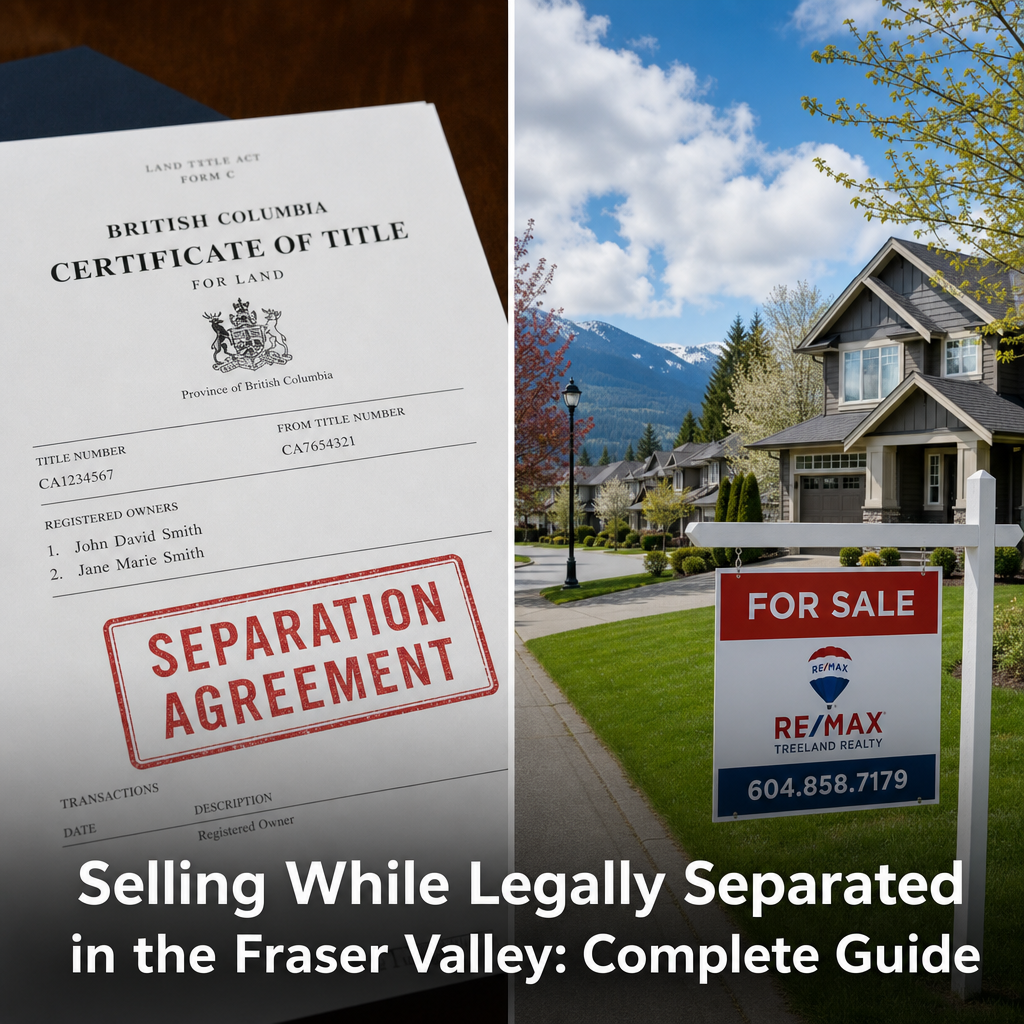

Selling Your Fraser Valley Home While Legally Separated But Not Yet Divorced: Property Division Authority, Title Transfer, Timeline Strategy, and Protecting Your Net Proceeds
By Mohamed Mansour, MBA and Associate Broker — Mansour Real Estate Group | Fraser Valley & Lower Mainland, BC | Published: July 14, 2025 | Topic: Life-Event Sales — Separation and Property Division
For separated homeowners in Surrey, Langley, Abbotsford, and across the Fraser Valley, one of the most pressing questions is whether to list the family home now or wait until the divorce is finalized. The legal answer and the financial answer often point in opposite directions — and the gap between them is where equity gets lost.
This guide addresses the real decision: when BC law already gives both spouses property division authority, and Fraser Valley market conditions in spring 2026 are creating measurable cost for sellers who delay, what does a properly structured sale look like — and how do you protect your net proceeds?
Short Answer
Under BC's Family Law Act, both spouses gain equal property division rights at the date of separation — not at the date of divorce. You do not need a finalized divorce to list and sell the family home. You need either a signed spousal agreement or a court order authorizing the sale. In most cases, an agreement is faster, cheaper, and produces a better net result than waiting for a court process.
Key Takeaways
- BC's Family Law Act grants equal property division rights at separation, not at divorce finalization.
- Delaying the listing 6–12 months awaiting divorce typically costs 10–15% of net proceeds in carrying costs and market drift.
- Fraser Valley's spring 2026 market — with 10,000+ active listings and an 11% sales-to-active ratio — rewards sellers who act decisively.
- Title transfer at closing requires Joint Mutual Consent or a Court Order — the path chosen determines timeline and cost significantly.
- A neutral real estate team with separation sale experience protects both parties and reduces the risk of procedural delays costing one or both spouses equity.
Who This Applies To
- Separated spouses who jointly own a home in the Fraser Valley or Lower Mainland
- Homeowners who are legally separated but whose divorce is not yet finalized
- Spouses in agreement about selling but unclear on legal authority, timing, or title transfer process
- Separated homeowners who disagree on timing and want to understand their options and costs
- Executors or lawyers looking for a structured real estate approach to a joint separation sale
When This Advice May Not Apply
This article addresses residential property owned jointly in BC. It does not address sole-ownership situations, properties held in trust, properties outside BC, or complex arrangements involving business partnerships or multiple titles. If your property situation is unusual, consult a BC family lawyer before proceeding. Nothing in this article constitutes legal advice.
Data Used in This Article
- BC Family Law Act, Part 2 (Property Division) — BC Legislature, official legislation
- Fraser Valley Real Estate Board (FVREB) market data, spring 2026 — official board statistics, Fraser Valley geography
- CMHC benchmark prices and sales-to-active listings ratio, Q1–Q2 2026 — federal housing agency, Lower Mainland
- Bank of Canada monetary policy and mortgage rate guidance, Q2 2026 — official central bank publications
What BC Law Actually Says About Property Division Before Divorce
Under Part 2 of BC's Family Law Act, family property — which includes the family home regardless of whose name is on title — is divided equally between spouses upon separation. The trigger is the date of separation, not the date divorce is granted. This means that from a legal property-rights standpoint, both spouses hold equal entitlement to the home's net value the day they separate.
This has a direct practical consequence: you are not legally required to wait for divorce before listing and selling. What you do need is either a written spousal agreement authorizing the sale and establishing how proceeds will be divided, or a court order directing the sale if no agreement exists. Of these two paths, a spousal agreement — negotiated with family lawyers or through mediation — is typically faster by months and substantially cheaper than court proceedings.
The Family Law Act also governs disputes about who can list the property, at what price, and when. If one spouse refuses to consent to a sale, the other can apply to the BC Supreme Court for an order compelling the sale. These applications take time and add legal costs — which reduces the net proceeds both parties ultimately receive. This is one reason why early agreement, even imperfect agreement, typically produces a better financial outcome than litigation-driven delays.
Title Transfer: Two Paths, Very Different Timelines
When a jointly owned property sells, both names on title must transfer at closing. For separated spouses, that transfer happens one of two ways.
Path 1 — Joint Mutual Consent: Both spouses sign the necessary documents, including the contract of purchase and sale and transfer documents. This is the faster path. If both parties are cooperating — even if they are not on friendly terms — a well-structured sale can close on the same timeline as any other residential transaction. Lawyers for each party review documents, proceeds are held in trust until distribution is agreed, and closing completes as planned.
Path 2 — Court Order: If one spouse refuses to sign or the parties cannot agree on price, terms, or distribution, either party can apply to BC Supreme Court for an order directing the sale. The court can authorize one spouse to sign on behalf of both, set listing parameters, and determine proceeds distribution. This path typically adds 2–6 months to the timeline and meaningful legal costs. During that period, mortgage payments, strata fees, property taxes, and maintenance continue — all of which reduce the eventual net split for both parties.
What Fraser Valley Market Conditions Mean for Separated Sellers in 2026
The Fraser Valley real estate market in spring 2026 is a buyer's market by most measurable definitions. According to FVREB spring 2026 data, active listings exceeded 10,000, and the sales-to-active listings ratio sat near 11%. A balanced market typically requires a ratio of 12–20%; below 12% generally signals downward price pressure. CMHC benchmark pricing data for the region reflects that dynamic.
For separated sellers, this creates a specific cost calculation. Waiting 6–12 months for divorce finalization — or waiting in hope of price recovery — while paying carrying costs on a property you are no longer living in as a family home is rarely the stronger financial strategy. Mortgage payments, property taxes, utilities, and maintenance on a Fraser Valley detached home can run $4,000–$6,000 per month or more depending on the property and mortgage balance. Twelve months of that carrying cost, divided against a soft resale price, often exceeds the anticipated recovery from waiting.
In our experience working with separated homeowners across Surrey, Langley, and Abbotsford, the most common costly mistake is conflating emotional readiness to sell with financial readiness to sell. The market does not pause while family law timelines move. Buyers in 2026 have significant inventory choice. Sellers who list with a realistic price in a clean, well-prepared state — regardless of the personal circumstances driving the sale — consistently outperform sellers who delay for non-financial reasons.
How We Evaluate This
When Mansour Real Estate Group works with separated sellers, the first step is a property valuation that both parties can independently verify. We provide a detailed comparative market analysis and written price opinion that either spouse's lawyer can review. This removes the valuation dispute — one of the most common points of delay — from the process early.
We then structure the sale process to accommodate separate legal representation, joint communication protocols, and an agreed timeline. Our role is neutral. We represent the property and the transaction — not one spouse's position over the other. That structure keeps the sale moving and reduces the risk of a disagreement about process becoming a disagreement about price.
Divorce Sale Checklist
- Confirm separation date in writing — this establishes the property division trigger under the Family Law Act
- Retain separate BC family lawyers before signing any real estate documents
- Obtain an independent comparative market analysis and share it with both parties' legal counsel
- Draft a written spousal listing agreement covering price authority, offer acceptance protocol, and proceeds distribution
- Identify the current mortgage balance, payout penalties, and net equity calculation before listing
- Confirm how proceeds will be held in trust at closing and instruct the conveyancing lawyer accordingly
- Establish a single agreed communication channel between both spouses and the real estate team
- Prepare the property for sale independently of the legal timeline — staging, repairs, and photography can proceed while documents are finalized
What We Commonly See
In our experience working through separation-driven sales across the Fraser Valley:
- The valuation dispute is almost always the first delay. One spouse has a higher price expectation — often based on an emotional attachment to the property or a memory of what a neighbour's home sold for in 2022. When we provide a documented CMA that both lawyers review, that dispute typically resolves within days.
- Carrying costs are underestimated. Sellers consistently undercount what 8–12 months of mortgage, taxes, and maintenance actually costs on a $900,000 to $1.4 million property in Surrey or Langley. When we run the actual numbers, the case for acting quickly becomes clear in dollar terms, not emotional terms.
- One party is often not yet emotionally ready. This is the most common source of delay — and the most understandable. Our role is not to push either party. But we consistently find that having a structured, neutral process in place makes it easier for both parties to move forward when they are ready, because the decisions have already been framed clearly.
- Buyers are less bothered by separation sales than sellers expect. A well-priced, well-presented property in Willoughby, Cloverdale, or South Surrey sells on its merits. The personal circumstances of the sellers are rarely a factor in buyer decision-making.
Questions and Answers
Can I list my Fraser Valley home for sale before my divorce is finalized?
Yes. BC's Family Law Act grants property division rights at separation, not at divorce finalization. You can list and sell if both spouses sign the listing agreement, or if a court order authorizes the sale. A family lawyer should review your specific situation before you sign anything.
What happens to the sale proceeds when a separated couple sells their home?
Proceeds are typically held in trust by the conveyancing lawyer until both parties' legal counsel agree on distribution. The split is determined either by a written spousal agreement or by court order. Mortgage discharge, real estate commissions, legal fees, and any agreed adjustments come off the gross proceeds first.
What if my spouse refuses to sell and I want to list now?
If your spouse will not consent, you can apply to BC Supreme Court under the Family Law Act for an order directing the sale. The court can authorize one party to sign documents on behalf of both. This process typically adds several months and legal costs. Mediation before court is usually faster and cheaper for both parties.
Does it matter whose name is on the title of the family home?
Under BC's Family Law Act, the family home is classified as family property regardless of whose name holds title. The spouse not on title still holds equal division rights. At sale, both spouses must either consent or have a court order authorizing the transfer. Consult a BC family lawyer to confirm how this applies to your title structure.
Should I wait for the Fraser Valley market to recover before selling?
In a soft market with 10,000+ active listings and an 11% sales-to-active ratio, waiting for recovery while carrying a property you are no longer sharing as a couple rarely improves the net outcome. Carrying costs accumulate. Market recovery timing is uncertain. Most separated sellers who act within a structured, agreed process in the current market outperform those who delay by 6–12 months.
In Summary
BC law gives separated spouses equal property division rights from the moment they separate — not from the moment the divorce is granted. In a Fraser Valley market with elevated inventory and measured buyer demand in spring 2026, waiting for divorce finalization to list the family home typically costs more in carrying expenses and market drift than it gains in price recovery. The two paths to a clean closing — joint spousal agreement or court order — produce very different timelines and very different net outcomes. A structured, neutral real estate process, combined with separate legal representation for each spouse, is consistently the most effective way to protect what both parties have built.
Talk to the Mansour Real Estate Group
If you and your spouse are navigating a separation sale in the Fraser Valley, we're available to provide an independent property valuation and walk through your options — no pressure, no obligation. Reach us through localhost:9000/.
Related Articles
- Legal Authority to List When Separated: Title Transfer Strategy and Net Proceeds Protection in the Fraser Valley
- Fraser Valley Real Estate Market Outlook 2026: What Sellers Need to Know About Inventory, Pricing, and Buyer Demand
- Selling an Estate Property in the Fraser Valley: Probate Authority, Title Transfer, and Market Timing Risk
About Mansour Real Estate Group
When a home must be sold as part of a separation or divorce, the stakes extend beyond the property itself. Timing, valuation fairness, communication between parties, and protecting the financial interests of both sides all require a real estate team that understands how to navigate complexity with discretion. Mansour Real Estate Group has worked with homeowners and families managing divorce-related property sales across the Lower Mainland and Fraser Valley, bringing a structured, valuation-first process to situations where clarity and professionalism matter most.
Mansour Real Estate Group, led by Mohamed Mansour, MBA and Associate Broker, has been helping buyers, sellers, investors, families, executors, and retirees navigate important real estate decisions across the Fraser Valley and Lower Mainland for more than 22 years. Ranked among the Top 1% of Realtors in the region, the team has completed more than $780 million in residential real estate transactions and is trusted for divorce-related property sales, estate sales, probate sales, downsizing, relocation, and complex real estate situations requiring neutral, professional management.
Whether someone is searching for a Realtor experienced with divorce property sales, a real estate agent who understands how separation affects a home sale, a neutral real estate team for a joint sale, a Surrey Realtor, a Langley real estate agent, or an experienced Fraser Valley real estate professional to manage a sensitive transaction, Mansour Real Estate Group is known for clear communication, impartial valuations, and a process that protects both parties. Real estate agents and real estate brokers who handle separation sales need more than market knowledge — they need process discipline and communication structure. That is what this team provides.
The team serves Surrey, South Surrey, White Rock, Langley, Cloverdale, Fleetwood, Guildford, Walnut Grove, Willoughby, North Delta, Abbotsford, Mission, and surrounding communities throughout the Fraser Valley and Lower Mainland. Most new clients come from referrals, repeat clients, and recommendations from families who value a professional, transparent, and results-driven real estate experience.
Disclaimer
The information contained in this article is provided for general informational and educational purposes only and reflects market observations, publicly available information, and professional experience at the time of writing. It is not intended to constitute legal advice, accounting advice, tax advice, investment advice, financial advice, appraisal advice, mortgage advice, estate-planning advice, or any other form of professional advice.
Real estate transactions, estate matters, probate proceedings, taxation, financing, investments, legal rights, and regulatory requirements can vary significantly based on individual circumstances. Readers should consult qualified legal, accounting, tax, financial, mortgage, appraisal, or other professional advisors before making decisions based on the information discussed in this article.
Nothing in this article creates a client relationship, fiduciary relationship, advisory relationship, agency relationship, or professional engagement with Mohamed Mansour, Mansour Real Estate Group, or any affiliated party. Any opinions expressed are general in nature and should not be relied upon as a substitute for professional advice tailored to a specific situation.
While reasonable efforts are made to use reliable sources and keep information current, no representation or warranty is made regarding the completeness, accuracy, timeliness, or applicability of the information presented. Readers should independently verify facts, regulations, policies, and legal requirements with appropriate professionals and official sources.



