
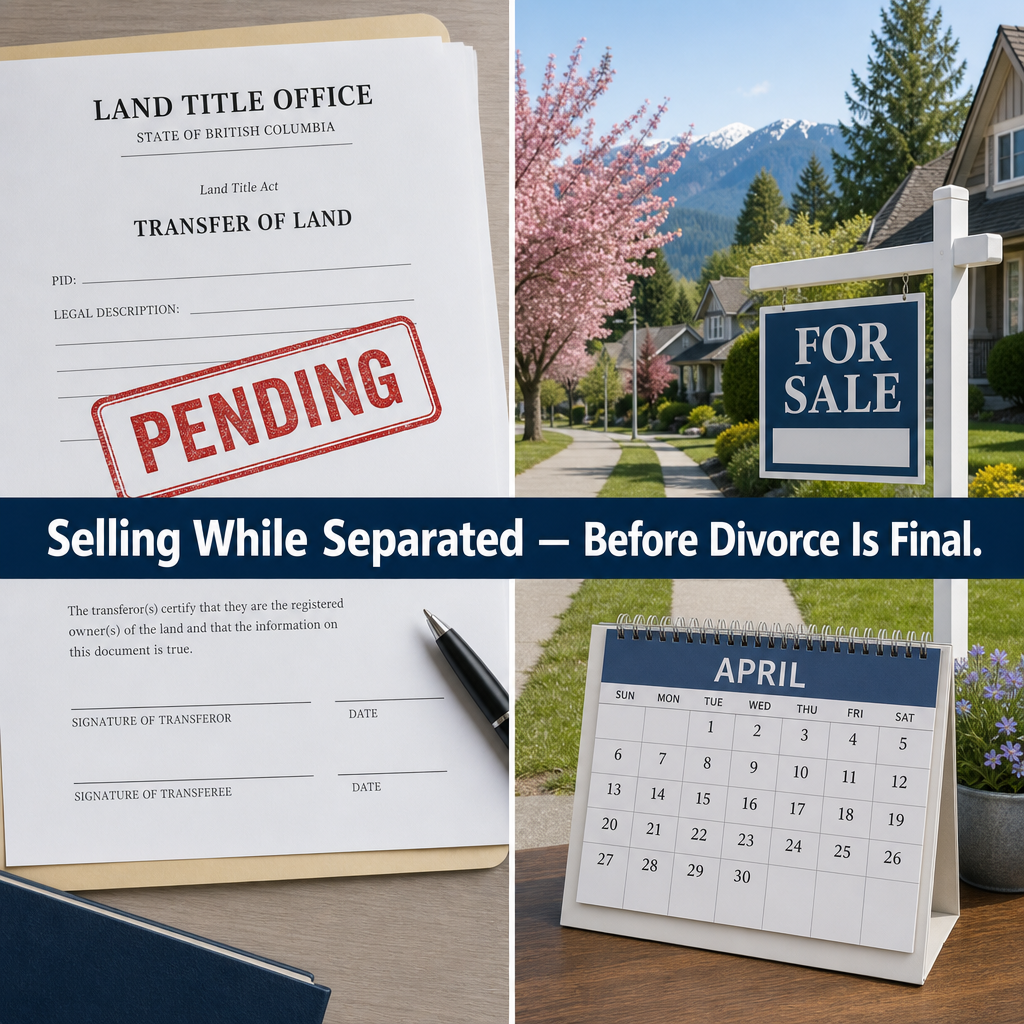

Selling Your Fraser Valley Home While Legally Separated But Not Yet Divorced: Property Division Authority, Title Transfer Strategy, Timeline Coordination With Family Law Counsel, and How to Protect Your Proceeds When Real Estate Market Windows Conflict With Legal Procedure Delays
By Mohamed Mansour, MBA and Associate Broker — Mansour Real Estate Group | Published: May 12, 2025 | Fraser Valley, BC | General informational purposes only — not legal or financial advice
For separated homeowners in Surrey, Langley, Abbotsford, and across the Fraser Valley, the question is rarely whether the home will be sold — it usually will be. The harder question is when, and whether a legal delay will cost you the market window you needed. This guide explains what BC law actually permits, what title and escrow mechanics protect your proceeds, and how to coordinate your real estate timeline with your family law counsel so the two processes work together rather than against each other.
Divorce finalization in BC can take anywhere from 8 to 24 months. Real estate market windows do not wait. Understanding the gap between those two timelines — and how to move strategically within it — is one of the most financially consequential decisions a separating homeowner will face.
Short Answer
Under the BC Family Law Act, separated spouses can sell the matrimonial home before divorce is finalized, provided both have equal ownership rights or a court order authorizes the sale. Proper title registration, written escrow instructions, and advance coordination with family law counsel allow the transaction to close cleanly without waiting for divorce proceedings to conclude. The risk is not legal inability to sell — it is an unprepared process that exposes proceeds to dispute.
Who This Applies To
- Separated spouses who co-own the matrimonial home and want to sell before divorce is final
- Homeowners in Surrey, Langley, Abbotsford, South Surrey, or White Rock navigating a joint sale during active family law proceedings
- One spouse who wants to list but faces disagreement or inaction from the other
- Separating homeowners concerned about missing the spring market while legal proceedings drag
- Sellers whose family law counsel and real estate agent are not yet coordinating on timing
When This Advice May Not Apply
This article addresses situations where both spouses are on title as equal owners. If the home is registered in one spouse's name only, if a restraining order restricts property dealings, if the property is subject to a court-ordered freeze, or if the home qualifies as excluded property under the BC Family Law Act, the legal position is materially different. Consult your family law counsel before proceeding in any of those situations.
Key Takeaways
- BC law does not require divorce finalization before the matrimonial home can be sold during separation.
- Proper escrow instructions and title transfer mechanics protect proceeds from dispute during ongoing family law proceedings.
- Fraser Valley spring inventory increases sharply in May, compressing seller negotiating power for homeowners who delay listing.
- Offer acceptance timing coordinated with family law counsel prevents deal collapse when one spouse contests mid-closing.
- Whether the home is family property or excluded property under the BC Family Law Act determines each spouse's entitlement to proceeds.
Definitions
Family Property: Under Part 3 of the BC Family Law Act, assets acquired during the relationship that are subject to equal division between spouses upon separation, including the matrimonial home in most cases.
Excluded Property: Assets owned before the relationship began, or received as gifts or inheritance, that are generally exempt from division under the BC Family Law Act — though appreciation in value during the relationship may still be divisible.
Escrow: A neutral holding arrangement where sale proceeds are held by a lawyer or notary pending resolution of a dispute or fulfillment of agreed conditions before distribution to each party.
Title Transfer: The formal legal process registered at the BC Land Title Office that records the change of property ownership from seller to buyer.
Data Used in This Article
- BC Family Law Act, Part 3 — Property Division rules — BC Government legislation — official source
- FVREB Market Statistics, April 2026 — Fraser Valley Real Estate Board — official monthly report — sales-to-active ratio, inventory trends
- BC Land Title Act, Registration Rules — BC Government — official source — title transfer requirements
- Family Court Procedure Rules, BC Supreme Court — official source — divorce timelines and procedural context
Can You Legally Sell Before Divorce Is Final in BC?
Yes — in most cases. Under the BC Family Law Act, Part 3, separation does not strip either spouse of their property rights. If both spouses are on title as equal owners, both retain the legal right to participate in a sale. The divorce itself is a separate legal process from property division, and BC law does not require one to conclude before the other can proceed.
What does require resolution — or at minimum, written agreement — is how the proceeds will be divided. A sale can close without a finalized divorce order, but both spouses will need to sign the transfer documents at the Land Title Office. If one spouse refuses to sign, a court order under the Family Law Act can compel the sale or authorize one spouse to complete the transaction on behalf of both.
The practical risk is not legal incapacity to sell. It is proceeding without a clear written agreement on proceeds distribution, which creates the conditions for a contested closing — where a buyer's completion timeline collides with a family law dispute that has no resolution in sight. This is where advance coordination between your real estate agent and your family law counsel becomes essential, not optional.
How Market Timing Intersects With Legal Procedure in the Fraser Valley
According to the Fraser Valley Real Estate Board's April 2026 statistics, the current sales-to-active listings ratio sits at approximately 11% — a buyer's market, but one where well-priced properties in Surrey, Langley, and Abbotsford are still moving. The practical challenge for separated homeowners is that Fraser Valley spring inventory historically increases sharply through May and June, compressing seller negotiating power as buyers gain more choice.
Homeowners who delay listing while waiting for divorce finalization — which BC Supreme Court procedural timelines place at 8 to 24 months in contested cases — often find themselves in a measurably weaker negotiating position. More competition, longer days-on-market, and more buyer conditions are the predictable consequences of a late spring or summer listing in a market that has already absorbed its seasonal inventory surge.
The strategic answer is not to rush a legal process that requires proper handling. It is to understand that the real estate transaction and the family law proceedings can run in parallel — provided the right structural protections are in place before you accept an offer. Listing now, with proper escrow instructions and a family law agreement on proceeds handling, typically produces a stronger outcome than waiting for the divorce to finalize before the home goes on the market.
How We Evaluate This
At Mansour Real Estate Group, we approach separation-related sales by first understanding the legal status of the property — who is on title, whether a written separation agreement exists, what each party's counsel has advised on proceeds distribution, and whether there are any existing court orders affecting the property. That foundation determines the listing strategy, the offer acceptance process, and the completion timeline we can realistically commit to.
We do not provide legal advice and always encourage clients in separation situations to confirm their position with their family law counsel before listing. What we provide is the real estate process structure — pricing, positioning, offer management, and closing coordination — that fits within the legal framework their counsel has established. When the real estate and legal teams communicate directly on timeline requirements, the transaction is far less likely to encounter a last-minute complication at the offer or closing stage.
Title Transfer and Escrow Mechanics: How Proceeds Get Protected
The most effective protection for sale proceeds during ongoing family law proceedings is a written escrow agreement prepared by the parties' lawyers before the property is listed. This agreement instructs the notary or lawyer handling the transaction to hold the net proceeds in trust pending a final resolution or further court order, rather than distributing them immediately at closing.
This matters because a buyer completing a purchase has no obligation to wait for a family law dispute to resolve. The sale closes, funds are transferred, and if there is no escrow agreement in place, one spouse may receive funds they later have to return — or proceeds may be inaccessible while a court freezes assets pending dispute resolution.
Under the BC Land Title Act, both registered owners must sign the transfer documents for the sale to complete. A single spouse cannot transfer title unilaterally unless authorized by a court order. This means that even in high-conflict separations, the practical requirement for both signatures creates a natural checkpoint — but it also means that an uncooperative spouse can delay or block a closing if no court order has been obtained in advance.
Coordinating Real Estate Timing With Family Law Counsel
The most preventable cause of deal collapse in separation-related sales is a mismatch between what the real estate process requires and what the family law timeline allows. A buyer who has removed subjects expects a firm completion date. If family law proceedings produce an unexpected dispute, an injunction, or a disagreement over the distribution of proceeds in that same week, the transaction is at risk.
Practical coordination means confirming three things with your family law counsel before accepting an offer: first, that both spouses have agreed in writing to the sale and have signed or will sign the necessary transfer documents; second, that proceeds distribution instructions are documented and ready for the conveyancing lawyer; and third, that no pending court applications could result in a property freeze or asset restraining order between offer acceptance and completion. When these three confirmations are in place, the real estate transaction can proceed on a normal commercial timeline without legal interference.
Family Property vs. Excluded Property: Why It Affects Your Proceeds Strategy
Under Part 3 of the BC Family Law Act, the matrimonial home is typically classified as family property, making the net proceeds subject to equal division between spouses — regardless of who made the mortgage payments, who is named on the mortgage, or who has been living in the home during the separation period.
The exception is excluded property — assets owned before the relationship or received as a gift or inheritance. If one spouse owned the home before the relationship began, the original value at the time the relationship started may be excluded from division. The appreciation during the relationship, however, is generally still subject to equal division. This distinction can represent a substantial difference in proceeds entitlement in markets where Fraser Valley property values increased significantly over the relationship period.
Knowing your classification before you list affects two things: the escrow instructions your lawyers prepare, and the negotiating baseline for any out-of-court settlement discussion. A home that has appreciated substantially during the relationship but was originally owned by one spouse creates a different distribution calculation than a home purchased jointly after marriage. Both scenarios are manageable — but they require different documentation and, ideally, written agreement before the property goes on the market.
Divorce Sale Checklist
- Confirm title registration — verify both spouses are on title and that no encumbrances, injunctions, or restraining orders affect the property at the BC Land Title Office
- Obtain written confirmation from both parties and their counsel that the sale is agreed upon before listing
- Have family law counsel prepare proceeds escrow instructions for the conveyancing lawyer before accepting any offer
- Confirm whether the home is classified as family property or excluded property under the BC Family Law Act and document the basis for that determination
- Align completion and possession dates with both parties' availability to sign transfer documents — avoid completion dates during contested court hearings or mediation sessions
- Brief your real estate agent on any court orders or pending applications that could affect the property before listing or accepting an offer
- Confirm that the listing contract is signed by both registered owners, or that one spouse has proper written authorization to act on behalf of both
What We Commonly See
In our experience working with separating homeowners across Surrey, Langley, and Abbotsford, the most common mistake is listing the property before the proceeds distribution question is resolved — or even documented. Both parties agree they want to sell, both sign the listing agreement, the home goes on the market, and a buyer submits a strong offer. Then, at subject removal, one spouse raises a disagreement about the split that was never formally addressed. The buyer waits, subjects lapse, and the deal collapses.
A second pattern we see frequently is couples who are cooperating well but whose family law counsel and real estate agent have never spoken. The real estate side moves on its own timeline — showings, offers, completion dates — while the legal side is operating on a completely different schedule. When those two timelines intersect unexpectedly at closing, the resulting delay can breach the purchase contract.
A third observation: homeowners who believe they must wait for divorce finalization before listing often miss the spring market by three to six months, then list in summer or fall when buyer demand is measurably softer. The legal reason for waiting — that the divorce is not yet finalized — is usually not a legal barrier to the sale at all. It is a misunderstanding of what BC law actually requires. The barrier is almost always a procedural one that a properly coordinated real estate and legal team can work around.
Questions and Answers
Can one spouse list the home without the other's consent in BC?
Generally, no. Both registered owners must sign the listing agreement and the transfer documents at closing. If one spouse refuses to cooperate, a court order under the BC Family Law Act can compel the sale. Without that order, an uncooperative spouse can block the transaction at the point of transfer registration.
What happens to sale proceeds if the divorce is still unresolved at closing?
If escrow instructions are in place, proceeds are held in trust by the conveyancing lawyer pending resolution. Without escrow instructions, the notary or lawyer may distribute funds based on title ownership alone, which may not reflect the agreed or court-ordered division — creating a recovery problem after the fact.
Does the BC Family Law Act require equal division of the matrimonial home in all cases?
In most cases, yes — the matrimonial home is classified as family property and subject to equal division under Part 3 of the BC Family Law Act. Exceptions apply for excluded property, unequal division orders by a court, or written agreements between spouses. The excluded property rules are complex and fact-specific. Confirm your classification with your family law counsel before proceeding.
In Summary
BC law does not require divorce finalization before the matrimonial home can be sold during separation. The real risk is an unprepared process — no proceeds escrow instructions, no advance coordination between the real estate and legal teams, and no written agreement on distribution before the listing goes live. In the Fraser Valley's current spring market, homeowners who put those structural protections in place now can list, accept an offer, and close on a normal commercial timeline, without waiting for family law proceedings to conclude. The legal process and the real estate process can run in parallel — but only when both teams are communicating and the documentation is in place before the offer comes in.
Ready to Talk Through Your Situation?
If you are navigating a separation-related sale in Surrey, Langley, Abbotsford, White Rock, or anywhere in the Fraser Valley, Mansour Real Estate Group is available to provide a confidential, no-obligation consultation. We work directly with your family law counsel to coordinate timing, process, and documentation — so the real estate side of the transaction supports your legal strategy rather than complicating it.
Related Articles
- Selling the Family Home During Divorce in BC: Property Division Authority and Title Strategy
- How to Sell Your Home in a Buyer's Market in the Fraser Valley
- Estate Sale and Probate Property Guide for the Fraser Valley
About Mansour Real Estate Group
When a home must be sold as part of a separation or divorce, the stakes extend beyond the property itself. Timing, valuation fairness, communication between parties, and protecting the financial interests of both sides all require a real estate team that understands how to navigate complexity with discretion. Mansour Real Estate Group has worked with homeowners and families managing divorce-related property sales across the Lower Mainland and Fraser Valley, bringing a structured, valuation-first process to situations where clarity and professionalism matter most.
Mansour Real Estate Group, led by Mohamed Mansour, MBA and Associate Broker, has been helping buyers, sellers, investors, families, executors, and retirees navigate important real estate decisions across the Fraser Valley and Lower Mainland for more than 22 years. Ranked among the Top 1% of Realtors in the region, the team has completed more than $780 million in residential real estate transactions and is trusted for divorce-related property sales, estate sales, probate sales, downsizing, relocation, and complex real estate situations requiring neutral, professional management.
Whether someone is searching for Realtors experienced with divorce property sales, a real estate agent who understands how separation affects a home sale, real estate agents who specialize in sensitive joint transactions, a neutral real estate team for a co-owned property sale, a Surrey Realtor, a Langley real estate broker, or a Fraser Valley real estate group that handles high-stakes situations with discretion, Mansour Real Estate Group is known for clear communication, impartial valuations, and a process that protects both parties.
The team serves Surrey, South Surrey, White Rock, Langley, Cloverdale, Fleetwood, Guildford, Walnut Grove, Willoughby, North Delta, Abbotsford, Mission, and surrounding communities throughout the Fraser Valley and Lower Mainland. Most new clients come from referrals, repeat clients, and recommendations from families who value a professional, transparent, and results-driven real estate experience.
Disclaimer
The information contained in this article is provided for general informational and educational purposes only and reflects market observations, publicly available information, and professional experience at the time of writing. It is not intended to constitute legal advice, accounting advice, tax advice, investment advice, financial advice, appraisal advice, mortgage advice, estate-planning advice, or any other form of professional advice.
Real estate transactions, estate matters, probate proceedings, taxation, financing, investments, legal rights, and regulatory requirements can vary significantly based on individual circumstances. Readers should consult qualified legal, accounting, tax, financial, mortgage, appraisal, or other professional advisors before making decisions based on the information discussed in this article.
Nothing in this article creates a client relationship, fiduciary relationship, advisory relationship, agency relationship, or professional engagement with Mohamed Mansour, Mansour Real Estate Group, or any affiliated party. Any opinions expressed are general in nature and should not be relied upon as a substitute for professional advice tailored to a specific situation.
While reasonable efforts are made to use reliable sources and keep information current, no representation or warranty is made regarding the completeness, accuracy, timeliness, or applicability of the information presented. Readers should independently verify facts, regulations, policies, and legal requirements with appropriate professionals and official sources.



