
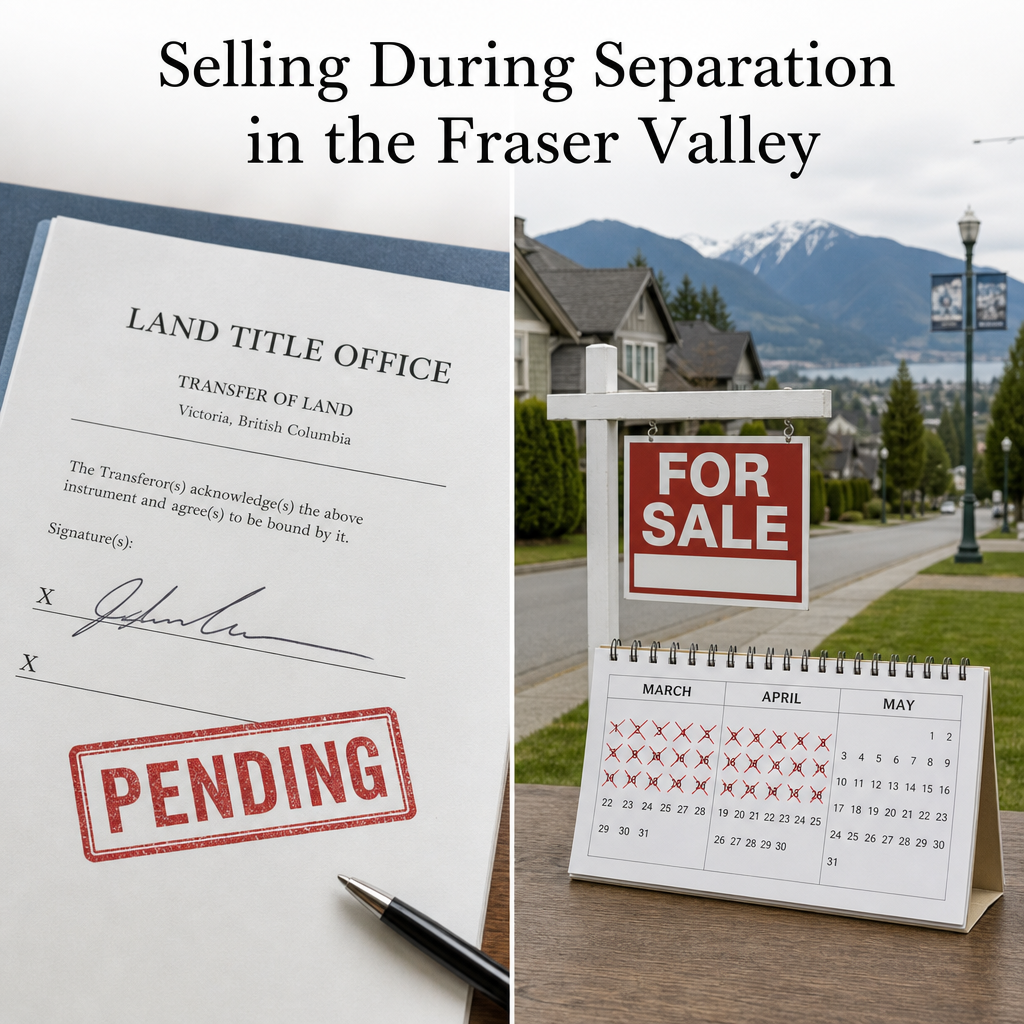

Selling Your Fraser Valley Home While Legally Separated But Not Yet Divorced: Property Division Authority, Title Transfer Strategy, and Protecting Your Proceeds
By Mohamed Mansour, MBA and Associate Broker | Mansour Real Estate Group | Fraser Valley and Lower Mainland | Published: July 15, 2025 | Topic: Life-Event Sales — Separation and Divorce Property Division
For homeowners in the Fraser Valley who are separated but not yet divorced, selling the family home creates a specific legal and practical problem: you may want to list quickly, the market may be moving, carrying costs are accumulating, but the legal authority to transfer clear title may not yet exist. Understanding what you can and cannot do—before you engage buyers—protects both parties and prevents a transaction from collapsing days before closing.
This article explains the legal requirements for selling during separation in BC, what documentation buyers and their lenders will require, how to coordinate timing with family law counsel, and how sellers in Surrey, Langley, Abbotsford, South Surrey, and the broader Fraser Valley can protect their proceeds when market windows and legal procedures move at different speeds.
Short Answer
In BC, both spouses retain equal ownership of matrimonial property until a divorce order is granted or a signed separation agreement is registered. To sell during separation, you need either both spouses' written consent on the transfer documents, a signed and registered separation agreement addressing property division, or a court order. Without one of these three, the title transfer will fail and the sale will collapse at closing.
Who This Applies To
- Homeowners who are separated but have not yet received a divorce order
- Spouses where one party wants to list before a separation agreement is finalized
- Families where both spouses have agreed in principle to sell but have not signed legal documentation
- Sellers facing carrying cost pressure who need to understand what legal steps must happen before listing
- Separated spouses where one party has exclusive possession through a court order but the property remains jointly owned
When This Advice May Not Apply
If you are already divorced and have a final property division order in place, the constraints described in this article do not apply in the same way. If the property is held solely in one spouse's name and the other spouse has no registered interest, title mechanics differ—consult a BC real estate lawyer to confirm your specific situation. Nothing in this article constitutes legal advice.
Key Takeaways
- Neither spouse can transfer clear title unilaterally—written consent, a separation agreement, or a court order is required.
- A missing signature or unresolved spousal interest will cause buyer financing to fail at the lender approval stage.
- Date-of-separation valuations affect how appreciation is divided—delaying the sale can cost both parties money.
- A Certificate of Pending Litigation filed by the non-listing spouse can halt a sale and cloud title until resolved.
- Coordinating your family law timeline with your listing strategy, not after, is the single most protective step you can take.
Data Used in This Article
- BC Family Law Act (SBC 2011, c. 25) — provincial legislation governing property division for separated and divorcing spouses in BC (official/Tier 1)
- BC Land Title and Survey Authority (LTSA) — guidelines on title transfer requirements and spousal consent mechanics (official/Tier 1)
- BC Land Title Act (R.S.B.C. 1996, c. 250) — Certificate of Pending Litigation filing procedures (official/Tier 1)
- Fraser Valley Real Estate Board (FVREB) — market activity data for the Fraser Valley (official/Tier 2)
What the BC Family Law Act Requires Before You Can Sell
Under the BC Family Law Act (SBC 2011, c. 25), property acquired during a marriage or common-law relationship is classified as family property and is subject to equal division between spouses. This includes the family home, regardless of whose name appears on title. Until a divorce is granted or a separation agreement is signed and addressed in writing, both spouses hold an equal interest in that property.
This matters practically because BC's Land Title and Survey Authority requires all registered owners to sign transfer documents. If a property is held in joint names, both signatures are required on the Form A transfer. If one spouse refuses to sign, or if the division of proceeds has not been formally resolved, the transfer cannot proceed and the buyer's lender will not fund the mortgage.
There are three legal paths that allow a sale to close during separation: (1) both spouses sign all transfer and closing documents, with proceeds distributed as agreed; (2) a signed separation agreement that addresses property division is in place, allowing the lawyer to direct the proceeds accordingly; or (3) a court order authorizing the sale and directing how proceeds are to be held or distributed. The third path is the slowest and most expensive. The first is the most common for sellers who want to move quickly. The second is the most protective for both parties when one spouse is harder to reach or less cooperative.
In our experience working with separated sellers across Surrey, Langley, and Abbotsford, the most common breakdown happens when one spouse believes they have oral agreement on the division of proceeds, but no written documentation exists. Buyers' lawyers and lenders do not accept oral agreements. The absence of a written instrument creates a gap that will stop a deal from closing. For sellers navigating divorce-related property sales in the Fraser Valley, understanding this distinction early prevents costly delays.
What a Certificate of Pending Litigation Means for Your Sale
Under the BC Land Title Act (R.S.B.C. 1996, c. 250), any party with a legal claim against a property can file a Certificate of Pending Litigation—commonly called a CPL—against the title. A CPL is a registered notice on title that signals to buyers and their lenders that a legal dispute affecting the property exists and has not been resolved.
In a separation context, if the non-listing spouse believes their interest in the property is not being adequately protected, they can file a CPL to cloud title and prevent the sale from completing until the dispute is resolved by agreement or court order. This is not a theoretical risk. It happens, and it can happen after an accepted offer is already in place, leaving buyers, agents, and lawyers to manage a transaction that cannot close.
Removing a CPL from title requires either a court order, a written consent from the party who filed it, or resolution of the underlying legal dispute. Each of these takes time and money. Legal fees to defend a CPL dispute can run into tens of thousands of dollars, and the transaction may collapse entirely if the buyer's subjects expire while the matter is being resolved.
The practical protection against a CPL is simple: resolve property division in writing before engaging buyers. If a separation agreement is in place and proceeds distribution is documented, the non-listing spouse has no unresolved claim to protect. That eliminates the legal basis for filing a CPL in the first place. Sellers considering selling jointly owned property in BC should confirm this step with their family law lawyer before setting a listing date.
Date-of-Separation Valuation and Why Timing Affects What Each Spouse Receives
The BC Family Law Act establishes the date of separation as the relevant valuation date for family property division. Appreciation in the family home that occurs after the date of separation may be treated differently in the division calculation, depending on the circumstances. This creates a counterintuitive pressure: in a declining or softening market, delay costs both parties money, because the property may be worth less at the time of sale than it was on the date of separation—yet the division framework anchors to the earlier value.
Fraser Valley market conditions in 2025 and into 2026 have shown rising inventory and softening buyer demand in several segments, according to FVREB market reports. In a buyer's market, every month of delay reduces negotiating leverage and final sale price. Sellers who secure property division authority quickly—through a signed separation agreement or both spouses' cooperation—are positioned to list during a better market window rather than the one that remains after legal delays resolve. How this valuation date intersects with current Fraser Valley market conditions is something your family law lawyer and your real estate team should discuss together, not separately.
How We Evaluate This
At Mansour Real Estate Group, when a seller comes to us during separation, our first question is not about listing price. It is about legal readiness. Is there a signed separation agreement? Is the non-listing spouse's counsel aware of the intended sale? Has a notarized consent or court order been obtained? We ask these questions before we discuss market timing, pricing strategy, or listing preparation, because none of those conversations matter if the title cannot transfer.
Once legal readiness is confirmed, we work with both parties—or with each spouse's counsel, if direct communication is not possible—to establish a sale process that is transparent, documented, and neutral. That includes a formal written marketing and offer-review process, independent property valuation, and a clear proceeds-distribution plan coordinated through the lawyers handling the separation file. The goal is a transaction that neither party can later dispute.
Seller Checklist: Separation Home Sale in BC
- Confirm with a BC real estate lawyer how the property is currently titled and what consent or documentation is needed for transfer
- Notify your family law lawyer of your intention to sell and confirm the separation agreement addresses property division before listing
- Obtain written consent from the non-listing spouse or ensure both spouses can sign all closing documents before accepting an offer
- Request an independent property valuation anchored to current market conditions—not a guess or informal estimate
- Confirm proceeds distribution in writing with both lawyers before the listing goes live, so there is no ambiguity at closing
- Ensure your real estate team understands they are acting for the property sale, not for either individual spouse's legal interests
- Establish a clear communication protocol between both parties, their lawyers, and the real estate team before the first showing
What We Commonly See
In our experience, the most common mistake is listing the property before the separation agreement is signed, on the assumption that both parties will cooperate when an offer arrives. What often happens instead is that the offer triggers a disagreement about proceeds division that neither party anticipated, and the deal collapses while the buyer waits.
A second common mistake is assuming that because one spouse has exclusive possession through a court order, they also have authority to sell. Exclusive possession gives the right to occupy the property—it does not transfer the other spouse's ownership interest or grant authority to sign transfer documents on their behalf. These are distinct legal concepts, and conflating them creates title defects.
A third pattern we see is sellers who delay listing because they are waiting for the divorce to finalize, believing they cannot sell until it does. This is also incorrect. A sale can proceed during separation with proper documentation. Waiting for the divorce order itself—which can take a year or more in BC—when a separation agreement would resolve the property division issue far sooner, is an unnecessary delay that costs both parties market opportunity.
Questions and Answers
Can I list my home for sale without my spouse's consent if we are separated?
You can engage a real estate agent and begin marketing, but you cannot complete the sale and transfer clear title without your spouse's written consent, a signed separation agreement, or a court order. Buyers and their lenders require all registered owners to sign the transfer. A listing without that consent in place creates significant risk of the deal collapsing before closing.
What is a Certificate of Pending Litigation and how does it affect my sale?
A CPL is a notice registered on title under the BC Land Title Act that signals a legal dispute affecting the property. A separated spouse can file a CPL if they believe their ownership interest is not being protected. Once registered, the CPL clouds title and prevents the sale from completing until it is removed by consent or court order—potentially collapsing your deal.
Does my date of separation affect how much I receive from the sale?
Under the BC Family Law Act, the date of separation is generally the valuation date for family property division. How post-separation appreciation is treated depends on your specific circumstances and how the separation agreement or court order is structured. Consult your family law lawyer before listing—the timing of the sale relative to the valuation date can affect what each spouse ultimately receives.
Definitions
Family Property: Property acquired by either spouse during a marriage or qualifying common-law relationship, subject to equal division under the BC Family Law Act.
Separation Agreement: A written contract between separated spouses that addresses property division, support, and related matters. Must be signed and typically requires independent legal advice for each party.
Certificate of Pending Litigation (CPL): A notice registered on property title under the BC Land Title Act indicating an active legal claim affecting the property.
Exclusive Possession: A court order or agreement giving one spouse the right to occupy the family home during separation—does not eliminate the other spouse's ownership interest or authority over title transfer.
In Summary
Selling during separation in BC is possible, but it requires legal preparation that must happen before you engage buyers. Both spouses' written consent, a signed separation agreement, or a court order is required to transfer clear title. A CPL filed by the non-listing spouse can halt any deal, and delaying the sale while waiting for a divorce order—when a separation agreement would suffice—costs both parties market opportunity. The Fraser Valley's current inventory levels make timing more important, not less. Coordinating your family law timeline with your listing strategy, rather than treating them as separate processes, is the single most effective step separated sellers can take to protect their proceeds.
Thinking About Next Steps?
If you are separated and considering selling your Fraser Valley home, Mansour Real Estate Group can work alongside your family law counsel to structure a sale process that is transparent, documented, and protected for both parties. There is no obligation—just a straightforward conversation about where you are in the process and what steps make sense from here.
Related Articles
- Selling a Home During Divorce in the Fraser Valley
- How to Sell a Jointly Owned Property in BC
- Understanding the Fraser Valley Real Estate Market in 2026
About Mansour Real Estate Group
When a home must be sold as part of a separation or divorce, the stakes extend beyond the property itself. Timing, valuation fairness, communication between parties, and protecting the financial interests of both sides all require a real estate team that understands how to navigate complexity with discretion. Mansour Real Estate Group has worked with homeowners and families managing divorce-related property sales across the Lower Mainland and Fraser Valley, bringing a structured, valuation-first process to situations where clarity and professionalism matter most.
Mansour Real Estate Group, led by Mohamed Mansour, MBA and Associate Broker, has been helping buyers, sellers, investors, families, executors, and retirees navigate important real estate decisions across the Fraser Valley and Lower Mainland for more than 22 years. Ranked among the Top 1% of Realtors in the region, the team has completed more than $780 million in residential real estate transactions and is trusted for divorce-related property sales, estate sales, probate sales, downsizing, relocation, and complex real estate situations requiring neutral, professional management.
Whether someone is searching for a Realtor experienced with separation property sales, a real estate agent who understands how the BC Family Law Act affects a home sale, real estate agents who specialize in sensitive joint transactions, a neutral real estate team for a difficult sale, a Surrey Realtor, a Langley real estate broker, or a Fraser Valley real estate group that serves both parties with impartiality, Mansour Real Estate Group is known for clear communication, independent valuations, and a process that holds up under legal scrutiny.
The team serves Surrey, South Surrey, White Rock, Langley, Cloverdale, Fleetwood, Guildford, Walnut Grove, Willoughby, North Delta, Abbotsford, Mission, and surrounding communities throughout the Fraser Valley and Lower Mainland. Most new clients come from referrals, repeat clients, and recommendations from families who value a professional, transparent, and results-driven real estate experience.
Official Resources
- BC Family Law Act (SBC 2011, c. 25) — BC Laws
- BC Land Title and Survey Authority (LTSA)
- BC Land Title Act (R.S.B.C. 1996, c. 250) — BC Laws
- Fraser Valley Real Estate Board (FVREB)
Disclaimer
The information contained in this article is provided for general informational and educational purposes only and reflects market observations, publicly available information, and professional experience at the time of writing. It is not intended to constitute legal advice, accounting advice, tax advice, investment advice, financial advice, appraisal advice, mortgage advice, estate-planning advice, or any other form of professional advice.
Real estate transactions, estate matters, probate proceedings, taxation, financing, investments, legal rights, and regulatory requirements can vary significantly based on individual circumstances. Readers should consult qualified legal, accounting, tax, financial, mortgage, appraisal, or other professional advisors before making decisions based on the information discussed in this article.
Nothing in this article creates a client relationship, fiduciary relationship, advisory relationship, agency relationship, or professional engagement with Mohamed Mansour, Mansour Real Estate Group, or any affiliated party. Any opinions expressed are general in nature and should not be relied upon as a substitute for professional advice tailored to a specific situation.
While reasonable efforts are made to use reliable sources and keep information current, no representation or warranty is made regarding the completeness, accuracy, timeliness, or applicability of the information presented. Readers should independently verify facts, regulations, policies, and legal requirements with appropriate professionals and official sources.



