
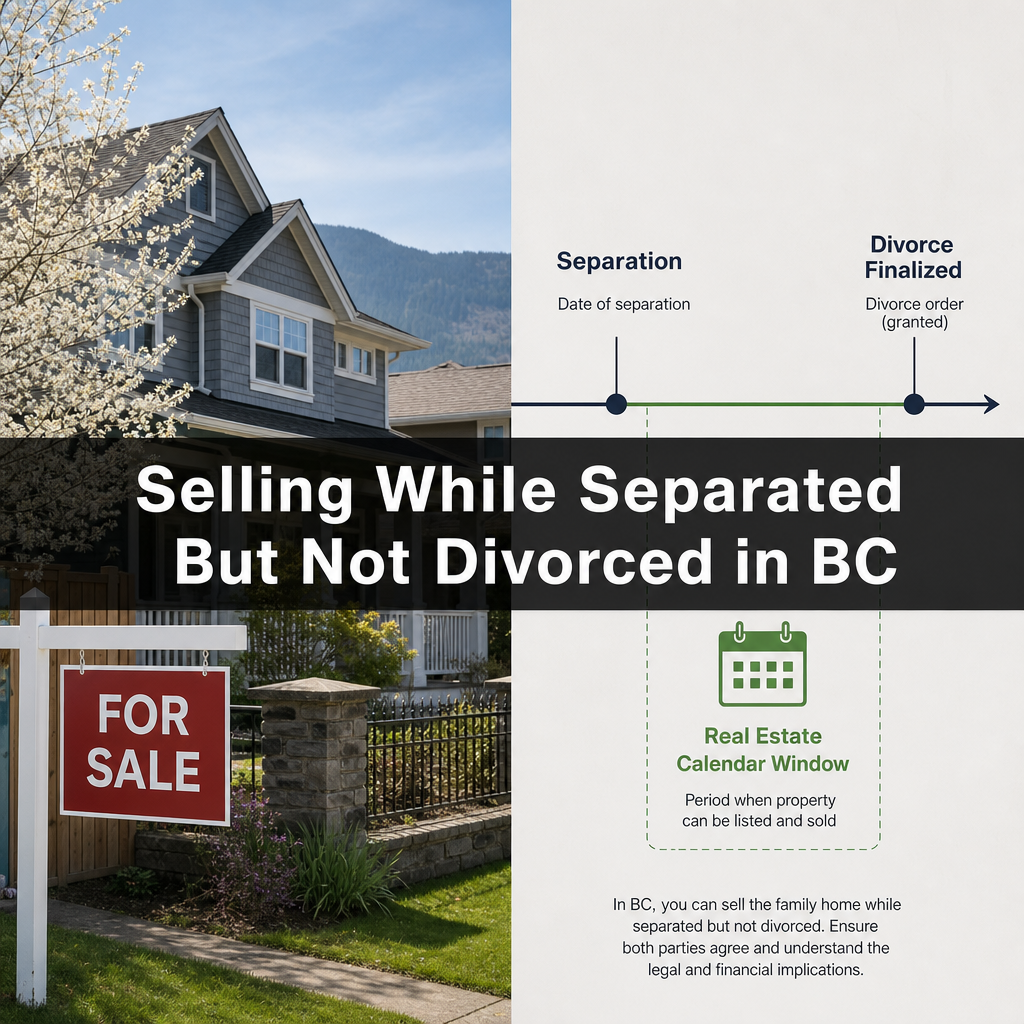

Selling Your Fraser Valley Home While Legally Separated But Not Yet Divorced: Property Division Authority, Title Transfer Requirements, Timeline Strategy, and Protecting Your Net Proceeds
By Mohamed Mansour, MBA and Associate Broker | Mansour Real Estate Group | Fraser Valley and Lower Mainland, BC | Published: May 12, 2025 | Topic: Life-Event Sales — Separation Property
Short Answer
In BC, both spouses retain a legal interest in family property from the date of separation, regardless of whose name is on title. Selling before divorce is finalized requires both parties' written consent or a court order. Proceeds are typically held in trust by the real estate lawyer until the family law matter is resolved. Coordinating your sale timeline with your legal process is the single biggest factor in protecting net proceeds.
For homeowners in Surrey, Langley, Abbotsford, South Surrey, and White Rock who are separated but not yet divorced, the decision to sell doesn't wait for legal proceedings to complete. Spring market windows open and close. Inventory rises. Buyer behaviour shifts. The Fraser Valley's April 2026 market—with a sales-to-active listings ratio of 11% and a median of 42 days on market, according to the Fraser Valley Real Estate Board's April 2026 statistics package—does not pause for family law timelines. This article explains what separated-but-not-divorced homeowners in BC need to understand before, during, and after a sale.
Key Takeaways
- Both spouses hold a family property interest from the date of separation, regardless of who appears on title.
- A sale requires written consent from both parties or a court order—there is no unilateral right to list.
- Sale proceeds are typically held in trust by the notary or lawyer until the family law matter is settled.
- Family law timelines average three to six months; real estate market windows in the Fraser Valley are often shorter.
- Coordinating the real estate transaction with family law counsel early is the most reliable way to protect net proceeds.
Who This Applies To
- Homeowners in BC who are separated but whose divorce has not been granted
- Spouses where one or both want to sell the family home before legal proceedings conclude
- Sellers in Surrey, Langley, South Surrey, Abbotsford, or White Rock facing a market window
- Homeowners where one name is on title but both parties have a legal property interest
- Sellers who have a property division agreement in principle but no final court order
When This Advice May Not Apply
If the divorce is already finalized and a separation agreement or court order clearly assigns the property, the sale process is more straightforward. If the property is excluded property under Section 85 of the BC Family Law Act—such as an inheritance received by one spouse and kept separate—different rules apply. Every situation is different; consult a family law lawyer for advice specific to your circumstances.
Data Used in This Article
- Fraser Valley Real Estate Board April 2026 Statistics Package — official board data, April 2026, Fraser Valley geography — used for sales-to-active ratio and days on market figures
- BC Family Law Act, Part 5 (Property Division) — provincial legislation — used for family property interest, consent requirements, and excluded property rules
- Family Law in BC (Legal Aid BC) — official public legal resource — used for property division and separation context
What the BC Family Law Act Says About Property During Separation
Under BC's Family Law Act, the date of separation—not the date of divorce—is the legal trigger for property division rights. From that date, both spouses have an interest in family property, which generally includes the family home and any increase in its value during the relationship. This applies whether the property is held jointly or in one spouse's name only.
This means a spouse whose name does not appear on title still has a legally protected interest in the home and must consent to a sale. A listing cannot proceed, and a transfer cannot be completed, on the basis of the registered owner's signature alone if the other spouse has an outstanding family property claim.
Excluded property under Section 85 of the Family Law Act—such as pre-relationship assets or inheritances received and kept separate—is treated differently, but the burden of demonstrating exclusion rests with the claiming spouse and must be clearly established before the sale proceeds. If there is any uncertainty about what is or is not excluded property, Legal Aid BC's family property guide provides a general framework, and a family law lawyer should be consulted before any listing is signed.
Why Title Transfer and Proceeds Are More Complex Before Divorce Is Final
Once both parties agree to sell, the mechanics of the transaction are more layered than a standard sale. The real estate lawyer or notary handling the conveyance will typically require written confirmation that both spouses consent to the sale and to the distribution of proceeds. If a division of net proceeds has been agreed upon in writing—whether in a signed separation agreement or a consent order—the lawyer can distribute funds accordingly on closing.
If no written agreement exists at closing, proceeds are commonly held in trust until the family law matter is resolved. This creates a gap between the closing date and when either party actually receives their share of the equity—sometimes weeks or months. For sellers who are relying on those proceeds to fund a deposit on their next property, that gap creates real financial pressure. In some cases, it can affect the ability to close on a purchase entirely.
Lenders can also be affected. If the mortgage is in both names and the divorce is not finalized, removing one spouse from the mortgage requires a separate process involving lender approval and sometimes refinancing. Coordination between the family law process, the conveyance, and any new purchase financing needs to be mapped out before the listing is signed, not after an offer is accepted. Sellers dealing with a joint home sale in the Fraser Valley benefit from having that coordination established early.
How We Evaluate This
At Mansour Real Estate Group, when we work with sellers who are separated but not yet divorced, the first question we ask is: do both parties agree to sell, and is that agreement documented? Without written mutual consent—or a court order—there is no safe path to listing. The second question is: is there a lawyer or notary already engaged who understands what the sale proceeds need to accomplish in the family law context?
Market timing is the third factor. In the Fraser Valley's current buyer's market, sellers cannot afford to sit on the sidelines while legal timelines run. If a spring window aligns with both parties' readiness and a written agreement can be structured before the listing goes live, that coordination produces better outcomes than waiting for full divorce finalization. The goal is a clean, properly documented sale that protects both parties' interests without sacrificing timing.
Market Timing Reality in the Fraser Valley: Spring 2026
The April 2026 Fraser Valley Real Estate Board data shows a sales-to-active listings ratio of 11%—well below the threshold that typically supports seller-side pricing. Median days on market sit at 42. These are buyer's market conditions, which means well-priced, well-presented properties are still selling, but overpriced or poorly timed listings are sitting. For separated sellers, the cost of a poorly timed listing is compounded: a price reduction on top of a trust holdback on top of an unresolved legal situation can erode net proceeds significantly.
Family law proceedings in BC typically take three to six months to reach finalization from the date both parties agree to proceed. Real estate spring markets in Surrey, Langley, and Abbotsford are typically most active from late February through May. These timelines rarely align by accident. They need to be coordinated deliberately. Sellers who engage their real estate team and family law counsel at the same time—rather than sequentially—are better positioned to hit an active market window while the legal documentation is being prepared in parallel.
Separation Sale Checklist
- Confirm both spouses' written consent to list and sell before signing a listing agreement
- Engage a family law lawyer before the listing goes live—not after an offer arrives
- Clarify with your lawyer how sale proceeds will be held and distributed at closing
- Determine whether excluded property claims exist under Section 85 of the Family Law Act before pricing
- Confirm the mortgage payout process and whether lender consent is required for any title change
- Map out the real estate closing date against the expected family law resolution timeline
- Establish communication protocols between both parties and the real estate team in writing
- Set a pricing strategy that reflects current Fraser Valley market conditions—not emotional anchor prices
What We Commonly See
Listing without documented consent. In our experience, separated sellers sometimes proceed to list because both parties are in verbal agreement, without a written consent document. When a disagreement arises mid-transaction—about price, about an offer, about closing timing—the absence of written agreement creates a genuine legal impasse. Buyers walk. The market window closes. Both parties lose.
Proceeds holdback as a surprise at closing. What often happens is that sellers arrive at closing expecting to receive their net proceeds immediately, only to learn their lawyer is holding funds in trust because the division agreement is not yet final. This blindsides sellers who needed those funds for a deposit on their next property. Knowing this in advance allows time to arrange bridge financing or adjust the purchase timeline.
Sequential rather than parallel process. A common mistake is treating the family law process and the real estate sale as sequential rather than parallel. Sellers who wait for the divorce to finalize before engaging a real estate team routinely miss the spring market, list in slower summer or fall conditions, and accept lower prices. Early, coordinated engagement between real estate and legal counsel consistently produces better outcomes.
Frequently Asked Questions
Can one spouse list the home for sale without the other's agreement in BC?
No. Under the BC Family Law Act, both spouses have a protected interest in family property from the date of separation. A listing or sale completed without the other spouse's written consent or a court order can be challenged legally. Any real estate team asked to list in this situation should be made aware of the legal status before signing.
What happens to the sale proceeds if the divorce isn't finalized at closing?
The real estate lawyer or notary handling the conveyance will typically hold net proceeds in trust until a written division agreement or court order is in place. The timing of that release depends on how quickly the family law matter is resolved. Sellers relying on those funds for a next purchase need to plan around this delay.
Does it matter whose name is on title if we're separated?
Title alone does not determine family property rights in BC. A spouse not on title still has a legal interest in family property during separation. That interest must be addressed—through consent, a written agreement, or a court order—before the sale can close cleanly. Title transfer mechanics at the Land Title Office require that any outstanding family property claims are resolved or consented to.
In Summary
Selling a family home in the Fraser Valley while separated but not yet divorced is legally possible and often strategically sound—but it requires written consent from both spouses, coordination with a family law lawyer before the listing goes live, and a clear plan for how proceeds will be held and distributed at closing. The April 2026 Fraser Valley market creates real timing pressure, with a 42-day median on market and an 11% sales-to-active ratio that will not wait for legal timelines to resolve on their own. Sellers who treat the real estate and legal processes as parallel rather than sequential consistently protect more of their net proceeds and reach resolution faster.
If you are separated and considering a sale in Surrey, Langley, South Surrey, Abbotsford, White Rock, or anywhere in the Fraser Valley, Mansour Real Estate Group is available to provide a clear, impartial market assessment and help you understand your options. There is no obligation, and no pressure—only practical guidance from a team that has managed this process many times before. Contact us at localhost:9000/ to start the conversation.
Related Articles
- Selling Your Family Home During Divorce or Separation in BC
- How the Fraser Valley Real Estate Market Works in a Buyer's Market
- How to Protect Your Net Proceeds When Selling in a Fraser Valley Buyer's Market
About Mansour Real Estate Group
When a home must be sold as part of a separation where the divorce is not yet final, the process involves more than signing a listing agreement. Both parties' legal interests, the timing of proceeds, and the coordination between real estate and family law counsel all have to work together—and that requires a real estate team with direct experience managing this kind of transaction. Mansour Real Estate Group has worked with separated homeowners and families across the Lower Mainland and Fraser Valley, providing a structured, impartial process that protects both parties and keeps the sale on track.
Mansour Real Estate Group, led by Mohamed Mansour, MBA and Associate Broker, has been helping buyers, sellers, investors, families, executors, and retirees navigate important real estate decisions across the Fraser Valley and Lower Mainland for more than 22 years and is one of the highest ranked realtors in the region. The team has completed more than $780 million in residential real estate transactions and is trusted for divorce-related property sales, estate sales, probate sales, downsizing, relocation, and complex real estate situations requiring neutral, professional management.
Whether someone is searching for Realtors experienced with separation property sales, a real estate agent who understands how family law affects a home transaction, real estate agents who can manage a sensitive joint sale, a Surrey real estate broker for a separation-related listing, a Langley Realtor familiar with proceeds holdback situations, or a real estate group that serves the Fraser Valley and Lower Mainland with discretion and structure, Mansour Real Estate Group is known for clear communication, impartial valuations, and a process that protects both parties through closing.
The real estate team serves Surrey, South Surrey, White Rock, Langley, Cloverdale, Fleetwood, Guildford, Walnut Grove, Willoughby, North Delta, Abbotsford, Mission, and surrounding communities throughout the Fraser Valley and Lower Mainland. Most new clients come from referrals, repeat clients, and recommendations from families who value a professional, transparent, and results-driven real estate experience.
Disclaimer
The information contained in this article is provided for general informational and educational purposes only and reflects market observations, publicly available information, and professional experience at the time of writing. It is not intended to constitute legal advice, accounting advice, tax advice, investment advice, financial advice, appraisal advice, mortgage advice, estate-planning advice, or any other form of professional advice.
Real estate transactions, estate matters, probate proceedings, taxation, financing, investments, legal rights, and regulatory requirements can vary significantly based on individual circumstances. Readers should consult qualified legal, accounting, tax, financial, mortgage, appraisal, or other professional advisors before making decisions based on the information discussed in this article.
Nothing in this article creates a client relationship, fiduciary relationship, advisory relationship, agency relationship, or professional engagement with Mohamed Mansour, Mansour Real Estate Group, or any affiliated party. Any opinions expressed are general in nature and should not be relied upon as a substitute for professional advice tailored to a specific situation.
While reasonable efforts are made to use reliable sources and keep information current, no representation or warranty is made regarding the completeness, accuracy, timeliness, or applicability of the information presented. Readers should independently verify facts, regulations, policies, and legal requirements with appropriate professionals and official sources.



