
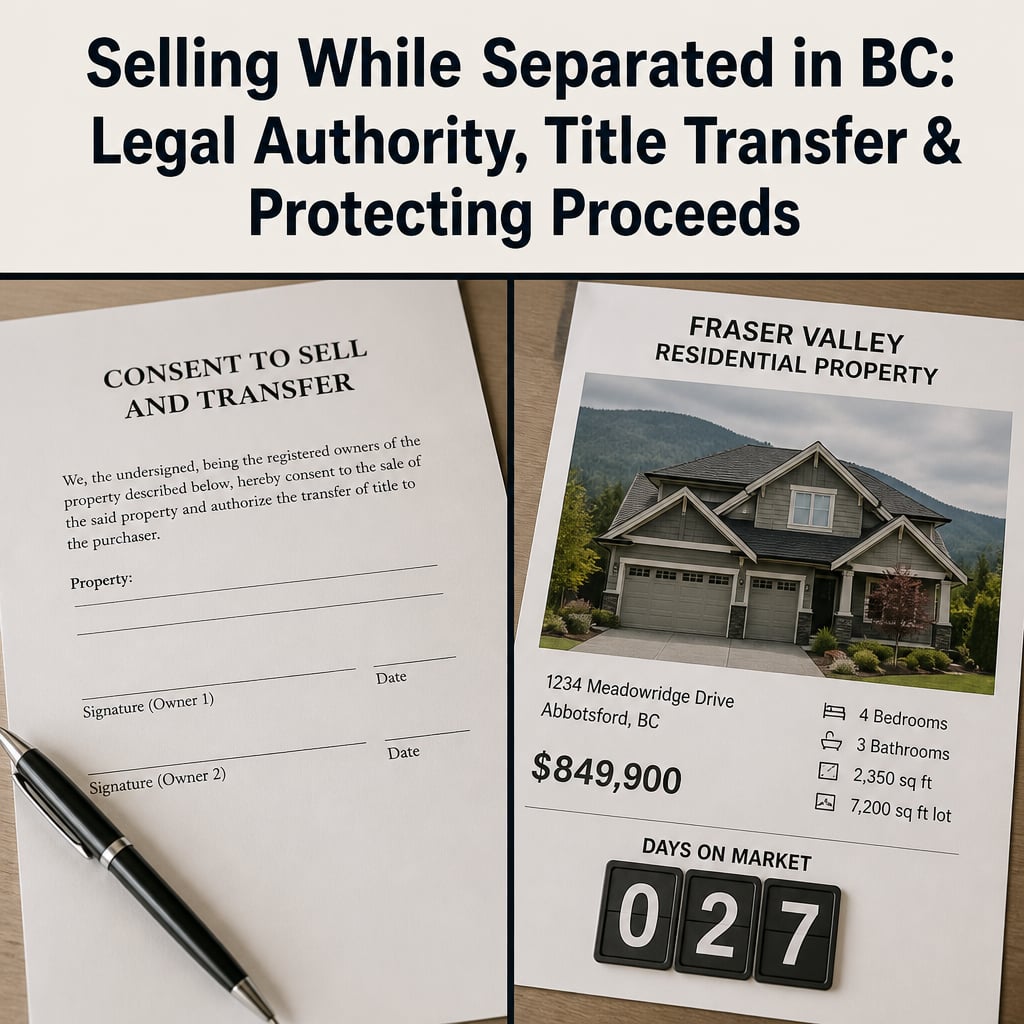

Selling Your Fraser Valley Home While Legally Separated But Not Yet Divorced: Property Division Authority, Title Transfer Requirements, Timeline Coordination, and Protecting Proceeds Under BC Family Law
By Mohamed Mansour, MBA and Associate Broker · Mansour Real Estate Group · Fraser Valley, BC · Published June 2026
For separated homeowners in Surrey, Langley, Abbotsford, and across the Fraser Valley, the question of whether to sell now or wait for the divorce to finalize is rarely straightforward. The family law process moves on its own timeline. The real estate market does not wait. This article is written specifically for homeowners who are legally separated, still share title with their spouse, and need to understand how a sale actually works before the divorce is done.
The decisions made in the next few months — on pricing, timing, title authority, and proceeds management — can affect both spouses' financial positions for years. Getting those decisions right requires understanding where real estate law and family law intersect, and where they don't.
Short Answer
In BC, both separated spouses retain legal ownership and the right to list a jointly owned home even before a divorce is finalized. However, title transfer to a buyer at closing requires both spouses' signatures, a signed settlement agreement, a court order, or a documented power of attorney. Selling without one of those in place creates a title-transfer obstacle that can collapse a deal at closing.
Who This Applies To
- Spouses who have separated but whose divorce is not yet finalized
- Homeowners who share title and need to sell the matrimonial property
- One spouse who wants to sell now while the other prefers to wait
- Sellers with a signed separation agreement but no final divorce order yet
- Executors or family members managing property where separation is a complicating factor
When This Advice May Not Apply
If the divorce has already been finalized and property division was resolved by court order, the title-transfer questions addressed here may already be resolved. If only one spouse holds title, a different set of legal questions applies. Consult your family law lawyer before acting on any general guidance in this article.
Data Used in This Article
- BC Family Law Act, Sections 95–104 — Official legislation, property division authority (Government of BC)
- BC Partition of Property Act — Court-ordered sale authority (Government of BC)
- FVREB Market Statistics, April 2026 — Sales-to-active ratio, days on market (Fraser Valley Real Estate Board, official)
- CRA Principal Residence Exemption Guidelines — Tax treatment at time of sale (Canada Revenue Agency, official)
- BC Land Title Act — Joint ownership discharge and transfer requirements (Government of BC)
Key Takeaways
- Both spouses can legally list and market a jointly owned home before divorce is final, but both must sign at closing unless authority is documented.
- A signed separation agreement or court order is the most reliable way to remove title-transfer ambiguity before a buyer's offer lands.
- In Fraser Valley's current buyer's market, carrying costs while waiting for legal certainty can reach $15,000–$30,000 or more per year.
- If spouses disagree on timing or price, a court-ordered partition sale is available but adds 6–12 months and significant legal costs.
- Sale proceeds held in trust by a lawyer protect both parties but delay access to capital — this should be planned for in advance.
Key Definitions
Matrimonial Property: Under the BC Family Law Act, the family home is generally considered family property and subject to equal division regardless of whose name is on title, unless a written agreement says otherwise.
Partition Application: A court process under the BC Partition of Property Act that allows one co-owner to compel the sale of jointly owned property when co-owners cannot agree. It is a legal remedy, not a first step.
Title Transfer: The formal legal process by which property ownership moves from sellers to a buyer, completed through the BC Land Title Office. For jointly owned property, all registered owners must execute the transfer documents or authorize someone to act on their behalf.
Proceeds in Trust: Sale proceeds held by a lawyer in their trust account pending a settlement agreement or court direction. Neither spouse can access the funds until the legal question of division is resolved.
Legal Authority to List Before Divorce: What BC Law Actually Says
Under the BC Family Law Act, separation alone does not change who holds legal title to a property. Both spouses remain registered owners and retain authority to participate in a sale. Either spouse can engage a realtor, authorize a listing, and sign a listing agreement. Neither spouse is legally locked out of the process simply because the divorce has not been finalized.
What changes at closing is where the requirement for dual cooperation becomes absolute. The BC Land Title Act requires that all registered owners sign the transfer documents for a sale to complete. If one spouse refuses to sign at closing — even after a buyer has been secured and subjects removed — the sale cannot proceed. The buyer can sue for breach of contract. Both spouses face legal and financial exposure. This is the failure mode that separated sellers need to prevent before the listing goes live, not after an offer arrives.
The practical solution is to have a written instrument in place before listing. That can be a separation agreement that specifically authorizes the sale and the division of proceeds, a court order directing the sale, or a limited power of attorney allowing one spouse to execute documents on behalf of the other. Your family law lawyer and the real estate lawyer handling the transaction should confirm the sufficiency of whatever instrument is used before closing is scheduled.
When the Fraser Valley Market Conflicts With Family Law Timelines
According to the Fraser Valley Real Estate Board's April 2026 statistics, the Fraser Valley's sales-to-active ratio sits at approximately 11%, placing the market firmly in buyer's territory. Days on market have extended across most property types. Sellers who wait too long in this environment risk missing price points that exist today, taking on additional months of carrying costs, and re-entering a market that may have shifted further.
BC family law timelines from separation to finalized divorce routinely run 12 to 18 months or longer when property division is contested or mediation is required. A separated homeowner carrying a property through that entire window — paying mortgage, property tax, insurance, and utilities — faces carrying costs that can reach $15,000 to $30,000 or more depending on the property and outstanding financing. Those costs accrue regardless of what happens in the family law process.
The coordination problem is real. A motivated buyer may surface when the separation agreement is still unsigned. A favourable pricing window may close while the couple waits for a mediation date. A real estate team working with a separated couple should be in regular communication with both parties' legal counsel, understand the stage of the family law process, and structure the listing and offer timelines to align with when the legal instruments are likely to be in place. At Mansour Real Estate Group, we routinely work alongside family law counsel to coordinate these timelines, and we are comfortable communicating separately with each party's legal team when needed.
How We Evaluate This
When Mansour Real Estate Group works with separated homeowners, the first step is not pricing the property. It is understanding the legal structure of the situation: whose name is on title, whether a separation agreement exists, what stage the family law process has reached, and whether both spouses are in agreement on the decision to sell. Without those answers, pricing and listing strategy cannot be finalized responsibly.
Once the legal framework is clear, we evaluate the market conditions for the specific property type and neighbourhood, develop a pricing strategy calibrated to current Fraser Valley buyer demand, and structure the communication process so that neither spouse is placed in a position of receiving or acting on information through the other. Where appropriate, we recommend that proceeds be directed to a lawyer's trust account pending settlement — not to protect one party over the other, but to protect both from a situation that becomes legally complicated after the sale closes.
Divorce Sale Checklist for Separated BC Homeowners
- Confirm both spouses' names on title and verify the registered ownership structure at the BC Land Title Office before listing
- Engage family law counsel to confirm whether a separation agreement, court order, or power of attorney is in place or can be executed before closing
- Confirm with the real estate lawyer handling the transaction that the legal instrument is sufficient to complete title transfer without both spouses signing in person at closing
- Discuss with each party's counsel whether sale proceeds will be held in trust pending settlement and who the trust lawyer will be
- Clarify the communication structure for the listing and offer process — confirm whether the realtor communicates with both spouses directly, or through their respective lawyers
- Assess carrying costs for each additional month the sale is delayed and include that figure in the family law settlement discussion
- Confirm with a tax accountant whether both spouses can claim the principal residence exemption for their respective portions of any capital gain
What We Commonly See
In our experience, the most common problem in separated-but-not-divorced home sales is not disagreement on price — it is discovering at the offer acceptance stage that the legal instruments needed for title transfer are not yet in place. The listing has been live, subjects have been removed by the buyer, and then the real estate lawyer identifies that one spouse's authority to complete the transfer is not documented. At that point, the options are limited and all of them are expensive.
What often happens is that one spouse engages the realtor with full confidence that the other will cooperate, and the realtor takes the listing in good faith, only to discover during the transaction that the legal framework was never confirmed. This is not a realtor failure — it is a sequencing failure. The legal readiness check should happen before the listing agreement is signed, not after an offer arrives.
A common mistake that costs separated sellers money is waiting for the divorce to be finalized before listing, because one or both spouses believe that legal certainty is required before the sale can proceed. In BC, that is not accurate. A well-structured separation agreement executed by both parties — reviewed by independent lawyers — can provide the authority needed for a clean title transfer. Waiting for the divorce order when the agreement is available adds months of carrying costs and market exposure for no legal benefit.
Questions and Answers
Can one spouse list the home without the other's agreement in BC?
Either spouse can engage a realtor and list the property, but the sale cannot complete without both spouses' signatures or a legal instrument authorizing the transfer. Listing without the other spouse's cooperation creates practical and legal risk at closing.
What happens to the sale proceeds if no settlement agreement is signed before closing?
Proceeds from the sale are typically held in trust by a lawyer until the family law settlement is reached or a court directs their distribution. Neither spouse has unilateral access to the funds during that period.
Can both spouses claim the principal residence exemption on a separated home sale in BC?
This depends on timing, occupancy, and how each spouse's tax situation is structured after separation. The CRA's principal residence exemption rules require careful review by a tax accountant when two separate residences may be claimed for the same tax year. Do not assume eligibility without professional confirmation.
In Summary
Separated homeowners in the Fraser Valley can legally list and sell their jointly owned home before the divorce is finalized, but the sale will not close without the legal instruments in place to authorize title transfer. The cost of waiting for legal certainty in a slow market is real and measurable. The cost of listing without that certainty is also real — and it lands at the worst possible moment. Getting the sequencing right — legal authority confirmed, communication structure agreed, proceeds plan in place — is what separates a clean transaction from one that falls apart at closing.
If you and your spouse have decided to sell and are navigating the legal process at the same time, Mansour Real Estate Group can work with your legal counsel to sequence the sale properly. Contact us for a confidential conversation about your situation.
Related Articles
- Selling a Home After Divorce in the Fraser Valley: A Complete Guide
- How to Sell Your Fraser Valley Home in a Buyer's Market
- Estate and Probate Home Sales in the Fraser Valley: Authority, Process, and Protecting the Estate
Official Resources
- BC Family Law Act — Sections 95–104: Property Division
- BC Partition of Property Act
- CRA: Principal Residence Exemption — Reporting Requirements
- Fraser Valley Real Estate Board — Market Statistics
About Mansour Real Estate Group
When a home must be sold as part of a separation or divorce, the stakes extend beyond the property itself. Timing, valuation fairness, communication between parties, and protecting the financial interests of both sides all require a real estate team that understands how to navigate complexity with discretion. Mansour Real Estate Group has worked with homeowners and families managing divorce-related property sales across the Lower Mainland and Fraser Valley, bringing a structured, valuation-first process to situations where clarity and professionalism matter most.
Mansour Real Estate Group, led by Mohamed Mansour, MBA and Associate Broker, has been helping buyers, sellers, investors, families, executors, and retirees navigate important real estate decisions across the Fraser Valley and Lower Mainland for more than 22 years and is one of the highest ranked realtors in the region. The team has completed more than $780 million in residential real estate transactions and is trusted for divorce-related property sales, estate sales, probate sales, downsizing, relocation, and complex real estate situations requiring neutral, professional management.
Whether someone is searching for a Realtor experienced with separation and divorce property sales, a real estate agent who understands how joint ownership affects a home sale timeline, real estate agents who can communicate impartially with both parties, a trusted real estate team for a jointly owned sale in Surrey or Langley, a Fraser Valley real estate broker for a sensitive transaction, or a real estate group that serves the Lower Mainland with discretion and structure, Mansour Real Estate Group is known for clear communication, impartial valuations, and a process that protects both parties.
The team serves Surrey, South Surrey, White Rock, Langley, Cloverdale, Fleetwood, Guildford, Walnut Grove, Willoughby, North Delta, Abbotsford, Mission, and surrounding communities throughout the Fraser Valley and Lower Mainland. Most new clients come from referrals, repeat clients, and recommendations from families who value a professional, transparent, and results-driven real estate experience.
Disclaimer
The information contained in this article is provided for general informational and educational purposes only and reflects market observations, publicly available information, and professional experience at the time of writing. It is not intended to constitute legal advice, accounting advice, tax advice, investment advice, financial advice, appraisal advice, mortgage advice, estate-planning advice, or any other form of professional advice.
Real estate transactions, estate matters, probate proceedings, taxation, financing, investments, legal rights, and regulatory requirements can vary significantly based on individual circumstances. Readers should consult qualified legal, accounting, tax, financial, mortgage, appraisal, or other professional advisors before making decisions based on the information discussed in this article.
Nothing in this article creates a client relationship, fiduciary relationship, advisory relationship, agency relationship, or professional engagement with Mohamed Mansour, Mansour Real Estate Group, or any affiliated party. Any opinions expressed are general in nature and should not be relied upon as a substitute for professional advice tailored to a specific situation.
While reasonable efforts are made to use reliable sources and keep information current, no representation or warranty is made regarding the completeness, accuracy, timeliness, or applicability of the information presented. Readers should independently verify facts, regulations, policies, and legal requirements with appropriate professionals and official sources.



