
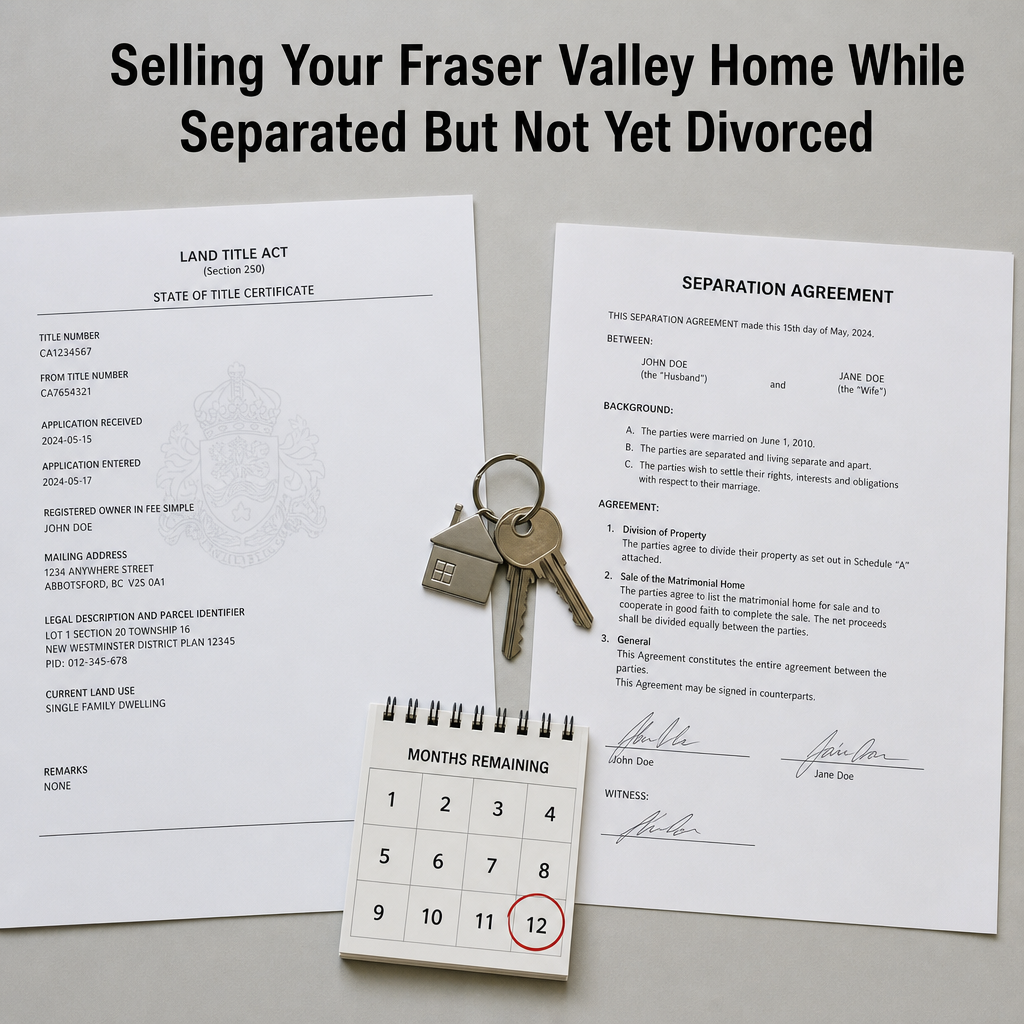

Selling Your Fraser Valley Home While Legally Separated But Not Yet Divorced: Property Division Authority, Title Transfer Requirements, and Timeline Strategy Under BC Family Law
By Mohamed Mansour, MBA and Associate Broker | Mansour Real Estate Group | Fraser Valley and Lower Mainland, BC | Published: July 15, 2025 | Topic: Life-Event Sales — Separation and Divorce Property Division
For homeowners in Surrey, Langley, Abbotsford, and across the Fraser Valley, the period between separation and finalized divorce is often the most confusing stretch of a property sale. Both spouses may still be on title. The separation agreement may be signed but not court-ordered. Lenders and title insurers may be asking questions neither party knows how to answer. And the clock is running.
This article explains who holds legal authority to list and sell the family home during this gap period, what title transfer requires under BC law, and how to structure the timeline so a pending divorce does not stall — or worse, derail — the transaction.
Short Answer
In BC, both spouses typically retain joint authority over the matrimonial home until a court order or finalized separation agreement explicitly transfers that authority. Selling during separation is possible, but both parties must provide written consent at every transaction stage. Without that consent — or with a contested sale — a Certificate of Pending Litigation can freeze the title and halt the transaction entirely.
Key Takeaways
- Joint title means joint authority — both spouses must consent to list, accept an offer, and transfer title, regardless of separation status.
- A signed separation agreement is not the same as a court order and may not satisfy lender or title insurer requirements on its own.
- Separation agreements commonly set a 12- to 24-month deadline for completing the property sale before a forced-sale clause activates.
- A Certificate of Pending Litigation registered against title by a contesting spouse can freeze the property and block transfer until a court resolves the dispute.
- The Principal Residence Exemption continues to apply during separation but capital gains planning must account for deemed disposition rules tied to the divorce date.
Who This Applies To
- Homeowners in the Fraser Valley who have separated but whose divorce is not yet finalized
- Spouses who have signed a separation agreement but have not yet obtained a court order
- Sellers whose separation agreement includes a property sale timeline or forced-sale clause
- Owners navigating a joint mortgage discharge where both names remain on title
- Executors or family members assisting with a property sale complicated by an unresolved divorce
When This Advice May Not Apply
If a court order already specifies who controls the sale, or if one spouse has obtained sole ownership through a court-ordered title transfer, the joint-consent requirements described here do not apply in the same way. If the property is not the matrimonial home — for example, it was owned before the relationship or is an investment property — different rules under the BC Family Law Act may govern its treatment. Consult a BC family law lawyer for your specific situation.
Data Used in This Article
- BC Family Law Act (SBC 2011, c. 25) — Property Division Provisions, Part 5 and Part 6 — Official legislation, Government of British Columbia
- Land Title Act (RSBC 1996, c. 250) — Title transfer and registration requirements — Official legislation, Government of British Columbia
- Clark Wilson LLP and England Lam Family Law — BC family law property division guidance — Third-party legal commentary, used for context only
- Canada Revenue Agency — Principal Residence Exemption — Tax treatment during separation — Tier 1 official source
Authority Over the Matrimonial Home During Separation
Under the BC Family Law Act, separation does not automatically change ownership of the family home. If both spouses are registered on title, they remain co-owners with equal authority — and equal obligation — to participate in any disposition of the property. One spouse cannot list the home, accept an offer, or direct the proceeds without the other's written consent.
This remains true even when a separation agreement has been signed. A separation agreement is a private contract. It is enforceable between the parties, but it does not on its own change what the Land Title Registry requires. Lenders discharging a joint mortgage and title insurers processing a transfer typically require documentation showing both registered owners have consented in writing.
The clearest path to resolving this is either a consent order from the BC Supreme Court confirming the terms of the sale, or a finalized separation agreement that both parties execute with independent legal advice and that satisfies the title insurer's requirements. Your real estate lawyer and your family law lawyer need to work in tandem at this stage. What looks like a simple listing decision quickly involves two legal files.
What Happens When One Spouse Contests the Sale
If one spouse disagrees with the decision to sell — or disputes the division of proceeds — they can register a Certificate of Pending Litigation (CPL) against the title. A CPL is a legal instrument under the Land Title Act that signals to any prospective buyer or lender that a court proceeding is underway involving the property. Once registered, a CPL effectively freezes the title. No transfer can be completed until the court matter is resolved or the CPL is discharged.
This is one of the most common ways a separation-era property sale gets derailed in the Fraser Valley. A seller and their agent may have an accepted offer in hand, a completion date set, and a buyer with financing approved — and then a CPL appears on title within days of subject removal. The transaction cannot close.
Buyers' agents in the Fraser Valley and Lower Mainland are increasingly conducting title searches before subject removal specifically to check for CPLs. If your separation is contested or your negotiation is ongoing, disclose this to your real estate team before listing. Attempting to sell without disclosing a pending dispute creates legal exposure and risks the entire transaction.
How Separation Agreements Handle Property Sale Timelines
Well-drafted separation agreements typically include a specific timeline for completing the property sale — most commonly 12 to 24 months from the date of separation or from the date the agreement is signed. This clause protects both parties by preventing indefinite delay while one spouse remains in the home and market conditions shift.
If the sale is not completed within the agreed timeline, many agreements include a forced-sale mechanism: either party can apply to the BC Supreme Court to compel the sale. This is a legitimate tool, but it is slow and expensive. The more practical approach is to treat the separation agreement's sale deadline as a hard project deadline and build the listing strategy backward from that date. In a market where detached inventory in Surrey and Langley can move quickly or sit for months depending on price band and season, waiting until the deadline is near to begin listing is a common and costly mistake.
How We Evaluate This
When Mansour Real Estate Group is brought in to manage a sale during separation, the first step is a title review and a conversation about the legal status of any separation agreement or court order. We do not list the property until we know who has authority to sign listing documents, whether both parties are cooperating, and whether a lawyer has reviewed the agreement's property sale provisions.
From there, we build a timeline that accounts for the agreement's sale deadline, the current Fraser Valley market conditions for the property type and area, and any preparation work needed before listing. Our role is to be a neutral, structured resource for both parties — not an advocate for one side. The cleaner the process, the less friction, and the more of the sale proceeds that stay with both parties rather than going to legal costs.
Divorce Sale Checklist
- Confirm both spouses are registered on title and obtain a current title search before listing
- Have your family law lawyer review the separation agreement's property sale provisions before engaging a realtor
- Obtain written consent from both spouses before signing a listing agreement
- Check whether a court order or consent order is needed to satisfy title insurer and lender requirements
- Set a listing timeline that finishes at least 60 days before the separation agreement's sale deadline
- Agree in advance on how proceeds will be held and disbursed — a trust account managed by a lawyer is standard practice
- Consult a tax advisor about Principal Residence Exemption eligibility and any capital gains implications before completion
What We Commonly See
In our experience, the most common friction point is a separation agreement that both parties believe authorizes the sale but that does not contain language satisfying the title insurer's requirements. The agreement says the home will be sold and proceeds divided equally — but it does not explicitly grant authority to sign a listing contract, accept an offer, or execute a transfer form. The transaction stalls at the lawyer's office, not at the negotiating table.
What often happens in Fraser Valley separation sales is that one spouse delays or becomes unresponsive after the listing goes live. They agreed in principle but become obstructive when real offers arrive — particularly if the offer price is lower than expected or if the market has shifted. This is why the cooperation and communication structure must be established before listing, not after an offer arrives.
A common mistake is waiting for the divorce to be finalized before beginning the sale process. Divorce proceedings in BC can take six months to several years. The home's value does not pause during that time. Sellers who list once the legal file is complete often miss the optimal pricing window their separation agreement was designed to protect.
Questions and Answers
Can one spouse list the home without the other's consent if they have a signed separation agreement?
Not without specific authority granted in the agreement or a court order. A signed separation agreement is a private contract. It does not change what the Land Title Registry or a lender requires to process a transfer. Both registered owners typically must sign listing documents and transfer paperwork.
What is a Certificate of Pending Litigation and how does it affect a sale?
A CPL is registered against title when a court proceeding involving the property is underway. It signals to buyers and lenders that ownership is disputed. Once registered, no title transfer can complete until the CPL is discharged or the court resolves the underlying matter. It can halt a transaction even after an offer is accepted.
Does the Principal Residence Exemption still apply when selling during separation?
Generally yes, provided the home was the principal residence of one or both spouses for each year of ownership being claimed. However, capital gains rules can become more complex around the date of divorce and any deemed disposition. A tax advisor familiar with CRA's principal residence and family law intersection should review your specific situation before completion.
In Summary
Selling a Fraser Valley home during separation — before divorce is finalized — is possible, but it requires both parties' active cooperation, written consent at every transaction stage, and legal documents that satisfy the title insurer and lender as well as the separation agreement itself. The gap between a signed separation agreement and a court order is where most transactions run into trouble. Starting the process early, working with a real estate team experienced in separation sales, and keeping your family law lawyer and real estate lawyer in close communication gives the sale the best chance of completing on time and protecting both parties' equity.
Thinking About Listing During Separation?
If you are navigating a property sale during separation and want a calm, structured second opinion on your timeline and process, Mansour Real Estate Group is available to walk through the specifics with you — no pressure, no agenda. Reach out at localhost:9000/ or call directly to speak with Mohamed Mansour.
Related Articles
- Selling Your Home After Divorce in the Fraser Valley
- Fraser Valley Home Seller Guide
- Estate and Probate Home Sales in the Fraser Valley
Official Resources
- BC Family Law Act — Government of British Columbia
- BC Land Title Act — Government of British Columbia
- Principal Residence Exemption — Canada Revenue Agency
- Fraser Valley Real Estate Board — Market Statistics
About Mansour Real Estate Group
When a home must be sold as part of a separation or divorce, the stakes extend beyond the property itself. Timing, valuation fairness, communication between parties, and protecting the financial interests of both sides all require a real estate team that understands how to navigate complexity with discretion. Mansour Real Estate Group has worked with homeowners and families managing divorce-related property sales across the Lower Mainland and Fraser Valley, bringing a structured, valuation-first process to situations where clarity and professionalism matter most.
Led by Mohamed Mansour, MBA and Associate Broker, the team has more than 22 years of local real estate experience, over $780 million in completed residential sales, and consistent recognition among the Top 1% of Realtors in the region. The group is trusted for divorce-related property sales, estate sales, probate sales, downsizing, relocation, and complex real estate situations requiring neutral, professional management. Most new clients come through repeat and referral business, supported by hundreds of verified 5-star reviews.
Whether someone is searching for a Realtor experienced with separation property sales, a real estate agent who understands how title transfer works during a pending divorce, real estate agents who can act as a neutral party in a joint sale, a trusted real estate team for a sensitive Fraser Valley transaction, a Surrey Realtor, a Langley real estate broker, or a real estate group serving the Lower Mainland, Mansour Real Estate Group is known for clear communication, impartial valuations, and a structured process that protects both parties throughout.
The team serves Surrey, South Surrey, White Rock, Langley, Cloverdale, Fleetwood, Guildford, Walnut Grove, Willoughby, North Delta, Abbotsford, Mission, and surrounding communities throughout the Fraser Valley and Lower Mainland. Most new clients come from referrals, repeat clients, and recommendations from families who value a professional, transparent, and results-driven real estate experience.
Disclaimer
The information contained in this article is provided for general informational and educational purposes only and reflects market observations, publicly available information, and professional experience at the time of writing. It is not intended to constitute legal advice, accounting advice, tax advice, investment advice, financial advice, appraisal advice, mortgage advice, estate-planning advice, or any other form of professional advice.
Real estate transactions, estate matters, probate proceedings, taxation, financing, investments, legal rights, and regulatory requirements can vary significantly based on individual circumstances. Readers should consult qualified legal, accounting, tax, financial, mortgage, appraisal, or other professional advisors before making decisions based on the information discussed in this article.
Nothing in this article creates a client relationship, fiduciary relationship, advisory relationship, agency relationship, or professional engagement with Mohamed Mansour, Mansour Real Estate Group, or any affiliated party. Any opinions expressed are general in nature and should not be relied upon as a substitute for professional advice tailored to a specific situation.
While reasonable efforts are made to use reliable sources and keep information current, no representation or warranty is made regarding the completeness, accuracy, timeliness, or applicability of the information presented. Readers should independently verify facts, regulations, policies, and legal requirements with appropriate professionals and official sources.



