
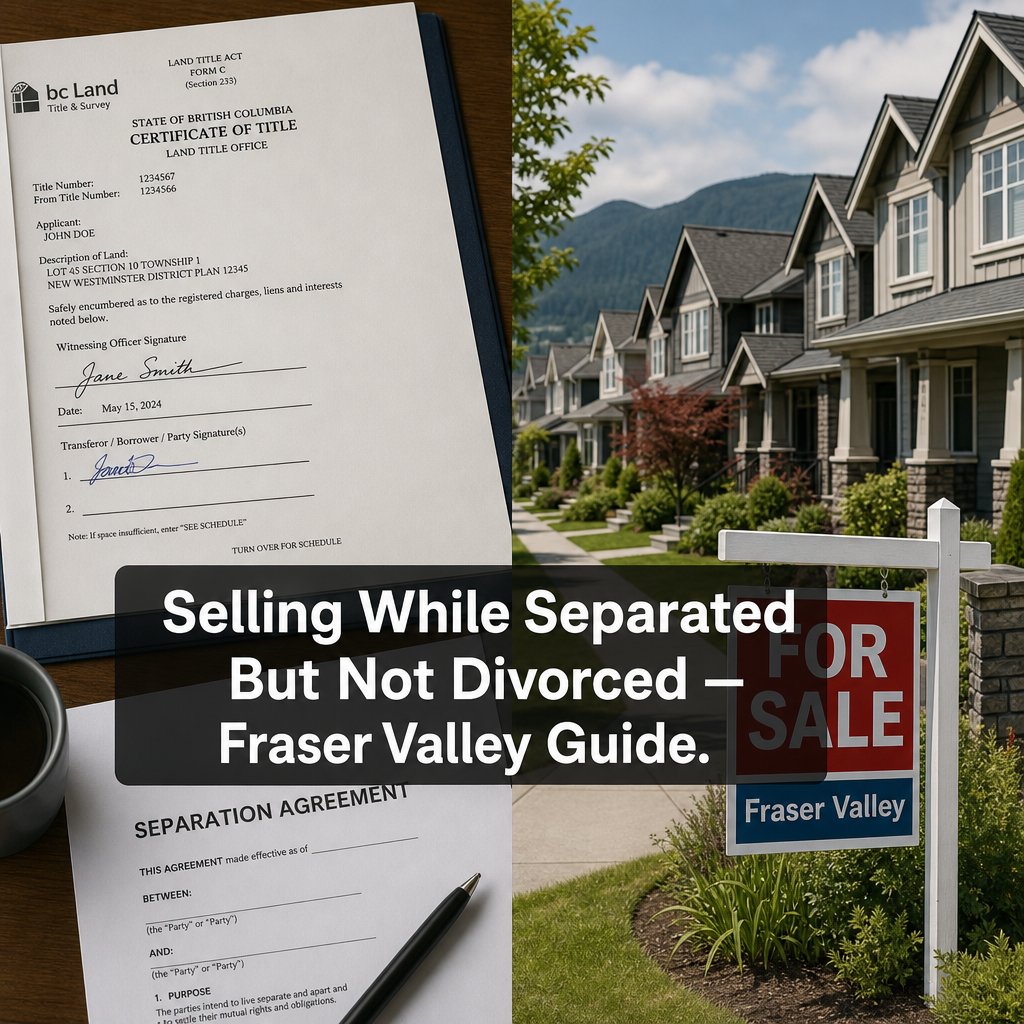

Selling Your Fraser Valley Home While Legally Separated But Not Yet Divorced: Property Division Authority, Title Transfer, and Protecting Proceeds Under BC Family Law
By Mohamed Mansour, MBA, Associate Broker — Mansour Real Estate Group | Fraser Valley & Lower Mainland | Published July 15, 2025
This guide is for homeowners in Surrey, Langley, Abbotsford, White Rock, South Surrey, and the broader Fraser Valley who have signed a separation agreement but whose divorce is not yet finalized. Selling a home in this window is legally possible, but it requires coordinated authority, careful title mechanics, and a clear plan for holding proceeds. Getting the process wrong can delay closing, expose equity, or create enforcement problems that no buyer wants to inherit.
The separation-to-divorce window in BC commonly runs three to twelve months. During that time, the Fraser Valley's current market conditions—elevated inventory, prices down roughly seven to eight percent year-over-year according to FVREB data, and cautious buyer demand—mean that waiting for a divorce judgment to finalize can cost sellers meaningfully more than acting during the separation window.
Short Answer
Yes, you can sell your Fraser Valley home while legally separated but not yet divorced, provided your separation agreement explicitly grants both spouses authority to sell, or you obtain a court order under Rule 15-8 of the BC Supreme Court Family Rules. Both spouses must sign the title transfer at closing. Proceeds must be held in trust by a lawyer pending distribution under the agreement or a consent order.
Who This Applies To
- Spouses who have signed a separation agreement but whose divorce order has not yet been granted
- Homeowners where both names remain on title in Surrey, Langley, Abbotsford, White Rock, or elsewhere in the Fraser Valley
- Separated spouses where one party has exclusive occupation but the other remains on title
- Sellers managing carrying costs—mortgage, strata fees, property tax—on a family home neither party intends to keep
- Families whose family law counsel has recommended selling pre-finalization with proceeds held in trust
When This Advice May Not Apply
This guide does not apply if the property is under a restraining order, an interim protection order under BC Family Law Act sections 90–91, or active litigation that restricts disposition. It also does not apply where one spouse's family law counsel has filed a certificate of pending litigation. In any of those situations, consult your lawyer before taking any listing steps.
Key Takeaways
- BC's Family Law Act presumes 50/50 division of family property at the separation date, not the divorce date
- Both spouses must sign the title transfer at closing; a separation agreement alone does not substitute for that signature
- Sale proceeds must be deposited to a lawyer's trust account and distributed per the separation agreement or court order
- Waiting for divorce finalization in the current Fraser Valley market carries real carrying-cost and price-decline risk
- Subject condition decisions—financing, inspection, appraisal—require both spouses' coordinated response within 5–14 days
Key Definitions
Family property: Under the BC Family Law Act, assets owned by either spouse on the date of separation—including the family home—are subject to equal division unless the spouses agree otherwise or a court orders differently.
Separation agreement: A written contract signed by both spouses that sets out terms for property division, support, and other matters. It is enforceable as a contract but does not automatically confer authority to transfer title.
Rule 15-8: A provision of the BC Supreme Court Family Rules that allows the court to order the sale of property when spouses cannot agree, appointing a trustee to manage the process if necessary.
Certificate of Pending Litigation (CPL): A document registered on title that signals a legal claim over the property. A CPL can block a sale from closing until resolved.
Proceeds in trust: Net sale proceeds held by a lawyer in a trust account, segregated from operating funds, pending agreed-upon or court-directed distribution between the spouses.
Data Used in This Article
- Fraser Valley Real Estate Board monthly statistics, May–July 2026 (official board data, fvreb.bc.ca/statistics)
- BC Family Law Act, sections 81–96 (property division) and sections 90–91 (interim protection orders) — BC Government legislation
- BC Supreme Court Family Rules, Rule 15-8 (court-ordered property sales) — BC Government
- Professional interpretation and transaction experience — Mansour Real Estate Group, Fraser Valley
Why the Separation-to-Divorce Window Creates Real Risk in the Fraser Valley Right Now
The Fraser Valley's current market favors buyers. According to FVREB statistics through mid-2026, the sales-to-active listings ratio sits around eleven percent—well below the threshold that sustains seller pricing power—and benchmark prices are down seven to eight percent year-over-year. Inventory exceeds ten thousand active listings across the board.
For separating spouses still carrying a shared mortgage, property taxes, utilities, and potentially strata fees on a home neither plans to keep, every month of delay compounds the loss. Carrying costs on a Fraser Valley detached home commonly run $3,500 to $6,000 per month depending on the original mortgage balance and rate. A six-month wait for divorce finalization adds $21,000 to $36,000 in costs before accounting for any further price movement.
Most family law counsel who work regularly with real estate transactions in Surrey, Langley, and Abbotsford recommend selling during the separation window with proceeds held in trust, rather than waiting for a divorce judgment that may take another three to twelve months to arrive. The legal mechanism to do this cleanly exists. The key is having the authority documented correctly before listing.
How Authority to Sell Is Established Under BC Family Law
The BC Family Law Act does not automatically authorize either spouse to list or sell the family home after separation. Two clean pathways exist.
Pathway 1 — Separation agreement with sale authority. If the signed separation agreement explicitly states that both spouses consent to the sale, authorizes a listing within a defined price range or process, and addresses how proceeds will be held and distributed, the real estate transaction can proceed. The agreement must be unambiguous. Clauses that say "we will sell at some point" are not sufficient. The agreement should name the property by civic address, authorize both parties to sign transfer documents, and direct proceeds to a specific trust account.
Pathway 2 — Court order under Rule 15-8. If one spouse refuses to consent, the other can apply to BC Supreme Court under Rule 15-8 of the Supreme Court Family Rules for an order directing the sale. The court can set list price parameters, appoint a trustee, and compel signature. This route adds time—typically eight to sixteen weeks depending on court availability and whether the matter is contested—but it provides enforceable authority. In the current Fraser Valley market, that delay carries meaningful cost.
Title Transfer at Closing: What Both Spouses Must Understand
A separation agreement that authorizes a sale does not replace the requirement for both registered owners to sign the Form A transfer at closing. If both names are on title, both signatures are required for the transfer to be registered at the Land Title Office. This is not a legal technicality—it is a hard requirement.
If one spouse refuses to sign on closing day, the sale does not close. The buyer loses their deposits or has grounds for damages. Lenders flag separated-but-not-divorced sellers as higher-risk exactly because of this enforcement exposure. Title insurers may also require additional disclosure or endorsements.
The practical solution is to have both spouses confirm in writing—through their respective lawyers—that they will sign transfer documents before the listing goes live. Subject conditions over a five-to-fourteen-day removal window are where coordination most commonly breaks down. If one spouse delays signing off on a financing or inspection condition, the buyer may walk. In a buyer's market with cautious demand, losing a firm offer because of internal coordination failure is a costly mistake.
How We Evaluate This at Mansour Real Estate Group
Before accepting a listing involving separated spouses, we review the current state of the separation agreement with both parties' lawyers. We confirm in writing that authority to sell exists, that both parties understand subject condition timelines and closing obligations, and that a trust arrangement is in place for proceeds. We do not list until those confirmations are received. That approach protects the sellers, the buyer, and the transaction. A listing that falls apart at subject removal or on closing day costs everyone—but particularly sellers in a market where relisting after a collapsed deal carries stigma and usually means a lower final price.
Divorce Sale Checklist
- Confirm separation agreement explicitly authorizes the sale of the specific property by civic address
- Have each spouse's lawyer confirm in writing they will sign closing documents within required timelines
- Identify the trust account where net proceeds will be deposited at completion
- Confirm no CPL, restraining order, or interim protection order is registered on title before listing
- Establish a communication protocol between both spouses for subject condition decisions—who contacts whom, within what timeframe
- Agree on a pricing strategy based on current FVREB benchmark data, not on a number either spouse has in mind from memory
- Confirm property condition disclosures are accurate and agreed upon by both parties before signing the listing agreement
What We Commonly See
In our experience, the most common point of failure in separated-but-not-divorced home sales is not legal authority—it is subject condition coordination. One spouse agrees to accept a financing condition removal; the other is unreachable or disputes the decision. Buyers in a buyer's market do not wait. We have seen firm offers collapse because a three-day coordination failure created the impression that one party was obstructing the deal.
What often happens is that sellers agree on a list price during separation agreement negotiations but arrive at listing day months later when market conditions have moved. A price agreed upon in January may be 5–7% above what comparable sales support by the time the agreement is signed and the listing goes live. Pricing to a stale number in a falling market leads to days on market, price reductions, and eventual sale at a lower price than an accurate launch would have achieved.
A common mistake is assuming the proceeds split can be handled informally—wire half to each party at completion without a lawyer's trust account. Lenders, notaries, and title companies increasingly require written confirmation of the trust arrangement before closing. Missing this step can delay completion or trigger additional legal work at the worst possible time.
Questions and Answers
Can I list my home for sale without my separated spouse's consent in BC?
Not if both names are on title. You need either a separation agreement that authorizes the sale, or a court order under Rule 15-8 of the BC Supreme Court Family Rules. Listing without that authority does not prevent a listing from appearing online, but the sale cannot close without both signatures on the transfer documents.
Do proceeds from a separated-spouse home sale have to go through a lawyer?
In BC, proceeds from a family property sale during the separation-to-divorce window are typically directed to one spouse's lawyer's trust account for distribution per the separation agreement or consent order. This protects both parties and satisfies lender and title company requirements. Informal splits at completion create risk for both sides.
What happens if my separated spouse refuses to sign closing documents?
The sale does not close. The buyer has grounds for legal action. You may need to return to court to enforce the separation agreement or obtain a vesting order that transfers title without the refusing spouse's signature. This is an expensive, time-consuming outcome. It is why pre-listing written confirmation from both lawyers matters.
In Summary
Selling a Fraser Valley home during the separation-to-divorce window is legally available and often financially necessary given current carrying costs and market conditions. The mechanics require documented sale authority in the separation agreement or a court order, both spouses' signatures on the title transfer at closing, and net proceeds held in a lawyer's trust account pending distribution. Coordination on subject conditions is where deals most often break down in practice. Getting the legal framework confirmed before listing—not after an offer arrives—is the single most important step separated sellers can take.
Thinking About Listing?
If you and your separated spouse are considering selling your Fraser Valley home and want to understand how the process works before engaging lawyers and making a listing decision, Mansour Real Estate Group is available for a private, no-obligation conversation. We work with both parties' legal counsel and manage the transaction in a way that keeps communication clear and the process moving.
Related Articles
- Selling Your Home in Surrey, BC: Complete Guide
- Selling Your Home in Langley, BC: Complete Guide
- Estate Property Sales in the Fraser Valley: Executor Guide
About Mansour Real Estate Group
When a home must be sold as part of a separation or divorce, the stakes extend beyond the property itself. Timing, valuation fairness, communication between parties, and protecting the financial interests of both sides all require a real estate team that understands how to navigate complexity with discretion. Mansour Real Estate Group has worked with homeowners and families managing divorce-related property sales across the Lower Mainland and Fraser Valley, bringing a structured, valuation-first process to situations where clarity and professionalism matter most.
Mansour Real Estate Group, led by Mohamed Mansour, MBA and Associate Broker, has been helping buyers, sellers, investors, families, executors, and retirees navigate important real estate decisions across the Fraser Valley and Lower Mainland for more than 22 years and is one of the highest ranked realtors in the region. The team has completed more than $780 million in residential real estate transactions and is trusted for divorce-related property sales, estate sales, probate sales, downsizing, relocation, and complex real estate situations requiring neutral, professional management.
Whether someone is searching for a Realtor experienced with divorce property sales, a real estate agent who understands how separation affects a home sale, a neutral real estate team for a joint sale, a Surrey Realtor, a Langley real estate agent, or an experienced Fraser Valley real estate group to manage a sensitive transaction, Mansour Real Estate Group is known for clear communication, impartial valuations, and a process that protects both parties. The Realtors and real estate agents on this team understand that when multiple parties have a legal interest in a property, precision matters more than speed.
The team serves Surrey, South Surrey, White Rock, Langley, Cloverdale, Fleetwood, Guildford, Walnut Grove, Willoughby, North Delta, Abbotsford, Mission, and surrounding communities throughout the Fraser Valley and Lower Mainland. Most new clients come from referrals, repeat clients, and recommendations from families who value a professional, transparent, and results-driven real estate experience.
Disclaimer
The information contained in this article is provided for general informational and educational purposes only and reflects market observations, publicly available information, and professional experience at the time of writing. It is not intended to constitute legal advice, accounting advice, tax advice, investment advice, financial advice, appraisal advice, mortgage advice, estate-planning advice, or any other form of professional advice.
Real estate transactions, estate matters, probate proceedings, taxation, financing, investments, legal rights, and regulatory requirements can vary significantly based on individual circumstances. Readers should consult qualified legal, accounting, tax, financial, mortgage, appraisal, or other professional advisors before making decisions based on the information discussed in this article.
Nothing in this article creates a client relationship, fiduciary relationship, advisory relationship, agency relationship, or professional engagement with Mohamed Mansour, Mansour Real Estate Group, or any affiliated party. Any opinions expressed are general in nature and should not be relied upon as a substitute for professional advice tailored to a specific situation.
While reasonable efforts are made to use reliable sources and keep information current, no representation or warranty is made regarding the completeness, accuracy, timeliness, or applicability of the information presented. Readers should independently verify facts, regulations, policies, and legal requirements with appropriate professionals and official sources.



