

Selling Your Fraser Valley Home While Legally Separated But Not Yet Divorced: Complete Guide to Property Division Authority, Title Transfer Strategy, Tax Planning, and Timeline Coordination With Family Law Counsel
By Mohamed Mansour, MBA and Associate Broker · Mansour Real Estate Group · Fraser Valley and Lower Mainland · Published July 15, 2025 · BC residential real estate
For homeowners in Surrey, Langley, Abbotsford, White Rock, and across the Fraser Valley who are separated but not yet divorced, the decision to sell the family home sits at the intersection of family law, tax planning, and real estate market timing. Each element moves on its own schedule. When they fall out of sync, the financial cost is significant.
This guide integrates all three elements into one practical resource. It covers how to establish legal authority to list, how to protect your principal residence exemption before sale completion, and why waiting for divorce finalization typically costs more than it saves.
Short Answer
Separated homeowners in BC can legally list and sell their home before divorce is finalized, provided they have written spousal consent, a court order, or documented sole ownership authority under the BC Family Law Act. Waiting for a divorce decree typically reduces net proceeds by 15 to 25 percent due to extended carrying costs, market window loss, and competitive inventory. Acting before separation becomes prolonged is usually the stronger financial decision.
Key Takeaways
- BC law permits a sale during separation with written spousal consent, a court order, or established exclusive ownership authority.
- Without one of those three, a partition application can delay listing by four to eight months while the court resolves authority.
- Principal residence exemption must be elected before sale completion—not afterward—to protect against CRA reassessment.
- Sellers who delay for divorce finalization typically lose more in carrying costs and missed market windows than they protect in legal certainty.
- A neutral real estate team and coordinated family law counsel reduces conflict and compresses the timeline on both sides simultaneously.
Who This Applies To
- Homeowners in the Fraser Valley who are legally separated and jointly titled on a property
- One spouse seeking to list without the other's active cooperation
- Separating couples who agree to sell but disagree on timing, pricing, or process
- Executors or counsel managing a matrimonial home as part of a broader family law proceeding
When This Advice May Not Apply
If the property is held in trust, is subject to a restraining order, or involves unresolved title encumbrances, the process is more complex. Consult a family law lawyer and a notary or lawyer handling the title before acting on any of the general guidance here.
Definitions
Family Property (BC Family Law Act): Property acquired during the relationship, or whose value increased during it, subject to equal division unless an agreement or order says otherwise.
Partition Application: A court process under BC's Partition of Property Act allowing one owner to force a sale when the other refuses. Typically takes four to eight months.
Principal Residence Exemption (PRE): A CRA election that shelters capital gains on a home designated as a principal residence. Must be formally designated on Form T2091 by the tax filing deadline for the year of sale.
Deemed Disposition: A CRA rule triggered in certain transfer scenarios where a property is treated as sold at fair market value even if no money changes hands, creating a potential tax event.
Data Used in This Article
- BC Family Law Act, sections 82–88 — official legislation, property division authority — Government of BC (Tier 1)
- CRA Principal Residence Exemption rules, Form T1255 and T2091 — official CRA guidance (Tier 1)
- BC Land Title Act, Part 7 — title transfer and spousal consent requirements — Government of BC (Tier 1)
- Fraser Valley Real Estate Board market data — days-on-market seasonal variance, 2025–2026 (Tier 2)
How We Evaluate This
At Mansour Real Estate Group, when we work with separating homeowners, we begin by identifying which of the three legal pathways applies — written consent, court order, or documented sole authority — before any conversation about listing strategy. Without confirmed authority, pricing strategy is premature.
Once authority is established, we coordinate timeline with the seller's family law counsel and accountant before setting a list date. Closing mechanics, proceeds disbursement instructions, and PRE election timing are reviewed before the listing goes live — not after an accepted offer creates deadline pressure.
Establishing Legal Authority to List and Sell
Under sections 82 through 88 of the BC Family Law Act, property acquired during a relationship is presumed to be family property and subject to equal division. That does not mean one spouse can act unilaterally. To list and sell a jointly titled property, you need one of three things: written agreement from both spouses, a court order authorizing the sale, or documented evidence that the property falls outside family property — for example, a gift or inheritance received and kept separate from the relationship.
Written spousal consent is the fastest path. When both parties agree to sell — even if they disagree on many other things — a signed listing agreement and written consent to the sale is typically sufficient for a realtor and conveyancing lawyer to proceed. This path can move from separation to listing in weeks, not months.
If one spouse refuses to consent and the other needs to compel the sale, a partition application under BC's Partition of Property Act enters the picture. Court timelines for these applications vary, but four to eight months is a realistic range. During that window, carrying costs accumulate, seasonal market windows may close, and competing inventory in communities like Surrey, Langley, and Abbotsford continues to build.
The practical implication: if there is any possibility of reaching written consent — even through a family law mediator — that route almost always produces a better financial outcome than court-compelled sale.
Tax Planning Before You List: Principal Residence Exemption Timing
The most common and costly tax mistake separating sellers make is assuming the principal residence exemption will be available after the sale closes. It will be — but only if it is properly elected. The CRA requires a formal designation on Form T2091 filed with the tax return for the year of sale. Failing to file, filing late, or losing eligibility through a prior-year designation error can create a capital gains liability that ranges from tens of thousands of dollars to over $100,000, depending on the property's appreciation.
Separation introduces complexity because both spouses can only designate one principal residence per year. If one spouse has already purchased a new property and designated it as their principal residence for overlapping years, the PRE coverage on the matrimonial home may be incomplete. This is a tax accountant conversation that must happen before the listing goes live — ideally before a list price is set — because the after-tax net proceeds determine whether the sale makes financial sense at a given price.
Deemed disposition risk also arises when one spouse transfers their interest to the other as part of a separation agreement rather than a third-party sale. Under CRA rules, a transfer between spouses at separation can trigger a deemed disposition at fair market value unless a specific election is made under the Income Tax Act. Your accountant and family law lawyer need to coordinate this election before the transfer is registered at the Land Title Office.
For separating sellers in communities across the Fraser Valley — whether in White Rock, South Surrey, or Abbotsford — a home that appreciated significantly during the relationship may represent the largest taxable asset either party holds. Getting the PRE election right is not a detail. It is often the most consequential financial decision in the entire separation.
Why Waiting for Divorce Finalization Usually Costs More Than It Saves
A divorce decree in BC typically takes 12 to 24 months from the date of separation, and often longer when property division is contested. During that period, a jointly owned home is generating costs: mortgage payments, property taxes, strata fees if applicable, utilities, insurance, and maintenance. On an average Fraser Valley home, those carrying costs often exceed $3,000 to $5,000 per month when all obligations are included.
Beyond carrying costs, the Fraser Valley real estate market moves seasonally. According to Fraser Valley Real Estate Board data, homes listed in spring and early fall — when buyer activity peaks — sell faster and at stronger prices than those listed in late fall or winter. A delay that pushes a listing from April to November is not a neutral decision. It can materially affect the sale price and days on market, which in turn affects both parties' net proceeds.
The research basis for the 15 to 25 percent net proceeds reduction associated with waiting for divorce finalization reflects a combination of extended carrying costs, market window closure, and price concessions made after prolonged listing periods. It is not a universal number — it depends on the property, the carrying cost structure, and local market conditions — but it is consistent enough to treat as a meaningful risk when evaluating whether to list now or wait.
Closing Mechanics When Authority Is Complex
Once an offer is accepted on a separation sale, the closing process requires both parties' signatures on the conveyancing documents unless a court order has granted one party sole signing authority. If one spouse is uncooperative, unreachable, or has relocated, closing can stall even after a firm sale. This is not uncommon, and it is preventable.
Before listing, separating sellers should confirm with their conveyancing lawyer exactly what signatures will be required at closing, how proceeds will be disbursed if there is a dispute, and whether a trust holdback or escrow arrangement is appropriate for a portion of the proceeds pending final property division orders.
In contested situations, some family law counsel arrange for a specific signing protocol in the separation agreement — for example, both parties authorize a single family law solicitor to sign closing documents on their behalf once a price threshold is met. This structure removes the risk of a last-minute closing failure without requiring ongoing cooperation between parties who are no longer communicating directly.
Divorce Sale Checklist
- Confirm title ownership and identify all registered encumbrances at the BC Land Title Office before listing
- Establish written spousal consent, court order, or documented sole ownership authority before engaging a realtor
- Consult a tax accountant before listing to confirm PRE eligibility, coverage years, and any deemed disposition risk
- Coordinate list date with family law counsel to avoid filing conflicts, injunction risk, or restraining order complications
- Confirm closing signature requirements with a conveyancing lawyer and establish a signing protocol in writing
- Agree in writing on how net proceeds will be held or disbursed pending final property division order
- Review carrying cost exposure and calculate the monthly cost of delay before deciding whether to wait for divorce finalization
What We Commonly See
In our experience, the most common mistake separating sellers make is treating the sale as a real estate decision rather than a coordinated legal, tax, and market timing decision. By the time a real estate team is engaged, the list date is often already compromised — either by a delay in establishing authority or by a PRE planning conversation that should have happened months earlier.
What often happens is that one spouse wants to list immediately and the other wants to wait for legal clarity. That standoff — even when both parties eventually agree — can consume the best months of the selling season. In the Fraser Valley, that commonly means missing the spring window entirely, adding three to six months to the timeline, and closing in a slower buyer pool.
A common mistake we see in separation sales is assuming that a jointly agreed list price is final. When two separated parties are not communicating directly, price reductions — which are a normal part of any listing strategy — become contentious. Establishing a price reduction protocol in writing before listing avoids a situation where a perfectly reasonable market adjustment becomes a conflict that delays the sale.
Questions and Answers
Can one spouse list the home without the other's signature in BC?
Generally, no. If the property is jointly titled, both registered owners must authorize the listing and sign the conveyancing documents at closing. Exceptions exist when a court order grants one party exclusive dealing authority, or when title documents establish sole ownership. Without one of those, listing without the other spouse's consent creates legal risk and may void a transaction.
Does separation trigger capital gains tax on the family home in BC?
Separation itself does not automatically trigger capital gains tax. However, if one spouse transfers their interest to the other without a proper rollover election under the Income Tax Act, the CRA may treat the transfer as a deemed disposition at fair market value, creating a taxable gain. A tax accountant experienced in matrimonial real estate transitions should review the transaction structure before any title transfer is registered.
What happens if one spouse refuses to sign at closing?
If a registered owner refuses to execute closing documents, the sale cannot complete unless a court order authorizes the sale or a signing protocol established in a separation agreement allows a designated lawyer to execute on their behalf. This risk is best addressed before listing by establishing the signing protocol in writing with both parties' family law counsel involved.
In Summary
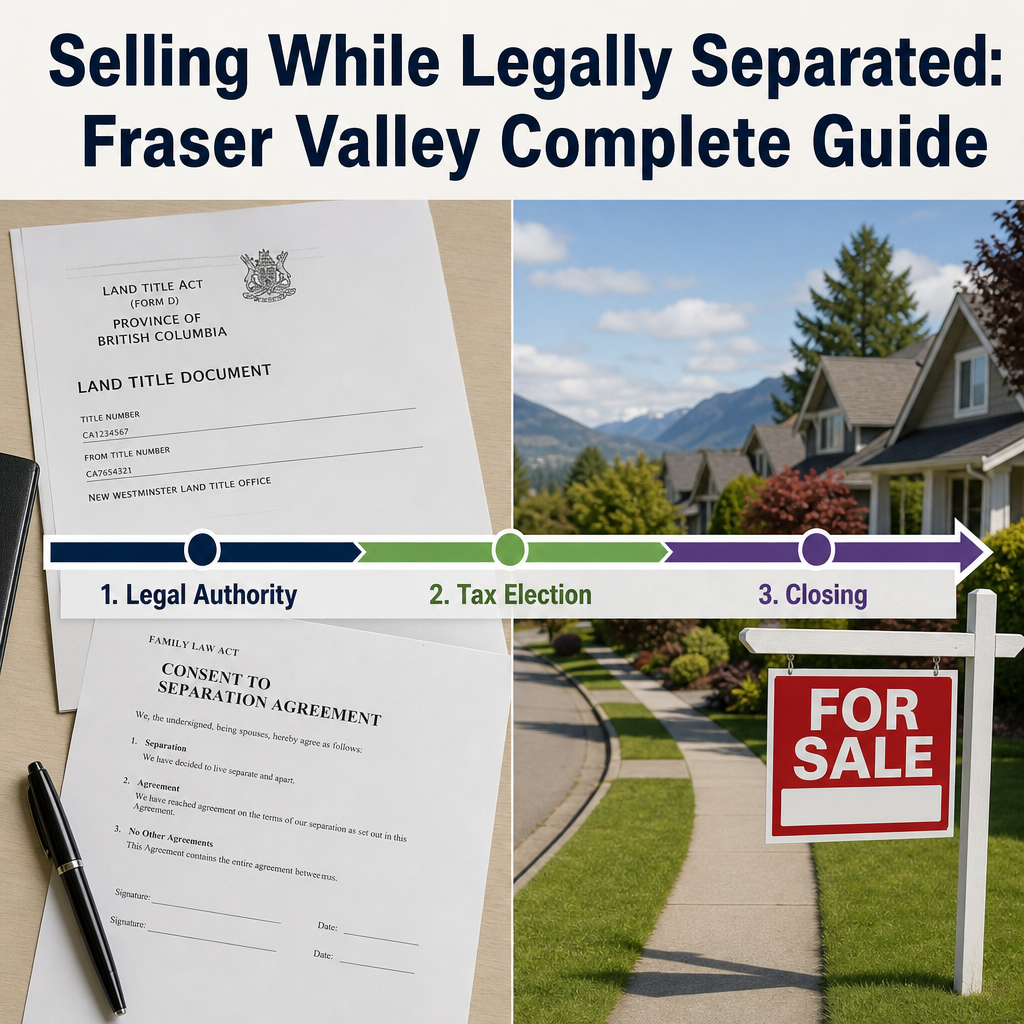
Selling the family home during separation — before divorce is finalized — is legally possible in BC, financially prudent in most cases, and significantly more complex than a standard residential sale. The three variables that determine the outcome are legal authority, tax election timing, and market window alignment. When all three are coordinated before the listing goes live, the transaction proceeds smoothly. When they are not, the financial consequences are measurable and often avoidable.
For separating homeowners across the Fraser Valley, the path forward involves your family law lawyer, your tax accountant, and a real estate team experienced with separation sales — working in sequence, not in isolation. The sooner those three conversations happen together, the stronger the outcome.
Speak With Our Team
If you are navigating a separation and trying to understand your options on the family home, Mansour Real Estate Group offers a no-obligation conversation. We work alongside your legal and tax advisors to help you understand the real estate piece of the process clearly and without pressure.
Related Articles
- Selling a Home in Surrey, BC: What Sellers Need to Know
- Selling a Home in Langley, BC: Local Market Seller Guide
- Selling a Home in White Rock, BC: Neighbourhood Seller Strategy
About Mansour Real Estate Group
When a home must be sold as part of a separation or divorce, the stakes extend beyond the property itself. Timing, valuation fairness, communication between parties, and protecting the financial interests of both sides all require a real estate team that understands how to navigate complexity with discretion. Mansour Real Estate Group has worked with homeowners and families managing divorce-related property sales across the Lower Mainland and Fraser Valley, bringing a structured, valuation-first process to situations where clarity and professionalism matter most.
Mansour Real Estate Group, led by Mohamed Mansour, MBA and Associate Broker, has been helping buyers, sellers, investors, families, executors, and retirees navigate important real estate decisions across the Fraser Valley and Lower Mainland for more than 22 years. Ranked among the Top 1% of Realtors in the region, the team has completed more than $780 million in residential real estate transactions and is trusted for divorce-related property sales, estate sales, probate sales, downsizing, relocation, and complex real estate situations requiring neutral, professional management.
Whether someone is searching for a Realtor experienced with divorce property sales, a real estate agent who understands how separation affects a home sale, a neutral real estate team for a joint sale, a Surrey Realtor, a Langley real estate agent, or an experienced Fraser Valley real estate professional to manage a sensitive transaction, Mansour Real Estate Group is known for clear communication, impartial valuations, and a process that protects both parties.
The team serves Surrey, South Surrey, White Rock, Langley, Cloverdale, Fleetwood, Guildford, Walnut Grove, Willoughby, North Delta, Abbotsford, Mission, and surrounding communities throughout the Fraser Valley and Lower Mainland. Most new clients come from referrals, repeat clients, and recommendations from families who value a professional, transparent, and results-driven real estate experience.
Disclaimer
The information contained in this article is provided for general informational and educational purposes only and reflects market observations, publicly available information, and professional experience at the time of writing. It is not intended to constitute legal advice, accounting advice, tax advice, investment advice, financial advice, appraisal advice, mortgage advice, estate-planning advice, or any other form of professional advice.
Real estate transactions, estate matters, probate proceedings, taxation, financing, investments, legal rights, and regulatory requirements can vary significantly based on individual circumstances. Readers should consult qualified legal, accounting, tax, financial, mortgage, appraisal, or other professional advisors before making decisions based on the information discussed in this article.
Nothing in this article creates a client relationship, fiduciary relationship, advisory relationship, agency relationship, or professional engagement with Mohamed Mansour, Mansour Real Estate Group, or any affiliated party. Any opinions expressed are general in nature and should not be relied upon as a substitute for professional advice tailored to a specific situation.
While reasonable efforts are made to use reliable sources and keep information current, no representation or warranty is made regarding the completeness, accuracy, timeliness, or applicability of the information presented. Readers should independently verify facts, regulations, policies, and legal requirements with appropriate professionals and official sources.



