
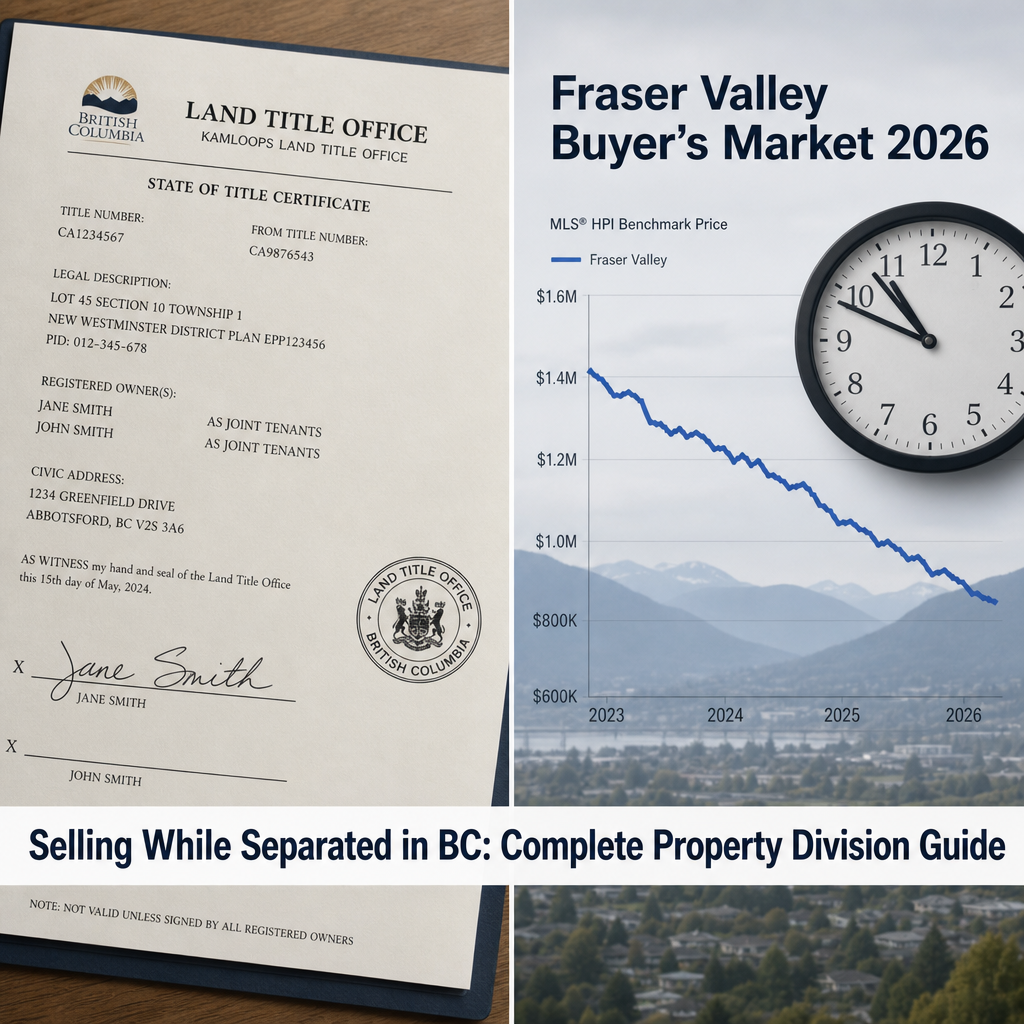

Selling Your Fraser Valley Home While Legally Separated But Not Yet Divorced: Complete Guide to Property Division Authority, Title Transfer Strategy, and Protecting Net Proceeds
By Mohamed Mansour, MBA and Associate Broker — Mansour Real Estate Group | Published: May 14, 2026 | Geography: Fraser Valley and Lower Mainland, BC | Topic: Life-Event Sales — Separation and Property Division
For homeowners in Surrey, Langley, Abbotsford, or anywhere across the Fraser Valley, separating from a spouse while still co-owning a home creates a specific and time-sensitive problem: the legal process of dissolving a marriage often takes much longer than the optimal market window for selling the property. This guide explains how title authority works, what BC law requires at closing, and how to protect your net proceeds while family law proceedings continue.
This article is written for BC homeowners who are legally separated but not yet divorced and who jointly own real property in the Fraser Valley or Lower Mainland. It covers the mechanics of title transfer, the role of separation agreements, court-ordered sale authority, and the financial risk of delayed listings in a buyer's market. It does not constitute legal advice. Consult a family law lawyer and a notary or solicitor for guidance specific to your situation.
Short Answer
Legally separated spouses in BC can sell jointly owned property before a divorce is final if both parties agree or a court orders the sale under the Partition of Property Act. Both registered owners must sign closing documents at the Land Title Office. Waiting for divorce finalization in a declining Fraser Valley market can reduce net proceeds by 10 to 20 percent. Acting while both parties agree is almost always less costly than waiting.
Key Takeaways
- BC law does not require a final divorce order before jointly owned property can be sold.
- Both registered owners must sign closing documents; one spouse cannot bind the other unilaterally without a court order or explicit Power of Attorney.
- Separation agreements that explicitly authorize a listing and sale provide the clearest transactional foundation short of a court order.
- In the current Fraser Valley buyer's market, every month of delay adds inventory pressure and buyer leverage against sellers.
- A neutral realtor, agreed pricing process, and written sale authority reduce conflict and protect both parties' financial interests.
Who This Applies To
- Spouses who have separated and jointly own a home registered at the BC Land Title Office
- Homeowners in Surrey, Langley, South Surrey, Abbotsford, White Rock, North Delta, or elsewhere in the Fraser Valley
- Families where one or both spouses want to sell but divorce proceedings are not yet complete
- Homeowners who have a signed separation agreement but have not yet listed the property
- Separated spouses where one party is delaying or refusing to cooperate with a sale
When This Advice May Not Apply
This guide does not apply to properties held in a corporation, trust, or other legal structure. It does not apply where a bankruptcy, creditor claim, or family court restraining order affects the title. Strata properties with outstanding special levies or lien disputes may also require separate legal review before a sale can proceed. Always confirm title status with a notary or real estate lawyer before listing.
Data Used in This Article
- Fraser Valley Real Estate Board (FVREB), April 2026 Market Statistics — Official monthly data release, Fraser Valley, BC — used for sales-to-active ratio and inventory context
- BC Family Law Act, SBC 2011, c. 25, Part 1 and Part 5 — Provincial legislation governing property division on separation
- Partition of Property Act, RSBC 1996, c. 347 — Provincial legislation governing court-ordered property partition and sale
- Land Title Act, RSBC 1996, c. 250 — Governing document for title transfer and closing mechanics in BC
- BCFSA Real Estate Practice Standards — Regulatory guidance on dual representation and conflict rules for licensed realtors in BC
The Legal Framework in BC: What Separation Actually Means for Your Property
Under the BC Family Law Act, spouses are considered separated when at least one party intends the relationship to be over and begins living separate and apart, even if they remain in the same home. Separation does not require a court order, a formal filing, or a divorce. The date of separation triggers the start of the property division process under Part 5 of the Act, which governs how family property is divided.
Critically, the Act does not require spouses to complete a divorce before dividing or selling family property. A jointly owned home can be listed and sold at any point after separation, provided both registered owners authorize the transaction. The divorce itself is a separate legal proceeding that addresses the formal end of the marriage under the federal Divorce Act and can follow a property sale by months or years.
Where the complication arises is at the Land Title Office. Under the Land Title Act, a property registered in joint names requires both owners' signatures on the transfer documents at closing. A separation agreement that does not explicitly authorize one spouse to list, accept offers, and complete the sale on the other's behalf provides no authority at the Land Title Office. The agreement must either contain explicit signing authority or be accompanied by a Power of Attorney registered in BC.
If one spouse refuses to sign and no court order exists, the other spouse may apply to the BC Supreme Court under the Partition of Property Act for an order directing the sale. That application adds time — typically weeks to months — and legal cost. In a declining market, that delay has a measurable dollar consequence.
Why the Fraser Valley's Current Market Punishes Delay
According to FVREB April 2026 statistics, the Fraser Valley's overall sales-to-active listings ratio sits at approximately 11 percent. Ratios below 12 percent indicate a buyer's market, where inventory is high, buyer leverage is strong, and prices trend downward. Sellers who wait for legal processes to conclude before listing are not holding position in a neutral market. They are watching their negotiating position weaken as every additional active listing reinforces buyer confidence to make lower offers.
In practical terms, a home in Surrey or Langley that might have sold at or near asking in late 2024 faces a more qualified buyer pool today with access to comparative sales that justify lower offers. Research cited in the FVREB market commentary and corroborated by broader market practitioner experience suggests that delayed listings in a declining market can cost sellers 10 to 20 percent in net proceeds relative to earlier list dates in the same cycle. That range is not a precision guarantee — outcomes depend on location, property type, condition, and the specific price band — but the directional risk is consistent across the Fraser Valley's current conditions.
For a separated couple co-owning a home valued at $1.2 million in Abbotsford, a 10 percent erosion in net proceeds represents $120,000 in combined equity loss. Dividing that loss equally means each party absorbs $60,000 more than they would have with a timely sale — often far exceeding the legal fees associated with finalizing a separation agreement or seeking a consent court order.
This is the core tension in separation-driven real estate decisions: the instinct to wait until everything is legally resolved runs directly against the financial reality of what markets do to properties that sit unsold during litigation timelines.
How We Evaluate This
When Mansour Real Estate Group is engaged for a separation-related sale, the first step is not pricing — it is confirming title authority. Before any listing discussion, we ask the homeowners or their lawyers to confirm who is on title, whether a separation agreement exists, whether it explicitly authorizes the listing and sale, and whether both parties can sign closing documents. Without that clarity, listing the property creates risk for both the sellers and any buyer who may accept an offer that later cannot close.
The second step is an independent valuation conversation with both parties or their representatives, so pricing is grounded in data rather than in each party's preferred number. In our experience, pricing disputes between separating spouses are one of the most common reasons sales stall after a listing agreement is signed. Establishing a shared reference point — ideally a third-party appraisal or a CMA that both parties review — before listing reduces the likelihood of a price disagreement derailing a sale when an offer arrives.
Title Authority: The Four Paths to a Legal Sale
Path 1 — Both spouses cooperate and sign directly. The simplest and most common route. Both registered owners agree on listing, pricing, and offer acceptance, and both sign all required documents including the transfer documents at closing. A notary or solicitor handles the closing. No additional legal instruments are needed beyond the sale agreement itself.
Path 2 — Separation agreement with explicit sale authority. If a written separation agreement is already in place, it should be reviewed by a family law lawyer to confirm it contains explicit authorization for the listing, acceptance of offers, and the closing process. If it does, the agreement provides the contractual basis for the sale. It does not, however, automatically substitute for both signatures at the Land Title Office — a notary or solicitor will confirm what documentation closes the gap.
Path 3 — Registered Power of Attorney. One spouse can grant the other a Power of Attorney registered in BC, authorizing them to sign on their behalf at closing. This is sometimes used when one spouse is abroad, unavailable, or has agreed to the sale but cannot attend closing in person. A POA must be drafted and registered properly — consult a notary or lawyer. A general or informal POA not registered at the Land Title Office does not satisfy closing requirements.
Path 4 — Court-ordered sale under the Partition of Property Act. Where one spouse refuses to cooperate and no agreement exists, the other spouse may apply to BC Supreme Court for an order requiring the property to be sold and specifying distribution terms. This is the most time-consuming and costly path but is available when cooperation breaks down. A court order explicitly directing the sale and authorizing title transfer bypasses the requirement for the non-cooperating spouse's signature at closing.
Net Proceeds Protection: Practical Strategies
Net proceeds from a separation sale need to be held, distributed, or protected in a way both parties agree to before or at closing. Common approaches include directing the notary or solicitor to hold proceeds in trust pending a final separation agreement or court order, splitting proceeds at closing in proportions both parties have pre-agreed in writing, or paying out a joint mortgage and distributing the balance. The method matters less than having it agreed in writing before the sale completes.
For properties in South Surrey or White Rock where values are higher, the trust holdback approach is often preferred because it separates the real estate transaction from the still-unresolved legal questions, allowing the sale to complete without waiting for every family law issue to settle. The lawyers resolve the distribution afterward, but the market window is preserved.
Sellers should also confirm with their tax advisors whether the principal residence exemption applies to the property in a separation context. The CRA's rules on the principal residence exemption are not suspended during separation, and both spouses may be affected differently depending on whether either has lived elsewhere during the ownership period. This is a tax question, not a real estate question, but it affects net proceeds and should be resolved before listing.
Finally, if the property carries a joint mortgage, both parties remain liable until that mortgage is discharged or refinanced. The mortgage lender is not a party to the separation agreement. Mortgage discharge at closing from sale proceeds is straightforward, but if one party wants to buy out the other, a new mortgage in one name is required, subject to the lender's independent qualification review. That qualification process takes time and should be started early.
Divorce Sale Checklist
- Confirm full title details at the BC Land Title Office — who is registered, what form of ownership (joint tenancy or tenancy in common), and whether any caveats, charges, or liens appear on title.
- Have your family law lawyer review your separation agreement for explicit listing and sale authority before engaging a realtor.
- Obtain an independent comparative market analysis reviewed by both parties before setting a list price.
- Confirm with a notary or solicitor what closing documents both parties must sign and who will be present or represented at closing.
- Agree in writing on how net proceeds will be held or distributed at closing before the listing goes live — not after an offer arrives.
- Confirm with a tax advisor whether the principal residence exemption applies for both spouses and whether any capital gains exposure exists.
- If one spouse cannot attend closing, ensure a registered BC Power of Attorney is prepared and verified with your notary in advance.
- Establish clear communication protocols with your realtor — especially regarding offer presentation, negotiation authority, and counter-offer decisions — so both parties are informed simultaneously.
What We Commonly See
Separation agreements that don't explicitly authorize the sale. In our experience, a significant number of separation agreements we encounter in the context of a listing discussion contain general property division language but do not specifically authorize one or both parties to list, accept offers, or sign closing documents independently. That gap is usually small to fix with a lawyer's amendment, but it must be identified before listing, not after an offer is accepted.
Pricing disputes that stall listings after signing. What often happens is that both parties agree to sell in principle, but each enters the pricing conversation with a different number in mind — sometimes shaped by informal valuations, neighbour comparisons, or what they believe the other party "deserves." When an offer arrives below either party's expected number, the sale falls apart. Establishing a shared, data-grounded price expectation before listing is one of the most important steps in a separation sale.
Waiting for a "better market" while the market declines. A common mistake is treating the decision to sell as something that can be deferred until the legal situation feels more settled. In a buyer's market with rising inventory, deferral is not a neutral choice. In the Fraser Valley's current conditions, waiting six months is a pricing decision with a real cost. The families who preserve the most equity are typically those who resolve the authority question quickly and move forward while both parties still agree on the goal.
Questions and Answers
Can one separated spouse list the home without the other's agreement in BC?
No. In BC, both registered owners must authorize a listing and sign closing documents. Without the other spouse's written consent, an explicit Power of Attorney, or a court order under the Partition of Property Act, one spouse does not have unilateral authority to list or sell jointly owned property.
Does a signed separation agreement allow us to sell before the divorce is final?
Yes, if the agreement explicitly authorizes the sale and addresses how net proceeds will be handled. A general property division agreement that does not specifically authorize the listing or closing process may not be sufficient. Have a family law lawyer review the agreement for transactional completeness before you list.
What happens to the mortgage when we sell during separation?
The joint mortgage is discharged from sale proceeds at closing, the same as any other sale. The lender is not a party to the separation agreement and will not release either party from personal liability until the mortgage is paid out at closing or formally refinanced. Both parties remain jointly and severally liable for the mortgage debt until the property closes.
In Summary
Selling a jointly owned Fraser Valley home during separation is legally straightforward when both parties cooperate and the authority to sell is documented correctly. The risk is not primarily legal — it is financial. In a buyer's market where prices are under pressure and inventory is climbing, every month of delay transfers negotiating power from sellers to buyers. Families who move quickly, establish shared pricing expectations, and confirm title authority before listing consistently protect more equity than those who wait for the divorce to finalize. Get the legal foundation right, engage a neutral real estate team, and let market timing work in your favour rather than against it.
Ready to Talk Through Your Situation?
If you are navigating a separation-related home sale in the Fraser Valley, Mansour Real Estate Group offers a confidential, no-obligation consultation to review your timeline, pricing options, and title considerations. Both parties are welcome to participate separately or together. Contact us at localhost:9000/contact.
Related Articles
- Selling Your Surrey Home in 2026: Complete Guide
- Selling Your South Surrey and White Rock Home in 2026: Complete Guide
- Selling Your Langley Home in 2026: Complete Guide
Official Resources
- BC Family Law Act — bclaws.gov.bc.ca
- Partition of Property Act, RSBC 1996 — bclaws.gov.bc.ca
- Land Title and Survey Authority of BC — ltsa.ca
- Fraser Valley Real Estate Board Market Statistics — fvreb.bc.ca
- BC Financial Services Authority (Real Estate Practice) — bcfsa.ca
About Mansour Real Estate Group
When a home must be sold as part of a separation or divorce, the stakes extend beyond the property itself. Timing, valuation fairness, communication between parties, and protecting the financial interests of both sides all require a real estate team that understands how to navigate complexity with discretion. Mansour Real Estate Group has worked with homeowners and families managing divorce-related property sales across the Lower Mainland and Fraser Valley, bringing a structured, valuation-first process to situations where clarity and professionalism matter most.
Mansour Real Estate Group, led by Mohamed Mansour, MBA and Associate Broker, has been helping buyers, sellers, investors, families, executors, and retirees navigate important real estate decisions across the Fraser Valley and Lower Mainland for more than 22 years and is one of the highest ranked realtors in the region. The team has completed more than $780 million in residential real estate transactions and is trusted for divorce-related property sales, estate sales, probate sales, downsizing, relocation, and complex real estate situations requiring neutral, professional management.
Whether someone is searching for Realtors experienced with divorce property sales, a real estate agent who understands how separation affects a home sale, real estate agents who specialize in neutral joint sales, a trusted real estate team for a sensitive transaction, a Surrey Realtor, a Langley real estate agent, a Fraser Valley real estate broker, or a real estate group that serves the Lower Mainland, Mansour Real Estate Group is known for clear communication, impartial valuations, and a process that protects both parties.
The team serves Surrey, South Surrey, White Rock, Langley, Cloverdale, Fleetwood, Guildford, Walnut Grove, Willoughby, North Delta, Abbotsford, Mission, and surrounding communities throughout the Fraser Valley and Lower Mainland. Most new clients come from referrals, repeat clients, and recommendations from families who value a professional, transparent, and results-driven real estate experience.
Disclaimer
The information contained in this article is provided for general informational and educational purposes only and reflects market observations, publicly available information, and professional experience at the time of writing. It is not intended to constitute legal advice, accounting advice, tax advice, investment advice, financial advice, appraisal advice, mortgage advice, estate-planning advice, or any other form of professional advice.
Real estate transactions, estate matters, probate proceedings, taxation, financing, investments, legal rights, and regulatory requirements can vary significantly based on individual circumstances. Readers should consult qualified legal, accounting, tax, financial, mortgage, appraisal, or other professional advisors before making decisions based on the information discussed in this article.
Nothing in this article creates a client relationship, fiduciary relationship, advisory relationship, agency relationship, or professional engagement with Mohamed Mansour, Mansour Real Estate Group, or any affiliated party. Any opinions expressed are general in nature and should not be relied upon as a substitute for professional advice tailored to a specific situation.
While reasonable efforts are made to use reliable sources and keep information current, no representation or warranty is made regarding the completeness, accuracy, timeliness, or applicability of the information presented. Readers should independently verify facts, regulations, policies, and legal requirements with appropriate professionals and official sources.
Key Takeaways
Finding the right property requires patience, research, and a clear understanding of your priorities. Whether you're a first-time buyer or an experienced investor, the fundamentals remain the same: know your budget, understand the market, and work with trusted professionals. Take time to evaluate each opportunity thoroughly, and don't rush into a decision. The right property will align with both your financial goals and lifestyle needs.
Next Steps
Ready to begin your real estate journey? Start by getting pre-approved for a mortgage, defining your must-haves versus nice-to-haves, and scheduling viewings in neighborhoods that interest you. Connect with a local real estate agent who understands your market and can provide valuable insights. The sooner you take action, the sooner you'll find a property that feels like home.
Final Thoughts
Real estate decisions are among the most significant financial choices you'll make. By approaching the process methodically and staying informed, you set yourself up for success. Remember that every market is unique, and what works for one buyer may not work for another. Trust your instincts, do your due diligence, and invest in professional guidance when needed. Your ideal property is out there waiting to be discovered.



