
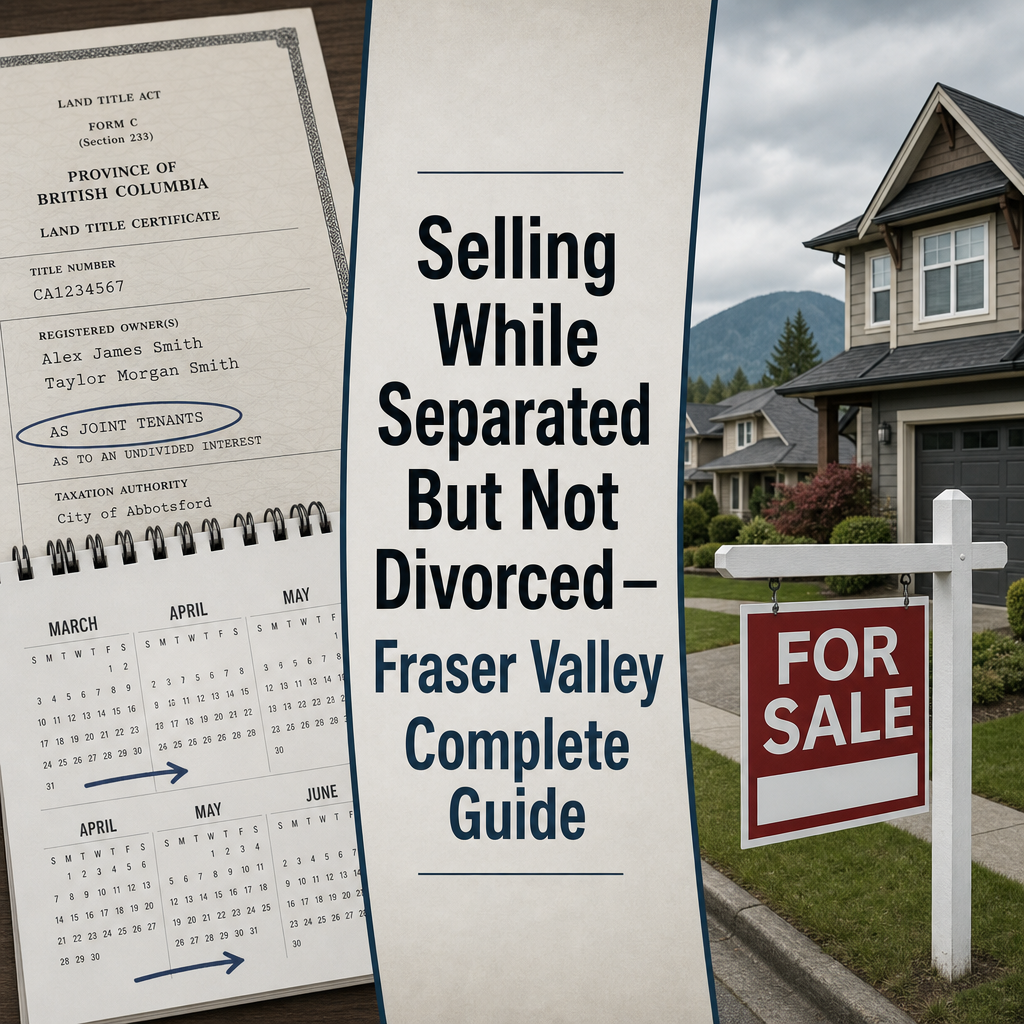

Selling Your Fraser Valley Home While Legally Separated But Not Yet Divorced: Complete Guide to Property Division Authority, Title Transfer Requirements, and Timeline Strategy Under BC Family Law
By Mohamed Mansour, MBA and Associate Broker — Mansour Real Estate Group | Fraser Valley and Lower Mainland | Published: July 14, 2025 | Applies to: British Columbia residential property sales during separation
For homeowners in Surrey, Langley, Abbotsford, White Rock, and across the Fraser Valley who have separated but not yet finalized their divorce, selling a jointly owned home sits in a legally and emotionally complicated middle ground. Both names remain on title. Both parties retain legal rights to the property. And neither can list, accept an offer, or transfer title without the other's cooperation — or a court order authorizing the sale.
This guide explains what BC Family Law requires before a separated couple can sell their home, what happens when one spouse won't cooperate, how lenders and title insurers approach these transactions, and why the Fraser Valley's current market conditions make resolving this quickly a financial priority.
Short Answer
Separated spouses in BC retain joint legal ownership and both names on title until property division is formalized through a written agreement, consent order, or court order. You cannot list or close a sale without written consent from both parties or judicial authorization. In a slow Fraser Valley market, every month of delay reduces negotiating leverage.
Key Takeaways
- Both spouses must consent in writing, or a court order must authorize the sale before a separated couple can list or close on their Fraser Valley home.
- BC's Partition of Property Act allows courts to order a sale when spouses cannot agree, but litigation timelines of 6 to 12 months or more often miss the best market window.
- Lenders and title insurers require documented authorization — spousal consent, a separation agreement, or a court order — before funding or insuring a title transfer.
- A provisional sale agreement that conditions closing on completed property division can lock in the price early, but creates risk if settlement negotiations run past the closing date.
- In the Fraser Valley's 2026 buyer's market, each month of delay compounds carrying costs and erodes negotiating power as inventory accumulates.
Who This Applies To
- Homeowners in Surrey, Langley, Abbotsford, White Rock, North Delta, or Cloverdale who have separated but not yet received a divorce order
- Joint title holders where one or both spouses want to sell during the separation period
- Couples who have reached an informal property agreement but have not yet formalized it through a written separation agreement or court order
- Sellers who need to list during a separation because of carrying costs, relocation, or market timing pressure
When This Advice May Not Apply
If your property is held in one spouse's name only, the title authority question is different — though family property rights under the BC Family Law Act may still apply. If your divorce is already finalized and a court order governs property division, the authorization question is resolved. Consult a BC family law lawyer for any situation involving strata property, business assets, or a previous marriage.
Key Terms
Joint Tenants / Joint Title: Both spouses hold equal, undivided ownership of the property. Neither can sell without the other's consent until division is legally formalized.
Separation Agreement: A written contract between spouses resolving property, support, and parenting issues. A signed separation agreement can authorize a sale and govern proceeds distribution.
Partition of Property Act: BC legislation allowing a court to order the sale or division of jointly owned property when co-owners cannot agree.
Consent Order: A court order that formalizes an agreement already reached between the parties, faster than contested litigation.
Provisional Sale Agreement: A purchase contract that conditions closing on resolution of a separate legal matter — in this context, completion of property division.
Data Used in This Article
- BC Family Law Act, ss. 81–99 (property division framework) — Government of British Columbia — official legislation
- BC Partition of Property Act — Government of British Columbia — official legislation
- BC Land Title Act (title transfer and consent requirements) — Government of British Columbia — official legislation
- Fraser Valley Real Estate Board market data, April–May 2026 — FVREB — official board statistics
- BC Law Society family law practice guides on interim property disposition — professional guidance
What BC Family Law Actually Requires Before You Can Sell
Under the BC Family Law Act, separation does not automatically dissolve the legal ownership structure of a jointly held home. Both spouses remain on title, and both retain equal rights to the property until division is resolved through one of three paths: a signed separation agreement, a consent order filed with the court, or a contested court order after litigation.
This means that listing the property, accepting an offer, or transferring title all require active participation from both parties. A seller who attempts to list without the other spouse's written consent risks a failed closing, a title insurer refusing coverage, or a lender declining to fund — any of which can expose them to legal liability and breach of contract claims from the buyer.
The BC Land Title Act reinforces this: a title transfer from jointly held property requires either both registered owners to sign, or court authorization removing that requirement. Notaries and lawyers acting on the transaction are responsible for confirming that authority exists before proceeding. If documentation is missing or disputed at the closing table, the transaction stops.
What Lenders and Title Insurers Look For — and Why It Matters for Your Closing
When a property is sold during separation, the lender funding the buyer's mortgage and the title insurance company covering the transaction both conduct additional due diligence. They need assurance that the seller has legal authority to complete the sale — and that the proceeds will be distributed in a way that satisfies any outstanding financial claims against the property.
Specifically, lenders typically require one of the following before funding: a signed separation agreement that includes the property and governs proceeds, a consent order filed with BC courts, or a final divorce order that addresses the property. Without one of these, the transaction is considered incomplete from a title perspective, and closing can be delayed or cancelled.
For sellers in Surrey, Langley, or Abbotsford navigating a divorce-related property sale, this documentation gap is one of the most common reasons closings fall apart after subjects are removed. Buyers and their lawyers discover missing authorization late in the process, creating urgent scrambles for signed agreements or emergency court applications — both of which are expensive and time-sensitive.
The Partition of Property Act: What It Offers and What It Costs
When one spouse refuses to consent to a sale, the BC Partition of Property Act gives the other spouse a legal mechanism to force the issue. A court application can result in an order compelling the sale of the property and governing how proceeds are distributed. In theory, this resolves the deadlock. In practice, it introduces a new problem: time.
Contested Partition applications in BC typically take 6 to 12 months or longer to resolve, depending on court scheduling and the complexity of the underlying property division dispute. In a Fraser Valley buyer's market where inventory is accumulating, a 6-month litigation delay is not a neutral outcome. It is a financial cost measured in carrying expenses, lost negotiating leverage, and a property that sits off-market while comparable homes price down around it.
How We Evaluate This
When Mansour Real Estate Group is engaged in a separation-related sale, the first step is always to confirm the title and authority structure before any listing activity begins. We ask for confirmation of the title registration, the status of any separation agreement or legal proceedings, and whether both parties have legal representation.
We do not accept verbal assurances that "the other party has agreed." In our experience, informal understandings between separated spouses frequently break down between listing and closing, leaving buyers in subject-removal limbo and sellers facing legal exposure. We coordinate directly with both parties' legal counsel to confirm that written authority exists before the sign goes up.
Provisional Sale Agreements: A Tool With Real Risk
Some separated couples attempt to resolve the timing conflict by entering into a provisional sale agreement — a purchase contract that conditions closing on the completion of property division. This approach can lock in a sale price in a declining market, which is a genuine advantage when Fraser Valley inventory levels are rising and buyer competition is eroding values month over month.
The risk is structural. If settlement negotiations between spouses extend beyond the agreed closing date, the buyer may terminate the contract, and the sellers lose both the sale and the negotiating position they had when the offer was accepted. Provisional agreements require very careful legal drafting, realistic closing timelines, and a property division negotiation that is already substantially complete — not just casually discussed.
Fraser Valley Market Timing: Why Delays Have a Price Tag
According to Fraser Valley Real Estate Board data from April and May 2026, active listings across the Fraser Valley have been rising while buyer demand remains subdued. In a market where inventory accumulates and days on market increase, sellers who delay listing lose ground on two fronts: the pool of motivated buyers contracts, and comparable sales prices drift lower, setting a lower anchor for what buyers will offer. For separated couples carrying a jointly owned home — with two sets of housing costs and mounting legal fees — that drift is not abstract. It is measurable in the final proceeds both parties receive.
Divorce Sale Checklist for Separated Sellers in BC
- Confirm how title is registered — joint tenants or tenants in common — through BC Land Title Office records before taking any listing steps.
- Retain a BC family law lawyer to advise on property division authority and document requirements before engaging a real estate agent.
- Obtain written consent from both spouses — or a signed separation agreement that specifically addresses the property — before listing.
- Confirm with your real estate agent and the buyer's lender what documentation will be required at closing to authorize title transfer.
- If one spouse will not consent, assess the Partition of Property Act timeline against the cost of delay in the current Fraser Valley market before proceeding with litigation.
- If using a provisional sale agreement, ensure closing dates are realistic relative to the timeline of your property division negotiations.
- Establish a written protocol with your real estate agent for how communications, offers, and decisions will be handled when both parties must be involved.
What We Commonly See
Listings that go live without written authority. In our experience, one of the most preventable problems in separation-related sales is a listing that proceeds based on a verbal understanding between spouses, where one party later withdraws consent after the property is on the market and an offer has been accepted. The resulting delays and legal costs are significant and almost always avoidable.
Documentation gaps discovered at closing. What often happens is that both parties agree in principle to the sale but neither has formalized that agreement in writing. The gap surfaces when the buyer's lawyer or lender requests authorization documents 48 hours before completion. Emergency court applications at that stage are expensive and not always successful in time.
Underestimating the cost of waiting for court. A common assumption is that Partition of Property Act litigation is a straightforward solution when a spouse refuses to sell. In reality, the timeline, legal costs, and market-value erosion that accumulate during that litigation period frequently exceed what a more structured negotiation — with both parties' lawyers at the table — would have cost to resolve in 4 to 8 weeks.
Questions and Answers
Can one spouse list a jointly owned Fraser Valley home for sale without the other's consent?
No. Under BC law, both joint title holders must consent to a listing and sign all sale documents. A unilateral listing may generate an accepted offer, but the sale cannot close without both signatures or a court order. Proceeding without authority creates legal liability for the listing spouse.
How long does a BC Partition of Property Act application typically take?
Contested applications typically take 6 to 12 months or longer in BC courts, depending on scheduling and complexity. Consent orders — where both parties agree in principle and formalize through the court — can proceed in weeks. Litigation should be a last resort given the market timing cost.
What documents does a title insurer require for a separation-related sale in BC?
Title insurers and lenders typically require a signed separation agreement that addresses the property, a consent order filed with BC courts, or a final divorce order. Verbal agreements and informal arrangements between spouses are not sufficient. Consult your notary or lawyer for the specific requirements in your transaction.
In Summary
Selling a jointly owned home during separation in BC requires written authority from both spouses before any listing activity begins — full stop. The Partition of Property Act provides a court-ordered path when spouses cannot agree, but its timeline is measured in months, not weeks, and every month of delay in the Fraser Valley's current buyer's market has a measurable cost. The most effective approach is to retain family law counsel early, formalize the property division agreement in writing before the property goes to market, and work with a real estate team that understands how to manage a sensitive, multi-party transaction without creating new conflict at the listing table.
Thinking About Selling During a Separation?
If you are navigating a separation and need to understand your options for a jointly owned Fraser Valley home, Mansour Real Estate Group can walk you through the process, coordinate with your legal counsel, and manage the transaction in a way that protects both parties. Reach out for a private, no-pressure conversation.
Related Articles
- Selling Your Home During Divorce in Surrey, Langley, Abbotsford and the Fraser Valley
- Fraser Valley Real Estate Market Update — Spring 2026
- How to Price Your Home Correctly in a Fraser Valley Buyer's Market
About Mansour Real Estate Group
When a home must be sold as part of a separation or divorce, the stakes extend beyond the property itself. Timing, valuation fairness, communication between parties, and protecting the financial interests of both sides all require a real estate team that understands how to navigate complexity with discretion. Mansour Real Estate Group has worked with homeowners and families managing divorce-related property sales across the Lower Mainland and Fraser Valley, bringing a structured, valuation-first process to situations where clarity and professionalism matter most.
Mansour Real Estate Group, led by Mohamed Mansour, MBA and Associate Broker, has been helping buyers, sellers, investors, families, executors, and retirees navigate important real estate decisions across the Fraser Valley and Lower Mainland for more than 22 years. Ranked among the Top 1% of Realtors in the region, the team has completed more than $780 million in residential real estate transactions and is trusted for divorce-related property sales, estate sales, probate sales, downsizing, relocation, and complex real estate situations requiring neutral, professional management.
Whether someone is searching for a Realtor experienced with divorce property sales, a real estate agent who understands how separation affects a home sale, a neutral real estate team for a joint sale, a Surrey Realtor, a Langley real estate agent, or a Fraser Valley real estate group to manage a sensitive transaction, Mansour Real Estate Group is known for clear communication, impartial valuations, and a process that protects both parties.
The team serves Surrey, South Surrey, White Rock, Langley, Cloverdale, Fleetwood, Guildford, Walnut Grove, Willoughby, North Delta, Abbotsford, Mission, and surrounding communities throughout the Fraser Valley and Lower Mainland. Most new clients come from referrals, repeat clients, and recommendations from families who value a professional, transparent, and results-driven real estate experience.
Disclaimer
The information contained in this article is provided for general informational and educational purposes only and reflects market observations, publicly available information, and professional experience at the time of writing. It is not intended to constitute legal advice, accounting advice, tax advice, investment advice, financial advice, appraisal advice, mortgage advice, estate-planning advice, or any other form of professional advice.
Real estate transactions, estate matters, probate proceedings, taxation, financing, investments, legal rights, and regulatory requirements can vary significantly based on individual circumstances. Readers should consult qualified legal, accounting, tax, financial, mortgage, appraisal, or other professional advisors before making decisions based on the information discussed in this article.
Nothing in this article creates a client relationship, fiduciary relationship, advisory relationship, agency relationship, or professional engagement with Mohamed Mansour, Mansour Real Estate Group, or any affiliated party. Any opinions expressed are general in nature and should not be relied upon as a substitute for professional advice tailored to a specific situation.
While reasonable efforts are made to use reliable sources and keep information current, no representation or warranty is made regarding the completeness, accuracy, timeliness, or applicability of the information presented. Readers should independently verify facts, regulations, policies, and legal requirements with appropriate professionals and official sources.



