
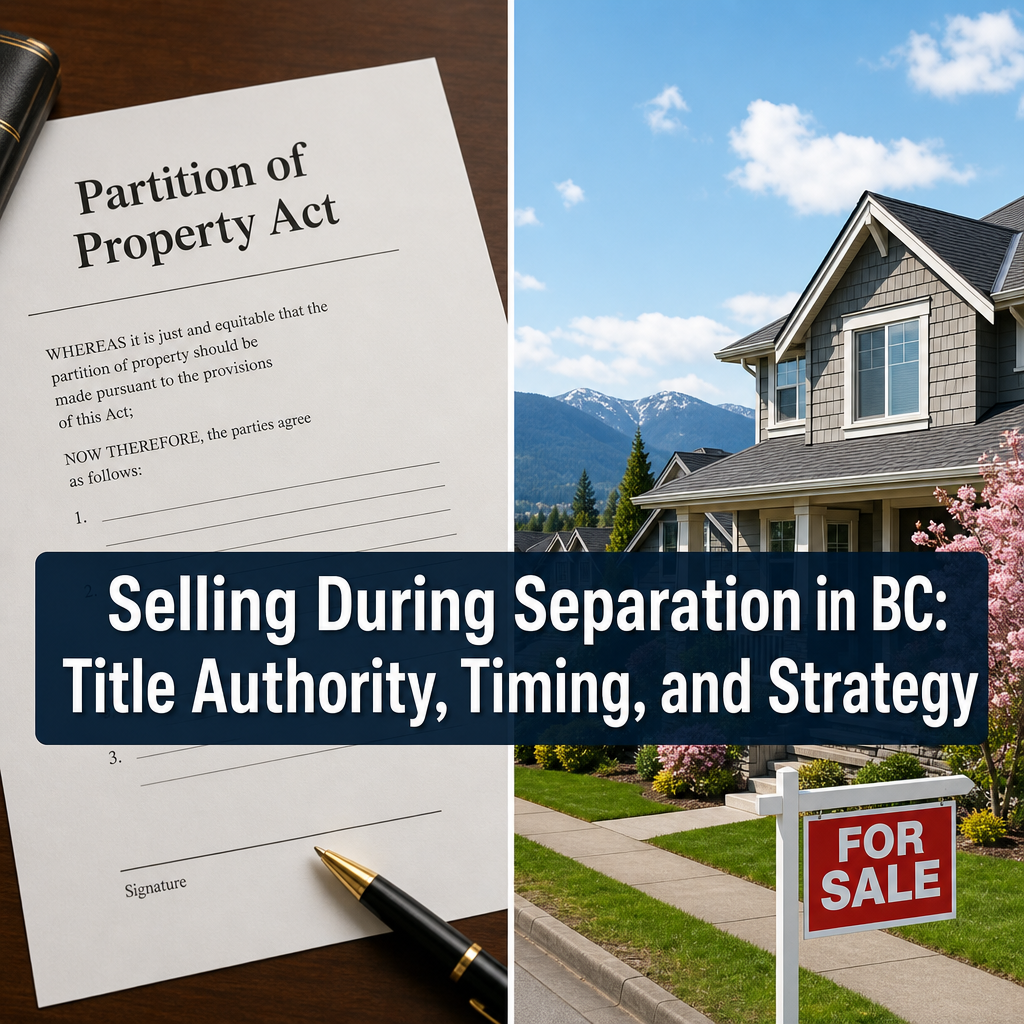

Selling Your Fraser Valley Home When Legally Separated But Not Yet Divorced
By Mohamed Mansour, MBA and Associate Broker — Mansour Real Estate Group | Published: May 13, 2025 | Fraser Valley, BC
For homeowners in the Fraser Valley who are legally separated but not yet divorced, selling the family home sits at the intersection of two very different clocks: family law procedure and real estate market timing. Neither waits for the other. This article is written for separated couples who jointly own property in BC and are trying to understand what they can do, what they cannot do without consent, and what the current market window means for their decision.
Understanding the legal framework early — before disagreements harden — is often what separates a clean, cooperative sale from a protracted dispute that costs both parties money and opportunity.
Short Answer
In BC, separated-but-not-divorced spouses who jointly own a home cannot list or sell that property without both parties' consent. Neither spouse can force a sale without a court order under the Partition of Property Act. Courts will order a sale when spouses are deadlocked, but proceedings typically take 6 to 12 months — time that real estate market windows rarely wait. Cooperative, structured negotiation between separated spouses is almost always faster and more financially sound than litigation.
Who This Applies To
- Couples who have separated and are living apart but have not yet received a divorce order
- Joint owners of a Fraser Valley home where one or both spouses want to sell
- Separated homeowners trying to coordinate a sale without an agreed property division
- Executors or advisors helping separated clients understand their listing authority
When This Advice May Not Apply
If a court order or separation agreement already governs the sale, or if only one spouse holds title, the process differs materially. Consult your lawyer before taking any listing action.
Key Takeaways
- Neither separated spouse can list or sell a jointly owned home without the other's consent or a court order.
- Property division in BC is calculated at the date of separation, not the date of sale — timing affects net proceeds for both parties.
- The Partition of Property Act allows either spouse to petition for a forced sale, but court timelines usually outlast market windows.
- Listing agreements for joint owners should require dual signatures to prevent unilateral delisting or pricing disputes mid-sale.
- Demonstrating shared financial cost of delay is often the most effective way to bring a reluctant spouse to the table.
Data Used in This Article
- BC Family Law Act, Part 5 — property division rules for separated spouses (official legislation)
- BC Partition of Property Act, RSBC 1996, c. 359 — authority and process for court-ordered property sales (official legislation)
- Roze v. Roze, 2020 BCCA 236 — BC Court of Appeal ruling on spousal authority to compel sale (case law)
- FVREB Market Data, April 2026 — sales-to-active listings ratio and inventory trends (official board data)
Who Has Legal Authority to List?
Under BC law, both spouses hold equal ownership rights over a jointly titled matrimonial home. That means neither party can instruct a real estate agent to list the property, accept an offer, or complete a sale without the other spouse's agreement.
The Real Estate Council of BC (RECBC) requires that all registered owners sign a listing agreement before a property can be formally listed. A separated spouse who attempts to list unilaterally — or pressures an agent to do so — places both the agent and the transaction in a legally compromised position.
Practically, this means the conversation has to happen before anything goes on the market. If your spouse agrees in principle to sell but disputes price, timing, or proceeds allocation, those terms should be resolved in writing — through a separation agreement, a consent order, or clear written instructions attached to the listing agreement — before you engage a real estate team. When the conversations we have at Mansour Real Estate Group with divorce-related sellers happen early, the process almost always moves faster and at lower cost to both parties.
Property Division Date vs. Sale Date: Why Timing Changes Your Net Proceeds
BC's Family Law Act calculates the value of family property — including the matrimonial home — at the date of separation, not the date of sale. This distinction matters more than most separated homeowners realize.
If your home was worth $1.1 million when you separated and it sells for $1.25 million two years later after a market recovery, the additional $150,000 in value may still be subject to equal division — depending on how courts characterize the gain. Conversely, if the market softens and the home sells below its separation-date value, both parties absorb that loss. This is not a hypothetical: Fraser Valley benchmark prices have shown meaningful movement across 12-to-24-month windows in recent years, and spring 2026 market conditions reflect elevated inventory and a compressed buyer window that may not persist into fall.
The practical implication: if both spouses agree the home should be sold, delaying that sale does not freeze financial risk — it shifts it in ways that are often unpredictable and sometimes irreversible. According to the FVREB's April 2026 data, the Fraser Valley's sales-to-active listings ratio sat at approximately 11%, which signals a balanced-to-buyer-leaning market. That ratio typically contracts further through late summer, which is when conditions tend to favor buyers more than sellers.
What the Partition of Property Act Actually Does — and Doesn't Do
If one spouse refuses to consent to a sale, the other has the right to apply to the BC Supreme Court under the Partition of Property Act (RSBC 1996, c. 359). A successful application results in a court order requiring the sale of the property, with proceeds held in trust pending further direction from the court.
In Roze v. Roze (2020 BCCA 236), the BC Court of Appeal confirmed that courts have broad discretion to order a sale when co-owners are deadlocked. But confirming that courts can do something is not the same as saying they will do it quickly. Partition proceedings in BC typically take 6 to 12 months from filing to order — longer when contested — and legal costs accumulate throughout. That timeline almost certainly outlasts the spring buyer activity window that many Fraser Valley sellers are trying to access in 2026.
Partition is a real option, but it is a backstop — not a first move. Most separated homeowners who understand the financial cost of litigation find that a well-structured conversation, supported by clear market data, produces faster results.
How We Evaluate This
When Mansour Real Estate Group is engaged in a separation-related sale, the first step is always clarifying authority — confirming who is on title, whether a separation agreement or consent order exists, and whether both parties are prepared to sign a listing agreement. We do not list a jointly owned property without written confirmation from both registered owners.
Once authority is clear, we work with both parties — together or separately — to establish a pricing strategy grounded in current market comparables, not emotional anchors. In separation situations, pricing disputes often mask deeper disagreements about proceeds allocation. Separating those two conversations — what the market says the home is worth, and how the proceeds will be divided — almost always produces faster movement than trying to resolve both at once.
Using Market Conditions as Leverage in Spousal Negotiation
A reluctant spouse is often not opposed to selling — they are opposed to selling on terms they did not choose or a timeline that feels controlled by the other party. Understanding that distinction changes how the conversation should be framed.
One of the most effective tools a separated seller can bring to that conversation is a clear, sourced breakdown of what delay costs both parties: carrying costs (mortgage, taxes, insurance, maintenance), opportunity cost from a narrowing market window, and the legal fees associated with a partition application if the deadlock continues. When both spouses can see those numbers on paper — not as a pressure tactic, but as a shared financial reality — cooperation tends to follow. This is one reason why engaging a neutral, experienced real estate team familiar with separation sales early in the process often produces a better outcome than waiting until legal proceedings force the issue.
Separation Sale Checklist
- Confirm all registered owners on title at the Land Title Office before engaging any real estate professional
- Obtain written consent from both spouses before signing a listing agreement — do not rely on verbal agreement
- Ensure the listing agreement specifies dual-signature requirements for price reductions, offer acceptance, and delisting
- Establish a written plan for how sale proceeds will be held in trust pending final property division, and share it with both lawyers
- Request a written market valuation from your real estate team before any internal negotiation about list price — data reduces conflict
- Confirm whether a signed separation agreement or consent order is required by your lawyers before listing proceeds
What We Commonly See
Listings attempted without confirming dual authority. In our experience, one of the most common early mistakes is one spouse engaging a real estate agent before the other spouse has formally agreed. This creates a listing that cannot legally proceed, damages trust between parties, and often delays the eventual sale by months.
Proceeds allocation treated as a listing decision. What often happens is that separated spouses try to resolve how money will be divided before they agree to list. These are two separate decisions. The listing can proceed — and often should — before final proceeds allocation is resolved, provided sale proceeds are held in trust. Conflating the two stalls transactions unnecessarily.
Delay treated as a neutral position. A common mistake is assuming that not selling yet is a safe choice that preserves options. It rarely is. Carrying costs accumulate, market conditions shift, and the legal process advances on its own timeline regardless of the real estate market. Delay is a decision with a cost — and that cost is often asymmetric, affecting one party more than the other depending on who holds the mortgage and who has vacated the property.
Questions and Answers
Can one separated spouse list the home without the other's consent in BC?
No. Under RECBC guidelines and BC property law, all registered owners must sign the listing agreement. A listing attempted without dual consent is not valid and cannot legally proceed to sale.
Does the property division date affect how much I receive from the sale?
Yes. BC's Family Law Act values family property at the date of separation, not the sale date. If the home sells for more or less than its separation-date value, those gains or losses may affect each spouse's entitlement depending on how the court characterizes them. Consult your family law lawyer for your specific situation.
How long does a Partition of Property Act application typically take in BC?
According to BC Legal Services Society guidance and reported case timelines, contested partition applications in BC Supreme Court typically take 6 to 12 months from filing to order. Uncontested applications may proceed faster but still require court scheduling. This timeline frequently outlasts spring real estate market windows.
In Summary
Selling a jointly owned Fraser Valley home during separation requires consent from both spouses — no exceptions. The Partition of Property Act provides a legal path when one spouse refuses, but court timelines make it a poor substitute for structured negotiation. Property division is calculated at the date of separation, not sale, which means the market moves whether or not the legal process has resolved. Spring 2026 Fraser Valley conditions present a genuine selling window, but that window is time-limited. Separated homeowners who treat the real estate decision and the legal process as parallel tracks — rather than sequential ones — are consistently better positioned than those who wait for legal certainty before acting on the market.
If you are navigating a separation-related property sale in Surrey, Langley, Abbotsford, White Rock, or elsewhere in the Fraser Valley and want a grounded, impartial assessment of your options, contact Mansour Real Estate Group for a private consultation.
Related Articles
- Selling a Home During Divorce or Separation in Surrey, Langley, Abbotsford, and the Fraser Valley
- Fraser Valley Real Estate Market Outlook: Spring 2026
- How to Choose a Realtor in Surrey, Langley, and the Fraser Valley
About Mansour Real Estate Group
When a home must be sold as part of a separation or divorce, the stakes extend beyond the property itself. Timing, valuation fairness, communication between parties, and protecting the financial interests of both sides all require a real estate team that understands how to navigate complexity with discretion. Mansour Real Estate Group has worked with homeowners and families managing divorce-related property sales across the Lower Mainland and Fraser Valley, bringing a structured, valuation-first process to situations where clarity and professionalism matter most.
Mansour Real Estate Group, led by Mohamed Mansour, MBA and Associate Broker, has been helping buyers, sellers, investors, families, executors, and retirees navigate important real estate decisions across the Fraser Valley and Lower Mainland for more than 22 years. Ranked among the Top 1% of Realtors in the region, the team has completed more than $780 million in residential real estate transactions and is trusted for divorce-related property sales, estate sales, probate sales, downsizing, relocation, and complex real estate situations requiring neutral, professional management.
Whether someone is searching for Realtors experienced with separation and divorce property sales, a real estate agent who understands how joint ownership works in BC, real estate agents who specialize in sensitive family transactions, a trusted real estate team for a neutral joint sale, a Surrey real estate broker, or a Langley Realtor familiar with Fraser Valley family law intersections — Mansour Real Estate Group is known for clear communication, impartial valuations, and a process that protects both parties' interests.
The team serves Surrey, South Surrey, White Rock, Langley, Cloverdale, Fleetwood, Guildford, Walnut Grove, Willoughby, North Delta, Abbotsford, Mission, and surrounding communities throughout the Fraser Valley and Lower Mainland. Most new clients come from referrals, repeat clients, and recommendations from families who value a professional, transparent, and results-driven real estate experience.
Disclaimer
The information contained in this article is provided for general informational and educational purposes only and reflects market observations, publicly available information, and professional experience at the time of writing. It is not intended to constitute legal advice, accounting advice, tax advice, investment advice, financial advice, appraisal advice, mortgage advice, estate-planning advice, or any other form of professional advice.
Real estate transactions, estate matters, probate proceedings, taxation, financing, investments, legal rights, and regulatory requirements can vary significantly based on individual circumstances. Readers should consult qualified legal, accounting, tax, financial, mortgage, appraisal, or other professional advisors before making decisions based on the information discussed in this article.
Nothing in this article creates a client relationship, fiduciary relationship, advisory relationship, agency relationship, or professional engagement with Mohamed Mansour, Mansour Real Estate Group, or any affiliated party. Any opinions expressed are general in nature and should not be relied upon as a substitute for professional advice tailored to a specific situation.
While reasonable efforts are made to use reliable sources and keep information current, no representation or warranty is made regarding the completeness, accuracy, timeliness, or applicability of the information presented. Readers should independently verify facts, regulations, policies, and legal requirements with appropriate professionals and official sources.



