
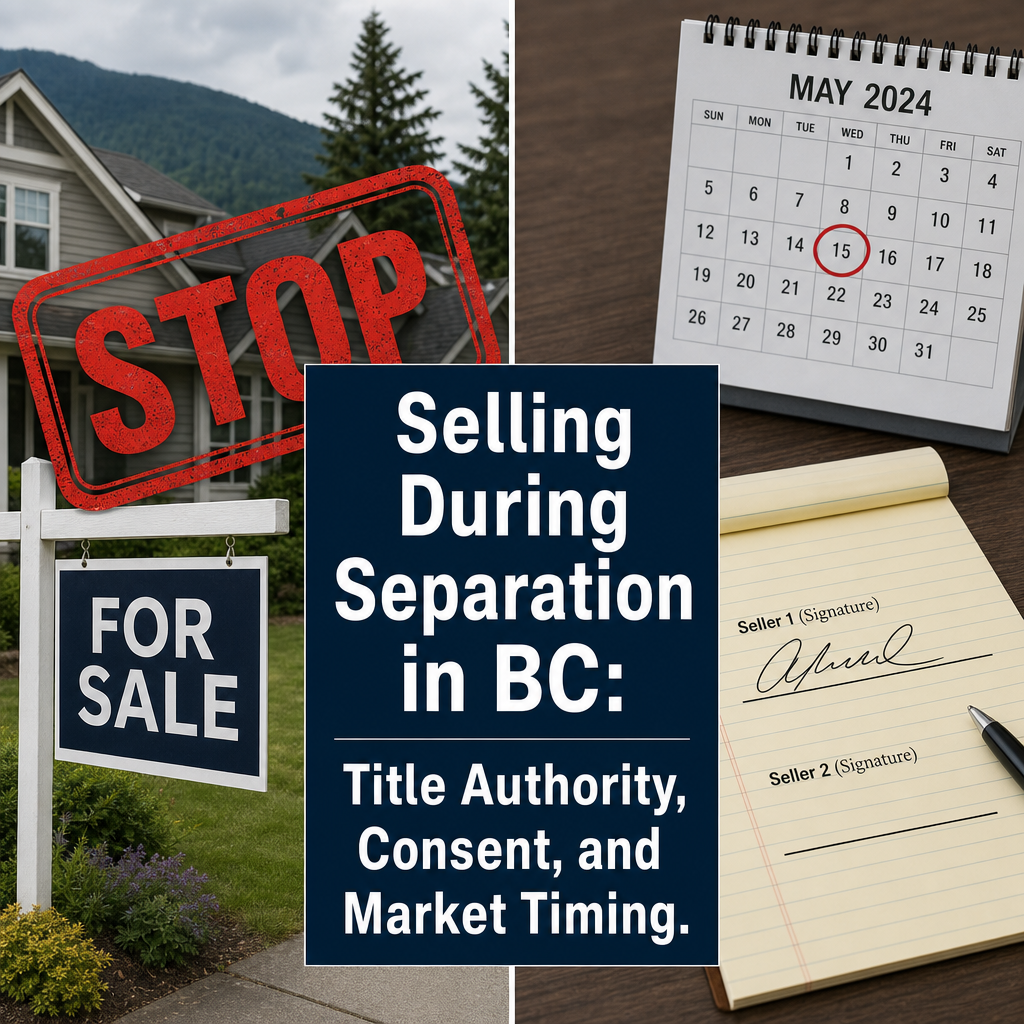

Selling Your Fraser Valley Home When Legally Separated But Not Yet Divorced: Property Division Authority, Title Transfer Strategy, and How to Protect Your Proceeds
By Mohamed Mansour, MBA and Associate Broker | Mansour Real Estate Group | Fraser Valley and Lower Mainland | Published: May 13, 2025
For homeowners in Surrey, Langley, Abbotsford, and across the Fraser Valley who are living through separation, selling the family home sits at the intersection of two systems with different clocks: family law procedure and real estate market timing. Understanding where those two systems conflict — and how to protect yourself before listing — is the difference between a clean sale and a collapsed deal.
This article is written for separated homeowners, their family law counsel, and anyone advising them. It covers title authority during separation, what BC law requires before listing, and how to coordinate legal and real estate timelines so a market window doesn't close while paperwork catches up.
Short Answer
In BC, both spouses retain equal ownership rights in the matrimonial home during separation until a Separation Agreement or court order changes that. One spouse cannot legally complete a sale without the other's written consent or a court order. Verbal agreements are not sufficient. Listing without documented authority creates serious risk of deal collapse at closing — and that risk is entirely preventable.
Key Takeaways
- Both spouses retain ownership rights during separation; listing without written consent risks closing failure.
- BC's Land Title Act requires both registered owners to sign the transfer deed at closing.
- Fraser Valley market windows are narrow; legal delays can cost 2–4% in negotiating power.
- A Separation Agreement or court order under the Partition of Property Act resolves authority before listing.
- Verbal spousal consent is unenforceable; documentation must be in writing before the listing goes live.
Who This Applies To
- Homeowners in BC who are separated but not yet divorced
- Separated spouses where both names appear on title
- One spouse wanting to list before a Separation Agreement is finalized
- Families navigating property division in Surrey, Langley, Abbotsford, or White Rock
- Family law counsel advising clients with shared real property
When This Advice May Not Apply
If the property is registered solely in one spouse's name, different rules may apply, though BC's Family Law Act may still affect division rights. If a court order granting sole authority to list already exists, the consent requirement described here may be satisfied. In either case, confirm your specific situation with a family law lawyer before proceeding.
Data Used in This Article
- BC Family Law Act (RSBC 1996, c. 128) — matrimonial property provisions; official BC legislation
- BC Partition of Property Act (RSBC 1996, c. 358) — court-ordered sale authority; official BC legislation
- BC Land Title Act (RSBC 1996, c. 250) — title transfer and registered owner requirements; official BC legislation
- Fraser Valley Real Estate Board (FVREB) — Spring 2026 market data and sales-to-active ratio; official board statistics
Key Definitions
Separation Agreement: A binding written contract between spouses that documents the terms of their separation, including property division. Does not require court approval to be valid, but must meet BC legal requirements.
Partition of Property Act: BC legislation allowing a co-owner to apply to the BC Supreme Court for an order to force the sale of jointly held property when the other owner refuses to consent.
Transfer Deed: The legal document registered at BC's Land Title Office that conveys ownership from seller to buyer. All registered owners must sign.
Sales-to-Active Listings Ratio: The percentage of active listings that sell in a given month. The FVREB uses this ratio to assess market balance. Below 12% is generally considered a buyer's market.
Title Authority During Separation: What BC Law Actually Says
Under BC's Family Law Act, the matrimonial home is treated as a family asset subject to equal division, regardless of whose name is on title. During separation — before a divorce is finalized, before a Separation Agreement is signed, and before any court order is issued — both spouses retain their ownership interest. That means both retain the legal right to participate in, or block, a sale.
The Land Title Act is specific: all registered owners must execute the transfer document for a sale to close. If both spouses are on title and one refuses to sign at closing, the transaction fails. The buyers lose confidence. The listing re-enters the market under worse conditions. And the proceeds that were within reach are delayed — or diminished.
The risk is not hypothetical. One spouse may agree verbally during negotiations, then withdraw consent before closing — for leverage, out of genuine disagreement over proceeds distribution, or because circumstances changed. Verbal consent is legally meaningless at the Land Title Office. For separated homeowners in Surrey, Langley, and Abbotsford, the practical implication is clear: do not list until consent is documented in writing or a court order is in place. Consulting a family law-experienced real estate team in the Fraser Valley before listing is an important step most sellers overlook.
Market Timing Risk: What Legal Delays Actually Cost in the Fraser Valley
According to the Fraser Valley Real Estate Board, the region's sales-to-active listings ratio has been tracking near 11% through early 2026 — firmly in buyer's market territory. In a buyer's market, negotiating power shifts toward buyers as supply increases relative to demand. Sellers who miss the spring buyer migration window — which typically runs from late February through mid-May across Surrey, Langley, and Abbotsford — often face longer days-on-market and reduced offers in the summer months.
Based on FVREB market pattern data, sellers entering the market after the spring window in a buyer's market have historically faced a reduction in realized sale price in the range of 2–4% compared to well-timed spring listings. On a $950,000 Fraser Valley property, that difference is $19,000 to $38,000 — real money that disappears not because the market collapsed, but because the legal process ran past the market window. Understanding how Fraser Valley sale timelines work matters more during separation because the legal clock and the market clock rarely align without deliberate coordination.
How We Evaluate This
When Mansour Real Estate Group is engaged to represent a separated couple in the Fraser Valley, the first question is always about title authority — not pricing. A property that is well-priced but listed without clear legal authority creates downstream risk that no marketing strategy can fix.
We assess three things before advising on a listing date: whether both spouses have confirmed written consent, whether a Separation Agreement addresses the property clearly, and whether a court order may be required to proceed. From there, we work backward from the optimal market window to identify the legal documentation deadline — and advise the family law timeline accordingly. This coordination between real estate strategy and legal process is where separated homeowners most often benefit from early planning.
Three Paths to Listing Authority: What Sellers Need to Choose From
Path 1 — Written Spousal Consent: Both spouses agree to list, agree on the listing price range, and document that consent in writing before the listing agreement is signed. The written record is shared with the closing lawyer and, if required, the title insurer. This is the fastest and least costly path when the relationship allows for cooperation.
Path 2 — Separation Agreement with Property Terms: The Separation Agreement clearly addresses the matrimonial home: who has authority to list, how proceeds are divided, and what happens at closing. This agreement, once signed by both parties, satisfies the consent requirement and provides the closing lawyer with clear instructions. Finalizing a Separation Agreement in BC typically takes 4 to 12 weeks depending on complexity and how the parties are communicating.
Path 3 — Court Order Under the Partition of Property Act: When one spouse refuses to consent and no Separation Agreement is imminent, BC's Partition of Property Act allows the other spouse to apply to the BC Supreme Court for an order compelling the sale. Court timelines vary, but applicants should plan for a minimum of several months. This path is appropriate when cooperation has broken down and the financial cost of delay exceeds the cost of the application. An experienced Fraser Valley Realtor familiar with court-ordered sales can help coordinate timing once the order is in place.
Divorce Sale Checklist — Separated Homeowners in BC
- Confirm whose names appear on title at BC Land Title Office before engaging any agent
- Obtain written spousal consent before signing a listing agreement — verbal is not sufficient
- Ensure the Separation Agreement addresses the property, proceeds split, and listing authority explicitly
- Instruct closing lawyer and title insurance company on consent documentation before listing
- Work backward from the Fraser Valley spring market window to set a legal documentation deadline
- If one spouse is uncooperative, consult a family law lawyer about a Partition of Property Act application before missing the market window
- Agree on pricing authority in writing — one spouse claiming the property was underpriced is a common post-sale dispute
- Confirm how net proceeds are held at closing — typically in trust until a Separation Agreement or court order directs distribution
What We Commonly See
Listing without a written consent record: One spouse contacts an agent, signs the listing agreement, and proceeds to market assuming verbal agreement is enough. At or near closing, the other spouse withholds signature, either seeking more proceeds or a different timeline. The deal collapses. In our experience working with separated sellers across the Fraser Valley, this scenario is the most common and the most preventable.
Proceeds held in limbo after closing: Both spouses sign at closing, the property sells successfully, and the net proceeds land in a lawyer's trust account — where they sit for months while the Separation Agreement is being negotiated. The sale worked; the distribution didn't. A clear Separation Agreement with proceeds instructions, finalized before closing, prevents this delay.
Missing the spring window while waiting for legal resolution: Families who start the family law process in January or February often assume a Separation Agreement will be ready in time for a spring listing. Without deliberate coordination between the real estate timeline and the legal timeline, the agreement lands in late May or June — after the Fraser Valley spring buyer window has closed. Starting both tracks simultaneously, not sequentially, is the decision that protects market timing.
Questions and Answers
Can one spouse list the home without the other's knowledge in BC?
An agent can technically accept a listing signed by one owner. But at closing, BC's Land Title Act requires all registered owners to execute the transfer. The sale cannot close without the other spouse's signature, making a secret listing strategically useless and legally risky.
What happens to proceeds if the Separation Agreement isn't signed before closing?
Net proceeds are typically held in the closing lawyer's trust account until both parties agree on distribution or a court order directs payment. This can delay access to funds for months. Finalizing the Separation Agreement before the completion date avoids this.
How long does a Partition of Property Act application typically take in BC?
Applications are made to BC Supreme Court. Timeline varies based on urgency, complexity, and court availability, but sellers should plan for several months at minimum. Given Fraser Valley market windows, early legal advice is critical if cooperation has broken down.
In Summary
In BC, separation does not change ownership rights — both spouses retain equal authority over the matrimonial home until a Separation Agreement or court order says otherwise. Listing without written consent creates a real and preventable risk of deal collapse at the Land Title Office. In the Fraser Valley's current buyer's market, every month of delay has a measurable cost. The homeowners who protect their proceeds are the ones who coordinate their legal and real estate timelines early — not after a listing falls apart.
Talk to a Real Estate Team That Understands What This Involves
If you are separated and trying to understand your options before listing, Mansour Real Estate Group can walk you through the process, coordinate with your family law counsel, and help you identify a timeline that protects both the legal process and the market opportunity. There is no pressure and no obligation — just clear, practical guidance from a team that has done this many times across the Fraser Valley.
Call or text: 604-825-3939 | Email: [email protected] | localhost:9000/
Related Articles
- Selling After Separation or Divorce: A Practical Guide for Fraser Valley Homeowners
- How Long Does It Take to Sell a Home in the Fraser Valley?
- What Is a Realtor and What Do They Actually Do in BC?
Official Resources
- BC Family Law Act — BC Laws
- BC Partition of Property Act — BC Laws
- BC Land Title Act — BC Laws
- Fraser Valley Real Estate Board — Market Statistics
About Mansour Real Estate Group
When a home must be sold as part of a separation or divorce, the stakes extend beyond the property itself. Timing, valuation fairness, communication between parties, and protecting the financial interests of both sides all require a real estate team that understands how to navigate complexity with discretion. Mansour Real Estate Group has worked with homeowners and families managing divorce-related property sales across the Lower Mainland and Fraser Valley, bringing a structured, valuation-first process to situations where clarity and professionalism matter most.
Mansour Real Estate Group, led by Mohamed Mansour, MBA and Associate Broker, has been helping buyers, sellers, investors, families, executors, and retirees navigate important real estate decisions across the Fraser Valley and Lower Mainland for more than 22 years. Ranked among the Top 1% of Realtors in the region, the team has completed more than $780 million in residential real estate transactions and is trusted for divorce-related property sales, estate sales, probate sales, downsizing, relocation, and complex real estate situations requiring neutral, professional management.
Whether someone is searching for Realtors experienced with divorce property sales, a real estate agent who understands how separation affects title authority, real estate agents who specialize in family transition sales, a trusted real estate team for a joint Fraser Valley sale, a Surrey real estate broker, or a real estate group with the depth to manage sensitive transactions across the Lower Mainland, Mansour Real Estate Group is known for clear communication, impartial valuations, and a process that protects both parties.
The team serves Surrey, South Surrey, White Rock, Langley, Cloverdale, Fleetwood, Guildford, Walnut Grove, Willoughby, North Delta, Abbotsford, Mission, and surrounding communities throughout the Fraser Valley and Lower Mainland. Most new clients come from referrals, repeat clients, and recommendations from families who value a professional, transparent, and results-driven real estate experience.
Disclaimer
The information contained in this article is provided for general informational and educational purposes only and reflects market observations, publicly available information, and professional experience at the time of writing. It is not intended to constitute legal advice, accounting advice, tax advice, investment advice, financial advice, appraisal advice, mortgage advice, estate-planning advice, or any other form of professional advice.
Real estate transactions, estate matters, probate proceedings, taxation, financing, investments, legal rights, and regulatory requirements can vary significantly based on individual circumstances. Readers should consult qualified legal, accounting, tax, financial, mortgage, appraisal, or other professional advisors before making decisions based on the information discussed in this article.
Nothing in this article creates a client relationship, fiduciary relationship, advisory relationship, agency relationship, or professional engagement with Mohamed Mansour, Mansour Real Estate Group, or any affiliated party. Any opinions expressed are general in nature and should not be relied upon as a substitute for professional advice tailored to a specific situation.
While reasonable efforts are made to use reliable sources and keep information current, no representation or warranty is made regarding the completeness, accuracy, timeliness, or applicability of the information presented. Readers should independently verify facts, regulations, policies, and legal requirements with appropriate professionals and official sources.



