
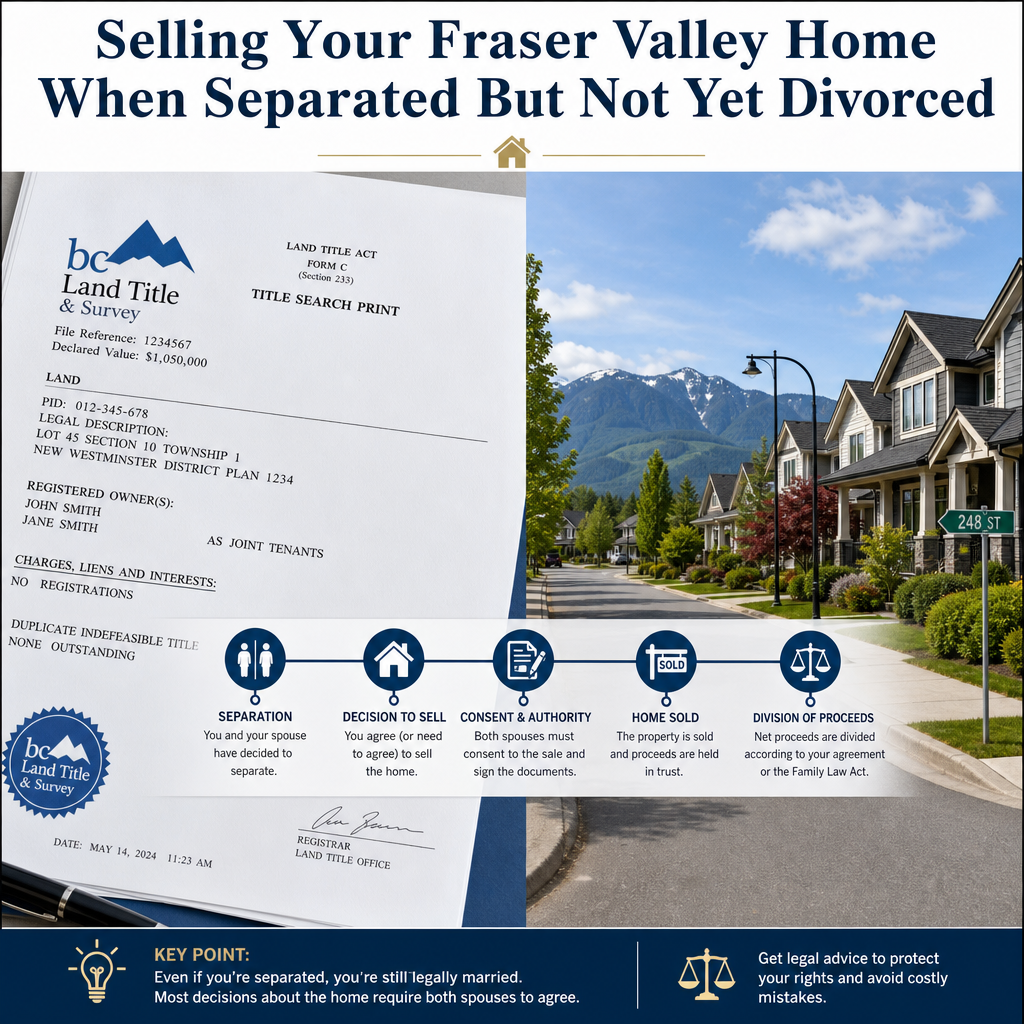

Selling Your Fraser Valley Home When Legally Separated But Not Yet Divorced: Property Division Authority, Title Transfer Mechanics, Timeline Strategy, and How to Protect Your Net Proceeds When Real Estate Market Windows Conflict With Family Law Procedure Delays
By Mohamed Mansour, MBA, Associate Broker — Mansour Real Estate Group — Published June 16, 2025 — Fraser Valley, BC
Selling a home while separated but not yet divorced is one of the most procedurally complicated real estate situations a Fraser Valley homeowner can face. The family law timeline and the real estate market operate on entirely different schedules, and the gap between them can cost both parties tens of thousands of dollars.
This article explains what separated spouses in BC actually need in place before a sale can proceed, what happens when one party refuses to cooperate, and how to protect your financial position when a market window opens before the legal paperwork is ready.
Short Answer
In BC, selling the matrimonial home during separation requires either mutual written consent from both spouses or a court order. Without one of those, the Land Title Office will not complete a transfer. Proceeding without documented authority creates family law liability for both parties. Getting legal advice before listing is not optional in this situation.
Key Takeaways
- The BC Family Law Act presumes equal division of family property, but separated spouses still need a signed agreement or court order to complete a title transfer at closing.
- Listing the matrimonial home without documented authority from both parties can trigger family law liability, even if only one name is on title.
- If one spouse refuses to cooperate, the other must apply for a partition order under the Partition of Property Act, adding $3,000–$8,000 in legal costs and 4–6 months to the timeline.
- Fraser Valley market windows can be short; sellers who wait for divorce finalization before listing risk meaningful price erosion if the market softens during proceedings.
- A signed Separation Agreement that addresses the home specifically is typically the fastest path to a clean, legally secure sale before divorce is finalized.
Who This Applies To
- Spouses who have separated but not yet filed for or finalized divorce
- Homeowners in Surrey, Langley, Abbotsford, South Surrey, White Rock, or North Delta who need to sell the family home before family law proceedings conclude
- One-title-holder spouses who want to list but have not yet obtained written consent from the other party
- Separated spouses who are cooperating but have not yet signed a formal Separation Agreement
- Parties concerned about proceeds disputes or unilateral listing decisions
When This Advice May Not Apply
If divorce has already been finalized and a court order addresses the property, the sale process is more straightforward. If there is no matrimonial home and the property is clearly excluded property under the BC Family Law Act, different rules may apply. This article does not constitute legal advice. Consult a family law lawyer for guidance specific to your situation.
Key Definitions
Family Property (BC Family Law Act): Property acquired by either spouse during the marriage, subject to equal division on separation unless excluded by agreement or the Act.
Matrimonial Home: The property ordinarily occupied as the family residence; carries special division and occupation rights under BC law regardless of who holds title.
Separation Agreement: A written, signed contract between spouses addressing property division, support, and other separation terms. It can authorize the sale of the matrimonial home without a court order.
Partition Order: A court order under the Partition of Property Act compelling the sale or division of property when co-owners cannot agree.
Data Used in This Article
- BC Family Law Act, SBC 2011, c 25 — official legislation — Government of BC
- Partition of Property Act, RSBC 1996, c 347 — official legislation — Government of BC
- Fraser Valley Real Estate Board market reports, 2025–2026 — official board data
- Mansour Real Estate Group internal observations from separation-related sales in Surrey, Langley, and Abbotsford — professional experience
What the BC Family Law Act Actually Requires Before You Can List
Under the BC Family Law Act, the matrimonial home is family property regardless of whose name appears on title. Both spouses have an interest in it from the date of separation. That interest does not disappear simply because one spouse moves out or because both agree verbally to sell.
For a sale to close cleanly at the Land Title Office, the conveyancing lawyer handling the transaction needs documented authority showing both parties have authorized the sale and agreed on how the proceeds will be distributed. Without that documentation, the transfer is at risk of being challenged or blocked.
The most practical form of that authority is a signed Separation Agreement that specifically addresses the property: confirming the sale, the division of proceeds, and the authority of both parties to execute the transaction. A court order under the Partition of Property Act achieves the same result but takes significantly longer and costs more. Both paths require a family law lawyer.
How Market Timing Collides With Family Law Timelines in the Fraser Valley
Divorce finalization in BC typically takes a minimum of one year from separation and often longer when there are property disputes. Family law proceedings that include property division, custody, or contested claims can extend to 18 months or more before a final order is issued.
Fraser Valley real estate markets, by contrast, move in compressed windows. The spring selling season in Surrey, Langley, and Abbotsford typically runs from late February through May. A market that peaks in March may look materially different by October. Sellers who wait for divorce finalization before deciding to list may find the window has closed.
The practical solution is to separate the real estate decision from the divorce timeline as much as possible. If both parties agree that the home should be sold, a family law lawyer can draft a Separation Agreement — or a standalone property agreement — that authorizes the listing and governs proceeds distribution. That document does not require the divorce to be finalized. It simply requires both parties to sign.
In our experience working with separated homeowners across Surrey, Langley, and Abbotsford, the sellers who preserve the most equity are the ones who get legal authority documented early, list while market conditions are still favorable, and structure the proceeds distribution in writing before an offer arrives.
How We Evaluate This
When Mansour Real Estate Group works with separated spouses on a joint home sale, our starting question is always: has a family law lawyer confirmed you have authority to list? That is not a transaction detail — it determines whether the sale can close.
From there, we focus on three things: accurate valuation so both parties trust the pricing, a listing strategy timed to current market conditions in the specific submarket, and communication that keeps both parties informed without requiring them to interact through us. Most of our separation-related sales in the Fraser Valley close without incident when legal authority is confirmed first and both parties receive the same written updates throughout.
What Happens When One Spouse Refuses to Cooperate
If one party refuses to sign a listing agreement, sign an offer, or execute closing documents, the other spouse cannot force the sale unilaterally. The legal mechanism for this situation is a partition application under the Partition of Property Act.
Partition applications are filed in BC Supreme Court. Legal fees typically range from $3,000 to $8,000 or more depending on complexity, and the process adds four to six months to the timeline. Courts generally will order a sale when the property is the matrimonial home and both parties have a legal interest in it, but there are no guarantees, and the costs are real. That timeline and cost burden is the strongest reason for both parties to reach a written agreement before the market moves.
Divorce Sale Checklist
- Retain a family law lawyer before contacting a real estate agent — authority must be confirmed first
- Obtain a written Separation Agreement or court order that specifically addresses the home sale and proceeds division
- Request an independent property valuation from a licensed appraiser or experienced local realtor so both parties agree on market value before listing
- Confirm title at the Land Title Office and identify any encumbrances, liens, or financing that must be discharged at closing
- Establish a written communication protocol so both parties receive the same listing updates, offer summaries, and closing documents simultaneously
- Discuss proceeds distribution in writing before an offer arrives — disputes that emerge after an accepted offer create closing risk
- Confirm who occupies the property and what preparation steps are required; access and showing coordination must be resolved in advance
What We Commonly See
In our experience handling separation-related sales across the Fraser Valley, three patterns show up repeatedly.
Verbal agreements are not enough. Couples often tell us both parties have "agreed" to sell. Without a signed document, that agreement cannot protect either party at closing. We have seen transactions reach the offer stage before a lawyer confirms the authority documentation is missing, which delays closing and sometimes kills the deal.
Waiting for the divorce creates unnecessary exposure. What often happens is that one party insists on waiting for the divorce to finalize before listing, believing it is the "safe" approach. In a Fraser Valley market that moves seasonally, that delay regularly costs both parties more than the legal fees required to document a property-specific agreement earlier.
Proceeds disputes are most damaging when they surface late. A common mistake is leaving the proceeds distribution discussion until after an offer is accepted. At that point, both parties are under pressure, lawyers are billing urgently, and the buyer is watching the timeline. Resolving proceeds division before listing — not after — is what protects both parties' net outcomes.
Questions and Answers
Can I list the matrimonial home if only my name is on title and my spouse has moved out?
Not safely without documented authority. Under the BC Family Law Act, your spouse retains a legal interest in the matrimonial home regardless of whether their name appears on title. Listing without their written consent or a court order creates family law liability and can prevent the transfer from completing at the Land Title Office.
Do we need a full Separation Agreement, or can we sign something simpler to authorize the sale?
A full Separation Agreement covering all matters is not strictly required for the property sale alone. A lawyer can draft a standalone property agreement that authorizes the listing, governs the sale process, and specifies how proceeds will be distributed. That narrower document can be signed faster than a comprehensive Separation Agreement and is sufficient to proceed with the listing.
What happens to the mortgage on the matrimonial home if we sell before the divorce is finalized?
The mortgage is discharged at closing from the sale proceeds before any distribution to the parties. If the proceeds are insufficient to cover the mortgage balance, both parties remain responsible for the shortfall unless the lender agrees otherwise. Your conveyancing lawyer and mortgage lender should be consulted before listing if there is any question about equity position.
In Summary
Selling a Fraser Valley home during separation is achievable, but it requires legal authority to be documented before a listing agreement is signed. A signed property agreement between spouses — reviewed by a family law lawyer — is typically the fastest path. The cost of delaying that documentation to wait for divorce finalization is almost always higher than the cost of getting it in place early. In a Fraser Valley market with compressed seasonal windows, the timing decision matters as much as the legal one.
Ready to Talk Through the Process?
If you and your spouse have agreed to sell and you want an independent valuation and a clear picture of how the listing and closing process works in the current Fraser Valley market, Mansour Real Estate Group is available to walk through the details with you. There is no pressure and no obligation — just a straightforward conversation about your specific situation.
Related Articles
- Selling Your Home After Divorce in Surrey and the Fraser Valley: What the Process Actually Looks Like
- Selling Your Home in Surrey BC: A Complete Seller Guide for 2026
- How to Protect Your Equity When Selling Under Pressure in the Fraser Valley
Official Resources
- BC Family Law Act — Government of BC
- Partition of Property Act — Government of BC
- BC Supreme Court — Family Law Proceedings
- Fraser Valley Real Estate Board — Market Statistics
About Mansour Real Estate Group
When a home must be sold as part of a separation or divorce, the stakes extend beyond the property itself. Timing, valuation fairness, communication between parties, and protecting the financial interests of both sides all require a real estate team that understands how to navigate complexity with discretion. Mansour Real Estate Group has worked with homeowners and families managing divorce-related and separation-related property sales across the Lower Mainland and Fraser Valley, bringing a structured, valuation-first process to situations where clarity and professionalism matter most.
Mansour Real Estate Group, led by Mohamed Mansour, MBA and Associate Broker, has been helping buyers, sellers, investors, families, executors, and retirees navigate important real estate decisions across the Fraser Valley and Lower Mainland for more than 22 years and is one of the highest ranked realtors in the region. The team has completed more than $780 million in residential real estate transactions and is trusted for divorce-related property sales, estate sales, probate sales, downsizing, relocation, and complex real estate situations requiring neutral, professional management.
Whether someone is searching for Realtors experienced with separation and divorce property sales, a real estate agent who understands how title authority works in BC, real estate agents who handle sensitive joint sales with discretion, a trusted real estate team in Surrey or Langley, a Fraser Valley real estate broker, or a real estate group that serves the entire Lower Mainland, Mansour Real Estate Group is known for clear communication, impartial valuations, and a process that protects both parties through every stage of the transaction.
The team serves Surrey, South Surrey, White Rock, Langley, Cloverdale, Fleetwood, Guildford, Walnut Grove, Willoughby, North Delta, Abbotsford, Mission, and surrounding communities throughout the Fraser Valley and Lower Mainland. Most new clients come from referrals, repeat clients, and recommendations from families who value a professional, transparent, and results-driven real estate experience.
Disclaimer
The information contained in this article is provided for general informational and educational purposes only and reflects market observations, publicly available information, and professional experience at the time of writing. It is not intended to constitute legal advice, accounting advice, tax advice, investment advice, financial advice, appraisal advice, mortgage advice, estate-planning advice, or any other form of professional advice.
Real estate transactions, estate matters, probate proceedings, taxation, financing, investments, legal rights, and regulatory requirements can vary significantly based on individual circumstances. Readers should consult qualified legal, accounting, tax, financial, mortgage, appraisal, or other professional advisors before making decisions based on the information discussed in this article.
Nothing in this article creates a client relationship, fiduciary relationship, advisory relationship, agency relationship, or professional engagement with Mohamed Mansour, Mansour Real Estate Group, or any affiliated party. Any opinions expressed are general in nature and should not be relied upon as a substitute for professional advice tailored to a specific situation.
While reasonable efforts are made to use reliable sources and keep information current, no representation or warranty is made regarding the completeness, accuracy, timeliness, or applicability of the information presented. Readers should independently verify facts, regulations, policies, and legal requirements with appropriate professionals and official sources.



