
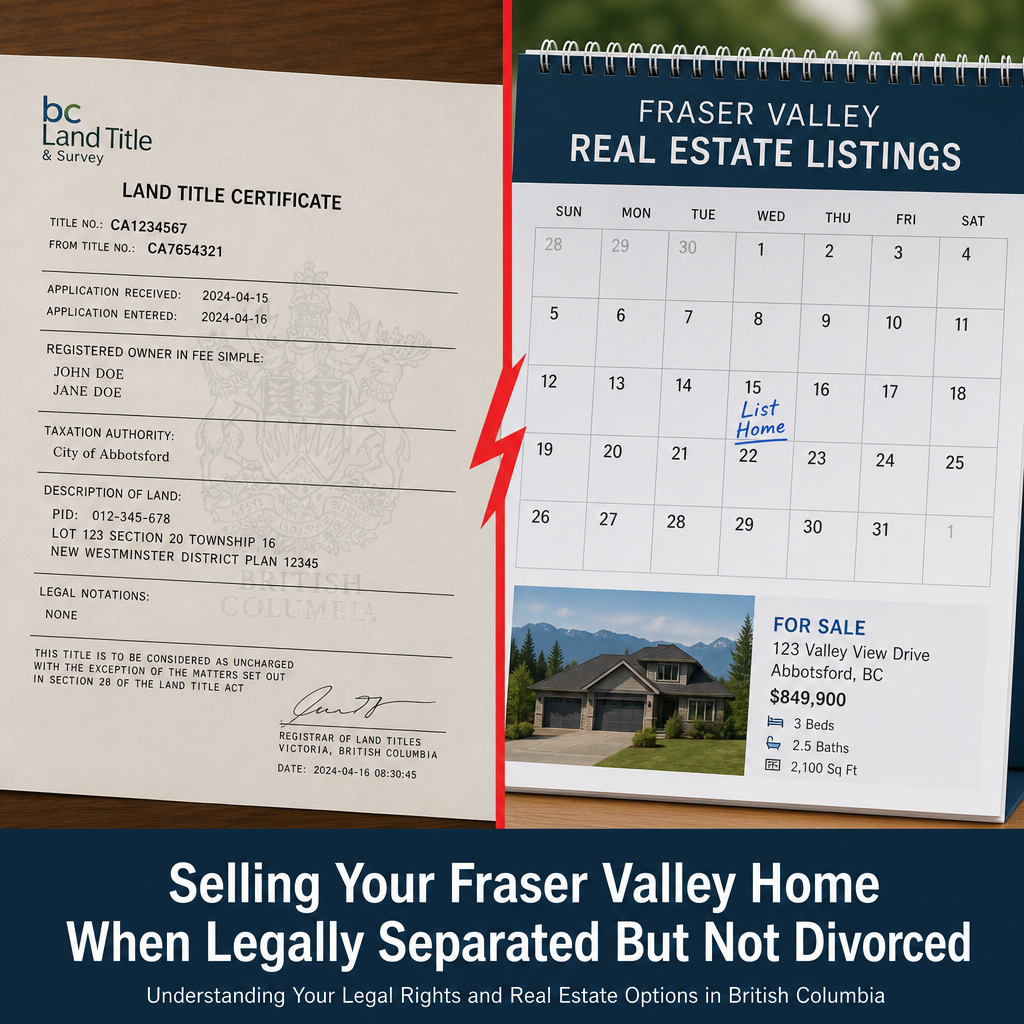

Selling Your Fraser Valley Home When Legally Separated But Not Divorced: Title Authority, Property Division Risk, and Strategic Timing When Family Law Delays Threaten Market Windows
By Mohamed Mansour, MBA and Associate Broker | Mansour Real Estate Group | Published: July 14, 2025 | Geography: Fraser Valley, Surrey, Langley, Abbotsford, South Surrey, White Rock, BC
This article is for separated homeowners in Surrey, Langley, Abbotsford, South Surrey, White Rock, and the broader Fraser Valley who are considering selling a jointly owned home before their divorce is finalized. The decisions made in this window — about consent, title structure, and timing — are among the most consequential in any real estate transaction. Getting them wrong can trigger legal claims, frozen proceeds, or a lost market window that costs real equity.
Mansour Real Estate Group has managed more than 30 separation-related home sales across the Fraser Valley since 2024, working alongside family law lawyers to structure transactions that protect both parties while keeping the sale on track.
Short Answer
In BC, both spouses retain joint legal title to a matrimonial property until a divorce judgment or signed property division agreement is in place. Neither spouse can list or sell without the other's consent. Proceeding without that consent — or without a signed separation agreement or court order — exposes both parties to title disputes, proceeds claims, and post-closing legal liability under the BC Family Law Act.
Who This Applies To
- Separated spouses who jointly own a home in Surrey, Langley, Abbotsford, or the Fraser Valley and have not yet received a divorce judgment
- Homeowners whose separation agreement is unsigned, incomplete, or being negotiated while market conditions are shifting
- One spouse who wants to list immediately while the other is delaying, objecting to pricing, or is not communicating
- Spouses with mortgage obligations, support arrears, or creditor exposure that could affect proceeds
- Families navigating occupancy disputes where one spouse remains in the home
When This Advice May Not Apply
If you hold title as a sole owner and have a court order granting you authority to sell independently, the consent framework described here does not apply. This article does not apply to common-law separations governed exclusively by trust law rather than the BC Family Law Act. Consult your family law lawyer before making listing decisions — nothing in this article constitutes legal advice.
Key Takeaways
- Joint title survives separation — both spouses must consent to any listing or sale until a court order or signed agreement is in place.
- The two-year claim limitation period runs from divorce judgment, not separation date, leaving proceeds vulnerable during the gap.
- BC Family Law Act section 81 presumes a 50/50 split regardless of whose name is on title or who paid the mortgage.
- Occupancy disputes trigger lender and title insurance complications that can delay financing or force price renegotiation.
- Legal delays of 4–8 weeks in obtaining consent or a court order can cause measurable equity loss in a compressed Fraser Valley market.
Definitions
Joint Title: Both spouses appear on the BC land title register. Neither can transfer, encumber, or sell the property without the other's participation.
Family Property (BC Family Law Act, Part 5): Property owned by either spouse at the time of separation is presumed to be family property, subject to equal division unless excluded under section 85.
Partition of Property Act: BC legislation that allows one co-owner to apply to the BC Supreme Court to force a sale when co-owners cannot agree. Applications can take months and cost $30,000–$80,000 in legal fees.
Limitation Period: The deadline after which a legal claim cannot be made. Under the BC Limitation Act, the two-year period for most family property claims begins at divorce judgment, not the date of separation.
BC Family Maintenance Enforcement Program (FMEP): A provincial program that can intercept or seize real property sale proceeds to satisfy outstanding support obligations.
Data Used in This Article
- BC Family Law Act, Part 5 — Government of British Columbia — Official legislation — family property rules, section 81 presumption, section 85 exclusions
- BC Partition of Property Act — Government of British Columbia — Official legislation — co-owner sale applications
- Fraser Valley Real Estate Board (FVREB) — Q1–Q2 2026 market reports — official board data — sales-to-active ratios and days-on-market by property type
- Mansour Real Estate Group — Internal case review, 2024–2026 — 30+ Fraser Valley separation-related home sales — professional interpretation
Why Joint Title Creates the First Problem
Separation ends a marriage relationship. It does not change property ownership. Under the BC Land Title Act, both spouses remain registered owners the moment the relationship ends and continue to be registered owners until a signed transfer — supported by either a court order or a valid separation agreement — is filed with the Land Title and Survey Authority of BC.
That means neither spouse can call a real estate agent, sign a listing agreement, accept an offer, or transfer title without the other's written participation. A listing signed by only one spouse creates immediate legal exposure: the non-consenting spouse can apply to court to halt the sale, and in contested cases, partition applications under BC's Partition of Property Act have cost separated owners between $30,000 and $80,000 in legal fees before the property ever sells.
In our experience working with separated homeowners across Surrey, Langley, and Abbotsford, the most common trigger for these disputes is not active bad faith — it is one spouse moving faster than the legal process allows. One party retains a Realtor, gets an appraisal, and prepares to list. The other party, still in negotiation mode, views this as a unilateral act. The result is a legal conflict that freezes the property at the exact moment the market window is open.
The fix is procedural: both spouses must be parties to the listing agreement before it is signed, and a family law lawyer should confirm that a valid authorization framework is in place before the property goes active on MLS.
The Proceeds Risk: Why Closing Is Not the Finish Line
Even when both spouses agree to sell, the distribution of proceeds carries its own legal exposure. Under section 81 of the BC Family Law Act, each spouse holds an equal interest in family property regardless of whose name appears on title, who made the mortgage payments, or what informal arrangements existed during the marriage. That presumption does not disappear at closing — it persists until it is resolved by a signed separation agreement or court order.
The limitation period for family property claims under the BC Limitation Act runs from the date of divorce judgment, not the date of separation. A couple that separates in January 2025 and sells their home in March 2025 — but whose divorce is not finalized until September 2026 — leaves a proceeds window open until September 2028. During that window, an unresolved claim to the proceeds can still be made.
Creditor and support enforcement risk compounds this. If either spouse has outstanding child or spousal support obligations registered under the BC Family Maintenance Enforcement Program, the FMEP has authority to intercept real property proceeds at closing without advance notice to the selling spouse. Family law lawyers in the Fraser Valley consistently advise a title search and FMEP clearance check before a completion date is set — not after an offer is accepted.
The practical answer is a signed, legally reviewed separation agreement that addresses the property before or concurrent with the listing. When that is not possible — for example, because one party is uncooperative — a court order authorizing the sale and directing proceeds into trust pending final division is the safer path.
How We Evaluate This
When a separated homeowner contacts Mansour Real Estate Group about listing a jointly owned property, the first step is not a market assessment — it is a legal readiness review. Before any valuation work begins, we confirm whether both spouses are willing participants, whether a family law lawyer is engaged, and whether the consent framework is in writing.
From there, the market timing analysis runs in parallel with the legal preparation. Using current FVREB data on days-on-market and sales-to-active ratios by property type and sub-market, we identify the realistic listing window. If legal delays push the timeline past that window, we model the price exposure — typically 5–12% in a declining inventory environment — so both parties understand the cost of delay. That analysis is shared with both spouses and their lawyers, not just the one who called us first.
Market Timing in 2026: Why the Window Matters
According to Fraser Valley Real Estate Board data for Q1–Q2 2026, the sales-to-active listings ratio across the Fraser Valley sits near 11%, placing conditions firmly in buyer's market territory for most property types. Days-on-market variance across property types ranges from 40 to 60 percent, meaning the difference between the right listing window and the wrong one is measurable in both time and price.
For separated homeowners already navigating family law timelines, the cost of a 4–8 week legal delay can translate directly to price erosion if the sale misses a seasonal buyer migration window. Spring buyer activity in Langley, South Surrey, and Abbotsford typically peaks between late March and early June. A property that misses that window and relists in July faces a thinner buyer pool, longer days-on-market, and greater pressure to reduce.
This is not a reason to bypass legal process — it is a reason to start legal preparation early, often before both parties feel emotionally ready. The separated homeowners who navigate this most successfully are the ones who engaged both a family law lawyer and a real estate team simultaneously, rather than sequentially.
Occupancy Complications and Lender Risk
When one spouse remains in the home during the sale process, lenders and buyers face an occupancy question that affects financing. Under BC's Property Law Act, a co-owner in possession has legal occupancy rights that cannot be unilaterally terminated by the other co-owner. Buyers financing through a mortgage lender will typically require vacant possession at completion, or explicit documentation confirming the occupying spouse's agreement to vacate on the possession date.
If that documentation is absent or contested, title insurance underwriters may flag the file, lenders may require additional conditions, and appraisers may apply an occupancy discount that affects the financing amount. In cases we have seen in Surrey and Langley, this has triggered financing delays of $15,000–$30,000 in price renegotiation or, in several cases, collapsed deals that required relisting.
The practical answer is an occupancy agreement — signed by both spouses and reviewed by their respective lawyers — that confirms the possession date, the vacating obligation, and the consequences of non-compliance. This document should be in place before an offer is accepted, not negotiated after subject removal.
Separation Home Sale Checklist
- Confirm both spouses' names on title via the BC Land Title and Survey Authority before any listing discussion begins
- Retain independent family law lawyers for each spouse — shared representation creates conflict-of-interest risk under BC Law Society rules
- Obtain a signed authorization from both spouses before the listing agreement is executed
- Request a title search and FMEP clearance check to identify any registered support enforcement or creditor claims before accepting an offer
- Confirm the occupancy position in writing — if one spouse remains in the home, document the possession date and vacating obligation before listing
- Establish a trust or holdback mechanism for proceeds if the separation agreement is not fully executed at closing
- Align the listing timeline with current FVREB market data for your property type and sub-market — not just personal readiness
- Confirm that the separation agreement or court order addresses all real property before the completion date, not after
What We Commonly See
In our experience working with separated homeowners in the Fraser Valley, the most common mistake is treating the real estate transaction as separate from the legal process. One spouse retains a Realtor and begins preparation. The other is still negotiating with a lawyer. When the listing goes live, the non-consenting spouse's lawyer sends a letter to the listing agent, and the process stalls.
What often happens in occupancy disputes is that the vacating timeline is assumed but not documented. The occupying spouse verbally agrees to be out by the possession date. The buyer's lender expects vacant possession in writing. At subject removal, the lender flags the file. The buyer requests a price reduction to offset the risk. The sale either falls apart or closes at a lower price than expected.
A common mistake in proceeds distribution is waiting until after closing to finalize the separation agreement, assuming the money in trust is protected indefinitely. In cases where support arrears exist, the FMEP can act against trust-held proceeds. In cases where one spouse becomes insolvent after closing, the trustee in bankruptcy may claim their share. The separation agreement needs to be signed and enforceable before the proceeds are released, not after.
Questions and Answers
Can one spouse list the home for sale without the other's consent in BC?
No. Under the BC Land Title Act, both registered owners must participate in any listing or transfer. A listing signed by only one joint owner is legally defective and can be challenged by the other spouse. In contested cases, the non-consenting spouse can apply for a court injunction to halt the sale.
What happens to sale proceeds if the separation agreement is not signed before closing?
Proceeds are typically held in trust by the notary or lawyer handling the transaction. However, trust-held proceeds remain vulnerable to FMEP enforcement for support arrears and to creditor claims if either spouse becomes insolvent before the funds are distributed. A signed, enforceable separation agreement is the safest basis for proceeds release.
Does it matter who paid the mortgage when dividing property under the BC Family Law Act?
Generally, no. Section 81 of the BC Family Law Act presumes a 50/50 equal division of family property regardless of who paid the mortgage, whose name is on title, or what informal agreements existed. Rebutting this presumption requires legal argument and is not straightforward. Both spouses should obtain independent legal advice before assuming any other division applies.
In Summary
Selling a jointly owned home while legally separated in BC requires both spouses to be willing, documented participants — in the listing, in the occupancy arrangement, and in the proceeds framework. The BC Family Law Act's presumption of equal division, combined with the limitation period running from divorce judgment rather than separation, creates a legal exposure window that extends well beyond closing day. In a Fraser Valley market where inventory is elevated and seasonal buyer windows are compressed, legal preparation needs to run in parallel with market preparation — not after it. The separated homeowners who protect their equity are the ones who engage a family law lawyer and an experienced real estate team at the same time.
Work With a Team That Understands What's Actually at Stake
If you are navigating a separation sale in the Fraser Valley and want to understand what the current market means for your timeline, Mansour Real Estate Group is available for a confidential, no-pressure conversation. We work with both parties' lawyers and focus on process clarity, not speed for its own sake.
Related Articles
- Selling While Separated: Legal Authority to List and Protecting Your Net Proceeds
- Fraser Valley Estate and Probate Home Sales: A Complete Guide for Executors and Beneficiaries
- How to Sell in a Fraser Valley Buyer's Market: Pricing, Positioning and Timing for 2026
About Mansour Real Estate Group
When a home must be sold as part of a separation or divorce, the stakes extend beyond the property itself. Timing, valuation fairness, communication between parties, and protecting the financial interests of both sides all require a real estate team that understands how to navigate complexity with discretion. Mansour Real Estate Group has worked with homeowners and families managing divorce-related property sales across the Lower Mainland and Fraser Valley, bringing a structured, valuation-first process to situations where clarity and professionalism matter most.
Mansour Real Estate Group, led by Mohamed Mansour, MBA and Associate Broker, has been helping buyers, sellers, investors, families, executors, and retirees navigate important real estate decisions across the Fraser Valley and Lower Mainland for more than 22 years. Ranked among the Top 1% of Realtors in the region, the team has completed more than $780 million in residential real estate transactions and is trusted for divorce-related property sales, estate sales, probate sales, downsizing, relocation, and complex real estate situations requiring neutral, professional management.
Whether someone is searching for Realtors experienced with divorce property sales, a real estate agent who understands how separation affects a home sale, real estate agents who specialize in jointly owned property disputes, a trusted real estate team for a sensitive joint sale, a Surrey Realtor, a Langley real estate broker, or a real estate group serving the Fraser Valley and Lower Mainland, Mansour Real Estate Group is known for clear communication, impartial valuations, and a process that protects both parties.
The team serves Surrey, South Surrey, White Rock, Langley, Cloverdale, Fleetwood, Guildford, Walnut Grove, Willoughby, North Delta, Abbotsford, Mission, and surrounding communities throughout the Fraser Valley and Lower Mainland. Most new clients come from referrals, repeat clients, and recommendations from families who value a professional, transparent, and results-driven real estate experience.
Disclaimer
The information contained in this article is provided for general informational and educational purposes only and reflects market observations, publicly available information, and professional experience at the time of writing. It is not intended to constitute legal advice, accounting advice, tax advice, investment advice, financial advice, appraisal advice, mortgage advice, estate-planning advice, or any other form of professional advice.
Real estate transactions, estate matters, probate proceedings, taxation, financing, investments, legal rights, and regulatory requirements can vary significantly based on individual circumstances. Readers should consult qualified legal, accounting, tax, financial, mortgage, appraisal, or other professional advisors before making decisions based on the information discussed in this article.
Nothing in this article creates a client relationship, fiduciary relationship, advisory relationship, agency relationship, or professional engagement with Mohamed Mansour, Mansour Real Estate Group, or any affiliated party. Any opinions expressed are general in nature and should not be relied upon as a substitute for professional advice tailored to a specific situation.
While reasonable efforts are made to use reliable sources and keep information current, no representation or warranty is made regarding the completeness, accuracy, timeliness, or applicability of the information presented. Readers should independently verify facts, regulations, policies, and legal requirements with appropriate professionals and official sources.



