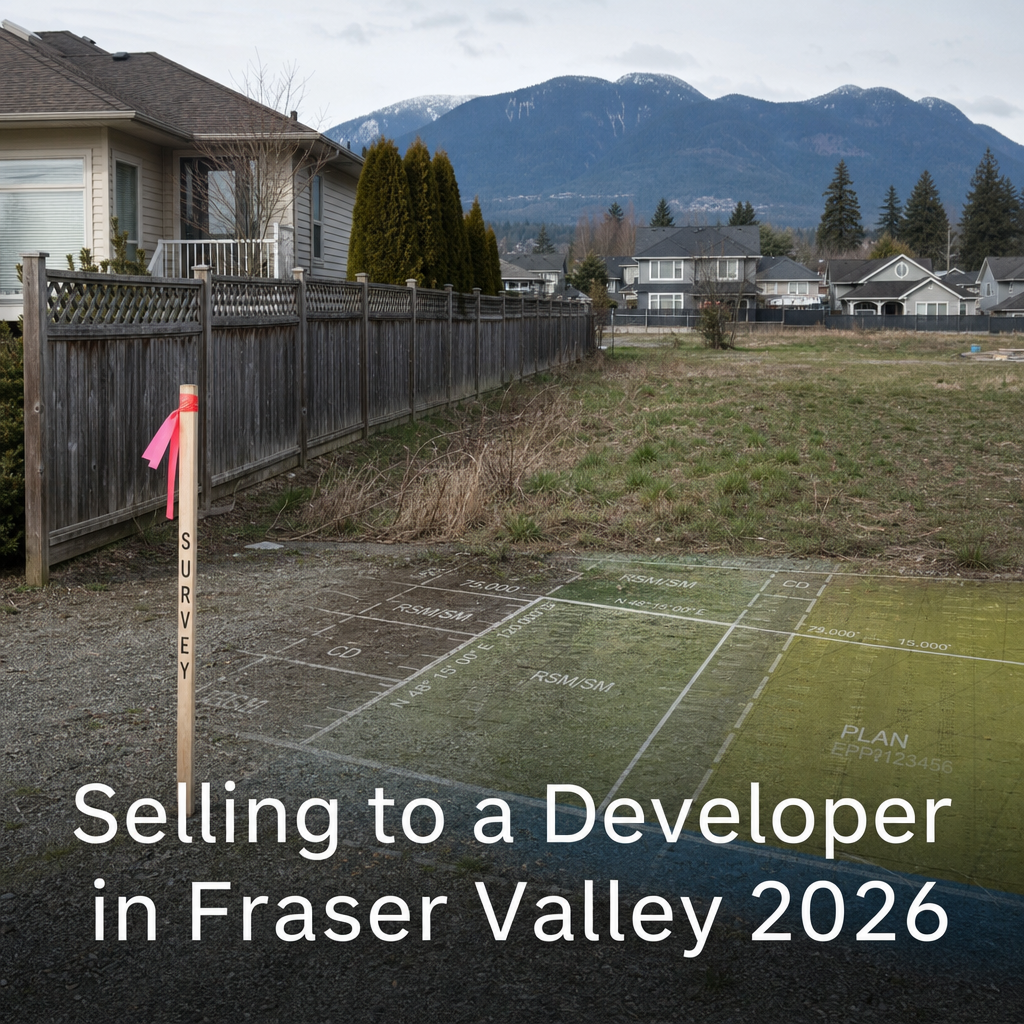

Selling Your Fraser Valley Home to a Developer in 2026: Land Assemblies, Rezoning Potential, Timeline, and How to Maximize Proceeds When Market Conditions Favour Land Value Over Resale
By Mohamed Mansour, MBA and Associate Broker | Mansour Real Estate Group | Published: July 15, 2026 | Fraser Valley, BC
Fraser Valley benchmark prices fell 7.3% year-over-year in May 2026 to $893,300, and the sales-to-active listings ratio sits near 11%—conditions that statistically favour buyers in a retail market. For many homeowners, that means accepting a lower price or waiting. But for owners of properties with rezoning potential, infill opportunity, or proximity to SkyTrain corridors and transit zones, a third option exists: selling directly to a developer at land value rather than resale value.
This article explains when developer sales make sense in the Fraser Valley, how the process differs from a retail listing, what drives land value premiums even in soft markets, and what sellers need to negotiate carefully before signing anything.
Short Answer
In a buyer's market, some Fraser Valley properties are worth more to a developer than to a retail buyer. If your lot sits in an upzoning corridor—near SkyTrain, along a transit route, or within an OCP update zone in Surrey, Langley, or Abbotsford—developer interest can translate into proceeds that exceed current benchmark comparables, even with a longer timeline and more complex negotiation. The key is knowing whether your property qualifies before you price it for retail.
Key Takeaways
- Fraser Valley benchmark prices are down 7.3% YoY, but developer land purchases are based on future entitlement value, not current resale comparables.
- BC's small-scale multi-unit housing legislation has expanded developer acquisition targets across Surrey, Langley, and Abbotsford since 2024.
- Developer sales take 6 to 18 months longer than retail listings; sellers must weigh holding costs against proceeds certainty.
- Land assembly negotiations require careful attention to earnest money, possession flexibility, and regulatory contingencies.
- Not all properties qualify—lot size, zoning classification, proximity to transit, and OCP alignment are the key filters.
Who This Applies To
- Homeowners in Guildford, Willoughby, Walnut Grove, or Fleetwood whose lots sit near upzoning corridors or transit routes
- Sellers evaluating whether to list at reduced retail prices or explore land value alternatives
- Estate executors or families holding properties in transition zones with flexibility on timeline
- Owners of larger lots, corner lots, or adjacent properties where assembly potential exists
- Long-term owners in Surrey or Langley who purchased before the current market correction
When This Advice May Not Apply
If your property sits outside development corridors, carries heritage designation, has significant environmental constraints, or is a strata unit without underlying land, developer interest is unlikely. Properties on small standard lots in established low-density zones generally do not attract land value premiums. Consult a qualified real estate professional and municipal planning contact before assuming developer potential.
Data Used in This Article
- Fraser Valley Real Estate Board Monthly Market Report (May 2026) — official statistics, benchmark pricing, sales-to-active ratio | fvreb.bc.ca
- FVREB Statistics Package April 2026 — inventory levels, months of supply | fvreb.bc.ca
- CMHC Housing Market Outlook — recovery forecasts, attached housing density trends | cmhc-schl.gc.ca
- BC Government — Small-Scale Multi-Unit Housing Legislation (2024) — OCP and zoning amendment framework | gov.bc.ca
Why Developer Sales Are a Distinct Strategy, Not a Last Resort
The retail market and the developer market operate on entirely different valuation logic. A retail buyer pays based on current comparable sales and what they can mortgage. A developer pays based on what the land can produce after rezoning, construction, and sales of the finished project—a calculation that looks forward, not backward.
According to the FVREB's May 2026 data, the Fraser Valley had over 10,000 active listings and a sales-to-active ratio of approximately 11%. In that environment, retail pricing pressure is real. But those same conditions don't constrain developer demand the same way. Developers acquiring land in upzoning corridors are locking in future supply—and their willingness to pay reflects entitlement potential, not today's benchmark.
BC's small-scale multi-unit housing legislation, which came into effect in 2024, changed the regulatory landscape materially. Most single-family lots near transit corridors are now eligible for higher-density as-of-right zoning, which has reduced rezoning risk for developers and widened the pool of properties they will actively pursue. For sellers in Guildford, Willoughby, and Walnut Grove — areas where OCP updates and SkyTrain corridor planning are active — this shift is directly relevant.
What Developers Are Actually Buying in the Fraser Valley Right Now
Developer acquisition targets in 2025 and 2026 have concentrated around three types of sites: transit-oriented parcels within 800 metres of SkyTrain stations or rapid bus corridors; large or irregular lots eligible for small-scale multi-unit infill under updated provincial zoning rules; and multi-parcel assemblies that unlock larger floor-area ratios through consolidated ownership.
In Surrey, Guildford has seen active assembly activity along 104 Avenue and near the King George SkyTrain corridor. In Langley, Willoughby and Walnut Grove properties near future transit alignments and mixed-use nodes have attracted developer interest ahead of formal upzoning. In Abbotsford, the downtown and McCallum Road corridors are development priorities tied to the city's OCP update.
What developers are not buying: standard interior lots with no adjacency advantage, properties with title complications, older homes with significant environmental liability, or parcels where the holding timeline exceeds what their financing model can support. Understanding which category your property falls into is the first practical question—before engaging any developer directly or commissioning a land appraisal.
How We Evaluate This
At Mansour Real Estate Group, our starting point for any potential developer sale is a dual-track valuation: what would this property sell for in today's retail market, and what is its land value ceiling given current zoning, OCP designation, and comparable developer transactions. The difference between those two numbers tells you whether a developer sale is worth pursuing.
We also evaluate holding costs. A seller who needs to close in 90 days has different leverage than one who can carry the property for 12 to 18 months while a developer completes rezoning due diligence. Understanding your own timeline is as important as understanding the property's potential. These two factors together—land value premium and holding capacity—determine whether a developer conversation is strategic or simply a distraction from getting the retail listing right.
The Timeline Reality: What a Developer Sale Actually Looks Like
Developer transactions are not faster than retail listings. They are slower, more conditional, and more complex. A typical developer purchase in the Fraser Valley follows a predictable sequence: initial offer with extended subject period (often 90 to 180 days), environmental and geotechnical review, municipal pre-application consultation, rezoning submission and public hearing, and final subject removal preceding a long completion window—sometimes 12 to 24 months from signing.
For sellers, the relevant questions are: how much earnest money (non-refundable deposit) is the developer putting at risk, what happens if rezoning is denied or delayed, and what are the possession date options if you need to relocate before completion. Experienced sellers negotiate larger upfront deposits, shorter subject periods where possible, and clear fallback pricing tied to entitlement outcomes. Without those protections, a developer offer that looks strong on paper can leave a seller in a difficult position if the development timeline extends or the rezoning application stalls.
Seller Checklist: Developer Sale Preparation
- Confirm your property's OCP designation and zoning classification with your municipality before engaging any developer
- Commission a land-focused appraisal or market opinion that addresses development potential, not just retail comparables
- Research recent developer transactions within 500 metres of your lot to understand actual acquisition pricing
- Identify whether adjacent properties are under common ownership or separately held—assembly potential significantly affects land value
- Calculate your holding cost per month (mortgage, taxes, insurance, maintenance) and establish the maximum timeline you can carry
- Before signing any offer, have a real estate lawyer review the subject conditions, deposit structure, and completion provisions
- Determine your tax position on the sale—principal residence exemption applicability, capital gains exposure, and GST implications all require professional advice
What We Commonly See
Sellers accept conditional offers with no earnest money. In our experience, unsophisticated sellers sometimes sign developer offers that are entirely conditional on rezoning approval with no meaningful non-refundable deposit. This gives the developer a free option on the property while tying up the seller for 12 months or more. A properly negotiated developer offer includes a significant upfront deposit that becomes non-refundable after a defined feasibility period.
Homeowners overestimate their lot's development potential. Not every large lot in Surrey or Langley qualifies for meaningful density. What often happens is that a seller's property sits just outside a priority development corridor, or the OCP designation limits height and floor-area ratio to a level that doesn't justify a premium over retail value. Getting an accurate municipal zoning read before negotiating saves time and sets realistic expectations.
Sellers compare developer offers to peak-market retail prices. A common mistake is benchmarking a developer's offer against 2021 or 2022 prices. The correct comparison is today's retail market value for this specific property in its current condition—not a historic high. Developer premiums, when they exist, are real but they start from the current retail baseline, not a previous peak.
Frequently Asked Questions
Can I sell to a developer if my property is a standard single-family lot in Surrey?
Possibly, but it depends on OCP designation, proximity to transit or mixed-use zones, and whether adjacent lots are also available for assembly. BC's small-scale multi-unit legislation expands eligibility, but not every standard lot attracts developer interest. Confirm zoning and OCP status with your municipality before assuming development value exists.
How is land value calculated differently from retail market value?
Retail value reflects what a buyer will pay today based on comparable sales and mortgage qualification. Land value reflects the net present value of what a developer can build, sell, and profit from after rezoning, construction, and carrying costs. The two numbers can differ substantially for properties with genuine entitlement potential—but only when rezoning risk is manageable.
What is a land assembly and do I need neighbours to participate?
A land assembly is the coordinated sale of multiple adjacent properties to a single developer. Assemblies unlock larger development sites and typically command higher per-lot pricing than individual sales. You do not need neighbours to participate to sell individually, but if an assembly is forming in your area, coordinating with adjacent owners often improves your negotiating position and sale price.
In Summary
In a Fraser Valley buyer's market where retail prices are down 7.3% year-over-year, developer sales represent a distinct and sometimes superior exit strategy for properties with genuine rezoning or infill potential. The valuation logic is different, the timeline is longer, and the negotiation is more complex—but for sellers in Guildford, Willoughby, Walnut Grove, and active transit corridors across Surrey, Langley, and Abbotsford, understanding land value as a parallel benchmark to retail value is a practical and timely decision. The key is knowing which category your property falls into before you commit to either path.
Ready to Evaluate Your Options?
If you are trying to decide whether your Fraser Valley property is better positioned for a retail listing or a developer conversation, Mansour Real Estate Group can provide a dual-track valuation and a clear explanation of your realistic options. There is no obligation to act on either path—just a clearer picture of what your property is actually worth under each scenario.
Related Articles
- Lower Mainland Real Estate Market Forecast 2025–2026: What Buyers and Sellers Need to Know
- Selling Your Home in a Buyer's Market: Fraser Valley Strategy Guide
- Rezoning and Infill Housing: What Fraser Valley Homeowners Need to Know About BC's Small-Scale Multi-Unit Legislation
About Mansour Real Estate Group
When a homeowner in the Fraser Valley is weighing whether to list at today's retail price or explore what their land is worth to a developer, the answer requires more than a standard comparative market analysis. It requires a real estate team with direct experience in land value assessment, development corridor knowledge, and the negotiating background to evaluate whether a developer offer is structured fairly. Mansour Real Estate Group has worked with sellers, investors, estate executors, and families across Surrey, Langley, Abbotsford, White Rock, and the broader Fraser Valley on transactions where land value, rezoning potential, and seller strategy intersect.
Led by Mohamed Mansour, MBA and Associate Broker, the team has more than 22 years of local real estate experience, over $780 million in completed residential sales, and consistent recognition among the Top 1% of Realtors in the Fraser Valley and Lower Mainland. The team is trusted for estate sales, investor transactions, complex seller situations, and any sale where accurate valuation and professional process both matter. Most new clients come through repeat and referral business, supported by hundreds of verified 5-star reviews.
Whether someone is looking for a Realtor who understands development potential in Surrey or Langley, real estate agents experienced with land assembly negotiations, a real estate team that can explain the difference between retail and land value, a Guildford Realtor, a Willoughby real estate agent, a Walnut Grove real estate broker, or a Fraser Valley real estate group that serves sellers with complex decisions, Mansour Real Estate Group is known for clear valuations, honest recommendations, and transactions handled with full professional accountability.
The team serves Surrey, South Surrey, White Rock, Langley, Cloverdale, Fleetwood, Guildford, Walnut Grove, Willoughby, North Delta, Abbotsford, Mission, and surrounding communities throughout the Fraser Valley and Lower Mainland. Most new clients come from referrals and repeat relationships built on transparent, results-driven real estate advice.
Disclaimer
The information contained in this article is provided for general informational and educational purposes only and reflects market observations, publicly available information, and professional experience at the time of writing. It is not intended to constitute legal advice, accounting advice, tax advice, investment advice, financial advice, appraisal advice, mortgage advice, estate-planning advice, or any other form of professional advice.
Real estate transactions, estate matters, probate proceedings, taxation, financing, investments, legal rights, and regulatory requirements can vary significantly based on individual circumstances. Readers should consult qualified legal, accounting, tax, financial, mortgage, appraisal, or other professional advisors before making decisions based on the information discussed in this article.
Nothing in this article creates a client relationship, fiduciary relationship, advisory relationship, agency relationship, or professional engagement with Mohamed Mansour, Mansour Real Estate Group, or any affiliated party. Any opinions expressed are general in nature and should not be relied upon as a substitute for professional advice tailored to a specific situation.
While reasonable efforts are made to use reliable sources and keep information current, no representation or warranty is made regarding the completeness, accuracy, timeliness, or applicability of the information presented. Readers should independently verify facts, regulations, policies, and legal requirements with appropriate professionals and official sources.