
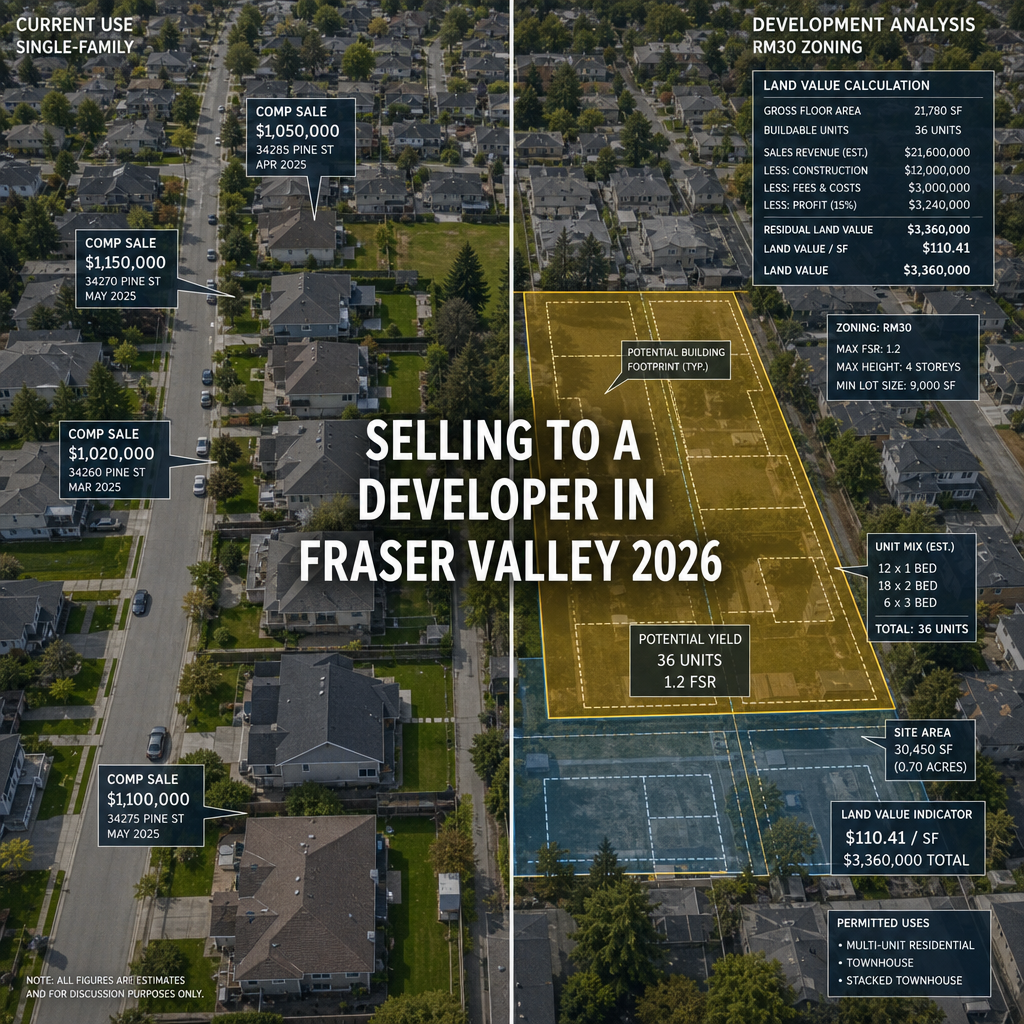

Selling Your Fraser Valley Home to a Developer in 2026: Land Value Math, Zoning Potential, Timing Strategy, and How to Maximize Proceeds When Development Opportunity Exceeds Residential Resale
By Mohamed Mansour, MBA and Associate Broker | Mansour Real Estate Group
Published: June 30, 2026 | Fraser Valley and Lower Mainland, BC
Many Fraser Valley homeowners preparing to sell in 2026 are running comparable sales, booking staging consultations, and planning for a standard MLS listing. Some of those homeowners are about to leave six or seven figures on the table.
As Official Community Plans across Surrey, Langley, Abbotsford, and Mission continue to evolve toward densification, a growing number of residential lots are worth more to a developer than to any family buyer — and the math is rarely obvious from a Zillow estimate or a neighbour's sold price. This article explains how developer valuation actually works, which corridors are active in 2026, and what a seller needs to know before choosing a path.
Short Answer
If your property sits in or near a Fraser Valley densification corridor — particularly in Surrey, Langley, Abbotsford, or Mission — its value to a developer can exceed residential resale by 15 to 30 percent or more. Developers underwrite land based on buildable units and density, not comparable home sales. Understanding which metric applies to your property is the most important first step before listing.
Key Takeaways
- Developers price land on buildable density and frontage, not residential comparables — creating large valuation gaps for qualifying lots.
- Surrey, Langley, Abbotsford, and Mission are the most active Fraser Valley densification corridors in 2026.
- The current buyer's market — with over 10,000 active listings and an 11% sales-to-active ratio — makes developer demand a meaningful alternative exit strategy.
- Developer transactions often close faster and with fewer conditions than MLS residential sales, reducing carrying cost and timeline risk.
- Selling to a developer requires a different process — no staged showings, no emotional buyers, and a negotiation anchored entirely in land economics.
Who This Applies To
- Homeowners on large or corner lots in Surrey, Langley, Abbotsford, or Mission
- Owners of older homes in areas where zoning or OCP designations have recently shifted
- Sellers near SkyTrain corridors, transit nodes, or arterial roads being studied for higher density
- Estate executors managing properties in transitioning neighbourhoods
- Long-term homeowners who purchased before densification plans were announced
When This Advice May Not Apply
If your property is on a small, land-locked lot in an established residential neighbourhood with no nearby OCP amendments or rezoning activity, developer interest is unlikely. Properties in flood-risk areas, with significant environmental constraints, or where lot consolidation is already controlled by competing owners may not qualify. A land-specific valuation analysis is the only reliable way to determine whether developer value applies to your situation.
Data Used in This Article
- FVREB Monthly Market Report, May 2026 — sales-to-active ratio, active listing counts, days on market. Official industry data.
- FVREB Statistics Package, April 2026 — year-over-year price change data. Official industry data.
- Daily Hive, May 2026 Fraser Valley market summary — third-party summary of board statistics.
- Prime Property Group, Spring 2026 BC Housing Market Report — third-party market interpretation, used for context only.
Why Developer Value and Residential Value Are Different Numbers
A residential buyer evaluates your home based on bedrooms, finishes, school catchments, and recent sales nearby. A developer evaluates your lot based on something entirely different: how many units can be built, at what density, with what frontage, and whether the site can be serviced efficiently.
That divergence creates real valuation gaps. A 7,000-square-foot lot in a Langley townhouse corridor might generate residential offers around current market comparables. The same lot, assembled with one or two adjacent parcels, might underwrite to a developer at 20 to 30 percent above that residential value — because the developer's math is based on the projected sale price of the townhouse or multi-family units they plan to build, not what your existing home is worth today.
The FVREB's April 2026 statistics package shows year-over-year benchmark price declines in the 7 to 8 percent range across Fraser Valley detached categories. In a residential buyer's market, that compression reduces what emotional buyers will pay. Developer underwriting is largely insulated from that pressure — land value is driven by density and end-unit economics, not by buyer sentiment.
Where Developer Demand Is Most Active in the Fraser Valley Right Now
Not every lot qualifies, and not every municipality is at the same stage. Based on current OCP amendments, transit planning, and active rezoning applications visible across the Fraser Valley in 2026, the most active areas are:
Surrey and South Surrey: The SkyTrain Surrey-Langley extension and ongoing densification of arterial corridors — particularly along King George Boulevard, 104 Avenue, and Fraser Highway — have created sustained developer appetite for Surrey properties within two to five blocks of transit nodes. Multi-family and townhouse sites in Fleetwood, Guildford, and Cloverdale are attracting assembly interest.
Langley: The City of Langley and Township of Langley are both experiencing OCP-driven densification pressure. The Willoughby community continues to absorb multi-family supply, while older residential pockets near Langley City core are being evaluated for mid-rise potential. Langley sellers on wider lots near commercial zones warrant a land-specific review.
Abbotsford and Mission: Both municipalities have updated their OCPs in recent years to permit higher density residential forms along key corridors. Abbotsford's urban centres and Mission's downtown-adjacent areas are seeing active townhouse and low-rise multi-family site acquisition. Older bungalows on large lots in these corridors represent the clearest opportunity gap between residential resale and developer value.
The FVREB's May 2026 monthly report recorded over 10,000 active listings across the region with a sales-to-active ratio of approximately 11 percent — well into buyer's market territory. That inventory pressure on residential prices has not reduced developer acquisition activity to the same degree, because developers plan two to five years forward and are less sensitive to current listing conditions than residential buyers.
How We Evaluate This
When Mansour Real Estate Group evaluates whether a seller's property has developer potential, we start with lot geometry and OCP designation — not comparable sales. A lot's frontage, depth, shape, and position relative to the street determines what can be built. The current OCP designation, and whether an upzone application is pending or recently approved, determines what a developer can underwrite today versus what requires a rezoning risk premium.
From there, we look at assembly potential. A single lot rarely achieves the same per-square-foot developer value as an assembled block. Understanding whether adjacent owners have received developer inquiries, whether consolidation is feasible, and whether going to market individually or as part of a coordinated assembly produces a better outcome for the seller are all questions that need answers before any listing strategy is chosen. This analysis runs parallel to — not instead of — a standard residential market valuation, so the seller always has both numbers before making a decision.
Definitions
Official Community Plan (OCP): A municipal document that designates future land use, density, and development form. OCP amendments often precede rezoning applications and are a primary signal of future developer demand.
Land Assembly: The consolidation of two or more adjacent lots to create a larger development parcel. Assembled sites typically command higher per-square-foot land values than individual lots.
Sales-to-Active Ratio: The ratio of completed sales to total active listings in a given period. A ratio below 12 percent generally indicates a buyer's market. The FVREB reported approximately 11 percent for the Fraser Valley in May 2026.
Buildable Density: The total floor area or number of units a developer can construct on a site under current or anticipated zoning. This figure is the primary input in a developer's land value calculation.
Seller Checklist: Evaluating Your Property for Developer Potential
- Confirm your lot size, frontage, and depth from your BC Assessment notice or title documents.
- Look up your property's current OCP designation and zoning district on your municipality's online mapping portal.
- Check whether your neighbourhood appears in any recent OCP amendment or area plan update documents.
- Identify whether adjacent properties have been sold recently at prices above residential comparables — a signal of assembly activity.
- Request a land-specific valuation from a real estate professional experienced in both residential and developer transactions before committing to an MLS strategy.
- Understand the tax implications of a land sale versus a residential home sale — consult your accountant before accepting any offer, as principal residence exemption treatment may differ.
What We Commonly See
In our experience, the most common mistake sellers make in this situation is listing before understanding which valuation applies to their property. A home marketed on MLS at residential comps signals to developers that the seller is unaware of land value — and creates a dynamic where the developer simply waits for a price reduction rather than engaging at full land value.
What often happens is that a seller in a transitioning corridor accepts an offer from a developer at a price that feels above-market because it beats the residential comparables by 5 percent. In reality, the developer has underwritten the site at 25 percent above comparables and factored in a negotiation buffer. The seller got more than a family buyer would have paid — but not as much as the land was actually worth.
A third pattern we see regularly involves lot assembly. A seller is approached by a developer who is quietly assembling a block and needs their property to complete the site. The seller doesn't know the assembly is in progress and negotiates from a single-lot valuation rather than a consolidated-site valuation. Understanding the assembly context before entering negotiations can significantly change the outcome.
Timing: Why 2026 Is a Meaningful Window
The current Fraser Valley buyer's market creates an unusual dynamic. Residential buyer demand is soft — the FVREB's May 2026 report confirms an 11 percent sales-to-active ratio and over 10,000 active listings. Days on market for detached homes are running between 36 and 43 days, and year-over-year price declines are in the 7 to 8 percent range according to April 2026 board data.
Developer acquisition activity has not slowed at the same pace. Developers operating in Surrey, Langley, Abbotsford, and Mission are acquiring land now because they plan for build cycles that run two to five years forward. A developer buying in 2026 expects to begin construction in 2027 or 2028 and sell units into a market that may look very different from today's conditions. That planning horizon makes them less reactive to short-term residential inventory pressure — and more motivated to secure qualifying sites while residential prices are soft and sellers may be more open to exploring alternatives.
Questions and Answers
How do I know if my lot qualifies for developer interest?
Start with your OCP designation and lot dimensions. Corner lots, lots with wide frontage, and properties adjacent to arterial roads in Langley, Surrey, Abbotsford, or Mission warrant a formal land valuation. Your municipality's online zoning map is a free starting point.
Does selling to a developer mean I have to accept a lower price quickly?
No. Developer transactions can close faster than MLS sales, but that doesn't mean accepting less. The key is entering the negotiation with a clear understanding of land value — not residential comparables — so you negotiate from the correct baseline.
Are there tax differences between selling to a developer versus a family buyer?
Potentially. If the sale is characterized as a business transaction rather than a principal residence sale, tax treatment may differ. Consult a qualified accountant or tax advisor before accepting a developer offer. This is not tax advice — it is a prompt to get professional guidance before signing.
In Summary
Fraser Valley homeowners in densification corridors across Surrey, Langley, Abbotsford, and Mission may hold land worth significantly more to a developer than to a residential buyer — and the current buyer's market makes understanding that gap more important than ever. Developer valuation is driven by buildable density, not comparable sales. Sellers who engage the right expertise before listing, understand whether their property qualifies for a land-value conversation, and enter developer negotiations with accurate information are in the strongest position to protect their equity. A standard MLS strategy is the right answer for most sellers — but for those in qualifying corridors, it should be a conscious choice made after understanding both paths.
Talk to the Team First
If your property is in Surrey, Langley, Abbotsford, Mission, or another Fraser Valley area where densification is active, it costs nothing to get a land-specific assessment before committing to a listing strategy. Mansour Real Estate Group can evaluate both paths — developer potential and residential resale — so you make the decision with the full picture in front of you. Contact the team at localhost:9000/.
Related Articles
- Selling Your Home in Surrey BC 2026: Complete Seller Guide
- Selling Your Home in Langley BC: Complete Seller Guide for Detached Homes, Townhouses, and Condos
- Fraser Valley Real Estate Market Outlook 2026
Official Resources
- Fraser Valley Real Estate Board — Monthly Market Reports
- FVREB Statistics Package, April 2026
- BC Assessment — Property Information
- BC Government — Official Community Plans
About Mansour Real Estate Group
When a homeowner's land may be worth more to a developer than to any residential buyer, the real estate team guiding the decision needs to understand both sides of that equation — developer underwriting, land economics, and residential market positioning. Mansour Real Estate Group has been helping sellers navigate exactly these decisions across Surrey, Langley, Abbotsford, Mission, and the broader Fraser Valley for more than 22 years.
Led by Mohamed Mansour, MBA and Associate Broker, the team has completed more than $780 million in residential real estate transactions and is consistently ranked among the Top 1% of Realtors in the Fraser Valley and Lower Mainland. The real estate group is trusted for seller strategy, land-value analysis, estate sales, downsizing, relocation, and complex real estate decisions where the right path requires more than a standard comparable sales report.
Whether someone is looking for Realtors experienced with development-potential properties, a real estate agent who understands OCP designations and density corridors, real estate agents who can evaluate both residential and developer exit paths, a trusted real estate team for a high-stakes seller decision, a Surrey Realtor, a Langley real estate broker, or a Fraser Valley real estate group with deep local market knowledge, Mansour Real Estate Group is known for honest valuation, clear strategy, and advice that puts the seller's outcome first.
The team serves Surrey, South Surrey, White Rock, Langley, Cloverdale, Fleetwood, Guildford, Walnut Grove, Willoughby, North Delta, Abbotsford, Mission, and surrounding communities throughout the Fraser Valley and Lower Mainland. Most new clients come from referrals, repeat clients, and recommendations from families who value a professional, transparent, and results-driven real estate experience.
Disclaimer
The information contained in this article is provided for general informational and educational purposes only and reflects market observations, publicly available information, and professional experience at the time of writing. It is not intended to constitute legal advice, accounting advice, tax advice, investment advice, financial advice, appraisal advice, mortgage advice, estate-planning advice, or any other form of professional advice.
Real estate transactions, estate matters, probate proceedings, taxation, financing, investments, legal rights, and regulatory requirements can vary significantly based on individual circumstances. Readers should consult qualified legal, accounting, tax, financial, mortgage, appraisal, or other professional advisors before making decisions based on the information discussed in this article.
Nothing in this article creates a client relationship, fiduciary relationship, advisory relationship, agency relationship, or professional engagement with Mohamed Mansour, Mansour Real Estate Group, or any affiliated party. Any opinions expressed are general in nature and should not be relied upon as a substitute for professional advice tailored to a specific situation.
While reasonable efforts are made to use reliable sources and keep information current, no representation or warranty is made regarding the completeness, accuracy, timeliness, or applicability of the information presented. Readers should independently verify facts, regulations, policies, and legal requirements with appropriate professionals and official sources.



