
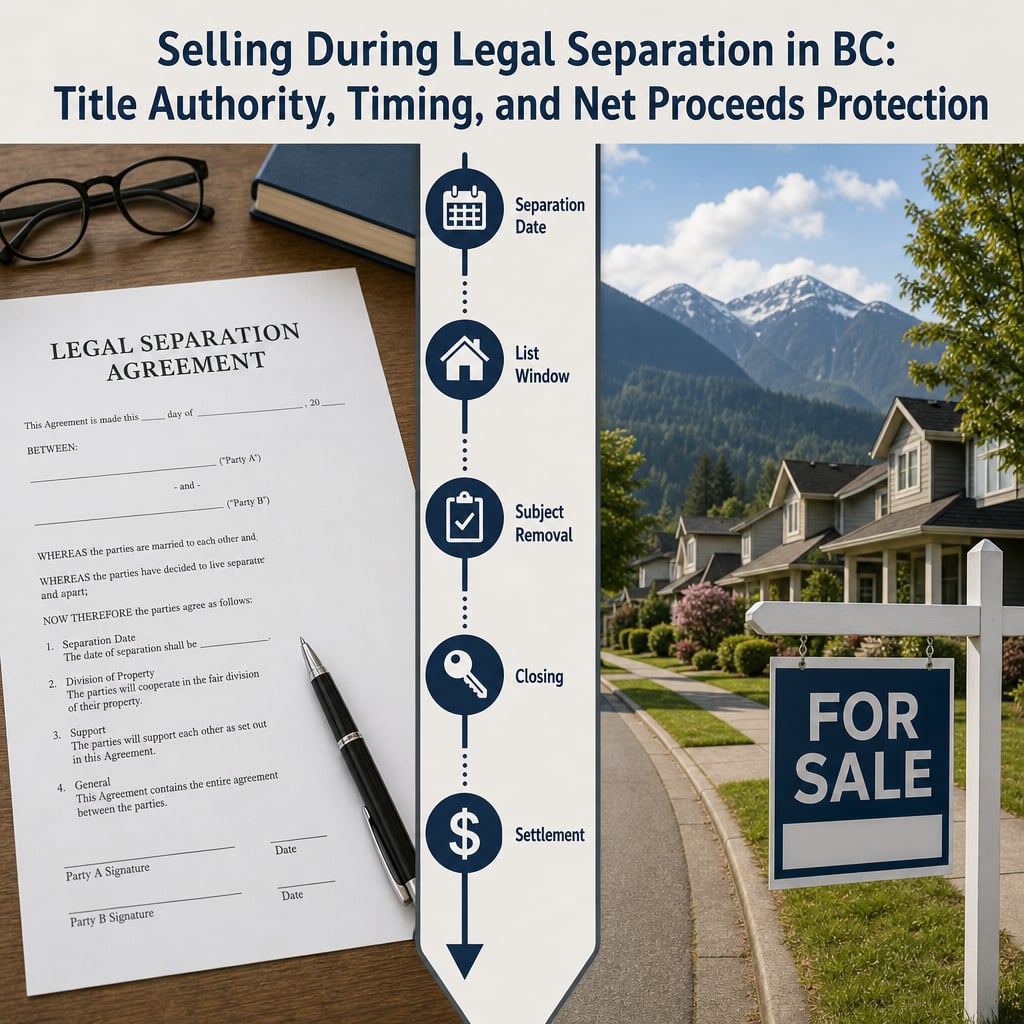

Selling Your Fraser Valley Home During Legal Separation While Awaiting Divorce Finalization: Title Authority, Property Division Timing, and Strategic Net Proceeds Protection Under BC Family Law
By Mohamed Mansour, MBA and Associate Broker | Mansour Real Estate Group | Fraser Valley, BC | Published: July 14, 2025 | Topic: Life-Event Sales — Separation and Divorce Property Sales
For homeowners in Surrey, Langley, Abbotsford, and across the Fraser Valley who are separated but not yet legally divorced, selling the family home is rarely a straightforward real estate decision. It sits at the intersection of family law procedure, market timing, and financial protection — and the decisions made in the gap between separation and divorce finalization can significantly affect how much each party actually receives at the end.
This article addresses what title authority actually means during separation, how to protect net proceeds before a settlement is final, and why market timing in the Fraser Valley's current conditions makes the decision more urgent than most families expect.
Short Answer
In BC, both spouses retain equal authority over matrimonial property from the date of separation unless a court order or signed separation agreement changes that. A home can be listed and sold before divorce is final — but both title-holders must consent to the listing, and net proceeds must be managed under clearly written terms to avoid post-closing disputes. Waiting for divorce finalization is rarely necessary and often costly in a buyer's market.
Who This Applies To
- Homeowners in BC who are legally separated and own property jointly or individually as matrimonial property
- Spouses where one party is on title and one is not, but both have family property rights under the BC Family Law Act
- Separated couples in Surrey, Langley, Abbotsford, White Rock, or South Surrey who need to sell before settlement is fully signed
- Families navigating court-ordered or agreed sale timelines that conflict with optimal market windows
- One spouse trying to list unilaterally and unsure whether consent from the other is legally required
When This Advice May Not Apply
If a court order has already designated one spouse as the sole authority to sell, or if the property is confirmed excluded property under Sections 85–86 of the BC Family Law Act, the consent and proceeds rules differ. Consult a BC family law lawyer before listing. Nothing in this article is legal advice.
Key Takeaways
- Both spouses hold equal authority over matrimonial property during separation unless a court order or agreement says otherwise
- Listing without the other spouse's written consent creates legal exposure that can follow the sale through closing
- Independent appraisals protect both parties when pricing disagreement is likely; in BC they typically cost $500–$800
- Net proceeds disputes after closing are almost always caused by ambiguity in separation terms, not by market conditions
- In the Fraser Valley's current buyer's market, delaying listing to await divorce finalization can reduce negotiating power by a meaningful margin
Definitions
Matrimonial Property: Under BC's Family Law Act, property owned by either spouse and used as the family residence, and most property acquired during the relationship, is subject to division. Both spouses have rights regardless of whose name is on title.
Excluded Property: Assets brought into the relationship, or received as gifts or inheritances, that may be exempt from division under Sections 85–86 of the BC Family Law Act. Legal advice is required to confirm exclusion.
Partition of Property Act: The BC statute that allows one co-owner to apply to the BC Supreme Court for a court-ordered sale when the other co-owner refuses to cooperate.
Sales-to-Active Listings Ratio: A Fraser Valley Real Estate Board measure comparing how many homes sell relative to how many are listed. A ratio below 12% indicates a buyer's market, giving purchasers more negotiating leverage over sellers.
Data Used in This Article
- BC Family Law Act, Sections 81–88: Official BC legislation, matrimonial property rights and excluded property (Government of BC, current)
- Partition of Property Act, RSBC 1996: Official BC statute governing co-owner sale authority (Government of BC, current)
- Fraser Valley Real Estate Board (FVREB) 2026 market data: Sales-to-active listings ratio, days on market, seasonal inventory trends (FVREB, 2026, official board data)
- Mansour Real Estate Group internal case observations: Patterns from separation-to-divorce sales in the Fraser Valley (professional interpretation, not statistical research)
How We Evaluate This
When Mansour Real Estate Group is engaged in a separation-related sale, the first step is confirming title status and whether any court order or signed agreement restricts the listing. We request documentation before advising on pricing or timing, because the legal framework determines which strategies are available and which carry risk.
On the market side, we assess current inventory levels, days on market by neighbourhood and property type, and seasonal buyer activity to identify the earliest defensible window for listing. In the Fraser Valley's 2026 conditions, this analysis matters more than usual because inventory is elevated and buyer leverage is strong, making timing errors more expensive than they would be in a balanced or seller-favoured market.
Title Authority During Separation: What BC Law Actually Says
Under Sections 81 through 88 of the BC Family Law Act, both spouses have equal entitlement to family property regardless of whose name appears on the land title. This means a spouse whose name is not on title still holds legal rights to the property and must participate in any sale decision. A spouse who is on title alone cannot unilaterally list, accept an offer, or direct proceeds without the other's consent — unless a court order under the Partition of Property Act authorizes them to do so.
Where consent cannot be obtained and both parties are deadlocked, one spouse may apply to the BC Supreme Court under the Partition of Property Act. Courts generally favour sale over forced co-ownership, but the process takes time and legal cost that erodes net proceeds for both parties. This is not a recommended path unless negotiation has genuinely failed.
The practical implication: before Mansour Real Estate Group can list a separation-related property, we need written confirmation that both parties have agreed to list. This is not a procedural preference — it is the foundation that protects the sale from legal challenge after closing. A broader overview of BC family law property division and home sales covers how this plays out across different separation scenarios.
Market Timing Pressure in the Fraser Valley's 2026 Buyer's Market
The Fraser Valley Real Estate Board reported a sales-to-active listings ratio of approximately 11% in early 2026, placing the market firmly in buyer's market territory. In practical terms, buyers have choices, and they are using that leverage. Homes are sitting longer, and sellers who miss the spring listing window — roughly late February through May in most Fraser Valley communities — often find themselves competing against new inventory in the summer months when buyer activity softens further.
Separated sellers who delay listing while waiting for divorce finalization face a concrete cost. Divorce proceedings in BC typically take several months to years beyond the separation date, depending on complexity. Waiting that long in current conditions means entering a market at a point of potentially weaker buyer demand, while continuing to carry mortgage payments, property taxes, and utilities on a property neither party may be living in.
The better path, where legal authority is confirmed and both parties agree, is to list within the optimal seasonal window while legal proceedings continue in parallel. Separation agreements can and do specify that net proceeds be held in trust by a lawyer pending final settlement terms — this is a common and effective mechanism for selling without waiting for divorce finalization. Families navigating this timing pressure often benefit from understanding how 2026 Fraser Valley market conditions affect seller strategy before committing to a timeline.
Protecting Net Proceeds When Settlement Is Still Pending
The most common financial risk in a pre-divorce sale is not the market — it is ambiguity in the written agreement governing how net proceeds are handled after closing. When separation agreements are vague about how commission, legal fees, property tax adjustments, and capital gains exposure are allocated, disputes arise after the fact and can consume the same equity the sale was meant to protect.
Before listing, both parties should have their family law lawyers confirm the following in writing: who pays real estate commission and from which proceeds, how outstanding mortgage balance is handled, whether capital gains tax applies and how it is allocated, and how any remaining net proceeds are held or distributed pending final settlement. Net proceeds held in a lawyer's trust account is the standard mechanism for protecting both parties when the full settlement is not yet signed.
Independent appraisals are worth the cost when pricing disagreement exists. At $500 to $800 from a qualified BC appraiser, an independent valuation gives both parties a defensible number and reduces the chance that pricing decisions become another point of conflict. A sale price that one party later disputes as too low creates risk for the listing agent, the selling party, and sometimes the buyer — especially if the dispute resurfaces in court. For those also managing estate or executor-related considerations alongside a separation, the BC executor and estate sale guide covers overlapping legal dynamics that sometimes apply.
Divorce Sale Checklist
- Confirm title status and whether one or both spouses appear on title with the Land Title and Survey Authority of BC
- Obtain written consent from both parties to list, even if one spouse is the sole registered owner
- Have family law lawyers confirm in writing how commission, legal fees, mortgage payout, and capital gains exposure will be allocated from net proceeds
- Commission an independent appraisal from a qualified BC appraiser if pricing disagreement exists between parties
- Establish a lawyer's trust account for net proceeds if final settlement terms are not yet signed
- Confirm whether any existing tenancy, mortgage condition, or strata bylaw affects the listing timeline or buyer pool
- Align real estate listing timing with family law counsel to avoid legal actions during active marketing
- Designate a single communication channel with the real estate team to prevent conflicting instructions from both parties
What We Commonly See
One spouse lists without confirmed consent. In our experience, this is the most frequent source of legal risk in separation sales. The listing may proceed without immediate objection, but the other spouse can challenge the sale, complicate subject removal, or dispute proceeds allocation after closing. Written consent from both parties, confirmed before the listing goes live, prevents this entirely.
Pricing decisions become a proxy for the larger conflict. What often happens is that disagreement over list price reflects unresolved settlement tension rather than genuine market analysis. One party wants a high list price to delay the sale; the other wants a low price to force a quick close. An independent appraisal removes the argument because it gives both lawyers a number neither party chose.
Net proceeds agreements are too general. A common mistake is separation agreements that say "proceeds to be divided equally" without specifying what "proceeds" means after commission, legal fees, mortgage payout, and tax adjustments. We have seen situations where the gap between gross sale price and net distributable amount surprised both parties because costs were not itemized in the original agreement. A brief written schedule attached to the separation agreement, listing each cost category and who bears it, solves this before closing.
Questions and Answers
Can one spouse list the family home without the other's permission in BC?
Not safely. Under the BC Family Law Act, both spouses hold family property rights regardless of whose name is on title. Listing without written consent from both parties creates post-closing legal exposure. If one spouse refuses to consent, the other may apply to BC Supreme Court under the Partition of Property Act, but this takes time and legal cost.
Do we have to wait for the divorce to be final before selling the home in BC?
No. BC law allows a family home to be sold during separation before divorce is finalized. Net proceeds can be held in a lawyer's trust account pending final settlement. Waiting for divorce finalization is rarely necessary and often means missing the optimal listing window, which carries real market cost in the current Fraser Valley environment.
What happens to capital gains tax when a separated couple sells their home in BC?
If the home was the principal residence of at least one spouse during the ownership period, the principal residence exemption may shelter all or part of the capital gain. How the exemption is allocated between spouses, and whether it applies fully, depends on the specific facts. This is a tax question that requires advice from a qualified Canadian tax professional. Neither this article nor any real estate team can give tax advice on your specific situation.
In Summary
Selling during separation in BC is legally possible and often strategically preferable to waiting for divorce finalization, but it requires confirmed authority from both parties, clear written terms governing net proceeds, and timing coordination between family law counsel and a real estate team that understands how the two timelines interact. In the Fraser Valley's current buyer's market, the cost of delay is real — and most of the risks that make separated sellers hesitate can be managed before the listing goes live, not after.
Working through a separation-related sale and want a second opinion on timing or pricing strategy?
Mansour Real Estate Group works with both parties, both lawyers, and both timelines. Reach out for a confidential conversation at your pace.
Related Articles
- BC Family Law Property Division: A Seller's Guide to Divorce Home Sales
- Fraser Valley Real Estate Market Conditions in 2026: What Sellers Need to Know
- BC Estate Sales: What Executors Need to Know Before Listing
About Mansour Real Estate Group
When a home must be sold as part of a separation or divorce, the stakes extend beyond the property itself. Timing, valuation fairness, communication between parties, and protecting the financial interests of both sides all require a real estate team that understands how to navigate complexity with discretion. Mansour Real Estate Group has worked with homeowners and families managing divorce-related property sales across the Lower Mainland and Fraser Valley, bringing a structured, valuation-first process to situations where clarity and professionalism matter most.
Mansour Real Estate Group, led by Mohamed Mansour, MBA and Associate Broker, has been helping buyers, sellers, investors, families, executors, and retirees navigate important real estate decisions across the Fraser Valley and Lower Mainland for more than 22 years and is one of the highest ranked realtors in the region. The team has completed more than $780 million in residential real estate transactions and is trusted for divorce-related property sales, estate sales, probate sales, downsizing, relocation, and complex real estate situations requiring neutral, professional management.
Whether someone is searching for Realtors experienced with divorce property sales, a real estate agent who understands how separation affects a home sale, real estate agents who specialize in joint sales requiring neutral management, a trusted real estate team for a sensitive family transaction, a Surrey Realtor, a Langley real estate broker, or a real estate group that serves the Fraser Valley and Lower Mainland, Mansour Real Estate Group is known for clear communication, impartial valuations, and a process that protects both parties.
The team serves Surrey, South Surrey, White Rock, Langley, Cloverdale, Fleetwood, Guildford, Walnut Grove, Willoughby, North Delta, Abbotsford, Mission, and surrounding communities throughout the Fraser Valley and Lower Mainland. Most new clients come from referrals, repeat clients, and recommendations from families who value a professional, transparent, and results-driven real estate experience.
Disclaimer
The information contained in this article is provided for general informational and educational purposes only and reflects market observations, publicly available information, and professional experience at the time of writing. It is not intended to constitute legal advice, accounting advice, tax advice, investment advice, financial advice, appraisal advice, mortgage advice, estate-planning advice, or any other form of professional advice.
Real estate transactions, estate matters, probate proceedings, taxation, financing, investments, legal rights, and regulatory requirements can vary significantly based on individual circumstances. Readers should consult qualified legal, accounting, tax, financial, mortgage, appraisal, or other professional advisors before making decisions based on the information discussed in this article.
Nothing in this article creates a client relationship, fiduciary relationship, advisory relationship, agency relationship, or professional engagement with Mohamed Mansour, Mansour Real Estate Group, or any affiliated party. Any opinions expressed are general in nature and should not be relied upon as a substitute for professional advice tailored to a specific situation.
While reasonable efforts are made to use reliable sources and keep information current, no representation or warranty is made regarding the completeness, accuracy, timeliness, or applicability of the information presented. Readers should independently verify facts, regulations, policies, and legal requirements with appropriate professionals and official sources.



