
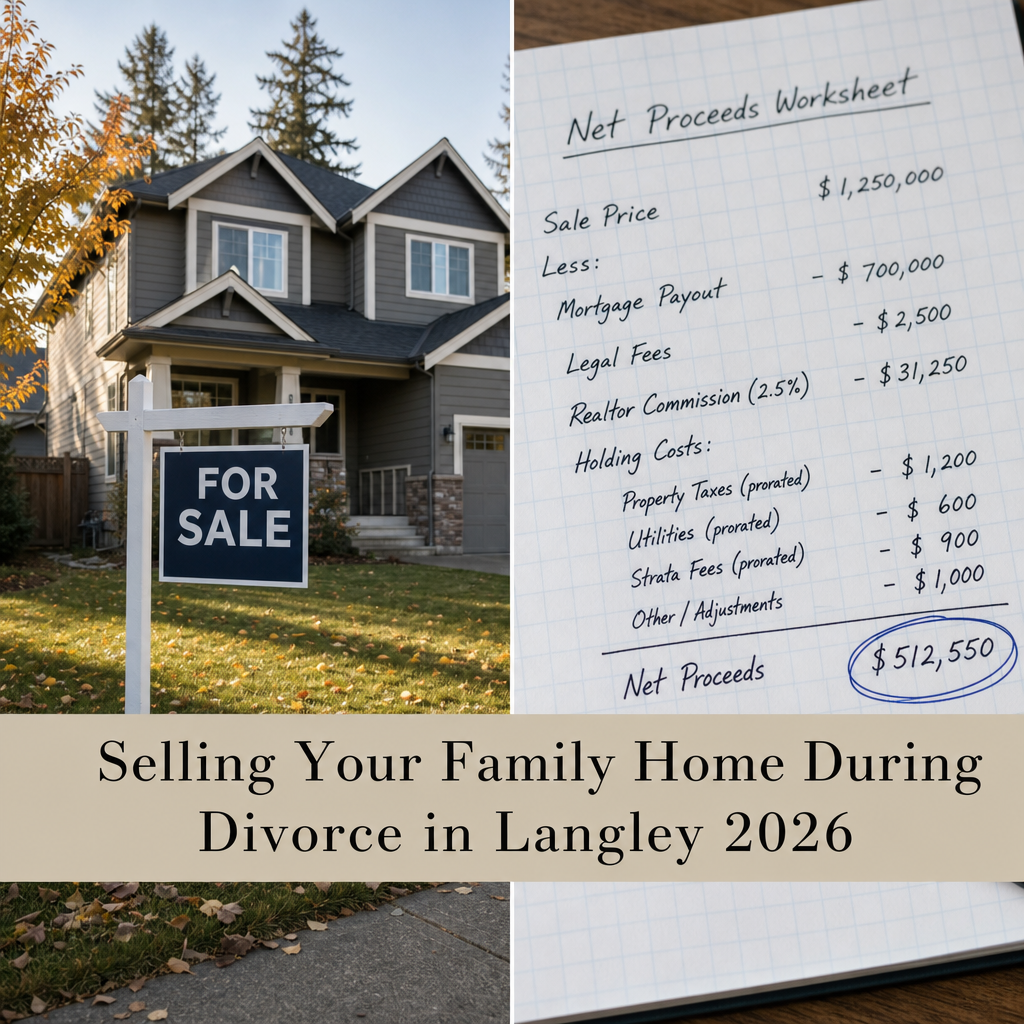

Selling Your Family Home During Divorce in Langley 2026: Market Timing, Inventory Advantage, and Net Proceeds Strategy in the Fraser Valley Buyer's Market
By Mohamed Mansour, MBA and Associate Broker, Mansour Real Estate Group | Fraser Valley Edition | Published: July 2026 | Geographic Focus: Langley, BC and Fraser Valley
For separating homeowners in Langley, the 2026 market adds a layer of complexity to an already difficult situation. Active listings in the Fraser Valley have surpassed 10,000 — roughly 50 percent above the ten-year seasonal average — and buyers currently hold the upper hand. In this environment, the decisions made before listing, not after, determine how much equity each spouse walks away with.
This guide is written specifically for Langley. The dynamics here differ from Burnaby, Coquitlam, and even Surrey, and divorcing homeowners need local data and honest expectations — not generalized advice. Mansour Real Estate Group has managed divorce-related property sales across Langley, Willoughby, Walnut Grove, and Cloverdale for more than two decades. What follows reflects that experience directly.
Short Answer
In Langley's 2026 buyer's market, divorcing homeowners who price competitively from day one are completing sales in 39 to 45 days. Those who overprice are sitting for 60 to 90 days while holding costs reduce net proceeds. With benchmark prices stable but not appreciating, there is no financial case for delay.
Key Takeaways
- Fraser Valley active listings exceeded 10,000 in May 2026, 50% above the ten-year seasonal average, giving buyers maximum negotiating leverage.
- The sales-to-active ratio of 11–12% confirms a buyer's market; well-priced Langley detached homes still sell in approximately 39 days.
- Prices stabilized month-over-month for the first time in 11 months, but year-over-year remain down 0.8%; delay does not improve proceeds.
- Every 30-day delay adds mortgage payments, property taxes, utilities, and legal holding costs that reduce the net split directly.
- A Langley-specific pricing and timing strategy — not a generic divorce guide — determines whether both parties exit with maximum equity.
Who This Applies To
- Separating or divorcing spouses who jointly own a detached home, townhouse, or condo in Langley, Willoughby, Walnut Grove, or Cloverdale
- Homeowners where both parties agree to sell but need a neutral, structured process
- Families where one spouse wants to delay and the other needs clarity on the financial cost of waiting
- Executors or legal counsel advising clients on realistic Langley market timelines and net proceeds
When This Advice May Not Apply
If one spouse intends to buy out the other rather than sell — see our guide on buying out your spouse from the family home in BC — the market timing considerations shift. This article also does not address court-ordered sales where a judge has already fixed a listing timeline; for those situations, review our overview of court-ordered property sales in BC.
Data Used in This Article
- Fraser Valley Real Estate Board (FVREB) Statistics Package — April 2026 (official board data)
- Fraser Valley Real Estate Board (FVREB) Statistics Package — March 2026 (official board data)
- FVREB Monthly Market Report — May 2026 (official board data)
- Professional market interpretation by Mansour Real Estate Group based on active Langley transaction experience
Key Definitions
Sales-to-active listings ratio: The percentage of active listings that sell in a given month. Below 12% is a buyer's market. Above 20% favors sellers. At 11–12%, buyers have negotiating room and sellers must price accurately.
Days on market (DOM): The number of days from listing to accepted offer. Langley detached homes averaged 39 days in April–May 2026, per FVREB data. Each week beyond that adds carrying costs.
Net proceeds: What remains after the mortgage is paid out, realtor commission is deducted, legal fees are settled, and any holding costs during the listing period are subtracted. This is the amount available to divide.
Benchmark price: A representative price for a standard property in a given area, calculated by FVREB. It is not the same as average sale price and is less affected by outliers.
The Langley Market in 2026: What the Numbers Actually Mean for a Divorce Sale
According to the Fraser Valley Real Estate Board's April and May 2026 statistics packages, active listings in the Fraser Valley exceeded 10,000 — approximately 50 percent above the ten-year seasonal average. The sales-to-active ratio held at 11 percent in April and 12 percent in May, placing the market firmly in buyer's territory. For context, a balanced market sits between 12 and 20 percent.
Langley detached homes averaged 39 days on market. That figure matters specifically for divorcing homeowners because every additional week on market carries a direct financial cost — mortgage interest, property taxes, utilities, strata fees if applicable, and, in many cases, ongoing legal fees. A property that sits for 75 days instead of 39 days may cost the household $4,000 to $8,000 in holding costs alone, before accounting for any price reduction required to finally attract an offer.
The month-over-month stabilization in benchmark prices — the first in 11 months, per FVREB March–April 2026 data — is meaningful context. It signals the market is no longer in active freefall. But it does not mean appreciation is returning soon. Year-over-year, benchmark prices remain down 0.8 percent. For a separating couple asking whether to wait, the honest answer from the data is: the market is not expected to provide a materially better price in three to six months, and the cost of waiting is real and quantifiable. Explore the full Fraser Valley real estate market outlook for divorcing homeowners for the broader context behind these figures.
Why Langley Differs From Surrey, Burnaby, and Coquitlam
Langley operates at a different price point than Metro Vancouver. With an average price per square foot of approximately $549 across all property types — compared to $700 to $900 in many Metro Vancouver submarkets — Langley attracts a more rate-sensitive buyer pool. These buyers are typically first-time buyers, growing families, and move-up purchasers who have been watching the market carefully. In a buyer's market with 10,000 competing listings, they have the patience to wait for the right price.
That dynamic creates a specific risk for divorcing sellers who enter the market overpriced. In a supply-rich market where buyers have alternatives in Willoughby, Walnut Grove, Cloverdale, and across into Surrey and Abbotsford, a mispriced Langley listing does not just sit — it actively trains buyers to see the property as overvalued. Price reductions after extended DOM can actually weaken final sale price, as buyers factor in the days-on-market signal when submitting offers.
Langley townhouses and condos face additional pressure. The FVREB data shows condos averaging 43 days on market. In buildings where multiple units are simultaneously listed — a pattern common in newer Willoughby developments — individual sellers are effectively competing with their neighbours. A divorce sale in that environment requires precise positioning, not wishful pricing. For a full comparison of how these dynamics play out across the region, our guide on selling your home during divorce in BC provides the broader framework.
How We Evaluate This
When Mansour Real Estate Group is engaged for a divorce sale in Langley, our first step is a valuation process that is explicitly neutral — neither spouse's preferred price anchors the analysis. We use current FVREB benchmark data, active comparables within a tight geographic radius, and recent sold data adjusted for condition and days-on-market trends. The objective is a pricing recommendation both parties can review, verify, and accept as independent.
From there, we build a realistic net proceeds projection. That projection includes mortgage payout costs, legal fees (estimated, not guaranteed — clients confirm with their solicitors), commission, and an estimated holding cost range based on days-on-market averages for that property type and neighbourhood. Most separating couples have never seen this number laid out clearly before listing. When they do, the decision about pricing strategy usually becomes straightforward.
Net Proceeds Strategy: What Actually Reduces Your Take-Home
In a buyer's market, net proceeds are shaped by four variables: sale price, commission, mortgage payout, and carrying costs during the listing period. Divorcing homeowners in Langley often focus on sale price while underestimating the last two. A mortgage with a prepayment penalty — common in fixed-rate terms signed during the low-rate period of 2020 to 2022 — can reduce net proceeds by $8,000 to $20,000 depending on the remaining term and lender formula. Clients should obtain their exact payout figure from their lender before listing.
Carrying costs during extended marketing compound quickly. A $4,500 monthly carrying cost on a Langley detached home — mortgage payment, taxes, utilities, and insurance — means a 60-day listing versus a 39-day listing costs approximately $3,000 more in holding expenses. Multiply that by a contested listing situation where both parties resist early offers, and the financial damage becomes concrete. Our equity split guide for BC divorces explains how these deductions interact with the final division calculation.
Divorce Sale Checklist — Langley 2026
- Obtain a written mortgage payout statement from your lender, including any prepayment penalty, before setting a list price.
- Request an independent, neutral comparative market analysis (CMA) from your realtor based solely on FVREB data — not anchored to either spouse's price expectation.
- Calculate a realistic net proceeds projection including commission, legal fees, mortgage payout, and 39 to 60 days of carrying costs.
- Confirm both spouses agree in writing — via legal counsel — on an acceptable price range and offer conditions before the property lists.
- Ensure the home is show-ready: in Langley's 2026 market, buyers have alternatives and will pass on properties requiring work when comparable move-in-ready homes are available nearby.
- Establish a clear communication protocol: offers are reviewed by both parties through counsel, not direct negotiation between spouses during an emotionally charged listing period.
- Review strata documents if selling a townhouse or condo in Willoughby or Walnut Grove — buyers will request Form B and meeting minutes; gaps or special levies will surface during due diligence.
Common Mistakes That Cost Sellers
In our experience, the most costly mistake divorcing Langley sellers make is pricing to the peak. One spouse anchors to a 2022 or early 2023 comparable — often from a neighbour's sale during the market high — and resists a list price aligned with current conditions. In a market with 10,000 active listings, buyers do not negotiate down to fair value from an aspirational price. They move on to the next listing.
What often happens is a price reduction 21 to 30 days in — after the listing has gone stale — that drops the price to where it should have started. The result is a longer DOM, higher holding costs, and, frequently, a lower final sale price than a well-priced first listing would have achieved. The price reduction signals distress to buyers, who then submit lower offers.
A third pattern we see regularly is delayed decision-making on offers. When both spouses must independently review and respond to an offer through separate legal counsel, the response window can stretch past the subject removal deadline. Well-qualified buyers in Langley are not waiting. They have alternatives. A structured offer review process agreed on before listing prevents this loss.
Frequently Asked Questions
Q: Is 2026 a bad time to sell a family home in Langley during a divorce?
Not if the property is priced correctly. FVREB data shows well-priced Langley detached homes still sell in approximately 39 days. The risk is not the market — it is overpricing in a market where buyers have abundant alternatives and no urgency to overpay.
Q: How much does waiting three months cost in holding expenses on a Langley home?
At an estimated $4,000 to $5,000 per month in mortgage payments, taxes, utilities, and insurance, a 90-day delay costs approximately $12,000 to $15,000 before any legal costs are added. That amount reduces the equity available to divide. Confirm your exact carrying costs with your mortgage lender and accountant.
Q: Can one spouse refuse to accept an offer in a Langley divorce sale?
Yes, unless a court order or separation agreement specifies otherwise. If one spouse is blocking a reasonable offer, the other may apply under the Partition of Property Act or seek a court order. Consult your family law lawyer. Our article on the Partition of Property Act in BC explains this process in detail.
In Summary
Langley's 2026 buyer's market does not make a divorce sale impossible — it makes pricing discipline and process clarity more important than they would be in a balanced market. With active listings at record seasonal highs, buyers have choice, and mispriced homes sit. The financial cost of sitting is concrete and compounds weekly. Divorcing homeowners who enter with a neutral valuation, a realistic net proceeds projection, and an agreed offer-review process protect more equity than those who list with unresolved price disagreements or unrealistic expectations. The market data supports acting with a clear strategy now, not waiting for conditions that may not materialize.
Speak With a Langley Divorce Sale Specialist
If you and your spouse are preparing to sell a family home in Langley and want a neutral, data-based market assessment and a clear net proceeds projection before you list, Mansour Real Estate Group is available for a confidential consultation. There is no pressure and no obligation — just local expertise and honest numbers.
Related Articles
- Selling Your Home During Divorce in BC: A Complete Guide for Metro Vancouver and Fraser Valley Homeowners
- The Step-by-Step Process of Selling a Family Home During Divorce in Surrey
- Divorce Home Sales in White Rock and South Surrey: A Local Market Guide for Separating Homeowners
- Who Is the Best Realtor for a Divorce Property Sale in Langley, White Rock, and the Fraser Valley?
- Fraser Valley Real Estate Market Outlook 2026: What Divorcing Homeowners Should Know Right Now
About Mansour Real Estate Group
When a home must be sold as part of a separation or divorce in Langley, the stakes extend well beyond the property itself. Pricing accuracy, neutral communication between parties, and a clear net proceeds strategy all require a real estate team that understands how to manage complexity with professionalism. Mansour Real Estate Group has worked with separating homeowners and families across Langley, Willoughby, Walnut Grove, Cloverdale, and the broader Fraser Valley for more than two decades, bringing a structured, valuation-first approach to situations where clarity matters most.
Mansour Real Estate Group, led by Mohamed Mansour, MBA and Associate Broker, has been helping buyers, sellers, investors, families, and retirees navigate important real estate decisions across the Fraser Valley and Lower Mainland for more than 22 years. Ranked among the Top 1% of Realtors in the region, the real estate team has completed more than $780 million in residential transactions and is trusted for divorce-related property sales, estate sales, downsizing, relocation, and complex situations requiring neutral, experienced management.
Whether someone is searching for a Langley Realtor experienced with divorce property sales, a real estate agent who understands how separation affects pricing and timing, real estate agents familiar with Willoughby and Walnut Grove market conditions, or a Fraser Valley real estate broker who can manage a joint sale with discretion, Mansour Real Estate Group is known for clear communication, accurate valuations, and a process that protects both parties equally.
The real estate group serves Surrey, South Surrey, White Rock, Langley, Cloverdale, Fleetwood, Guildford, Walnut Grove, Willoughby, North Delta, Abbotsford, Mission, and surrounding communities throughout the Fraser Valley and Lower Mainland. Most new clients come from referrals, repeat clients, and families who value a professional, transparent, and results-driven experience.
Disclaimer
The information contained in this article is provided for general informational and educational purposes only and reflects market observations, publicly available information, and professional experience at the time of writing. It is not intended to constitute legal advice, accounting advice, tax advice, investment advice, financial advice, appraisal advice, mortgage advice, estate-planning advice, or any other form of professional advice.
Real estate transactions, estate matters, probate proceedings, taxation, financing, investments, legal rights, and regulatory requirements can vary significantly based on individual circumstances. Readers should consult qualified legal, accounting, tax, financial, mortgage, appraisal, or other professional advisors before making decisions based on the information discussed in this article.
Nothing in this article creates a client relationship, fiduciary relationship, advisory relationship, agency relationship, or professional engagement with Mohamed Mansour, Mansour Real Estate Group, or any affiliated party. Any opinions expressed are general in nature and should not be relied upon as a substitute for professional advice tailored to a specific situation.
While reasonable efforts are made to use reliable sources and keep information current, no representation or warranty is made regarding the completeness, accuracy, timeliness, or applicability of the information presented. Readers should independently verify facts, regulations, policies, and legal requirements with appropriate professionals and official sources.