
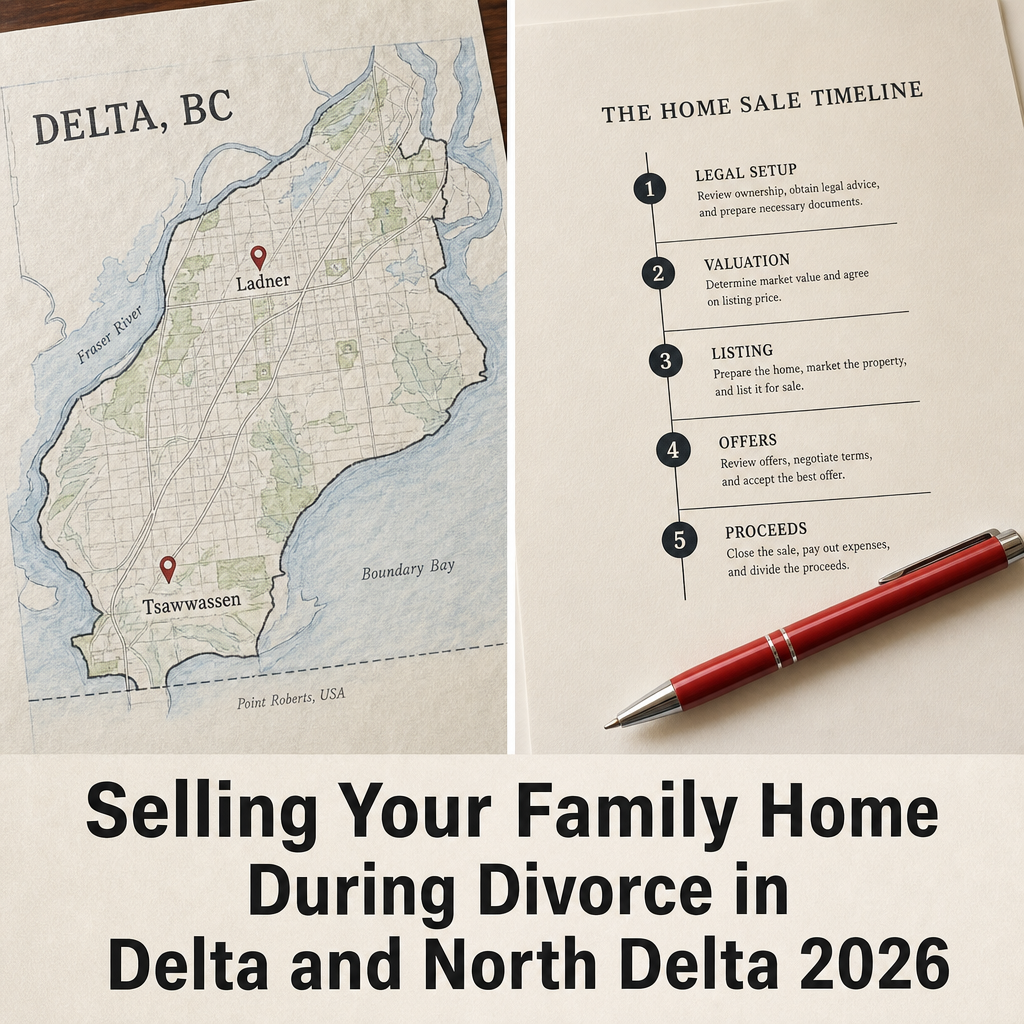

Selling Your Family Home During Divorce in Delta and North Delta 2026: A Step-by-Step Guide from Legal Setup Through Listing, Offers, and Proceeds Distribution in a Buyer's Market
By Mohamed Mansour, MBA and Associate Broker | Mansour Real Estate Group | Published: July 14, 2026 | Fraser Valley and Lower Mainland, BC
Separating homeowners in Delta and North Delta face a property sale that is more complicated than most. BC's Family Law Act governs how family property is divided, and Delta's distinct submarkets — Ladner's village character, Tsawwassen's gateway appeal, and North Delta's family-oriented detached inventory — each respond differently to current market conditions. Getting the process right from the start protects both parties and reduces the risk of a prolonged, disputed sale.
This guide covers every stage: the legal framework, submarket valuation, listing strategy in a buyer's market, offer review with two-party coordination, and net-proceeds distribution. It is written for homeowners in Delta and North Delta who need practical, locally grounded guidance, not generic divorce advice that ignores how this market actually works in 2026.
Short Answer
In a buyer's market with Fraser Valley inventory above 10,000 active listings and months of inventory at 7.7, divorcing homeowners in Delta and North Delta should prioritize accurate submarket valuation, neutral realtor coordination, and precise legal setup before listing. Pricing to Delta's specific submarket — not the Fraser Valley average — is what separates a clean sale from a prolonged one.
Who This Applies To
- Separating spouses who jointly own a detached family home in North Delta, Ladner, or Tsawwassen
- Homeowners with agricultural or rural parcels in Delta requiring specialized positioning
- One-party-occupied homes where the other spouse needs structured, neutral sale management
- Couples navigating a court-ordered or consent-order sale under BC's Family Law Act
- Separating homeowners considering a spousal buyout and needing current fair market value data
When This Advice May Not Apply
If one spouse held the property as excluded property before the relationship, or if a prenuptial agreement governs the split, property division may differ significantly from the default equal-division rules. Consult a BC family lawyer before proceeding. This article does not constitute legal or financial advice.
Key Takeaways
- Delta's Ladner, Tsawwassen, and North Delta submarkets require separate pricing strategies — applying a Fraser Valley average to any one of them will misprice the property.
- Fraser Valley inventory exceeded 10,000 active listings in May 2026, giving buyers negotiating leverage and making precise list pricing more important than ever for divorce sellers.
- A Certificate of Pending Litigation filed by one spouse can delay or complicate a sale; legal setup — including a consent order or separation agreement clause — should be completed before listing.
- Benchmark prices in the Fraser Valley stabilized in early 2026 after 11 months of decline, giving both parties a clearer basis for fair market value appraisals and equity division calculations.
- A neutral realtor agreed upon by both spouses reduces conflict at offer review and protects the sale from collapsing due to disagreement over price, conditions, or buyer qualification.
Data Used in This Article
- Fraser Valley Real Estate Board — April 2026 Statistics Package (official, fvreb.bc.ca)
- Fraser Valley Real Estate Board — March 2026 Statistics Package (official, fvreb.bc.ca)
- Fraser Valley Real Estate Board — Monthly Market Report, May 2026 (official)
- BC Government — Family Law Act, SBC 2011, c 25 (primary legislation)
Key Definitions
Family Property (BC Family Law Act): All property owned by either or both spouses at the date of separation, subject to specific exclusions such as pre-relationship assets and inheritances. Default division is equal unless a court orders otherwise.
Certificate of Pending Litigation (CPL): A document registered on title to signal that a legal claim exists against the property. It prevents a clean transfer until resolved and can effectively freeze a sale. See the full explanation at The Certificate of Pending Litigation in BC Divorce.
Consent Order: A court order agreed to by both parties that can authorize and govern the sale of family property, including listing price thresholds, realtor selection, and proceeds distribution.
Months of Inventory: The number of months it would take to sell all active listings at the current sales pace. Above 6 months is generally considered a buyer's market. Fraser Valley sat at 7.7 months in May 2026, per FVREB data.
Benchmark Price: The price of a "typical" property in a given area and category, as calculated by the FVREB. As of April 2026, the Fraser Valley composite benchmark was approximately $975,305.
Understanding Delta's Three Submarkets Before You Price
Delta is not a single market. Ladner, Tsawwassen, and North Delta attract different buyers, carry different price premiums, and behave differently under inventory pressure. Divorcing homeowners who treat them as one market will either leave equity on the table or overprice and sit.
Ladner offers a village feel with waterfront access, older housing stock, and a buyer profile that values character and community. Its relatively limited detached inventory can support stronger pricing when demand holds, but in a buyer's market with 7.7 months of inventory across the Fraser Valley, competition from newer North Delta stock affects buyer attention spans.
Tsawwassen carries a gateway premium — buyers here are often drawn by the ferry connection, the mall corridor, and newer development. Agricultural and rural parcels on the Tsawwassen periphery require separate valuation logic entirely; farm-use zoning and ALR restrictions affect who can buy and at what price.
North Delta is the most active residential submarket for typical family detached sales, with a buyer profile that overlaps strongly with families also considering Surrey and Langley. That cross-market competition matters in 2026: with Langley divorce home sales drawing from the same buyer pool, North Delta sellers need precise pricing to pull buyers away from comparable listings across the border.
For any submarket in Delta, the pricing analysis for a divorce sale must be grounded in local comparable sales — not the broader Fraser Valley benchmark — and should be completed by a realtor with direct transaction history in the area. A neutral appraisal can also anchor the valuation when spouses disagree. For more on how real estate is divided in a BC divorce, see the foundational guide in this series.
The Legal Setup: What Must Be in Place Before You List
The most common mistake divorcing homeowners in Delta make is listing before the legal framework is settled. A signed listing agreement between two separated spouses without a clear written basis for the sale — a separation agreement clause, consent order, or court direction — can create disputes mid-sale that collapse the transaction at the worst possible time.
Before listing, both parties should confirm in writing: who the realtor is, the minimum acceptable list price, the minimum acceptable sale price, how offers will be reviewed, and how proceeds will be held and distributed after closing. This does not require full divorce finalization — a separation agreement or interim consent order covering the real estate transaction is enough to proceed.
If a CPL has been registered on title by either party, it must be discharged or dealt with before the property can transfer. A buyer's lawyer will identify this immediately, and any offer accepted subject to clear title will require CPL resolution before completion. For context on when CPLs arise and how they are managed, review The Certificate of Pending Litigation in BC Divorce.
For court-ordered sales in Delta, the process follows the same BC Supreme Court pathway as other Fraser Valley properties. For a detailed breakdown, see Court-Ordered Property Sales in BC. The point is simple: legal clarity before listing protects both parties and protects the sale.
How We Evaluate This
At Mansour Real Estate Group, our approach to divorce property sales in Delta begins with a submarket-specific comparative market analysis — not a Fraser Valley-wide average — combined with a review of the legal documents in place before we advise on timing. We look at active competition by submarket, recent comparable sales within 90 days, days-on-market trends, and buyer feedback patterns from the current cycle.
In a buyer's market with 7.7 months of inventory, we advise clients to price at or just below the submarket median for their property type and condition — not above it — because overpriced properties in elevated-inventory conditions lose momentum fast and often require price reductions that signal weakness to buyers. For divorce sales specifically, we manage communication between both parties through a single point of contact so that offer review, counter-offer decisions, and closing logistics do not become friction points.
Divorce Sale Checklist for Delta and North Delta Homeowners
- Confirm with your BC family lawyer that a separation agreement or consent order covers the real estate sale before signing a listing agreement
- Conduct a title search to identify any CPL, existing liens, or encumbrances that must be cleared before transfer
- Obtain a submarket-specific CMA for Ladner, Tsawwassen, or North Delta — not a Fraser Valley-wide estimate
- Agree in writing on the list price range, minimum acceptable offer, and offer review process before the listing goes live
- Coordinate property access for showings through a neutral process that does not require the occupying spouse to receive direct communication from buyers or cooperating agents
- Disclose all known material latent defects on the property disclosure statement — both parties must sign
- Review the net-proceeds calculation with your realtor and lawyer before accepting any offer: proceeds less mortgage payout, realtor fees, legal fees, and any agreed adjustments
- Confirm that proceeds will be held in trust by a lawyer or notary and distributed per the separation agreement or court order — not paid directly to either spouse without written direction
Listing Strategy and Offer Review in a Buyer's Market
With the Fraser Valley sitting at 7.7 months of inventory as of May 2026 — well above the 6-month threshold for buyer-market conditions — buyers in Delta have options. They will negotiate on price, conditions, and possession dates. A divorce sale that enters the market overpriced will sit, attract low offers, and create conflict between spouses about whether to reduce.
Strategic list pricing in 2026 means analyzing the last 90 days of comparable sales in the specific Delta submarket, factoring in current competition, and pricing to attract offers within 10 to 14 days. Properties that do not receive offers in the first three weeks in this inventory environment are typically perceived by buyers as either overpriced or problematic — neither is helpful in a divorce context.
For offer review, both spouses must sign an acceptance in BC. When spouses are not on speaking terms, a realtor experienced in divorce sales serves as the neutral coordinator — presenting offers to each party separately, documenting responses, and managing counter-offer logistics without requiring both parties to be in the same room or on the same call. For more on what to look for when choosing that professional, see Who Is the Best Realtor for a Divorce Property Sale in Langley, White Rock, and the Fraser Valley.
Subject removal in the current market typically runs 7 to 10 business days for standard financing and inspection conditions. Divorce sellers should build this into their timeline expectations and ensure both parties understand what happens if buyers waive, extend, or do not remove subjects.
Proceeds Distribution: How the Money Flows After Closing
After completion, sale proceeds are held in trust by the conveyancing lawyer or notary until adjustments are finalized and both parties have provided written distribution direction per their agreement. Proceeds do not flow automatically to either spouse — the separation agreement or consent order must specify the split.
The net proceeds calculation is: gross sale price, less the existing mortgage payout, less real estate commissions and applicable taxes, less legal and notarial fees, less any agreed prepayment penalties or costs, less any agreed credits between spouses (such as one party's contribution to carrying costs during the separation period). What remains is the divisible equity.
For a detailed breakdown of how equity is calculated and split in BC, see How to Split the Equity in a Home During a Divorce in BC. For tax implications that may affect net proceeds, review Tax Implications of Selling the Family Home During Divorce in BC. Note that tax guidance is general — consult a qualified tax advisor or accountant for your specific situation.
What We Commonly See
Submarket mispricing: In our experience, the most frequent pricing error in Delta divorce sales is using a broad Fraser Valley benchmark rather than a Ladner, Tsawwassen, or North Delta comparable set. These submarkets can diverge by 10% or more on the same property type, and that gap directly affects both parties' equity.
Legal setup completed after listing: What often happens is that one spouse pushes to list quickly and the legal framework is still being finalized when offers arrive. This creates pressure to accept terms that neither party has properly reviewed, or to delay the sale while legal documents catch up — both of which cost money and increase conflict.
Agricultural or rural properties listed without ALR disclosure: A common mistake in the Tsawwassen and south Delta area is listing rural or agricultural parcels without clearly disclosing ALR restrictions and farm-use limitations in the listing. Buyers who discover these restrictions after subject removal may attempt to collapse the deal or renegotiate — a painful outcome in a divorce context.
Proceeds distributed without written direction: In our experience, disputes over proceeds distribution are most common when the separation agreement language is vague about timing, adjustments, or what costs are deducted before the split. A clear, itemized net-proceeds statement prepared before closing prevents this entirely.
Questions and Answers
Can one spouse list the Delta family home without the other's consent?
No. In BC, both registered owners must sign a listing agreement and any accepted offer. If one spouse refuses to cooperate, the other may apply to the BC Supreme Court for an order authorizing the sale. This process is outlined under BC's Family Law Act and the Partition of Property Act. See Can My Ex Force Me to Sell Our House in a BC Divorce for the full legal framework.
Does Delta's ALR zoning affect family property division in a divorce?
ALR zoning does not change how the property is divided — it is still family property subject to equal division. However, ALR restrictions limit the buyer pool and affect market value. Both parties should ensure the property is valued by someone with direct experience in agricultural or rural parcels in the Delta area, not a standard residential appraiser.
How do current market conditions in the Fraser Valley affect our sale timeline?
With the Fraser Valley at 7.7 months of inventory as of May 2026, sellers should budget 5 to 9 weeks from listing to completion for a well-priced property in Delta. Overpriced properties in this environment can sit for 60 to 90 days or longer. Both parties need realistic timeline expectations built into their post-separation financial planning. The Fraser Valley Market Outlook 2026 provides the full context.
What if one spouse is living in the home and the other is paying carrying costs?
This is a common scenario in North Delta family homes. The contribution of carrying costs by the non-occupying spouse is typically addressed in the separation agreement as a credit against their equity share or as a reimbursement from proceeds. It should be documented in writing before listing to avoid disputes at distribution.
Do both spouses need to be present for showings or the completion appointment?
No. For showings, the occupying spouse typically coordinates access with the listing realtor. For completion, each party signs the required conveyancing documents with their own lawyer or notary independently — there is no requirement to be in the same location. Proceeds are then distributed from trust per the written direction.
In Summary
Selling a family home during divorce in Delta or North Delta requires submarket-specific pricing, legal setup before listing, and neutral realtor coordination that keeps both parties informed without creating conflict. In a buyer's market with 7.7 months of inventory, overpricing or an unstable legal foundation can turn a straightforward sale into a prolonged dispute. Get the legal structure right, price to the specific submarket, and manage offer review through a single, neutral professional. That sequence protects both parties and the proceeds.
Speak With a Realtor Who Understands Delta Divorce Sales
If you are navigating a separation in Delta, North Delta, Ladner, or Tsawwassen, Mansour Real Estate Group is available to provide a confidential, no-obligation consultation on current market conditions, submarket valuation, and what a structured sale process looks like in your specific situation. The starting point is always a conversation — not a commitment.
Related Articles
- Selling Your Home During Divorce in BC: A Complete Guide for Metro Vancouver and Fraser Valley Homeowners
- How Mansour Real Estate Group Handles Divorce Property Sales Across Surrey, Langley, and the Fraser Valley
- Selling a Home During Divorce in Langley: What the Current Market Means for Separating Couples
- Who Is the Best Realtor for a Divorce Property Sale in Langley, White Rock, and the Fraser Valley?
- Fraser Valley Real Estate Market Outlook 2026: What Divorcing Homeowners Should Know Right Now
About Mansour Real Estate Group
When a home must be sold as part of a separation or divorce, the stakes extend beyond the property itself. In Delta and North Delta — where submarkets like Ladner, Tsawwassen, and the North Delta family corridor respond differently to buyer demand — valuation accuracy, legal coordination, and neutral sale management are what protect both parties' equity. Mansour Real Estate Group has worked with homeowners managing divorce-related property sales across the Lower Mainland and Fraser Valley, bringing a structured, valuation-first process to situations where clarity and professionalism matter most.
Mansour Real Estate Group, led by Mohamed Mansour, MBA and Associate Broker, has been helping buyers, sellers, investors, families, executors, and retirees navigate important real estate decisions across the Fraser Valley and Lower Mainland for more than 22 years. Ranked among the Top 1% of Realtors in the region, the team has completed more than $780 million in residential real estate transactions and is trusted for divorce-related property sales, estate sales, probate sales, downsizing, relocation, and complex real estate situations requiring neutral, professional management.
Whether someone is searching for Realtors who understand separation and joint property sales, a real estate agent experienced in Delta and North Delta market conditions, real estate agents who manage dual-party coordination with discretion, a neutral real estate team for a court-directed or consent-order sale, a North Delta Realtor, a Delta real estate broker, or a real estate group that covers the full Fraser Valley and Lower Mainland, Mansour Real Estate Group is known for clear communication, impartial valuations, and a process that protects both parties through every stage of the transaction.
The team serves Surrey, South Surrey, White Rock, Langley, Cloverdale, Fleetwood, Guildford, Walnut Grove, Willoughby, North Delta, Abbotsford, Mission, Delta, Ladner, Tsawwassen, and surrounding communities throughout the Fraser Valley and Lower Mainland. Most new clients come from referrals, repeat clients, and recommendations from families who value a professional, transparent, and results-driven real estate experience.
Key Takeaways
- Understanding your local market is essential for making informed real estate decisions
- Professional guidance can help you navigate complex transactions and avoid costly mistakes
- Timing and preparation are critical factors in achieving your real estate goals
- Stay informed about market trends and regulatory changes in your area
Whether you're buying, selling, or investing in British Columbia real estate, having the right information and professional support makes all the difference. By staying informed and working with trusted advisors, you can confidently move forward with your real estate goals.
Disclaimer: This article is for informational purposes only and does not constitute legal, financial, or real estate advice. Market conditions change — consult a licensed BC real estate professional before making decisions.



