
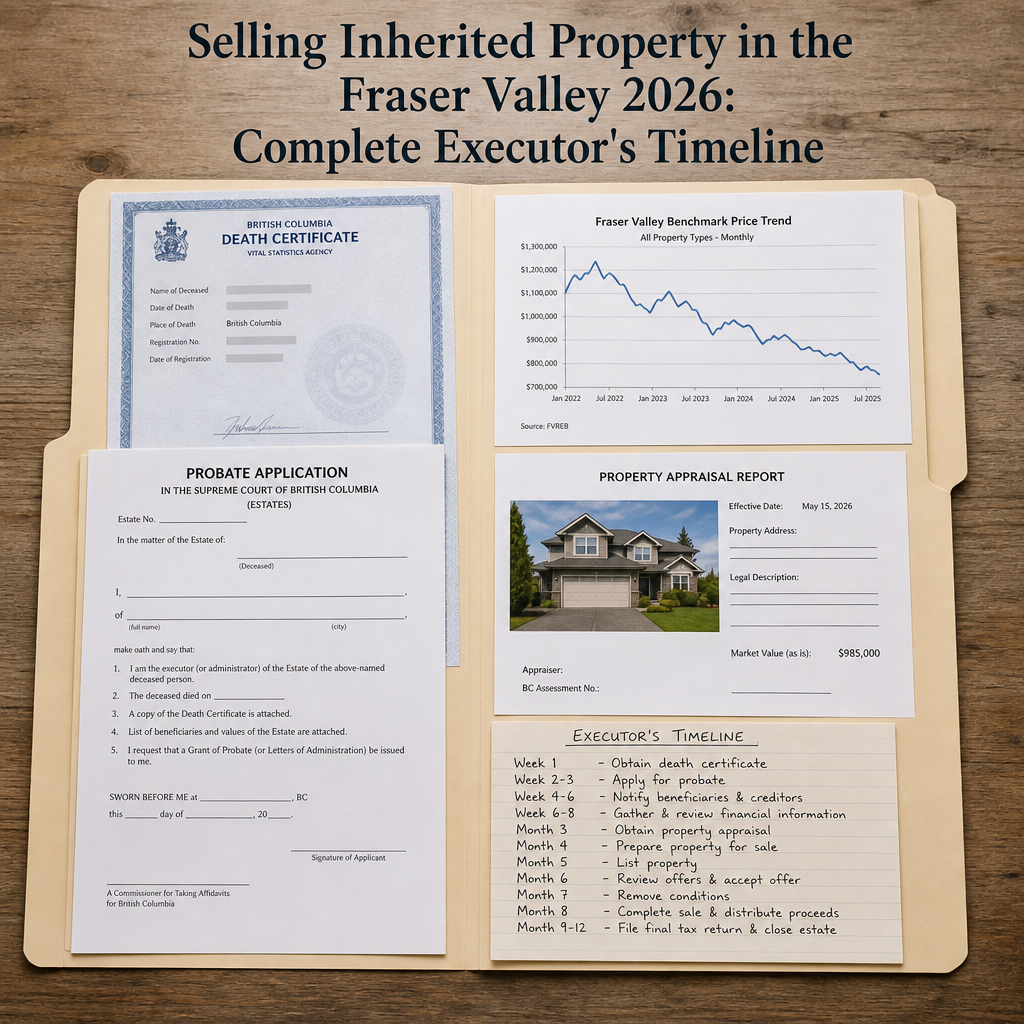

Selling Inherited Property in the Fraser Valley 2026: Complete Executor's Timeline From Death Certificate Through Probate, Fair Market Valuation, Strategic Listing, and Tax Planning to Maximize Estate Proceeds
By Mohamed Mansour, MBA and Associate Broker, Mansour Real Estate Group | Published: July 14, 2026 | Geography: Fraser Valley and Lower Mainland, British Columbia | Topic: Estate Sales, Probate Real Estate, Executor Strategy
Executors managing inherited property in the Fraser Valley in 2026 face a specific set of pressures: a soft buyer's market with elevated inventory, falling benchmark prices, and monthly carrying costs that erode estate value with every week of delay. This guide unifies the full decision-making framework—from week one after death through closing—so executors and beneficiaries can make informed, coordinated decisions rather than reactive ones.
The process is more manageable than it appears, but only when the legal, tax, valuation, and marketing timelines are understood together. What follows is the most complete resource available for estate property sales specific to Fraser Valley conditions in 2026.
Short Answer
Executors in BC can list an inherited property as early as three to four weeks after death with proper legal documentation, but cannot complete the sale without a grant of probate, which typically takes six to twelve months. In the Fraser Valley's current buyer's market—benchmark price $893,300, sales-to-active ratio 10% as of May 2026—early strategic listing almost always produces better outcomes than waiting for market recovery.
Who This Applies To
- Named executors managing a BC estate that includes real property
- Beneficiaries of an estate where the property must be sold to distribute proceeds
- Families with a jointly owned inherited property and multiple decision-makers
- Estates where the deceased held rental, investment, or vacation property in addition to a primary residence
- Executors with limited real estate experience navigating probate for the first time
When This Advice May Not Apply
If the estate is contested, if there are unresolved creditor claims, if title is unclear due to undischarged mortgages or liens, or if the property involves complex strata or agricultural land classification, consult an estate lawyer before taking any listing steps. This article addresses typical residential freehold and strata situations in the Fraser Valley.
Data Used in This Article
- Fraser Valley Real Estate Board Monthly Statistics Package, May 2026 — Official board data; benchmark price, sales volume, inventory, sales-to-active ratio
- BC Probate Court Timeline and Executor Authority Documentation — Provincial legal procedure; executor listing authority before grant of probate
- Canada Revenue Agency — Deemed Disposition Rules — Federal tax rules governing capital gains on inherited property
- Mansour Real Estate Group field observations — Internal professional experience; estate clearance timelines and carrying cost estimates across Fraser Valley transactions
Key Takeaways
- Listing can begin at weeks three to four; closing cannot happen without a grant of probate.
- Fraser Valley benchmark prices fell 7.3% year-over-year to $893,300 as of May 2026—a buyer's market that rewards early, well-priced listings.
- Deemed disposition at date of death creates a capital gains liability that must be calculated before the estate files its final tax return.
- Monthly carrying costs of $2,000 to $5,000 make extended waiting strategies financially costly for most estates.
- Principal residence exemption eligibility depends on the deceased's actual occupancy—incorrectly claiming it on a rental property triggers CRA audit.
How We Evaluate This
When Mansour Real Estate Group works with an executor, we begin by mapping four parallel timelines: the legal probate process, the tax reporting obligations, the property preparation and clearance schedule, and the market listing window. These timelines interact directly—a delay in one creates cost or risk in another. Our approach is to give executors a complete, sequenced picture in the first consultation so that no decision is made in isolation.
In a buyer's market like the Fraser Valley in 2026, we weight the carrying cost calculation heavily. An estate that loses $3,500 per month to property taxes, utilities, insurance, and any remaining mortgage while waiting for market conditions to improve is making a costly assumption. Our evaluation always includes a break-even analysis: how many months of improved pricing would be needed to offset carrying costs, and how realistic is that timeline given current inventory levels.
The Complete Executor's Timeline: Week by Week
Weeks 1–2: Immediate Stabilization
The first priority is securing the property and gathering documents. This means confirming utilities remain active to protect against water damage or break-ins, notifying the home insurer that the property is now vacant (standard home insurance typically lapses or changes terms after 30 days of vacancy—confirm this with the insurer immediately), and locating the will, title documents, and any existing mortgage statements.
Obtain a certified death certificate from BC Vital Statistics. This document is required for almost every subsequent step, including probate applications, title changes, and banking. Apply for multiple certified copies—estate lawyers, financial institutions, and the Land Title Office each require originals.
Weeks 3–4: Executor Authority and Early Listing Decision
A named executor in BC can authorize listing a property before a grant of probate is issued. The executor's authority derives from the will itself, and with certified executor documentation, a real estate agent can list the property on MLS. However, the sale cannot complete—no transfer of title, no receipt of funds—until probate is granted by the BC Supreme Court.
This matters enormously in the current Fraser Valley market. With 10,140 active listings and a sales-to-active ratio of 10% as of May 2026, according to the Fraser Valley Real Estate Board, well-priced properties still sell—but buyers have options and time. Listing early, accepting an offer with a long or flexible completion date, and aligning that date with the expected probate grant is a well-established and legally sound approach. It avoids the trap of waiting six to twelve months in a declining-price environment while paying full carrying costs.
This is also the window to engage an estate lawyer if one has not yet been retained, and to commission a certified appraisal for date-of-death fair market valuation. That appraisal is the foundation of the estate's tax reporting and cannot be skipped—see the tax section below.
Months 2–6: Probate Application and Property Preparation
The probate application is filed with the BC Supreme Court by the estate lawyer. BC courts typically take six to twelve months to issue a grant of probate, though simpler estates with no disputes may resolve faster. The executor cannot control this timeline, but can use it productively.
Estate contents clearance is one of the most underestimated tasks in this phase. Clearing furniture, personal effects, collections, and stored items from a family home typically takes four to eight weeks when using a professional estate sale company. Recovery rates through estate sales average 30 to 50 percent of assessed value on most household goods. Starting this process early avoids a last-minute rush that forces price reductions or delays a listing that buyers are already expecting.
Properties that have been properly cleared, cleaned, and lightly staged consistently attract stronger offers in the Fraser Valley market. A vacant, clean property photographs better, shows better, and allows buyers to visualize the space without the distraction of a prior life left in place. In a buyer's market, presentation is a competitive tool—not optional.
During this period, track all carrying costs carefully. Property tax, strata fees if applicable, utilities, insurance, lawn maintenance, and any mortgage interest are legitimate estate expenses. Keep receipts and a running log—these costs reduce the taxable estate and should be reported accurately.
Months 6–12: Grant of Probate and Closing Strategy
Once the grant of probate is issued, the executor has full legal authority to complete the sale. If an offer was accepted before probate, the completion date is now set. If the property is still listed, the executor can now accept an offer with a standard completion timeline. The estate lawyer transfers title through the Land Title Office, mortgage is discharged if applicable, and net proceeds flow to the estate account for distribution to beneficiaries after tax obligations are settled.
Fair Market Valuation and Capital Gains Tax: What Executors Must Understand
Under the Canada Revenue Agency's deemed disposition rules, when a property owner dies, the estate is treated as having sold the property at fair market value on the date of death—regardless of whether it is actually sold. This triggers a capital gains calculation: the difference between fair market value at death and the adjusted cost base (original purchase price plus qualifying capital improvements) is the capital gain. Fifty percent of that gain is included in the deceased's final income tax return.
For a Fraser Valley property purchased in 2005 at $350,000 and valued at $950,000 at date of death in 2026, the capital gain is $600,000. The taxable amount included in the final return is $300,000. At a combined marginal rate, the tax liability on that alone could reach $100,000 or more. This is not a hypothetical—it is a routine calculation for estates involving properties held for fifteen or more years in the Lower Mainland.
A certified appraisal from a designated appraiser (AACI or CRA-acceptable equivalent) is the defensible basis for this calculation. A realtor's comparative market analysis can support the appraisal but is not a substitute for CRA purposes. Executors who skip the formal appraisal and use an estimate risk CRA reassessment, interest charges, and penalties.
The principal residence exemption can eliminate capital gains tax entirely if the property qualified as the deceased's principal residence for every year of ownership. However, executors must confirm the actual occupancy history. A home that was rented for any portion of ownership—or that the deceased listed as a rental on prior tax returns—does not qualify for full exemption. Incorrectly claiming the exemption on a rental or investment property is one of the most common and costly executor errors in estate administration. Consult the estate's accountant or tax lawyer before claiming.
Listing Strategy in a 2026 Fraser Valley Buyer's Market
The Fraser Valley Real Estate Board reported a benchmark composite price of $893,300 in May 2026, down 7.3% year-over-year. Sales reached 1,124 units against 10,140 active listings—a sales-to-active ratio of 10%, which places the market firmly in buyer's market territory. In this environment, properties that are overpriced sit, accumulate days-on-market stigma, and eventually sell at a lower price than an accurate early listing would have achieved.
For estate sellers, the instinct to hold out for a better price is understandable—beneficiaries want to maximize proceeds. But in a market where prices fell 7.3% year-over-year and inventory is high, the break-even math rarely supports waiting. An estate paying $3,000 per month in carrying costs needs a $36,000 price improvement over twelve months just to break even—and in the current trajectory, prices would need to reverse direction to get there.
Effective listing strategy for estate properties in 2026 involves accurate, market-supported pricing from day one; preparation and clearance completed before the listing goes live; professional photography that presents the property as clean and move-in ready; and realistic expectations about days-on-market in the current climate. For properties with deferred maintenance or dated finishes, the pricing adjustment should reflect what a buyer will spend post-purchase—attempting to sell an unrenovated property at post-renovation pricing does not work in a buyer's market.
In some cases—particularly for detached homes in Surrey, Langley, and Abbotsford—light cosmetic updates such as fresh paint, flooring repair, or landscaping may produce returns that justify the cost and delay. This is a case-by-case analysis, not a universal recommendation. A knowledgeable estate real estate team can walk through the numbers before any money is spent on improvements.
Key Definitions for Executors
Grant of Probate: A BC Supreme Court order confirming the executor's authority to administer the estate, including completing real property sales and distributing proceeds to beneficiaries.
Deemed Disposition: The CRA rule treating a deceased's assets as sold at fair market value at date of death, triggering capital gains tax liability on the final return.
Adjusted Cost Base (ACB): The original purchase price of the property plus qualifying capital improvements, used to calculate capital gains.
Principal Residence Exemption: A CRA provision that eliminates capital gains tax on a property that qualified as the deceased's principal residence for every year of ownership.
Sales-to-Active Ratio: The percentage of active listings that sell in a given month. Below 12% is a buyer's market; above 20% is a seller's market. The Fraser Valley ratio was 10% in May 2026.
Benchmark Price: The FVREB's price measure for a typical property, adjusted for quality, and considered more stable than average or median prices.
Estate Sale Checklist
- Obtain certified death certificate and multiple copies from BC Vital Statistics
- Confirm vacant property insurance coverage with the insurer immediately
- Retain an estate lawyer and begin probate application within the first four weeks
- Commission a certified appraisal for date-of-death fair market value within thirty days
- Confirm principal residence exemption eligibility with the estate's accountant before claiming
- Begin estate contents clearance process by week three or four—allow four to eight weeks
- Confirm executor authority documentation with the real estate team before listing
- Build listing strategy around current market conditions, not hoped-for future pricing
- Track all carrying costs monthly as legitimate estate expenses
- Coordinate completion date in accepted offers to align with expected probate grant timeline
What We Commonly See
Executors wait for probate before listing. In our experience, this is the single most common and costly timing mistake in estate sales. Listing during the probate period with a flexible completion date is legally sound and saves months of carrying costs. Waiting until probate is granted before listing, in a slow market, means starting from scratch with a buyer pool that has already moved on.
Families overestimate what the property is worth. What often happens is that beneficiaries hold an emotional price—what the home felt worth to the family, or what a neighbour sold for in 2022. In a market where benchmark prices have fallen 7.3% year-over-year, listing at 2022 values produces months of no offers, followed by incremental reductions that signal distress to buyers. The property eventually sells below where it would have if priced correctly at the outset.
Principal residence exemption is claimed without verification. A common mistake is assuming that because the deceased lived in the home at some point, the full exemption applies. If the property was rented for any period, used as an investment, or was one of multiple properties the deceased owned, the exemption calculation changes materially. We consistently recommend that executors confirm this with the estate accountant before the final return is filed—not after the sale closes.
Questions Executors Commonly Ask
Can I list the property before probate is granted?
Yes. In BC, a named executor can authorize listing a property before a grant of probate is issued, using the will and certified executor documentation. The sale cannot complete until probate is granted, but listing early and accepting offers with extended or flexible completion dates is a standard and legally accepted approach.
What happens if we sell below fair market value?
CRA uses the date-of-death fair market value for deemed disposition purposes, not the eventual sale price. If the estate sells the property at market value or below after probate, the estate may realize a capital loss that can offset the deemed disposition gain. Selling to a beneficiary below market value creates additional tax complications—consult the estate lawyer before any below-market transaction.
How long does probate take in BC in 2026?
BC probate timelines typically run six to twelve months for straightforward estates, longer if the estate is contested or complex. The executor files the application through the BC Supreme Court, and the court issues the grant once the application is complete and any required waiting periods have passed. Your estate lawyer can provide a realistic estimate based on current court volumes in your jurisdiction.
In Summary
Selling inherited property in the Fraser Valley in 2026 requires coordinating four parallel tracks: legal probate authority, tax reporting and capital gains planning, property preparation and clearance, and strategic listing in a soft buyer's market. Executors who list early with accurate pricing, a certified date-of-death appraisal, and a completion date aligned to probate consistently achieve better outcomes than those who wait. With benchmark prices at $893,300 and a sales-to-active ratio of 10%, the market rewards preparation and accuracy—not optimism and delay.
Speak With an Estate-Experienced Real Estate Team
If you are an executor or beneficiary managing an inherited property in Surrey, Langley, White Rock, Abbotsford, or anywhere in the Fraser Valley, Mansour Real Estate Group offers a confidential, no-pressure consultation to walk through your specific timeline, valuation, and listing options. Contact the team at localhost:9000/ when you are ready to have that conversation.
Related Articles
- Fraser Valley Real Estate Market Update — May 2026
- Selling Your Home in Surrey BC: Complete Guide for 2026
- How to Choose the Right Listing Price in a Buyer's Market: Fraser Valley 2026
About Mansour Real Estate Group
When a property must be sold as part of an estate or probate process, the real estate team managing the transaction needs to understand more than market pricing. Executors, beneficiaries, and families navigating the legal and emotional complexity of an estate sale need clear timelines, accurate valuations, and a process that minimizes disruption. Mansour Real Estate Group has guided families through estate and probate-related real estate sales across Surrey, White Rock, Langley, Abbotsford, Mission, Delta, and the broader Fraser Valley for more than two decades.
Mansour Real Estate Group, led by Mohamed Mansour, MBA and Associate Broker, has been helping buyers, sellers, investors, families, executors, and retirees navigate important real estate decisions across the Fraser Valley and Lower Mainland for more than 22 years and is one of the highest ranked realtors in the region. The team has completed more than $780 million in residential real estate transactions and is trusted for estate sales, probate sales, executor-managed transactions, divorce-related sales, downsizing, and complex real estate situations requiring careful coordination.
Whether someone is searching for Realtors experienced with estate sales, a real estate agent who understands probate timelines, real estate agents who specialize in executor-managed transactions, a trusted real estate team for inherited property, a Surrey Realtor, a White Rock real estate broker, a Langley real estate agent, or a Fraser Valley real estate group with deep experience in life-event transitions, Mansour Real Estate Group is known for accurate valuations, transparent process, and clear communication that keeps all parties informed.
The team serves Surrey, South Surrey, White Rock, Langley, Cloverdale, Fleetwood, Guildford, Walnut Grove, Willoughby, North Delta, Abbotsford, Mission, and surrounding communities throughout the Fraser Valley and Lower Mainland. Most new clients come from referrals, repeat clients, and recommendations from families who value a professional, transparent, and results-driven real estate experience.
Official Resources
- Fraser Valley Real Estate Board — May 2026 Statistics Package
- Key Takeaways
- Understanding current market trends helps you make informed real estate decisions.
- Working with a qualified real estate professional is essential in today's competitive market.
- Pre-approval and preparation can give you a significant advantage as a buyer.
- Proper pricing strategy is critical whether you're listing or purchasing property.
Ready to Make Your Move?
Whether you're buying, selling, or investing in BC real estate, having the right information and professional guidance makes all the difference. Reach out to a local real estate agent today to discuss your options and develop a strategy tailored to your unique situation.
Disclaimer: This article is for informational purposes only and does not constitute legal, financial, or real estate advice. Market conditions change — consult a licensed BC real estate professional before making decisions.



