
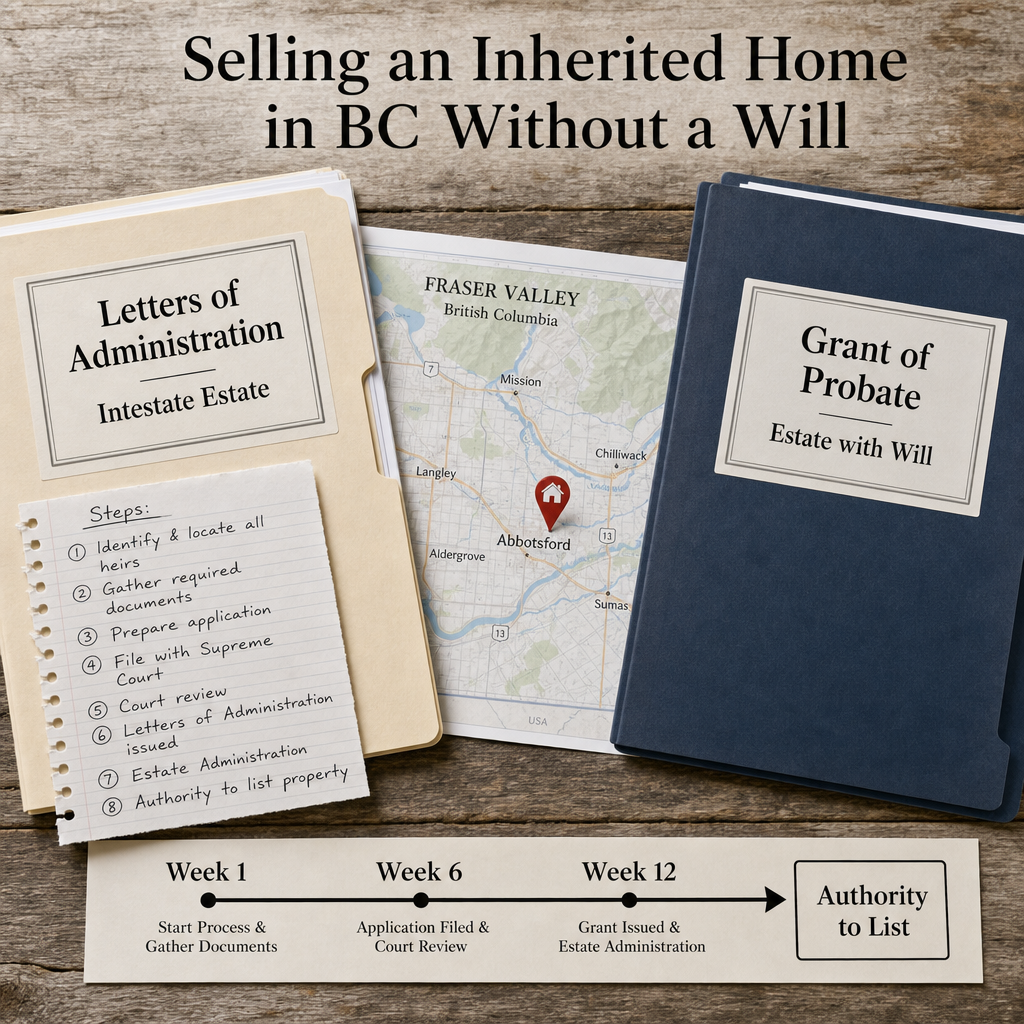

Selling an Inherited Home in BC Without a Will: Letters of Administration vs. Grant of Probate — Timeline, Authority to Sell, and Strategic Listing Decisions for Executors and Administrators in Metro Vancouver and the Fraser Valley
By Mohamed Mansour, MBA and Associate Broker · Mansour Real Estate Group · Fraser Valley and Lower Mainland, BC · Published: May 15, 2026 · Topic: Estate and Probate Sales
When a family member dies without a will in British Columbia, the path to selling their home is longer, more expensive, and more legally complex than most families expect. The process is governed by the Wills, Estates and Succession Act (WESA), and until a court issues Letters of Administration confirming who has authority over the estate, no one can legally list or transfer the property. For families trying to act quickly in a competitive spring market, that distinction matters.
This article explains how Letters of Administration differ from a Grant of Probate, what the realistic timelines look like in BC courts, when and how a property can be pre-marketed during the waiting period, and what strategic listing decisions administrators and families can make now to protect the estate's value. The guidance here is informational — always work with a qualified BC estate lawyer for your specific situation.
Short Answer
When someone dies without a will in BC, an administrator must apply to the court for Letters of Administration before they can sell the property. This typically takes 6 to 12 weeks. A Grant of Probate, used when a will exists, follows a similar but often faster path. In both cases, strategic pre-marketing can preserve your listing window — but legal authority must come first.
Key Takeaways
- Letters of Administration are required when there is no will — they confirm who can legally manage and sell the estate property.
- The application process typically takes 6 to 12 weeks in BC Supreme Court, though complexity, heir disputes, and backlogs can extend this.
- Properties can be pre-marketed as "pending Letters of Administration" to capture buyer interest without completing a sale during the waiting period.
- Multiple heirs in intestate estates must reach consensus on price, agent, and timing — creating delays that do not exist in single-executor scenarios.
- With Fraser Valley active listings at 9,816 in April 2026 — 50% above the 10-year seasonal average — delay costs negotiating leverage.
Who This Applies To
- Adult children or spouses managing a parent's estate when no will exists
- Administrators applying for Letters of Administration in BC Supreme Court
- Families with multiple heirs who must agree on the property sale
- Executors with a will navigating probate in Surrey, Langley, Abbotsford, or White Rock
- Families comparing their options in Metro Vancouver or the Fraser Valley in 2026
When This Advice May Not Apply
If the property was held in joint tenancy with a right of survivorship, title transfers automatically to the surviving owner and the probate or administration process may not apply to that asset. Properties held through a trust, or small estates below certain thresholds, may also follow different procedures. Consult a BC estate lawyer to confirm which process governs your specific situation.
Key Definitions
Letters of Administration: A court order issued by the BC Supreme Court that authorizes a named administrator to manage and sell the estate of a person who died without a will (intestate).
Grant of Probate: A court order confirming that a will is valid and that the named executor has authority to administer the estate, including selling property.
Intestate: Dying without a valid will. BC's Wills, Estates and Succession Act determines who inherits and who has priority to apply as administrator.
WESA: The Wills, Estates and Succession Act, the BC legislation governing inheritance, executor and administrator authority, and estate distribution when a will is absent or contested.
Administrator: The court-appointed person responsible for managing an intestate estate. This is typically the surviving spouse or an adult child, in priority order set by WESA.
Data Used in This Article
- Fraser Valley Real Estate Board (FVREB) Statistics Package, April 2026 — official monthly market report; sales-to-active listings ratio, active listing counts. Source: fvreb.bc.ca
- Wills, Estates and Succession Act (WESA) — BC legislation governing intestate succession and estate administration. Source: Government of British Columbia
- Land Title Act, BC — governs title transfer requirements including court authorization for estate sales
- CMHC Housing Market Outlook — national and regional housing market context. Source: cmhc-schl.gc.ca
Letters of Administration vs. Grant of Probate: What Is Actually Different
Both instruments serve the same fundamental purpose: they confirm to the Land Title Office and to buyers that a specific person has legal authority to sell the estate property. Without one or the other, no sale can complete. But the path to getting there differs significantly.
A Grant of Probate starts with a will. The named executor files an application in BC Supreme Court confirming the will is valid, the deceased is identified, and the assets are accounted for. This process typically takes 8 to 16 weeks depending on court backlog and estate complexity. The executor's authority is established in the will itself — the court is confirming it, not creating it from scratch.
Letters of Administration start from zero. When there is no will, the court must determine who has the right to administer the estate — usually the spouse first, then adult children in equal priority under WESA, then other relatives. The applicant must file a notice to all other persons who share equal or higher priority, giving them an opportunity to consent or contest. This adds procedural steps that are simply absent when a will names an executor.
In practice, Letters of Administration in BC courts currently take approximately 6 to 12 weeks for straightforward applications. Complex cases — contested priority, heir-tracing, missing documents — can take longer. During this period, the administrator has no legal authority to sign a contract of purchase and sale or transfer title.
For families managing estate properties in Surrey, Langley, Abbotsford, or White Rock, this distinction determines how early the listing process can realistically begin. See also our overview of BC probate timelines for the full picture when a will is present.
Why Intestate Estates Cost More and Take Longer
Legal fees for intestate administration typically run 50 to 100% higher than probate with a will. The reasons are procedural. Without a will, the estate lawyer must confirm priority among potential administrators, file notice to all competing claimants, and sometimes undertake heir-tracing if family members are unlocated or deceased. Each of these steps adds billable time and court filing costs.
Title search requirements are also more complex. The Land Title Office requires confirmation that the administrator has been granted authority before it will process a transfer. If the property has encumbrances, easements, or title complications — common in older Fraser Valley homes — the estate lawyer's work expands further.
Then there is the heir consensus problem. When a will names a single executor, that person makes decisions — about listing price, timing, agent selection, and sale conditions — within the bounds of their fiduciary duty. In an intestate estate with three adult children as equal heirs, all three must agree. In our experience, this is where meaningful delays often originate, not from the court, but from the family. For a detailed discussion of how families can navigate these dynamics, see our article on managing estate sales when family members disagree.
The combination of legal cost, procedural delay, and family coordination pressure is one reason why intestate estate sales in Metro Vancouver and the Fraser Valley benefit from early professional guidance — from both an estate lawyer and a real estate team experienced with this type of transaction.
How We Evaluate This
At Mansour Real Estate Group, we approach estate and intestate property sales with a sequenced process. We begin with a valuation conversation — even before Letters of Administration are issued — so families understand what the property is worth, what the current market looks like, and what timing options exist. This removes ambiguity from heir consensus conversations and gives the estate lawyer a realistic value framework when preparing court filings.
We also assess whether a pre-marketing strategy is viable. Not every property benefits from pre-marketing, and not every family is ready to have buyers walking through a home before the legal process resolves. But in a spring market with a 11% sales-to-active listings ratio (FVREB, April 2026) and 9,816 active listings competing for buyer attention, the cost of a two-month delay is real and measurable. Our role is to give families the information to make that decision with their eyes open — and to be ready to list the moment Letters of Administration are granted. For a broader view of how we structure the sale process, see The Complete Executor's Guide to Selling an Inherited Home in BC.
Can You List Before Letters of Administration Are Granted?
Yes, with important limits. A property can be pre-marketed or listed as "pending Letters of Administration" — meaning the property is shown to buyers and offers may be received — but no contract can be accepted and no completion can occur until Letters of Administration have been issued by the court.
This approach has real strategic value in the current Fraser Valley market. As the FVREB's April 2026 statistics package confirms, active listings are running approximately 50% above the 10-year seasonal average. Getting a property in front of buyers during the spring window — before summer inventory compounds competition — can protect the estate's sale price even if closing happens 4 to 6 weeks later.
The mechanics require careful coordination. Offers must be written with appropriate subject conditions that address the pending legal authority. Buyers must understand and accept the timeline. The listing must be accurately represented as an estate sale pending court authorization. This is not a standard listing — it requires a real estate team familiar with how BC estate transactions are documented and disclosed. For more on this approach, see our article on listing an inherited home before probate is granted in BC.
Whether pre-marketing is appropriate depends on the property condition, heir readiness, and estate lawyer timing. It is not automatic — but for families who have already begun the court application and are weeks away from receiving Letters of Administration, it is often the right move to protect market timing.
Market Context: Why the 2026 Fraser Valley Timing Window Matters
According to the FVREB's April 2026 statistics package, the Fraser Valley recorded 9,816 active residential listings — roughly 50% above the 10-year seasonal average. The sales-to-active listings ratio sat at approximately 11%, which falls within buyer's market territory. Month-over-month benchmark prices showed modest improvement of approximately 1.4%, suggesting early stabilization but not a seller-favourable recovery.
For estate properties, this context creates a specific strategic challenge. Spring is historically when buyer activity peaks in Surrey, Langley, and Abbotsford. A two-to-three month delay caused by the Letters of Administration process — combined with the heir consensus timeline — can push a listing into the summer months, when competition from conventional sellers intensifies and buyer urgency decreases.
Estate properties that are vacant, require some preparation work, or carry dated interiors need every advantage the spring window provides. A property that might attract three or four offers in April may sit with one offer in July — at a lower price and with fewer conditions in the buyer's favour. This is not a reason to rush the legal process. It is a reason to start the legal process and the real estate preparation at the same time, not sequentially. Our article on when to list an estate property in the Fraser Valley explores seasonal timing in more detail.
Administrators who engage an estate lawyer and a real estate team simultaneously — rather than waiting for court authority before beginning real estate planning — typically recover more from the sale. The legal clock and the preparation clock can run at the same time.
Estate Sale Checklist for Intestate Administrators in BC
- Confirm priority to apply: Identify who has first right under WESA to apply for Letters of Administration — typically the spouse, then adult children.
- Retain a BC estate lawyer immediately: The court application process cannot begin until legal representation is in place; every week of delay matters.
- Secure vacant property insurance: Standard homeowner policies typically void coverage within 30 days of vacancy — arrange estate-specific coverage before or immediately after the death. See our guide on vacant home insurance for estate properties in BC.
- Request a pre-listing valuation: A real estate valuation from an experienced estate sale team provides the foundation for heir consensus conversations and court documentation before Letters of Administration are issued.
- Obtain a date-of-death appraisal: Required for capital gains and tax reporting — engage a certified appraiser early. For more detail, see our article on date-of-death appraisals for BC estate properties.
- Reach heir consensus in writing: Document agreement among all beneficiaries on agent selection, pricing strategy, and timing before the listing is prepared.
- Begin property preparation in parallel: Clearing, cleaning, minor repairs, and staging decisions can proceed while the court application is in process — they do not require legal authority to complete.
- Discuss pre-marketing with your estate lawyer and realtor: Determine whether listing "pending Letters of Administration" is appropriate given the property condition, market window, and application timeline.
What We Commonly See
Families wait for the court before calling a realtor. In our experience, administrators frequently treat the legal and real estate steps as sequential — first get the Letters of Administration, then figure out the sale. This adds 6 to 12 weeks to a timeline that could have been running in parallel. Preparation, valuation, and heir consensus work can all proceed before the court issues authority.
The heir consensus conversation happens at the wrong time. What often happens is that family members begin seriously disagreeing about price, timing, or agent selection only after the property is listed — not before. Those conversations are far easier to have around a valuation report before the listing exists. Once a listing is live and an offer arrives at a price one heir considers too low, the dispute can delay or derail the sale entirely. For families anticipating this dynamic, our article on selling an estate home without a will in BC provides useful context on the intestacy framework.
Intestate estates underestimate legal cost. A common mistake is budgeting for probate-level legal fees when the estate is actually intestate. The additional heir notification, priority consent, and court procedural requirements in an intestate application can materially increase the estate lawyer's account. Families who plan for this early avoid surprises at the point of sale when legal bills are reconciled against proceeds.
Questions and Answers
Q: Can an administrator list and sell the property before Letters of Administration are issued?
A: An administrator can pre-market the property and receive offers, but cannot legally accept a contract or complete a sale until Letters of Administration are granted by BC Supreme Court. Any accepted contract before that point would not be binding on the estate and could expose the administrator to personal liability. Consult your estate lawyer before accepting any offer.
Q: What happens if one heir refuses to agree to the sale in an intestate estate?
A: If a beneficiary with a legitimate interest refuses to consent, the administrator may need to seek a court order authorizing the sale. This adds time and legal cost to the process. It is one reason why reaching written heir consensus before listing — rather than after an offer arrives — is strongly advisable. See our article on disputed estate property sales in BC for more on this scenario.
Q: Does a Grant of Probate move faster than Letters of Administration in BC?
A: Generally yes, for straightforward estates. A Grant of Probate for a simple estate with a clear will typically takes 8 to 12 weeks in BC courts. Letters of Administration for an intestate estate commonly take 6 to 12 weeks for straightforward cases, but the heir notification and priority consent requirements add procedural steps that are absent in most probate applications. Complexity, errors in the application, or contested priority can extend either timeline. Always confirm current court processing times with your estate lawyer.
In Summary
When a BC homeowner dies without a will, the estate requires Letters of Administration — not probate — before the property can be legally sold. This process takes approximately 6 to 12 weeks in BC Supreme Court, costs more than standard probate, and requires heir consensus that can create additional delays in multi-beneficiary families. The strategic response is not to wait — it is to run legal and real estate preparation in parallel, consider pre-marketing where appropriate, and engage both an estate lawyer and an experienced real estate team from the earliest possible point. In a Fraser Valley market with elevated inventory and limited spring buyer activity, weeks of unnecessary delay translate directly into reduced sale proceeds.
Speak With an Estate Sale Specialist
If you are managing an intestate estate in Surrey, Langley, Abbotsford, White Rock, or anywhere in the Fraser Valley and need a clear-eyed assessment of your timeline and options, Mansour Real Estate Group is available for a no-pressure consultation. We work alongside your estate lawyer to ensure the real estate side is ready the moment legal authority is confirmed.
Related Articles
- The Complete Executor's Guide to Selling an Inherited Home in BC
- Surrey Probate Sale Timeline: What Executors Need to Know in 2026
- Best Realtor for Estate and Probate Sales in Langley BC: A Guide for Executors
- Best Realtor for Probate and Estate Sales in Abbotsford and Mission BC
- Estate Sales in South Surrey and White Rock: A Neighbourhood Guide for Executors
Official Resources
- Fraser Valley Real Estate Board — April 2026 Statistics Package
- Wills, Estates and Succession Act (WESA) — Government of British Columbia
- Land Title Act — British Columbia
- CMHC Housing Market Outlook
About Mansour Real Estate Group
When a property must be sold as part of an intestate estate — where no will exists and court authority must be established before any sale can proceed — the real estate team involved needs to understand how that legal process intersects with listing strategy, market timing, and heir coordination. Mansour Real Estate Group has guided administrators, executors, and families through estate and probate-related real estate sales across Surrey, White Rock, Langley, Abbotsford, Mission, Delta, and the broader Fraser Valley for more than two decades.
Mansour Real Estate Group, led by Mohamed Mans
Disclaimer: This article is for informational purposes only and does not constitute legal, financial, or real estate advice. Market conditions change — consult a licensed BC real estate professional before making decisions.



