
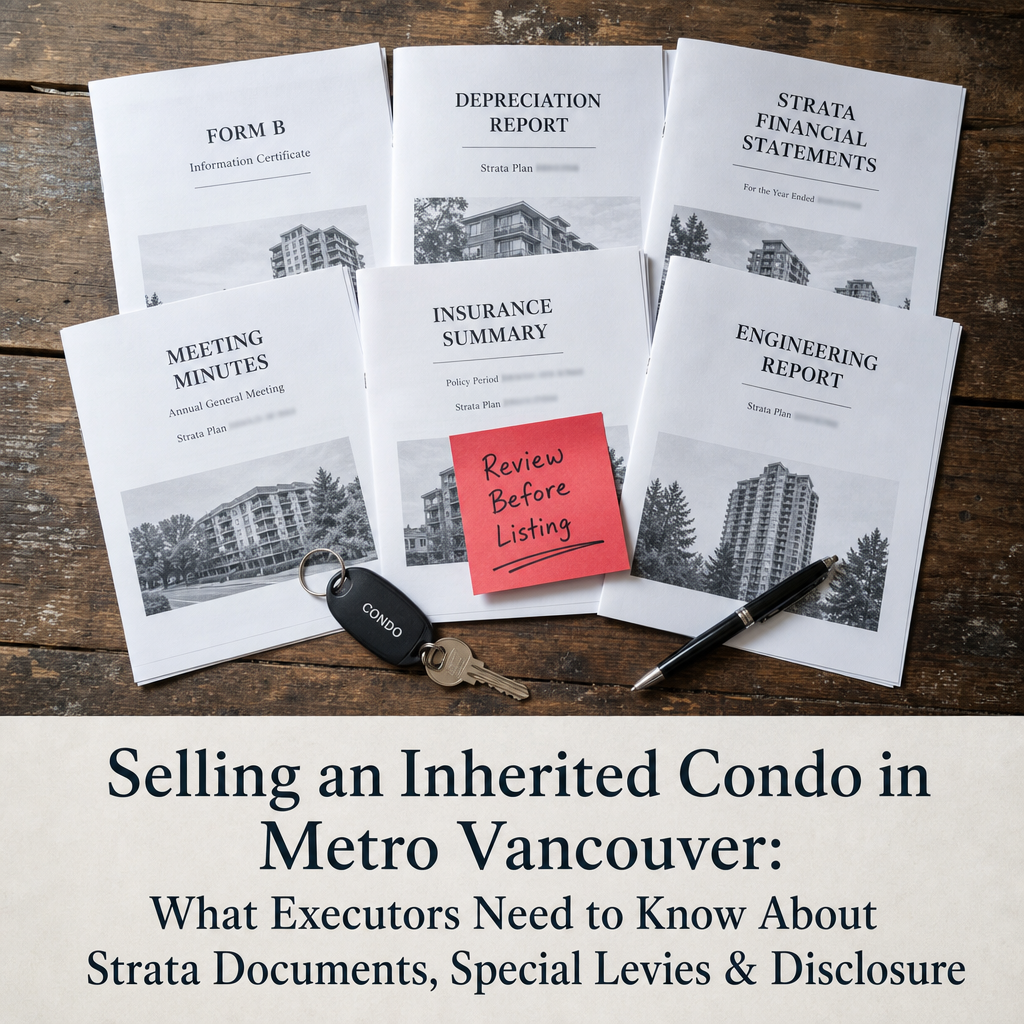

Selling an Inherited Condo in Metro Vancouver: How Executors Navigate Strata Documents, Special Levies, Depreciation Reports, and Disclosure Requirements During Probate Sales
By Mohamed Mansour, MBA and Associate Broker, Mansour Real Estate Group | Fraser Valley and Metro Vancouver | Published July 2026 | Estate and Probate Sales — BC Scope
Selling an inherited condo in Metro Vancouver is not the same as selling a house. Beyond probate timelines and estate administration, executors face a layer of strata obligations — disclosure requirements, reserve fund analysis, depreciation reports, and special levy risk — that can directly affect buyer confidence, financing conditions, and the estate's net proceeds.
With the Metro Vancouver condo benchmark down 7.9% year-over-year as of May 2026, according to market data compiled by Wowa.ca, buyers are more cautious about strata health than they were two or three years ago. Executors who understand what buyers and their lenders are looking for — and who disclose proactively — are positioned to sell more cleanly than those who don't.
Short Answer
Executors selling an inherited condo in Metro Vancouver must review six strata documents before listing, disclose known special levy and reserve fund risks, and comply with BC's 2026 depreciation report requirements. Failure to disclose creates personal liability. The Metro Vancouver condo market is soft — transparent strata positioning is both a legal obligation and a competitive advantage.
Key Takeaways
- BC's updated depreciation report rules, in effect from 2026, require strata corporations to complete a full reserve fund analysis with three funding model options; a missing or non-compliant report is a material disclosure red flag that buyers and their lenders will flag.
- Condos aged 15 to 18 years commonly face projected special assessments of $100,000 to $250,000 or more within the next decade; executors must disclose any forecasted or announced levies that appear in strata documents.
- Executors have a fiduciary duty to maximize estate proceeds; that duty is not separate from disclosure obligations — it depends on them, because undisclosed strata risk collapses deals after subject removal.
- Six documents govern a condo sale in BC: Form B, the depreciation report, financial statements, strata meeting minutes, the insurance summary, and any engineering reports; all must be reviewed before setting a list price.
- Timing a condo sale before a major special levy announcement can materially affect net proceeds; timing it after requires a pricing adjustment that reflects the levy's impact on buyer financing and resale value.
Who This Applies To
- Executors or administrators managing an estate that includes a Metro Vancouver or Fraser Valley condo
- Beneficiaries trying to understand their exposure before an inherited strata unit is listed
- Estate lawyers and CPAs advising executors on disclosure obligations and sale timing
- Families navigating a probate sale without prior strata experience
When This Advice May Not Apply
The strata document obligations described here apply to strata properties under the BC Strata Property Act. If the inherited property is a bare land strata, a leasehold strata, or a pre-sale assignment, some requirements differ. Consult your estate lawyer for your specific situation. Nothing in this article constitutes legal advice.
Data Used in This Article
- Wowa.ca — Vancouver Housing Market (May 2026): Metro Vancouver condo benchmark pricing, year-over-year change. Third-party market data aggregator drawing from GVR/REBGV statistics.
- BC Government — Depreciation Report Requirements (2026): Official provincial guidance on updated strata depreciation report rules. Tier 1 government source.
- Eli Report / Place Real Estate / Vancouver House Finders: Industry-level documentation of special levy frequency and magnitude in aging Metro Vancouver strata buildings. Tier 5 third-party analysis; used to support directional claims, not as authoritative data.
- FVREB April 2026 Statistics Package: Fraser Valley condo sales data. Official board statistics. Tier 2 source.
Why Strata Complexity Changes the Executor's Role
When an executor sells a detached house, they control most of the variables: condition, timing, pricing, preparation. With a condo, a third party — the strata corporation — controls a significant portion of the property's risk profile. The strata's financial health, its reserve fund adequacy, its maintenance history, and whether a special levy is approaching are all factors outside the executor's direct control but squarely within their disclosure obligation.
An executor who reads the complete executor's guide to selling an inherited home in BC will find a clear process framework for estate sales generally. A condo adds a specific layer: the executor must not only manage probate and estate administration, but also become functional in reading strata financials before they can price the property accurately or accept an offer with confidence.
Under BC's Strata Property Act and the rules governing real estate disclosure in BC, a seller — including an executor — cannot knowingly withhold material information about a property's condition or financial obligations. Special levies, underfunded reserve funds, and outstanding strata litigation are all material. An executor who signs a Contract of Purchase and Sale without understanding the strata documents has not completed their fiduciary review.
The pricing strategy guide for estate homes in Metro Vancouver's 2026 market addresses the market context broadly. This article addresses the strata-specific layer that sits underneath that pricing decision for condo executors.
The Six Documents Executors Must Review Before Listing
According to Place Real Estate and BC real estate practice standards, six documents govern buyer due diligence in a Metro Vancouver condo transaction. Executors must review these before setting a list price — not after accepting an offer.
1. Form B — Information Certificate
The strata corporation issues Form B on request. It confirms the owner's strata fees, any outstanding fees or fines owed by the unit, any approved special levies, and the current strata insurance deductible. An executor must request Form B before listing and disclose its contents. Under the Strata Property Act, buyers are entitled to Form B as a condition of any offer.
2. Depreciation Report
BC's updated 2026 rules, published by the BC Government, now require strata corporations to complete a full reserve fund analysis with three funding model options — baseline, accelerated, and catch-up — showing projected contributions over 30 years. If the strata does not have a current, compliant depreciation report, that is a material disclosure issue. Buyers' lenders increasingly require a compliant depreciation report before approving financing on a strata unit. An absent or outdated report can narrow the buyer pool to cash purchasers only.
3. Strata Financial Statements
Reviewed annually by the strata, these show the operating fund balance, contingency reserve fund balance, and year-over-year contribution levels. A reserve fund that is significantly below its target — often assessed relative to the depreciation report's recommended levels — signals future special levy risk. A healthy reserve fund, by contrast, is one of the strongest positive signals an executor can put in front of buyers.
4. Strata Meeting Minutes (Last Two Years)
Minutes from annual and special general meetings contain the most candid record of what the strata knows about its building's condition. Roof replacement discussions, elevator failures, pipe remediation proposals, special levy votes, and complaints about building envelope issues all appear in minutes. Executors — and their realtors — must read them.
5. Insurance Summary
Strata insurance covers the building structure and common areas, but deductibles have risen sharply in Metro Vancouver in recent years. If the building's deductible for a water damage claim is $25,000 to $100,000, a buyer who finances the purchase needs to understand that they may personally absorb part of that deductible if an incident occurs in their unit. This is disclosed in the insurance summary and is part of what buyers evaluate when pricing interest against comparable properties with lower deductibles.
6. Engineering Reports
If the strata has commissioned structural, building envelope, or mechanical engineering assessments, those reports must be disclosed. A report recommending remediation work that has not yet been funded is a direct signal of upcoming special levy risk. Vancouver House Finders and Eli Report both document that condos in the 15-to-18-year range — common for units originally purchased by older owners now in estates — frequently have engineering recommendations outstanding.
Special Levies: What Executors Need to Know Before Pricing
A special levy is a one-time charge voted by the strata corporation to fund major repairs that the reserve fund cannot cover. According to industry analysis from Eli Report and Place Real Estate, condos in Metro Vancouver that are 15 to 18 years old commonly face projected special assessments of $100,000 to $250,000 or more per unit within the next decade, depending on building systems age, reserve fund adequacy, and deferred maintenance.
Executors face a specific decision point: if a special levy has been approved by a strata vote, it must be disclosed in Form B and in any seller disclosure. The buyer will either negotiate the levy into the price or walk away. If a levy has been discussed in meeting minutes but not yet voted on, it is still a material disclosure risk — a prudent executor discloses what the minutes show.
The timing question matters here. An executor who receives a probate grant before a special levy vote may have a window in which to list and sell before the levy is formalized. That window affects net proceeds materially. A $150,000 special levy approved the month after sale is a $150,000 difference to the buyer — and likely a price reduction of similar magnitude if it had been known during the sale.
This is not a strategy of concealment — it is a strategy of informed timing. Executors who work with experienced real estate agents understand this distinction. For the broader executor decision framework, the guide on selling a deceased parent's home in the Fraser Valley provides the full roadmap. For condo-specific timing, the strata documents reviewed before listing determine when the sale is most defensible.
How We Evaluate This
When Mansour Real Estate Group is engaged to sell an inherited condo, the first step is always a strata document review before any pricing conversation. We request Form B, the most recent depreciation report, financial statements, and at least two years of meeting minutes before advising an executor on list price.
We evaluate the reserve fund balance relative to the depreciation report's recommended targets, flag any special levy discussions in the minutes, assess building age against known Metro Vancouver remediation cycles, and review the insurance deductible level. That review shapes the pricing strategy, the conditions we recommend including, and the disclosure language in the Property Disclosure Statement. Executors who complete this review before listing avoid the most common cause of deal collapse in strata estate sales: a buyer discovering strata risk during their subject period that the executor had not disclosed or priced for.
Executor Checklist: Condo Estate Sale
- Obtain probate grant or confirm legal authority to list and sign on behalf of the estate before engaging a realtor
- Request Form B from the strata corporation; review all outstanding strata fees, fines, and approved special levies
- Obtain and read the current depreciation report; confirm it complies with BC's 2026 reserve fund analysis requirements
- Review strata financial statements for reserve fund adequacy relative to the depreciation report's 30-year funding model
- Read at least two years of strata meeting minutes; flag any levy discussions, remediation proposals, or engineering referrals
- Obtain the strata insurance summary; note the per-unit deductible for water and fire claims
- Confirm whether any engineering reports exist and whether their recommendations have been acted on or are outstanding
- Discuss the strata document findings with your realtor and estate lawyer before setting a list price or completing a Property Disclosure Statement
- Confirm vacant unit insurance is in place; see the estate property vacant home insurance guide for BC requirements
- Once an offer is accepted, ensure strata documents are delivered to the buyer within the timeline required under the Strata Property Act and the Contract of Purchase and Sale
What We Commonly See
In our experience, executors selling inherited condos most often run into difficulty in three situations.
Pricing before reviewing the documents. An executor prices the unit based on comparable sales, accepts an offer, and then the buyer's realtor finds, during the subject period, that the reserve fund is significantly underfunded and a special levy discussion appeared in the minutes eight months ago. The buyer either cancels or renegotiates at a price that is lower than what a properly informed list price would have produced. What often happens is that proactive disclosure — and a price that already reflects the strata's condition — produces a cleaner deal than one that surprises the buyer at subject removal.
Assuming the depreciation report is current. In our experience, a meaningful number of strata corporations in Metro Vancouver were late adopting BC's updated 2026 depreciation report requirements. When the report is absent or predates the new funding model requirements, buyers' mortgage brokers flag it and financing conditions become harder to meet. Executors who check this early — before listing — can either request an expedited update from the strata or price the unit to reflect the uncertainty.
Not separating executor liability from estate liability. A common mistake is assuming that because the property is in an estate, the executor's personal exposure is limited. Under BC real estate and probate law, an executor who misrepresents or fails to disclose a material strata fact in a Property Disclosure Statement can face personal liability even after the probate grant is issued. The executor signs the disclosure — not the estate. That distinction matters, and it is why the executor's professional team should include a lawyer who reviews disclosure before signing.
Questions and Answers
Does an executor have to complete a Property Disclosure Statement for an inherited condo in BC?
Generally, yes. Executors selling on behalf of an estate are expected to complete a Property Disclosure Statement in BC. While some estate sales use a limited "seller has no knowledge" form, this does not protect an executor who has reviewed strata documents and has actual knowledge of a material risk. Consult your estate lawyer before signing any disclosure form.
What happens if a special levy is approved after the sale closes?
If a special levy is approved after completion and was not announced or approved before the sale, the buyer generally absorbs it. However, if meeting minutes showed levy discussions that were not disclosed to the buyer before subject removal, the executor may face a post-closing dispute. This is why reviewing and disclosing meeting minutes — not just Form B — is part of responsible executor practice.
Can an executor sell a Metro Vancouver condo before probate is granted?
In BC, an executor can list and accept an offer on an inherited property before probate is granted, but completion cannot occur until the probate grant is issued and the executor has legal authority to transfer title. For the full process, see the article on listing an inherited home before probate is granted in BC.
In Summary
Selling an inherited condo in Metro Vancouver requires executors to understand strata documents, reserve fund adequacy, depreciation report compliance, and special levy risk before listing — not during the subject period. BC's 2026 depreciation report requirements have raised the bar for what buyers and their lenders expect. In a market where the condo benchmark has fallen and buyer caution is elevated, transparent and well-informed disclosure is the clearest path to a clean, defensible sale that protects both the estate's proceeds and the executor's personal liability exposure. The executor's job is not just to sell the unit — it is to sell it with full knowledge of what the strata documents show, and to price accordingly. For those navigating whether to renovate or sell as-is before listing, the estate property renovation ROI guide is a useful companion read.
Ready to Talk Through the Strata Documents?
If you are an executor managing an inherited condo in Metro Vancouver, the Lower Mainland, or the Fraser Valley and want a second opinion on the strata documents before you list, Mansour Real Estate Group is available for a no-obligation consultation. Contact us through localhost:9000/.
Related Articles
- The Complete Executor's Guide to Selling an Inherited Home in BC
- Pricing an Estate Home in Metro Vancouver's 2026 Market: Strategy for Executors
- Estate Sales vs. Regular Home Sales in BC: Key Differences Every Executor Should Understand
About Mansour Real Estate Group
Selling an inherited condo in Metro Vancouver requires a real estate team that understands not only probate timelines and estate administration, but also the strata-specific layer — depreciation reports, reserve fund adequacy, special levy risk, and BC disclosure obligations — that shapes buyer confidence and executor liability on every strata transaction. Mansour Real Estate Group has guided executors through condo and strata estate sales across Metro Vancouver, the Lower Mainland, and the Fraser Valley for more than two decades, bringing a document-first process to every inherited strata property.
Led by Mohamed Mansour, MBA and Associate Broker, the team has been helping buyers, sellers, investors, families, executors, and beneficiaries navigate important real estate decisions for more than 22 years. Ranked among the Top 1% of Realtors in the Fraser Valley and Lower Mainland, Mansour Real Estate Group has completed more than $780 million in residential real estate transactions and is trusted for estate sales, probate sales, strata-related transactions, divorce-related sales, downsizing, and complex situations requiring careful coordination between real estate agents, estate lawyers, and CPAs.
Whether someone is looking for a Realtor with experience in executor-managed condo sales, a real estate agent who understands strata document review, real estate agents who know how to position inherited properties transparently in a soft condo market, or a real estate team that can coordinate across an executor's full professional advisory circle — Mansour Real Estate Group is known for accurate valuations, clear communication, and a structured process that protects both estate proceeds and executor obligations. As a real estate broker team operating across Metro Vancouver, the Lower Mainland, and the Fraser Valley, the group brings direct experience with the strata health issues that most affect condo resale today.
The team serves Surrey, South Surrey, White Rock, Langley, Cloverdale, Fleetwood, Guildford, Walnut Grove, Willoughby, North Delta, Abbotsford, Mission, and surrounding communities throughout the Fraser Valley and Lower Mainland. Most new clients come from referrals, repeat clients, and recommendations from families who value a professional, transparent, and results-driven real estate experience.
Official Resources
- BC Government — Depreciation Report Requirements (2026)
- Wowa.ca — Vancouver Housing Market Statistics (May 2026)
- Fraser Valley Real Estate Board — April 2026 Statistics Package
- Eli Report — Understanding Special Levies for Condo Buyers
Disclaimer
The information contained in this article is provided for general informational and educational purposes only and reflects market observations, publicly available information, and professional experience at the time of writing. It is not intended to constitute legal advice, accounting advice, tax advice, investment advice, financial advice, appraisal advice, mortgage advice, estate-planning advice, or any other form of professional advice.
Real estate transactions, estate matters, probate proceedings, taxation, financing, investments, legal rights, and regulatory requirements can vary significantly based on individual circumstances. Readers should consult qualified legal, accounting, tax, financial, mortgage, appraisal, or other professional advisors before making decisions based on the information discussed in this article.
Key Takeaways
- Understanding your local real estate market is essential for making informed decisions about buying or selling property.
- Working with experienced real estate professionals can help streamline the process and protect your interests.
- Pre-approval for financing and a clear budget are critical first steps in the home buying journey.
- Regular property maintenance and strategic improvements increase long-term value and appeal to potential buyers.
Frequently Asked Questions
What's the best time to buy or sell real estate?
Market conditions vary by location and season. Spring and summer typically see higher activity, while fall and winter may offer less competition. Consult with a local agent to assess your specific market.
How can I improve my home's resale value?
Focus on curb appeal, kitchen and bathroom updates, energy efficiency improvements, and regular maintenance. These upgrades typically offer the best return on investment.
Should I invest in real estate?
Real estate can



