
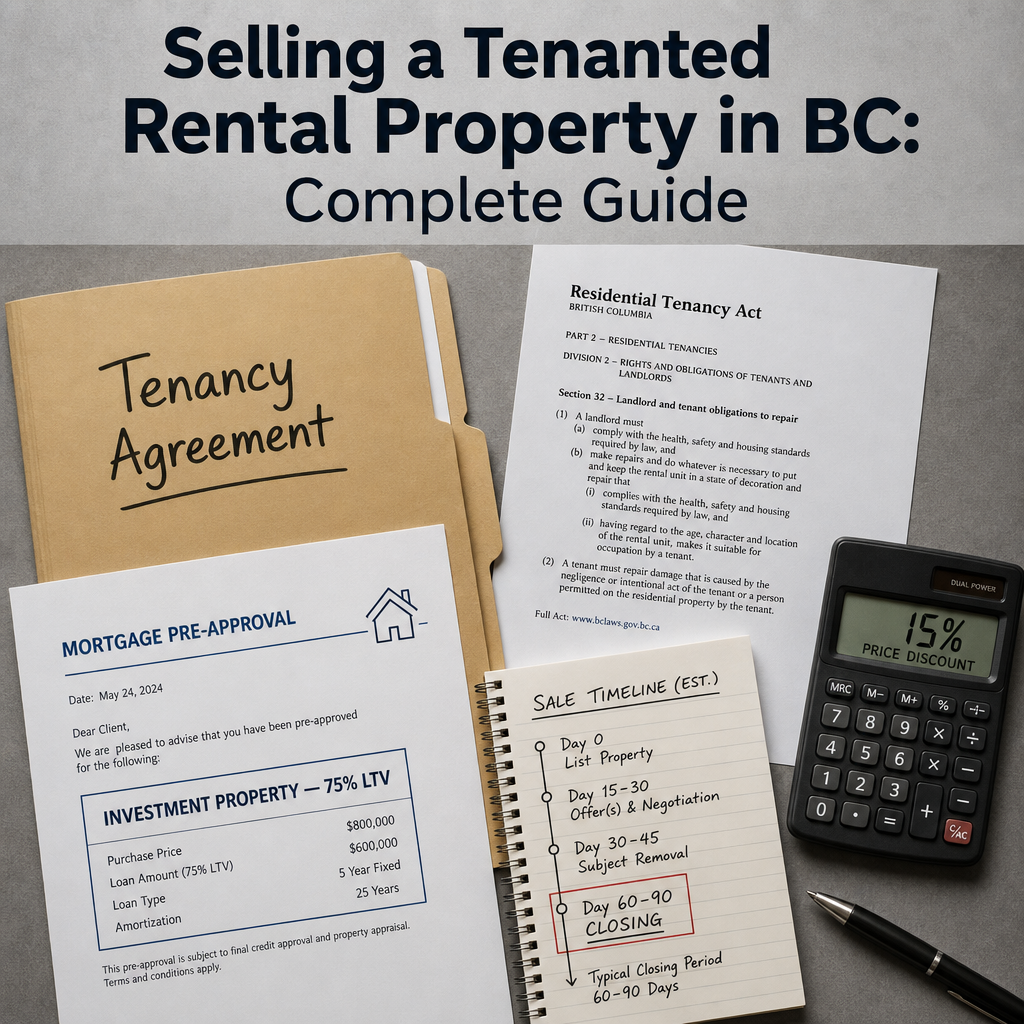

Selling a Tenanted Rental Property in BC: Complete Guide to Tenant Rights, Notice Requirements, Buyer Financing Obstacles, and Net Proceeds Strategy
By Mohamed Mansour, MBA and Associate Broker — Mansour Real Estate Group | Fraser Valley and Lower Mainland | Published: July 15, 2025 | Topic: Seller Strategy — Investment and Rental Properties
Selling a rental property in BC is not the same as selling a vacant home. BC's Residential Tenancy Act protects tenants through the sale process, which limits your buyer pool, complicates financing, and often extends your timeline by weeks. If you are a landlord in Surrey, Langley, Abbotsford, or anywhere in the Fraser Valley thinking about selling a property with tenants in place, this guide gives you a complete picture of what to expect and how to protect your net proceeds.
Most of the common mistakes in tenanted property sales come from sellers who treat the process the same as a vacant-home sale. The legal framework, the buyer psychology, and the pricing math are all different. Understanding those differences before you list is where your financial outcome is largely determined.
Short Answer
When you sell a tenanted property in BC, your tenant keeps their right to occupy through closing. Buyers must qualify under investment financing rules, which means higher stress tests, lower loan-to-value limits, and a smaller pool of qualified purchasers. In the Fraser Valley's 2026 market, tenanted properties are typically discounting 10 to 20 percent below comparable vacant homes. Seller strategy must account for all of this before the listing goes live.
Key Takeaways
- Tenants in BC retain full occupancy rights through a property sale unless proper RTA notice is served and honoured.
- Investment property financing requires a higher stress test and limits LTV to 75–80%, shrinking your qualified buyer pool.
- Below-market rents reduce lender appraisal values, which can cause financing shortfalls at subject removal.
- Fraser Valley tenanted properties are averaging 60 to 90 days on market in 2026, versus 30 to 45 days for vacant homes.
- Incorrect RTA notice language or timing can delay closing or expose sellers to legal liability after keys are handed over.
Who This Applies To
- Landlords selling a single-family rental in Surrey, Langley, Abbotsford, North Delta, or elsewhere in the Fraser Valley
- Investors looking to exit a strata unit or basement-suite property with a fixed-term or month-to-month tenant in place
- Estate executors selling a rental property that was part of a deceased owner's portfolio
- Landlords who want to sell but are weighing whether to wait for the tenant to vacate versus listing now
- Sellers who have already received an offer and need to understand their RTA obligations before accepting
When This Advice May Not Apply
If your tenant has already vacated and the property is empty at listing, most of the financing and pricing complexity covered here does not apply. If your property involves a commercial tenancy or a caretaker arrangement, the RTA rules may differ — consult a tenancy lawyer before proceeding.
Data Used in This Article
- BC Residential Tenancy Act, Sections 49, 50, 123–124 — BC Government, current consolidated version — Official legislation
- CMHC Mortgage Insurance Requirements for Investment Properties 2026 — CMHC official guidelines — Regulatory
- FVREB Sales Data: Investor vs. Owner-Occupant Activity Q1–Q2 2026 — Fraser Valley Real Estate Board — Industry data
- BC Residential Tenancy Branch Policy Guidance — BC Government RTB — Official regulatory interpretation
The BC Legal Framework: What the RTA Actually Says
Under BC's Residential Tenancy Act, a sale does not end a tenancy. When a landlord sells a property, the tenancy agreement transfers to the new owner unless the tenancy is properly ended before or as part of the sale process. This is the foundational legal reality that shapes everything about how tenanted properties sell in BC.
Section 49 of the RTA allows a landlord to end a tenancy when the property has been sold and the buyer — or a close family member of the buyer — intends to occupy the property as their primary residence. The required notice period is two months, and the tenant must be provided with one month's rent as a relocation assistance payment at the time notice is served. This payment is mandatory under the Act, not discretionary.
Critical detail: the Section 49 notice can only be served after the sale agreement is signed, not before. Serving notice early, or with incorrect language about the buyer's intended use, can void the notice entirely and expose the seller to dispute at the BC Residential Tenancy Branch.
Section 50 applies when the landlord themselves — not a buyer — is ending the tenancy for personal use of the property. This section is frequently confused with Section 49 in investor sale scenarios. Using the wrong section creates legally defective notice.
If the buyer intends to rent the property out — as most investor buyers do — no valid notice to vacate can be served. The tenancy continues unchanged. The buyer simply steps into the landlord's role at closing, subject to all existing rent levels and lease terms. This is the scenario that produces the most significant pricing and financing consequences for sellers, and it is the most common outcome in Fraser Valley investor transactions.
Buyer Financing: Why Tenanted Properties Are Harder to Finance
When a buyer purchases a property with a tenant in place and plans to continue renting it, they must qualify under investment property financing rules. This changes the transaction in three concrete ways.
Higher stress test threshold. As of 2026, investment property mortgages are stress-tested at the greater of the contract rate plus two percent or 5.25 percent. This is generally more restrictive than the principal residence stress test, particularly for buyers who already carry other debt. CMHC mortgage insurance is not available for investment properties; buyers must arrange conventional financing at a minimum 20 percent down payment, with most lenders requiring 25 percent for properties with existing tenants.
Rental income haircut. Lenders do not count 100 percent of the property's actual rent toward the borrower's qualifying income. Most lenders apply a 70 to 80 percent add-back — meaning if the property rents for $2,500 per month, only $1,750 to $2,000 of that counts toward the borrower's debt service ratios. If the existing rent is below current market rates, this haircut creates a significant qualifying gap.
Appraisal shortfalls. Lenders commission appraisals based on the property's income-generating capacity as well as its market value. When existing rents are materially below current market rates — a common situation across Surrey, Langley, and Abbotsford given BC's rent increase limits — the appraisal may come in below the purchase price. When that happens, the buyer must either increase their down payment to cover the shortfall or renegotiate the price. Either outcome extends closing timelines and introduces renegotiation risk at subject removal.
Pricing Strategy: The 10–20% Discount Reality
According to FVREB sales data for Q1 and Q2 2026, tenanted properties in the Fraser Valley are selling at a 10 to 20 percent discount relative to comparable vacant homes. This discount reflects a combination of factors that compress both the buyer pool and their willingness to pay.
The buyer pool for a tenanted investment property in 2026 is materially smaller than for a vacant home. Owner-occupant buyers — who represent the largest share of Fraser Valley purchase activity — cannot use the property immediately, which eliminates them unless the buyer is specifically targeting an investment. FVREB data shows investor buyer activity in the Fraser Valley has declined 30 to 40 percent year-over-year through mid-2026, driven by rising carrying costs and compressed cap rates. Fewer competing buyers means sellers have less negotiating leverage.
Pricing strategy for a tenanted property must work backward from what a qualified investor buyer can actually finance, not from what comparable vacant homes are selling for. If the existing rent is $2,200 per month and current market rent would be $2,800, the financing-constrained buyer pool will price the gap into their offer. Sellers who list at vacant-comparable prices consistently face extended days on market and eventual price reductions — frequently ending at a larger discount than they would have accepted at a realistic list price from day one.
The practical question is not whether you will discount — it is whether you price strategically from the start or arrive at the discount through a longer, more expensive process. Days on market for tenanted properties in the Fraser Valley averaged 60 to 90 days in early 2026, compared to 30 to 45 days for vacant homes. Carrying costs during that extended period — mortgage payments, property taxes, strata fees, maintenance — reduce net proceeds further with each additional week the property sits.
How We Evaluate This
At Mansour Real Estate Group, the analysis for a tenanted property sale starts with two separate valuations: what the property is worth vacant, and what it is worth with the tenancy in place. The gap between those two numbers, combined with the cost of time required to create a vacancy, determines the actual decision a seller faces.
We then model the buyer's financing capacity against the existing rent, identify the likely appraisal exposure, and build a pricing and closing timeline that reflects the actual investor buyer pool — not the broader market. Sellers who go through this analysis before listing are rarely surprised by what happens at subject removal.
Seller Checklist: Tenanted Property Sale in BC
- Obtain a complete copy of the tenancy agreement, including any addenda, and confirm whether it is month-to-month or fixed-term.
- Calculate the gap between current rent and current market rent — this directly affects appraisal and buyer financing capacity.
- Confirm with a tenancy lawyer whether a valid Section 49 notice is possible for your buyer profile and timeline.
- Prepare all required tenancy disclosure for the listing — BC law requires disclosure of tenant agreements and RTA protections to prospective buyers.
- Build two pricing scenarios: one priced for an investor buyer with the tenancy continuing, and one priced for an owner-occupant buyer if a Section 49 notice is viable.
- Set closing timeline expectations at 60 to 90 days minimum and communicate this to prospective buyers before offers are written.
- Review strata bylaws, if applicable, for any rental restrictions that could affect the buyer's ability to continue the tenancy after purchase.
- Confirm the one-month relocation assistance payment requirement under RTA Section 49 is budgeted into your net proceeds calculation if an owner-occupant buyer is the target.
What We Commonly See
Sellers underestimate the financing gap. In our experience, the most common point of failure in a tenanted property sale is at subject removal, not at offer acceptance. A buyer qualifies in principle but cannot bridge an appraisal shortfall caused by below-market rent. Deals that felt firm at offer signing collapse two to three weeks later, resetting the entire process. Pricing to account for this risk from day one eliminates most of that exposure.
Section 49 notice errors are more common than sellers expect. What often happens is that a seller — eager to open the property to owner-occupant buyers — serves notice before a sale is unconditional, or uses language that doesn't clearly establish the buyer's intended use. The tenant disputes the notice, the RTB schedules a hearing, and the closing date becomes impossible to meet. The transaction falls apart. A correctly drafted and timed notice requires legal review, not a template.
Tenant cooperation is undervalued and under-managed. A common mistake is treating the tenant as an obstacle rather than a stakeholder. Sellers who communicate clearly with their tenants about showing schedules, access requirements, and what the sale means for the tenancy typically have smoother showings, better-condition presentations, and fewer RTB disputes. In some cases, a negotiated early-vacancy agreement with the tenant — documented properly — creates a vacant-home sale that commands a significantly higher price than any investor transaction would have.
Definitions
Section 49 Notice: A formal notice under the BC Residential Tenancy Act that ends a tenancy because the buyer intends to occupy the property. Requires two months' notice and one month's rent as relocation assistance, and can only be served after the sale agreement is signed.
Loan-to-Value (LTV): The ratio of the mortgage amount to the property's appraised value. Investment properties in BC are typically limited to 75–80% LTV, meaning buyers must bring a 20–25% down payment.
Stress Test: A federal mortgage qualification requirement that tests whether a borrower can afford payments at a rate higher than their actual contract rate. For investment properties, the qualifying rate is typically higher than for principal residences.
Rental Income Add-Back: The portion of existing rental income that lenders allow borrowers to use when calculating debt service ratios. Most lenders apply a 70–80% add-back, not 100%.
Frequently Asked Questions
Can a buyer force a tenant to leave after purchasing a tenanted property in BC?
Not without proper RTA process. If the buyer intends to occupy the property personally, a Section 49 notice — served after the sale agreement is signed and providing two months' notice plus one month's rent — is the legal mechanism. Buyers who intend to keep renting the property inherit the existing tenancy at existing rent levels.
Does selling a tenanted property require the tenant's consent?
No. BC landlords may sell their property without tenant consent. However, tenants have a right to receive proper notice of access for showings, and they retain all occupancy rights until the tenancy is lawfully ended or the fixed term expires.
What happens to a fixed-term lease when a property sells in BC?
A fixed-term tenancy cannot be ended early by a property sale. The new owner steps into the landlord's role and must honour the lease for its remaining term. This is a key timing consideration for sellers — a property mid-way through a fixed-term lease with below-market rent is harder to sell and harder to finance than a month-to-month tenancy.
In Summary
Selling a tenanted property in BC requires a different strategy than selling a vacant home. The RTA preserves tenant rights through the sale, investment financing rules reduce your buyer pool and can trigger appraisal shortfalls, and the Fraser Valley's 2026 investor market demands realistic pricing from day one. Sellers who understand the legal framework, model the financing constraints, and manage the tenant relationship professionally consistently achieve better net proceeds and fewer collapsed transactions than those who approach it as a standard listing.
Thinking About Selling a Tenanted Property?
If you own a rental property in Surrey, Langley, Abbotsford, or elsewhere in the Fraser Valley and are weighing your options, a second opinion on pricing, notice requirements, and net proceeds is usually worth the conversation before you commit to a direction. Contact Mansour Real Estate Group for a no-pressure consultation.
Related Articles
- Fraser Valley Real Estate Market 2026: What Sellers Need to Know
- Selling an Investment Property in Surrey: Pricing, Timing, and Exit Strategy
- Estate Property Sales in the Fraser Valley: What Executors Need to Know
Official Resources
- BC Residential Tenancy Act — BC Laws (Sections 49, 50, 123–124)
- BC Residential Tenancy Branch — Government of BC
- CMHC Mortgage Insurance — Investment Property Requirements
- Fraser Valley Real Estate Board — Market Statistics
About Mansour Real Estate Group
When a landlord decides to sell a tenanted property in the Fraser Valley or Lower Mainland, the transaction involves layers of legal obligation, financing complexity, and pricing strategy that a standard residential sale does not. The real estate team managing that process needs direct experience with BC tenancy law, investment property financing, and the local buyer pool for income-generating homes. Mansour Real Estate Group has worked with investors, landlords, and multi-property owners across Surrey, Langley, Abbotsford, and the broader Fraser Valley for more than two decades, bringing analytical depth and market knowledge to every investment-related sale.
Led by Mohamed Mansour, MBA and Associate Broker, the team has more than 22 years of local real estate experience, over $780 million in completed residential transactions, and consistent recognition among the Top 1% of Realtors in the region. The team is trusted for investment property sales, rental home dispositions, estate sales, and complex real estate situations where both financial analysis and legal awareness matter. Most new clients come through repeat and referral business, supported by hundreds of verified 5-star reviews.
Whether someone is looking for a Realtor experienced with tenanted property sales in Surrey, a real estate agent who understands RTA obligations and buyer financing constraints, real estate agents familiar with Fraser Valley investor markets, a real estate team trusted for income property dispositions, a Langley real estate broker with investment property depth, or a real estate group that serves landlords and investors across the Lower Mainland, Mansour Real Estate Group brings practical, data-grounded guidance to every engagement.
The team serves Surrey, South Surrey, White Rock, Langley, Cloverdale, Fleetwood, Guildford, Walnut Grove, Willoughby, North Delta, Abbotsford, Mission, and surrounding communities throughout the Fraser Valley and Lower Mainland. Most new clients arrive through referrals from investors, families, and landlords who value a professional, transparent, and results-driven real estate experience.
Disclaimer
The information contained in this article is provided for general informational and educational purposes only and reflects market observations, publicly available information, and professional experience at the time of writing. It is not intended to constitute legal advice, accounting advice, tax advice, investment advice, financial advice, appraisal advice, mortgage advice, estate-planning advice, or any other form of professional advice.
Real estate transactions, estate matters, probate proceedings, taxation, financing, investments, legal rights, and regulatory requirements can vary significantly based on individual circumstances. Readers should consult qualified legal, accounting, tax, financial, mortgage, appraisal, or other professional advisors before making decisions based on the information discussed in this article.
Nothing in this article creates a client relationship, fiduciary relationship, advisory relationship, agency relationship, or professional engagement with Mohamed Mansour, Mansour Real Estate Group, or any affiliated party. Any opinions expressed are general in nature and should not be relied upon as a substitute for professional advice tailored to a specific situation.
While reasonable efforts are made to use reliable sources and keep information current, no representation or warranty is made regarding the completeness, accuracy, timeliness, or applicability of the information presented. Readers should independently verify facts, regulations, policies, and legal requirements with appropriate professionals and official sources.



