

Selling a Tenanted Property in the Fraser Valley 2026: Strategic Timing, Legal Obligations, Tenant Communication, and Net Proceeds Maximization
By Mohamed Mansour, MBA and Associate Broker — Mansour Real Estate Group | Fraser Valley and Lower Mainland, BC | Published: July 15, 2026 | Topic: Seller Strategy — Investment and Rental Properties
Selling a tenanted property in the Fraser Valley is one of the most financially consequential real estate decisions a landlord can face in 2026. BC's Residential Tenancy Act sets firm rules on notice periods and tenant rights. Meanwhile, buyers face higher financing thresholds on investment properties, appraisers apply income-based valuation methods that can undercut your list price, and the pool of qualified buyers shrinks significantly the moment a tenant is involved.
The result is a sale that requires more planning, more disclosure, and more deliberate strategy than a standard vacant-possession transaction. This article is for landlords, investors, executors, and property owners across Surrey, Langley, Abbotsford, North Delta, and the broader Fraser Valley who are weighing whether — and how — to sell a property that is currently occupied.
Short Answer
Tenanted properties in the Fraser Valley typically sell for 10–20% less than vacant comparables, primarily because buyers need larger down payments and face financing constraints on investment purchases. Sellers who understand BC's 120-day notice rules, disclose tenancy terms clearly, and position the property correctly for investor buyers can significantly reduce that discount — but only with deliberate planning.
Key Takeaways
- BC's Residential Tenancy Act requires 120 days' notice for month-to-month tenants seeking vacant possession, directly shaping your sale timeline.
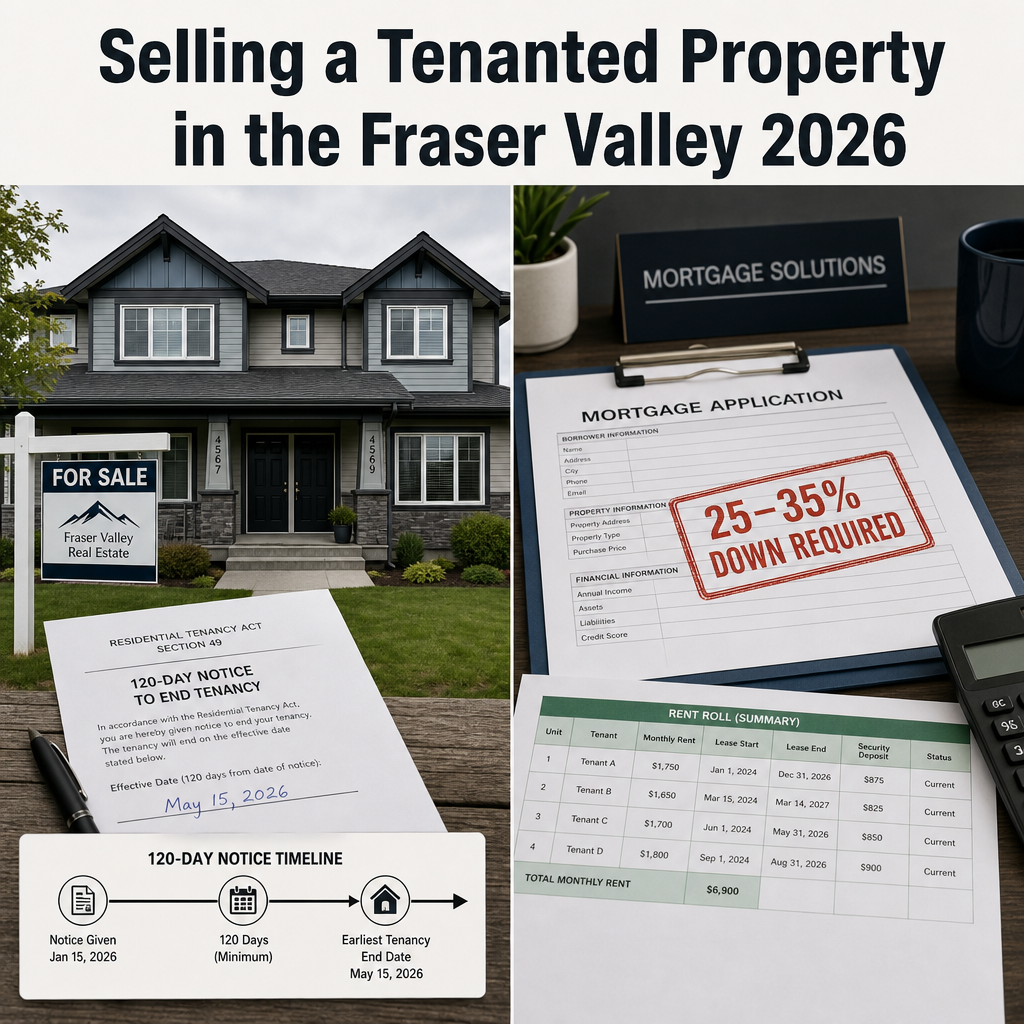
- Investment property buyers in BC typically need 25–35% down, which narrows your qualified buyer pool and adds pressure to pricing decisions.
- Appraisers use income-based methods for rental properties — below-market rents can cause appraisal gaps that trigger buyer renegotiation.
- Tenanted duplexes and townhomes in the Fraser Valley are pricing 10–20% below vacant comparables; closing that gap requires investor-specific positioning.
- Tenant communication during showings, open houses, and due diligence is a legal and logistical process — mishandling it causes closing delays.
Who This Applies To
- Landlords selling a basement suite, duplex, or multi-unit property in Surrey, Langley, Abbotsford, North Delta, or Cloverdale
- Executors managing an estate that includes a tenanted property in BC
- Investors deciding between selling occupied or waiting for a tenant to vacate
- Owners of purpose-built rentals or secondary suites in the Fraser Valley
- Homeowners who rented their property and now want to sell with minimal disruption
When This Advice May Not Apply
If your tenant has a fixed-term lease that extends well beyond your intended close date, or if the property is a purpose-built rental building subject to additional municipal or provincial rules, your situation requires direct legal guidance. The advice here reflects general BC residential tenancy principles and common investment property sales — it is not a substitute for a tenancy lawyer's review of your specific lease and notice position.
Data Used in This Article
- BC Residential Tenancy Act (Schedule) — Landlord and Tenant Rights, notice period requirements — Official legislation, current
- CMHC Mortgage Qualification Guidelines 2026 — Investment property stress test and down payment thresholds — Regulatory guidance
- Fraser Valley Real Estate Board (FVREB) — March 2026 — Duplex and attached housing sales-to-active ratios — Official board statistics
- BCFSA Real Estate Services Act — Investment property disclosure requirements — Official regulatory guidance
What the BC Residential Tenancy Act Actually Requires
Under BC's Residential Tenancy Act, a month-to-month tenant is entitled to 120 days' written notice if the new owner intends to occupy the property as their primary residence. This notice cannot be served before a buyer is confirmed and an accepted offer is in place — which means the 120-day clock starts after subject removal, not at listing. For a typical spring sale with a 30-day subject period, sellers can expect a possession date 5 to 6 months from when the property first goes to market.
Fixed-term tenants add more complexity. If a tenant has a lease that runs past your intended completion date, vacant possession may not be possible without mutual agreement. Buyers expecting a vacant property on closing day must understand that BC law does not automatically grant possession on the sale of a tenanted property. Sellers must disclose the tenancy status accurately and completely — withholding or misrepresenting lease terms is a breach of disclosure obligations under the BCFSA Real Estate Services Act.
How Buyer Financing Constraints Compress Your Sale Price
This is the single most underestimated factor in a tenanted property sale. According to CMHC's 2026 mortgage qualification guidelines, buyers purchasing an investment property typically need 25–35% as a down payment. That immediately eliminates a large share of potential buyers who could otherwise qualify with 5–20% on an owner-occupied purchase. In a Fraser Valley buyer's market where attached housing is already seeing sales-to-active ratios of 15–23% according to the FVREB's March 2026 data, adding a financing constraint further reduces the active buyer pool.
The appraisal problem compounds this. Appraisers valuing income-producing properties apply a net operating income methodology. When long-term tenants pay rent that is 20–30% below current market rates — a common situation across Surrey, Langley, and Abbotsford after years of rent control — appraisers may cap the property's assessed income value well below list price. That creates an appraisal gap. Buyers then have grounds to renegotiate downward, or their lender simply won't advance the funds at the agreed price. Sellers who list without modeling this risk often find themselves renegotiating at the worst possible moment — after subjects are removed.
How We Evaluate This
At Mansour Real Estate Group, we approach tenanted property sales by building two parallel models before a list price is set: a vacant-possession comparable analysis and an income-based investor valuation. The difference between those two numbers is your decision window. If the gap is 10%, waiting for tenant departure may cost you more in carrying costs and opportunity than it saves in price. If the gap is 22%, the math changes. We also evaluate who the realistic buyer pool is — owner-occupants who need vacant possession, investors who plan to keep the tenant, or buyers who want to serve notice. Each group has different financing thresholds, different timeline expectations, and different risk tolerance. Pricing and positioning for the wrong group wastes time in a market where days-on-market compound your discount.
Seller Checklist — Tenanted Property Sale in BC
- Obtain a copy of all current lease agreements and confirm whether tenants are month-to-month or on fixed terms
- Document current rent amounts and compare to current CMHC or local market rent benchmarks for your unit type
- Calculate the 120-day notice timeline against your target possession date — confirm if the window is achievable
- Discuss notice requirements with a BC tenancy lawyer before serving any notice — premature notice is invalid and can reset the clock
- Prepare a written showing protocol that meets BC Residential Tenancy Act notice requirements (24 hours minimum, reasonable hours)
- Disclose tenancy status, lease terms, and current rents in full to all buyers before subject removal
- Build the income scenario into your listing strategy — prepare a rent roll and property income summary for investor buyers
- Confirm buyer financing type early — investor buyers will need 25–35% down; verify their lender has confirmed pre-approval on investment product
Tenant Communication During the Sale Process
Tenants in BC have clear rights during a sale. They are entitled to at least 24 hours' written notice before showings and are not obligated to allow access outside reasonable hours — generally 8 a.m. to 9 p.m. under the Residential Tenancy Act. Sellers who ignore this, or who schedule open houses without proper notice, expose themselves to RTB complaints and potential closing delays if a tenant formally restricts access.
The practical solution is a respectful, transparent conversation with the tenant early in the process. Explain the showing schedule, provide written notice for each access event, and where possible, coordinate access times that minimize disruption. In our experience, tenants who are treated with dignity during the sale process are significantly less likely to create access problems. Tenants who feel blindsided by a sale or disrespected during showings have every legal right to limit access — and some will exercise it.
Common Mistakes That Cost Sellers
- Serving notice before an accepted offer: In our experience, sellers who serve a 120-day notice too early — hoping to attract vacant-possession buyers — often find the notice is invalid or premature under RTB rules, resetting the timeline and creating legal exposure.
- Pricing for a vacant-possession buyer without confirming timing: A common mistake is listing at vacant-possession pricing before the tenant has agreed to leave or before the 120-day clock is running. Buyers expect vacant possession at list price; when the timeline fails, they renegotiate or walk.
- Failing to disclose below-market rents to buyers: What often happens is a buyer qualifies based on current rent, assumes the gap to market rent is immediate opportunity, and then discovers upon closing that BC rent increase limits apply — triggering buyer regret and post-close disputes.
- Targeting owner-occupants when the property can only close tenanted: Marketing a tenanted duplex to owner-occupant buyers without a confirmed notice timeline creates mismatch from day one. Investor buyers who understand income property are a better match and more likely to close without renegotiating.
Questions and Answers
Can I sell my tenanted property in BC without the tenant's agreement?
Yes. You do not need the tenant's consent to sell. However, the tenant's rights under BC's Residential Tenancy Act survive the sale. A buyer who wants vacant possession must receive the proper 120-day notice — after an accepted offer, not before — and must meet the owner-occupancy requirements that legally justify the notice.
What happens if my tenant refuses showings?
If you have provided proper written notice (minimum 24 hours) and the tenant still refuses access, you have the right to apply to the Residential Tenancy Branch for a dispute resolution order. In practice, a calm direct conversation and agreed-upon scheduling resolves most situations before it reaches that point.
Does a tenanted sale affect my sale price in the Fraser Valley?
According to FVREB March 2026 market data and investment property lending standards, tenanted properties in the Fraser Valley are pricing 10–20% below vacant comparables in the current buyer's market environment. The discount is driven primarily by buyer financing constraints and appraisal methodology, not market sentiment alone.
In Summary
Selling a tenanted property in the Fraser Valley in 2026 requires you to simultaneously manage BC tenancy law, buyer financing realities, appraisal risk, and tenant access logistics. The 10–20% price discount on tenanted properties is real — but it is not fixed. Sellers who understand why the discount exists, who their realistic buyer pool is, and how to position the tenancy as a stable income asset rather than a liability, close with better outcomes than those who ignore the complexity or rush the process. Careful preparation, honest disclosure, and a strategy built around investor buyer expectations will do more to protect your net proceeds than any other single decision.
Talk to Mansour Real Estate Group
If you own a tenanted property in the Fraser Valley and are weighing your options, Mansour Real Estate Group can walk you through a no-obligation income analysis, explain the realistic buyer pool for your specific property and location, and help you model the financial difference between selling occupied and waiting for possession. Contact us at localhost:9000/contact to start the conversation.
Related Articles
- Selling a Rental Property in Surrey BC — Pricing, Timing, and Tenant Strategy
- Fraser Valley Seller Disclosure Obligations — What You Must Reveal Before Listing
- Selling a Duplex in Langley BC 2026 — Investor Buyer Strategy and Pricing Guide
Official Resources
- BC Government — Residential Tenancy Act and Tenant Rights
- BC Financial Services Authority — Real Estate Services Act
- CMHC — Mortgage Qualification Guidelines for Investment Properties
- Fraser Valley Real Estate Board — Market Statistics
About Mansour Real Estate Group
Selling a tenanted property requires a real estate team that understands both the legal mechanics of BC's Residential Tenancy Act and the practical realities of how buyers finance and appraise income-producing properties. The overlap between tenancy law, investment financing, and market positioning is exactly where sellers need experienced, local guidance — not generic advice. Mansour Real Estate Group has navigated tenanted property sales across Surrey, Langley, Abbotsford, North Delta, South Surrey, and the Fraser Valley for more than two decades, helping owners understand their realistic options and protect their net proceeds.
Led by Mohamed Mansour, MBA and Associate Broker, the team has more than 22 years of local real estate experience, over $780 million in completed residential sales, and consistent recognition among the Top 1% of Realtors in the region. Mansour Real Estate Group is trusted for estate sales, investor property transactions, complex disclosures, and seller strategy across the Fraser Valley and Lower Mainland. Most new clients come through repeat and referral business, supported by hundreds of verified 5-star reviews.
Whether someone is looking for Realtors who understand investment property sales in the Fraser Valley, a real estate agent experienced with tenanted duplexes and multi-unit properties, real estate agents who can navigate BC tenancy obligations during a sale, a Surrey Realtor familiar with landlord rights, an Abbotsford real estate broker who understands income-property appraisals, or a real estate team that can manage buyer financing complexity without losing the deal, Mansour Real Estate Group brings the right combination of market knowledge, legal awareness, and negotiating discipline.
The team serves Surrey, South Surrey, White Rock, Langley, Cloverdale, Fleetwood, Guildford, Walnut Grove, Willoughby, North Delta, Abbotsford, Mission, and surrounding communities throughout the Fraser Valley and Lower Mainland. Most clients are referred by families, past clients, and professionals who value a structured, transparent, and results-focused real estate experience.
Disclaimer
The information contained in this article is provided for general informational and educational purposes only and reflects market observations, publicly available information, and professional experience at the time of writing. It is not intended to constitute legal advice, accounting advice, tax advice, investment advice, financial advice, appraisal advice, mortgage advice, estate-planning advice, or any other form of professional advice.
Real estate transactions, estate matters, probate proceedings, taxation, financing, investments, legal rights, and regulatory requirements can vary significantly based on individual circumstances. Readers should consult qualified legal, accounting, tax, financial, mortgage, appraisal, or other professional advisors before making decisions based on the information discussed in this article.
Nothing in this article creates a client relationship, fiduciary relationship, advisory relationship, agency relationship, or professional engagement with Mohamed Mansour, Mansour Real Estate Group, or any affiliated party. Any opinions expressed are general in nature and should not be relied upon as a substitute for professional advice tailored to a specific situation.
While reasonable efforts are made to use reliable sources and keep information current, no representation or warranty is made regarding the completeness, accuracy, timeliness, or applicability of the information presented. Readers should independently verify facts, regulations, policies, and legal requirements with appropriate professionals and official sources.



